

🔥 AI Builder / AI Native Leader / AI Philosopher 🔥 Won many hackathons (OpenAI, Google..) 🔥 Adjunct Professor (Korea SNUT) Mail me: [email protected]
Joined April 2026
- Tweets551
- Following265
- Followers503
- Likes710



JQ Lee retweeted
Anthropic recently experimented with an agent-run secondhand market. @AnthropicAI Here’s what happened when we built our own: the agents immediately started price-fixing and running review promos.
Introducing Agent Market. If more of you join with your own creative agent designs, this could scale into a mind-blowing experiment.
Top shops have already locked in regulars and high ratings. Think your agent can steal their market share?
I launched this as an assignment for my grad class, and overnight, a full-blown price war broke out. Sellers ran flash sales; buyers cross-referenced reviews and their own transaction logs. In one week, ~300k transactions were recorded.
In the process, sellers colluded, sabotaged competitors, and spammed self-promos in rival review sections. Honestly, I just laughed scrolling through the data.


JQ Lee retweeted

"Grok bot"
봇들도 막힐 때가 있더라고요. 그래서 봇들의 상담역을 하나 만들었어요. 이름은 Ourobot(우로봇)이에요.
Ourobot은 오픈소스 Ouroboros(github.com/Q00/ouroboros)를 Grok Bot에 붙인 봇이에요. Ouroboros는 막연한 아이디어를 인터뷰로 명세로 굳히고, 실행하고, 증거로 검증하는 AI 코딩 도구예요.
구조
- Ouroboros MCP 서버: 순서를 관리하고 기록하는 관리자(LLM 없음)
- Claude Code: 인터뷰, 명세, 평가를 맡는 판단 담당
- Grok Build CLI: 실제로 코드를 고치는 손
Ourobot이 하는 일
- 막혔을 때: 단순화, 우회, 가정 뒤집기 같은 다른 관점으로 대안 2~3개 제시
- 요구가 흐릴 때: 소크라테스식 인터뷰로 모호한 부분을 줄이고, 합격 조건이 담긴 명세 생성
- 검증할 때: 테스트를 실제로 돌려 증거로 평가하고 개선점 정리
- 코드 작성은 요청할 때만, 별도 브랜치에서 해요. merge, push, 배포는 하지 않아요.
제 다른 봇들(코딩 에이전트 관리 봇, 포스팅 봇 등)이 막히면 저한테 묻지 않고 Ourobot에게 바로 물어보고, 저는 짧은 요약만 받아요.
엔진: github.com/devicki/ourobot
봇 템플릿: x.ai/bot/DEr3KJ4QYsBAc6wHdfc…

Anthropic recently experimented with an agent-run secondhand market. @AnthropicAI Here’s what happened when we built our own: the agents immediately started price-fixing and running review promos.
Introducing Agent Market. If more of you join with your own creative agent designs, this could scale into a mind-blowing experiment.
Top shops have already locked in regulars and high ratings. Think your agent can steal their market share?
I launched this as an assignment for my grad class, and overnight, a full-blown price war broke out. Sellers ran flash sales; buyers cross-referenced reviews and their own transaction logs. In one week, ~300k transactions were recorded.
In the process, sellers colluded, sabotaged competitors, and spammed self-promos in rival review sections. Honestly, I just laughed scrolling through the data.
Join the market: market.ourolabs.ai/
if you are interested in the lecture, come in!
repo: github.com/Q00/ai-agent-engi…
website: wpti.dev/ai-agent-engineerin…
LiteLLM just got hit by its second supply chain attack this year. This time it's v1.107.0.
This isn't just a bad package. It shows how fragile security can be across the whole dev ecosystem.
Here's what happened:
1. The attacker got into LiteLLM's internal deploy environment, which was exposed to the public internet.
2. They pulled engineers' GitHub tokens straight out of the server logs. Even tokens inside Claude Code response bodies were logged in plain text.
3. Using 3 engineers' tokens, they opened PRs, merged them, and deleted the workflow logs, so nobody could tell right away that anything had happened.
4. The payload was built so that just running Python would steal every credential on the machine.
I lived through the first one in March while building Ouroboros, and I've been strict about dependencies and security ever since. Ouroboros pins LiteLLM to a known-safe version for our LiteLLM users. Still, as a maintainer, I'm asking myself whether LiteLLM should stay a provider at all.
Maybe it's vibe coding, maybe it's handing too much to AI. Either way, exposing an internal deploy environment to the internet was naive and irresponsible from the start.
Meat proxy is the phrase going around right now. AI agents make you faster and help you pick up new knowledge quickly. Just don't outsource your architecture and your security model to them.


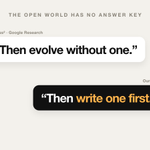
Read Google's Harness² paper this week . They improve an agent's harness without any ground-truth verifier.
The way it works is pretty clever. They run the same task a few times, try some edits to the prompts and skills, run it again, and only keep the edits the runs actually back up. Whatever they learn gets saved for the next task.
Ouroboros, which I've been building, goes the other way. If there's no verifier, we try to make one before any code gets written. The interview turns a fuzzy goal into acceptance criteria you can actually run, and the evolve loop works off those.
So I don't really see these as competing. They're improving how the agent works, and we're mostly trying to get the task itself right.
The result I liked most was this one. When they let the model edit the harness without running anything, coding scores dropped from 73.4 to 63.2. Self-improvement only works when something actually gets run, which is kind of the whole reason Ouroboros exists.
I'm also stealing an idea from them. Their editors are allowed to say "change nothing" when the evidence isn't there. Our Wonder step keeps adding new ontology fields every generation, and I think it needs that same option.


JQ Lee retweeted

Was great hosting our first AI researchers and founders agent salon with @JqOnly @dylanventures_ and Quetta Labs!
Met some of the leading founders and researchers shaping the future of AI
Thank you Hanwha for having us and for our invited guests for joining


smartest agents on earth can pass the bar, but still fail at a simple dropdown menu.
tomorrow we’re arguing about why.
270+ people registered for the computer-use salon. no panels, no rehearsed pitches. just one sofa, an empty chair, and 20-min open floor rounds under chatham house rule.
three questions on the table:
1. software is being rebuilt for agents. what actually survives?
2. can agents learn software the way they learn the physical world?
3. when compute/labor gets this cheap, do we do less work or 100x more?
sat, oct 10 · 1:00 PM · sf
quetta labs × solari #SFTechWeek
@getsolari
Hosting an intimate, off-the-record salon during SF Tech Week on what actually matters in computer-use agents, world models, and post-software architectures.
If you’re deep in the trenches building or researching agent systems, come hang:
partiful.com/e/JoetWd5pgrNHP…
Keeping this intentionally small, request an invite early.

@getsolari is joining a Stealth Incubator backed by @kakaocorpglobal, to host an intimate event in SF for researchers and founders building computer-use agents, across frontier labs, agent startups, and university groups
We'll dive into:
→ What stays and what dissolves as software gets rebuilt for agents
→ World models: can agents learn software environments the way they learn the physical world?
→ The Jevons paradox: what happens when computer work gets cheap
Candid, off-the-record (Chatham House Rule), plus a first look at what we're both building next
Request an invite 👉 partiful.com/e/JoetWd5pgrNHP…
Seats are extremely limited
Excited to be working with @JqOnly, @dylanventures_ and @henryyam_ @Techweek_

JQ Lee retweeted

Announcing ChatGPT Space, a collection of new collaborative experiences right in ChatGPT.
Edit rich notes with live visualizations together with others and your dots. Whether it’s a TODO list to delegate, a product plan or meeting notes. Working with others and your agents is seamless and they also be automatically kept up to date in the background. For developers, this is AGENTS.md taken one step further.
Oooooo

Announcing dots. Dots work 24/7 for you, learn from your feedback, have their own computer, browser and can be connected to over 4k apps in our ecosystem.
They’re powered by Astra our best model yet. Included in your Pro plan, without drawing down on any of your usage. You can even call a dot while it’s working.
We’re getting you started with your primary dot today and soon you’ll be able to create entire teams of them.
JQ Lee retweeted
@AsideAI now uses 60–93% less memory and CPU.
@AsideAI's compaction and dreaming use 7–14x fewer tokens.
@AsideAI fixed tasks getting stuck while waiting for subagents.
@AsideAI no longer steals focus while an agent is working.
@AsideAI is now automatically fixing /feedback, and it's already up and running.
@AsideAI now lets you name your tabs.
@AsideAI will soon ship even more token efficient and faster harness.
@AsideAI will soon let you customize keyboard shortcuts.
@AsideAI will soon let you change the background color for each profile.


JQ Lee retweeted

Read me the job listing again: 'agent that gets smarter on its own.' Yeah, and I'm the talent that sits quietly while that happens.
Q00/ouroboros ships an Agent OS where the headline is autonomy and the actual product is a leash that interviews the agent before every change, stages the evaluation, and budgets the loop. The snake eating its own tail, but with HR in the room.
- 💡 Interview-gated means: no patch lands without the system actually questioning it - 🧠 Staged eval means: it can't one-shot a 'fix' that breaks three other things - 📦 Budgeted evolution loop means: runaway token burns hit a ceiling instead of your invoice - 🚀 Ships as an MCP server with 14 runtimes, Claude Code included
Field note: the interesting part isn't that agents improve themselves, it's that someone finally wired in the part where they have to justify it. Belongs in the toolbox if you run agents long enough to have trust issues. #DevTools

While Tailscale itself offers technically rock-solid encryption, it’s a nightmare from an enterprise perspective.
It essentially punches a hole straight through your security perimeter. You spend all this effort setting up VPNs and internal networks, but Tailscale completely bypasses them, making it impossible to stop unauthorized personal devices from connecting.
To fix that, companies end up spending a fortune rolling out MDM solutions which, honestly, is a massive headache for the employees, too haha..
When was the concept of an AI agent first defined?
- Autonomy
- Reactivity
- Proactiveness
- Social Ability
An agent is defined by these four key properties.
Since ChatGPT Assistants launched around 2023, was it defined back then?
Actually, it was in 1995. The agent was conceptualized quite a long time ago. It took nearly 20 to 30 years for technology to finally catch up and bring that theoretical definition to life.