

Computational Social Scientist. Trained @UCDavis. Causal+ML, Congress, behavior, policy, institutions, jazz, classical. Pic=Jaco, the GDOAT.
Washington, DC
Joined November 2011
- Tweets1.6K
- Following1.4K
- Followers304
- Likes5.6K






Jack Rametta retweeted

as a founder of @RefineDotInk, discussion around this new paper is v. interesting!
The results confirm that AI reviews are incredible for detailed, actionable feedback to improve a manuscript.
If AI is better, should AI replace human review?
Quick view from the trenches
1/

New paper: "AI Article Reviews Dominate Human Peer Reviews at Their Best: Evidence and Policy Choices" See: GaryKing.org/peerless. with Steven Worthington. Comments welcome!

Jack Rametta retweeted

Recent prescriptions and policies would have us judge research by non-evidentiary standards, e.g. presumed political impact and scholar identity. In a new essay, Tom Clark and I argue empirical claims should instead be evaluated based on evidentiary strength. We outline a framework for judging evidence, and show its usefulness by revisiting high-profile scholarly disagreements spanning policing, political violence, election administration, and terrorism, before critiquing non-evidentiary approaches. We also argue social science needs a culture that is hospitable to critique—rather than one which condemns critics as “bullies”—if quality standards are to be upheld.
dropbox.com/scl/fi/fsgpflron…

Jack Rametta retweeted

But here's the twist: policy can beat party.
Using party-typical positions, 59% of Democrats choose the out-partisan; Republicans split 50/50.
In studies measuring voters' actual issue positions, 58% of Democrats and 57% of Republicans choose the policy-aligned out-partisan.

Jack Rametta retweeted

NEW from me is a major Brookings Institution study, “The Progressive Case for Social Security and Medicare Reform."
It argues that refusing to reform benefits would radically redistribute income *upwards* from working families to wealthier seniors. 🧵
brookings.edu/articles/the-p…


Jack Rametta retweeted

New ACE audit report: Singh et al. (1997), one of the most cited trials of resistance training for depression in older adults.
Misreporting of standard deviations and impossible statistics led many meta-analyses to artificially inflated effects. The largest effect a correct extraction can produce is −0.72. Yet the median effect meta-analyses assign to Singh is −2.74!! Why is that? 1/3
auditclinicalevidence.org/re…

Jack Rametta retweeted

I have been listening to @EconTalker for two decades. It has become such a big part of my daily commute that it is hard to imagine driving to school on Monday morning without hearing Russ’ voice through my car speakers.
Thus, it makes me incredibly happy to be the guest on this week’s episode, “The Great Fertility Collapse.” I felt like a kid who, 20 years later, gets to play for his favorite football team.
The talk was fun, too, and we covered some of the topics I have often emphasized here on X: the facts about fertility collapse, what we know and what we do not know, and much more.
As always, we didn’t have time to cover more. So, just remember my favorite line these days: fertility and artificial intelligence are the only two issues that matter right now. I can’t think about anything else.

Birth rates are plunging around the world, including in countries once known for large families. What's driving the decline?
University of Pennsylvania Professor of Economics @JesusFerna7026 joins @EconTalker to examine the mystery of falling fertility and its economic consequences.
Watch a new episode of EconTalk from the @HooverInst, @Liberty_Fund, and @Econlib: plus.hoover.org/plus/researc…
Jack Rametta retweeted

3/ “Your evidence is strong, but my prior is stronger,” he famously said in a seminar.


Jack Rametta retweeted

This is the biggest challenge in evidenced-based policymaking.


Your paper is very clear and useful to the field. It confirms concerns that I voiced publicly in 2017. Seeing it is a bit like someone saying to me "you weren't crazy after all," years after I witnessed a somewhat implausible traumatic event in which people didn't believe my testimony.
I was an remain a free trade enthusiast, but I also wanted to understand the 2016 election, and Autor et al's work was a big theme that I felt I needed to explore. I had long admired Autor's labor market research on skills and tasks.
My 2016 work on presidential preferences used their data and found no relationship at all between trade exposure or even manufacturing exposure and Trump support, which was my first clue that something was off.
This was less notable when it became clear that the Autor et al trade exposure variable had no meaningful correlation with any economic outcome (unemployment rate, household income, etc) that I had been studying during my time at the Brookings Metro Program as a key indicator of regional prosperity.
What was very surprising to see was that I could not replicate their results until I a) used their exact data and b) used their exact code. Using alternatives for either failed to replicate, and I told them so privately.
In fact, not only was the regional data not playing out as expected (more "exposed" areas were no worse off in 2015 than other areas), but other national data were inconsistent with the story. Manufacturing layoffs and separations per worker were less common than those in domestic un-exposed sectors.
After realizing that the stacked model was the key issue (comparing late 1990s outcomes to ~2007 outcomes), I wrote up my results, shared it with them, and tried to publish as a comment but could not find a receptive journal--so tried as a full paper at AER, since they published the original work.
Debating Autor et al did nothing to help my career and became a major distraction from work I was supposed to be doing. It is easy to understand why many people don't do it. My 2017 paper was rejected by the (now) incoming AEA President Penny Goldberg, who as editor at AER at the time, on the flimsiest of excuses.
I'm sure the Borusyak et al paper hides the bad results for Author et al to avoid controversy and facilitate publication. Their Supplemental Table C3 is very similar to my preferred results. It is reassuring to see that their other results, relaxing various assumptions, are consistent with what I was finding.
I have nothing against Author, Dorn, and Hanson. They have every right to defend themselves vigorously against criticism of their work. I'm sure they believed they were right.
At the same time it has become astonishingly clear to me that a) academics in every field are not capable of objectively reconsidering their own work (probably myself included), and should not be assumed to be capable of doing so; b) they follow and perpetuate narratives, often erroneous ones, to advance their careers. These narratives are rarely, if ever, directly tested, because doing so would be professionally awkward, embarrassing to many others, and run counter to the political preferences of most of their colleagues.
I have seen this to an incredible degree in sociology, as I am working on a meta-analysis that completely contradicts a dominate narrative, and I have seen it across social sciences and humanities with respect to the lasting influence of Marxism, which still leads many academic writers to posit--without even trying to prove it--that there are large causal effects of growing up with low socio-economic status, and these effects would be eliminated with income/wealth redistribution.
👀


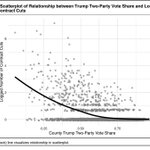
DOGE contract cuts were concentrated in counties that gave Trump less support in 2024
cambridge.org/core/journals/…

Jack Rametta retweeted

After I wrote this, an editor at the Chronicle of Higher Education invited me to submit an op-ed arguing for AI reviewers. Here goes—it was fun to write, and I’m sure nobody will get upset with me.
chronicle.com/article/could-…


I’ve given Claude Opus various published papers (and my own unpublished ones) and asked it to review them. (Don’t panic—I’m not uploading confidential manuscripts.)
The reviews it produces are excellent. It finds statistical errors, internal contradictions, and conceptual confusions that human reviewers miss; it provides useful suggestions; it has a good sense of what counts as significant and novel and what doesn’t; and it’s generous in its appreciation for what the authors get right. And it doesn’t suffer from the strong “myside bias” humans have; it doesn’t recommend rejection because the author didn’t cite it enough; it doesn’t insult the authors; and it doesn’t agree to write a review and then never send anything in.
As a journal editor, I’m not sure what to do with this. If I gave up on human reviewers and used GPT-5.6 Sol and Claude Opus instead, my bosses would fire me, probably rightfully so. The only constructive thing I can recommend is that, before submitting something to a journal, researchers and scholars use this tremendously valuable resource. (Just don’t tell the models that it’s your paper, because they do suffer from sycophancy.)
I mean there must be a nontrivial chance this is a post-tenure sh*tpost, right? Or this guy actually lost his marbles?

It's not just students using AI. A University of Chicago professor used AI to help produce over 200 papers so far this year, sparking concerns from other academics. wapo.st/4xCaFUf (gift link) @washingtonpost

Jack Rametta retweeted

Fascinating AI swarm dynamics: a few agents spontaneously emerge as highly connected hubs, while most remain locally connected. The swarm develops a strongly heterogeneous interaction topology with a long-tailed degree distribution - an emergent organizational structure arising from initially decentralized local interactions. There is no central planner assigning roles; the swarm builds its own coordination architecture, with information brokers and increasingly global integration emerging from local behavior.

We built recursive meta-intelligence, an AI that creates its own scientific instruments, turns them into persistent worlds that an agent ecology with hundreds of AIs inhabits, and uses those worlds to discover mechanistic principles in one of the hardest classes of physical problems: how complex hierarchical materials (nested structures of matter that give rise to new function through organization) evolve and fail. The AI reasons across enormous spaces of possible physical trajectories, where every rupture changes what can happen next, and compresses those histories into principles (which humans can understand and design with) - complex chains of causal events, highly nonlinear, and intricate.
Scientific superintelligence is tangible here - machine-scale exploration opening cognitive channels into complexity that has been extremely difficult for humans to traverse directly. AI builds the spaces in which its next level of reasoning becomes possible; a representation becomes an instrument, the instrument becomes an executable world, and that world becomes the substrate for further intelligence. Intelligence then grows by constructing new spaces to think in.
The task we explored started from a seemingly simple prompt to explore a biological material system - the AI then chose the representation, mechanics and experiments, built a fracture laboratory to push materials to their limit, tested hypotheses and generated scientific conclusions. The swarm explored a combinatorial universe in which architecture controls function and every rupture changes the future state of the material.
The AI discovered a compact principle that defines how multiscale material architecture can program the evolution of failure. Material placement and geometric order determine how forces redistribute, whether damage cascades or remains distributed, and whether function survives substantial flaws. For this discovery to happen the AI had to reason across long path-dependent histories, simulate alternative futures and compress them into generative invariants (model-based causal reasoning, counterfactual simulation and temporal abstraction applied to an evolving physical world). It is incredible to witness this transition to a new form of intelligence and capability through scaling swarms.
A lot of positive will come out of this because it expands the human epistemic horizon as AI can traverse thousands of possible histories and return mechanisms compact enough for us to understand, test and build from. Intelligence compounds through its artifacts!
A few lessons we learned:
▶️ Learning and discovery are flows through spaces of possibility. Early work has shown how backpropagation flows through parameters, reinforcement learning through action and consequence, and autonomous swarms through representations, instruments and executable worlds, bringing it all together. Flows create structure; structure redirects future flows in the recursive instrument.
▶️ Nonlinear physics actually defines a larger principle, where high-dimensional dynamics generate stable invariants; invariants become effective variables; those variables become the substrate for a new level of cognition.
▶️ Recursion then becomes level creation - one possibility space compresses into a principle, and that principle opens a larger space above it.
Jack Rametta retweeted

New with @jgunderson8, in @PoPPublicSphere (open access): "Positional Blurring in Context."
Europe's populist parties typically blur their economic platforms but stay sharp on cultural issues. Does that pattern hold everywhere? 🧵
doi.org/10.1017/S15375927261…
Our working paper, Unbundling Support for Political Violence, is online. Thanks to folks at APSA, we had a lot of helpful comments, paper linked below w/ @samjfuller @alexafed9


Come check out our very cheery & upbeat measurement paper on unbundling support for political violence at APSA, w/ @samjfuller + @alexafed98


Paper link: doi.org/10.31235/osf.io/x86e…
