
In-depth analysis & prospect reports. Stats. Development. Big league impact. GitHub: https://teapawt.net/t.co/gPWE3YWgcA General MLB coverage: @PaintTheBlackBB
Joined February 2026
- Tweets183
- Following86
- Followers18
- Likes329




Which MLB teams have the most diverse bullpens?
Not all bullpens are built the same.
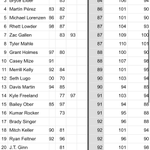
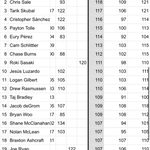
Using TeamBlend+, a component of my new TeamJuice+ model, I've ranked MLB bullpens based on how different their individual arms are from one another. Weighing arm angle, pitch mixes, pitch shapes, velocities and pitcher handedness.
The 5 most diverse bullpens in 2026:
Blue Jays — 131.8
Yankees — 131.7
Phillies — 122.2
Marlins — 110.7
Nationals — 109.2
I cant stress this enough. Despite lots of testing and how fun this topic is, diversity doesn't necessarily mean quality.
Washington ranks 5th in bullpen diversity but 27th in overall TeamJuice+, 28th in ERA and 29th in FIP.
More on TeamJuice+ coming soon. #Analytics #Baseball
1
15
Putting the final touches on a tool I'm calling TeamJuice+. It weighs different characteristics team-wide to rate bullpens, not just results. Two main parts: pitcher quality using my own stuff formula (pitch stuff + actual results) and arsenal mix (secondary pitches, lefty/righty balance, pitch variety, velocity spread) 🧃early results are showing it to be just as predictive as K-BB% over multiple season ma and potentially better in small samples.
1
14
Arm angle gets its own spinoff, TeamBlend+, which measures how different a bullpen's arms are from each other. It's about variety and uniqueness. Think the old Tampa Bay Rays faces of the clock bullpen. Still ironing out the kinks before a full breakdown, but the TeamBlend+ leaderboard is coming soon.
28
My most recent project has been experimenting with pitching staff varieties, seeing if there is any predictability to having different arsenals and arm slots from different pitchers. What I've found so far is that there is some correlation between different pitch arsenals and lower opponent WOBAs, however, it is less predictive at face value when compared to just simply using Stuff quality.
My original formula listed PHI, LAD, MIL and SD as the best bullpens by the metric, so it is doing its job to some extent, but i believe there's some more work to be done here, An 80/20 split between Stuff quality and arsenal uniqueness gave near identical wOBA outcomes to purely Stuff. Planning on diving further into arm angles and movement next. Stay tuned.
8
I recently launched my first ever coding project in GitHub!
Introducing the Pitch Analysis Tool!
With this tool you can select any player and time frame and view their pitch usage by count and batter handedness and see how those pitches have performed.
Also included is pitch sequencing. In the same result you can see what usually follows up the previous pitch. For example, does a pitcher like to follow up his fastball with a tunnelled slider? Or maybe double up on fastballs? That and more can be seen with this function.
I used this for Jose Soriano to see what, if any, changes the Blue Jays made at the trade deadline. I’ll have a piece coming out about him soon. Stay tuned, and enjoy the tool!
You can view the tool through this link github.com/JuiceOnStats/base… or by going to my GitHub that is linked in my bio.
PS. This is my first time coding anything for public use, so please inform me of any bugs or upgrades you guys would recommend

1
2
104
How do you outperform your Stuff metrics? Are they really all that important? Let's look at some of the MLBs biggest over performers and under performers to see what they have in common. An Analytics 🧵 by Juice.
1
133
The final thing is high splitter and changeup usages. Changeups often don’t grade out well by Stuff+, with the league average changeup being 94, but the ability to change speeds without huge shape differentials and the tunnelling ability with the fastball seems to have a benefit when it comes to outperforming your base arsenal. Rodriguez, Lambert, Mize and Martin all have a changeup or splitter as their second or third most used pitch, and all use it the most of all secondaries against opposite sides hitters, who tend to hit low stuff pitchers the hardest.
1
19
So in summary, command, the fastball triangle, deep arsenals and heavy changeup usage are big factors to over performing weak arsenal grades. The real question becomes; how can we use this at a youth level? Some pitchers may never be able to develop a true MLB arsenal, but can we round it out using some of this to help them still find success? Also, who of the low Stuff pitchers could find success in the future? I’ll talk about all this information in future threads, thanks for reading! End 🧵
19
OVERVIEW
Jacob Lopez (ATH) has had a below average year in terms of production, with a 107 ERA- and 114 FIP-. Despite the poor run prevention, Lopez has some intriguing data under the hood.
Lopez wields a 3.50 xERA, ranking in the 75th percentile around baseball. He's also elite at inducing weak contact, with his 30.2 Hard Hit% being in the 94th percentile.
A low slot lefty, Lopez creates an uncomfortable at bat for both sides of the plate. His 19° arm angle is 3rd lowest out of full time starters in the MLB trailing only Nick Lodolo and Chris Sale. His FF/SL combo are legit offerings that both have around average whiff rates and induce an immense amount of weak contact
He does struggle with walks sporting a 10.8 BB%, and the K rate has dropped by over 7%, but how concerning are these flaws, and how can we fix them without compromising what he does well?

1
2
205
SOLUTION/OUTLOOK
As mentioned for Lopez, the FF/SL combo is the bread and butter, the four seamer grades out as below average with a 92 Stuff+, but it’s a unique offering with plus arm-side run at 13.7” of HB as seen in the movement chart below.The result is a pitch that is extremely hard to square up, with a .275 xWOBA and a 32.7 Hard Hit%, trailing only Ranger Suarez for the lowest among all starters four seamers.
The slider is unique as well, and grades out very well. The offering has a 116 Stuff+, and generates a near 30% whiff rate to go with a .237 xWOBA and 22.7 Hard Hit% that trails just Chris Sale for the lowest among starters. It’s a velo offering, but has above average amounts of sweep which can also be seen in the movement chart and tunnels well off the FF.
My first move would be having him lean into this combo far more. His FC/CH are his two other offerings, and both have been extremely poor for Lopez. The cutter has a poor shape, with league average depth and below average arm side, the pitch is thrown far too often at nearly 20%, and has a xWOBA above .350 given up. The changeup is even worse, it lacks depth, and grades out at an 82 according to Stuff+, with a .500 BA and .825 SLG. Both pitches should be brought to near zero, with the cutter being used as more of a gyro slider type pitch against lefties, as its performed well against that side of the plate. I'd also give him more of a one seam sinker grip for his current SI and move his thumb positioning higher on the pitch, which should give him more depth on the offering, allowing this to be more of a weapon to try and elicit more groundballs.
There are also some mechanical deficiencies I would modify that could likely help with both command and velocity. He struggles with getting stacked on his backside and creating momentum down the mound. He drops his backside too early, leading to his momentum leaking out before he begins his drive down the mound. His front side also opens early. Part of this is due to his cross-body delivery, But his hips leak out early in his delivery, leading to both his shoulders and hips being open before foot strike. I'd have him focus on drills to address proper momentum sequencing, such as rocker drills, pivot picks, walking windups and increasing usage of pulldowns and other high intent drills to further encourage athleticism while moving on the mound.
The walk issue may look bad, but Lopez actually has an around average zone rate. I don't see the BB% being a major long term issue, and the reduced usage of the FC/CH and increased usage of the FF/SL combo should help regain his K%. In 2028 and beyond he'll also shed his current home park in Sacramento, where he's really struggled this year and ranks as the second worst park for pitchers in baseball.
The outlook is already decent for Lopez in 2027 according to projections, with a 3.98 ERA and FIP along with 1.7 fWAR according to ZiPS in just 104 IP. This would put him on approximately a 3.3 fWAR pace over 200 IP. I have a major up arrow beside him for the future, and with the adjustments I named earlier, he could easily be a no. 3 in a rotation.
End 🧵.

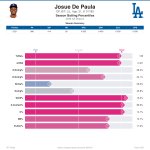
Josue De Paula is getting the call!
De Paula is an elite prospect, and my number 3 prospect in baseball behind Jesus Made and Leo De Vries. The LHH OFer combines a great approach with immense contact ability and good exit velos along with a swing geared for loft especially to the pull side. He has 25-30 home run power, and should be a run high BAs and OBPs. The speed is around average, and he should be a fine corner outfielder as he continues to get reps out there.
With rough years from both Teoscar Hernandez and Kyle Tucker in the corner OF, De Paula could have a quick impact on the team and add some more two way ability to an already loaded Dodgers lineup.


News: The Dodgers are calling up their best prospect, OF Josue De Paula, sources told ESPN.
He will be with the team on Friday, for the start of a weekend series in Miami.
More to come.
2
308