

Josephus records a Roman tribune shot on Jerusalem's walls because the men on the wall knew him. He never says how. I wrote the answer: Stand in the Breach.
Jerusalem, AD 70
Joined September 2026
- Tweets141
- Following53
- Followers15
- Likes42




Pinned Tweet
Nearly everything we know about the siege of Jerusalem comes through one man, and he changed sides halfway through the war.
Josephus. Born in Jerusalem in AD 37 to a priestly family. At twenty-nine the rebel government made him general of Galilee.
In 67 Vespasian trapped him at Jotapata. After 47 days the town fell. Josephus hid in a cave with forty men who chose death over surrender. They drew lots to kill each other in turn. He was one of the last two alive, and he talked the other man into walking out with him. That's his account. It's the only one we have.
Brought before Vespasian in chains, he predicted the general would become emperor. Suetonius, a Roman with no reason to flatter him, records the prediction too. Two years later Vespasian was emperor and Josephus was a free man. He took the family name: Flavius Josephus.
In 70 he stood outside Jerusalem with Titus, calling up to the walls for the city to surrender. His parents were inside. A stone from the wall knocked him senseless.
He spent the rest of his life in Rome on an imperial pension, writing it all down.
Read him knowing all of that. And know one more thing: he's also one of the earliest writers outside the New Testament to mention Jesus. In his Antiquities he names "James, the brother of Jesus who was called Christ."
The man we depend on for the fall of Jerusalem is also a witness that Jesus was real.
#Josephus #Jerusalem

1
1
219
Josephus watched the Roman army march into Galilee in AD 67, and he wrote down what a legionary carried.
Spear. Long shield. Breastplate and helmet. A sword on each side, the one on the right no longer than a span. And on top of that, a saw, a basket, a pick, an axe, a leather strap, a sickle, a chain, and three days' food. So, Josephus says, a foot soldier "hath no great need of a mule to carry his burdens."
He was the mule. Marius had cut down the baggage train almost two centuries earlier and put the load on the men, bundled on a forked pole over the shoulder. Rome's soldiers were called "Marius's mules" from then on.
The tools weren't for show. Josephus says that in enemy country they wouldn't fight until the camp was walled. Every stop on the march meant a ditch, a rampart, gates on four sides, streets laid out, the general's tent in the middle, all of it up "sooner than one would imagine."
Vegetius, looking back on the old legions centuries later, says recruits trained to cover twenty Roman miles in five summer hours and to carry up to sixty pounds. Then they dug.
So when Titus's legions came down on Jerusalem in the spring of 70, the people on the walls weren't just looking at swords. They were looking at men who could build a town in an afternoon, and who had brought the tools to take one apart.
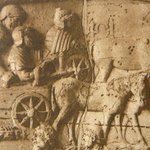
Pictured: legionaries on Trajan's Column crossing the Danube, helmets slung and packs on poles over their shoulders.


11
Caleb was forty when Moses sent him to spy out Canaan. Twelve men went. Ten came back and melted the hearts of the people. Caleb came back with a different report.
Forty-five years later he walked up to Joshua and said, "I am as strong this day as I was in the day that Moses sent me." He was eighty-five. He asked for the hill country of Hebron, where the Anakim lived, the giants who had scared his whole generation off the border. Then he went up and took it.
What was his secret? We usually look for it in the wrong place. We assume Caleb had more faith, more grit, a better attitude. But when God describes him in Numbers 14:24, He defines the "different spirit" in the same breath: "he hath followed me fully."
The different spirit was a following spirit.
Caleb spent forty-five years watching his generation die in the wilderness. He didn't spend them working up his faith. He spent them following. When the day came to take his mountain, the strength was already there. The faith was the overflow, not the focus.
Most of us do it backwards. We check our faith like a fuel gauge. Do I believe enough? Am I strong enough? That keeps our eyes on ourselves.
When you're following someone, you're not watching your own feet. You're watching Him.
Try it today. Morning, midday, before bed: stop and ask, "Where is Jesus going, and what is the next step He's taking?" Then take that step.
Pictured: James Tissot's The Grapes of Canaan and Gustave Doré's Return of the Spies.


19
Before Rome took a city, it took the forest.
At Jerusalem in AD 70, Josephus says, the legions cut down every tree for ninety furlongs around the city, about ten miles out, to build their siege banks. The gardens and orchards became a wasteland. He says a man who had known Jerusalem before the war could have stood in the middle of it and asked where the city was.
Then came the engines. Three years earlier, at Jotapata in Galilee, Vespasian ringed one hill town with 160 of them. Josephus was inside. One night a stone took the head off a man standing near him and threw it three furlongs.
At Jerusalem, Titus raised three towers fifty cubits high, about seventy-five feet, plated with iron so they couldn't be burned. One collapsed on its own in the night and panicked the whole camp. Under the towers the rams went to work. The defenders gave the biggest one a name: Nico. "Victor." Because it conquered everything.
The defenders had answers of their own. John of Gischala's men tunneled under the Roman banks at the Antonia, shored the tunnel with timbers smeared in pitch, and set it on fire. Seventeen days of Roman work dropped into the hole and burned.
So Titus quit trying to win at the walls. He built a wall of his own around the whole city and let hunger do the work.
Pictured: a cart-mounted Roman field engine on Trajan's Column, and the Roman siege ramp at Masada, still there almost two thousand years later.


33
Mark never names the centurion at the cross.
He stood facing Jesus, Mark says. He watched how He died. And he said it out loud: "Truly this man was the Son of God."
Think about who says that. The emperor's own silver called Tiberius the son of a god: TI CAESAR DIVI AVG F, son of the divine Augustus. Rome had a son of god, and he was on the money. A serving Roman officer looked at a Jew dying on Rome's own wood and gave Him the title. His own disciples weren't saying it that afternoon. Most of them were in hiding.
Legend later named him Longinus, but that name shows up centuries after the fact.
There's a candidate the record actually knows. Acts 10 puts a centurion named Cornelius in Caesarea, the governor's seat, within about a decade of the cross. Devout. Feared God. Gave to the poor. "Of good report among all the nation of the Jews." And when Peter walks into his house, he doesn't explain the crucifixion to him. He says, "That word, I say, ye know... whom they slew and hanged on a tree."
Cornelius already knew the story. Maybe he heard it in the barracks. Maybe he was standing there.
Nobody can prove it. But if it was him, then the first Gentile to call Jesus the Son of God at the cross became the head of the first Gentile household the Spirit fell on. The confession on that hill got its answer at his own door.
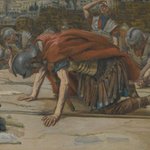
Pictured: James Tissot's The Confession of the Centurion, and a silver denarius of Tiberius, the emperor whose coins called him son of the divine Augustus.


24
For centuries, a lamb was offered in Jerusalem each morning and another each afternoon. The daily offering. The tamid.
In the summer of AD 70, it stopped.
When Pompey's troops entered the Temple courts in 63 BC, Josephus says the priests kept offering sacrifices and were killed at the altar. The service continued under attack.
But during Titus's siege, Josephus records that the daily sacrifice failed "for want of men to offer it."
Titus sent Josephus to appeal to John of Gischala to let the service resume. John answered with curses.
The Temple was still standing. The altar was still there. But the daily offering had ceased. Within weeks, the sanctuary would burn.
In Stand in the Breach, that news reaches Roman headquarters as a line in the morning report. Something that had ordered generations of life in Jerusalem had become an item for the besiegers to record.
Pictured: the excavated "To the place of trumpeting" inscription from the Temple Mount, and the Temple's menorah and trumpets carried away in the relief on the Arch of Titus.


18
The second-in-command of Titus's army at Jerusalem was a Jew. His father had paid to cover nine of the Temple's gates in gold and silver.
His name was Tiberius Julius Alexander. His uncle was Philo of Alexandria. Josephus says he did not remain in the religion of his fathers.
He built a Roman career instead. As procurator of Judea, he crucified two sons of Judas the Galilean. As prefect of Egypt, he sent troops against Alexandria's Jews in AD 66. Josephus puts the dead at fifty thousand.
In AD 69, he declared for Vespasian. A year later, he was serving under Titus outside Jerusalem.
When Titus gathered his commanders to discuss whether to destroy the sanctuary, Alexander was at the council.
His father had helped adorn the Temple. He helped command the army that destroyed it.
We have Josephus's account of his career. We don't have Alexander's account of what it meant to stand there.
Pictured: Alexander's surviving edict at Hibis Temple in Egypt, alongside a Vespasian coin depicting conquered Judaea.


1
34
During the siege of Jerusalem, the watchmen on the walls had a warning cry. Josephus preserved it. A short cry: "The Son is coming."
AD 70. The Tenth Legion had the heaviest engines in Titus's army. Josephus says they threw stones weighing a talent, roughly sixty pounds, a quarter mile and more, and anyone near the impact did not survive it.
But the stones were white. You could see them coming.
So watchmen sat on the towers, watching the Roman lines. When an engine fired, they shouted in their own tongue, and people in the street threw themselves flat. The stone struck and did no harm.
Then the Romans blackened the stones. Now no one saw them in time, and Josephus says many died at a single blow.
The Greek text records the cry as "ho huios erchetai": the Son is coming. Most scholars think it is a Hebrew pun. "Ha-even," the stone, shouted fast, sounds like "ha-ben," the son. Some English editions quietly change it to "the stone cometh."
I don't build doctrine on a pun. But forty years after Jesus warned that city of the Son of Man coming within that generation, its own watchmen were crying "the Son is coming," over and over, every day of the siege.
In Stand in the Breach, the man who calls it from the wall is a father who has buried three sons.
Pictured: first-century Roman artillery stones from the Great Revolt era, now in Jerusalem museums. White limestone, the kind the watchmen were tracking.


1
34
Jerusalem carries the word shalom in its name. Peace. Wholeness.
Coming down the Mount of Olives, Jesus wept over that city: "Would that you, even you, had known on this day the things that make for peace." Forty years later Titus's legions built the wall He described.
People ask the old question about that siege. Mothers starving. Children dying in the alleys. The Temple burning. If God is all-powerful and all-good, why?
The usual proof text cuts the other way. Isaiah 45:7, KJV: "I form the light, and create darkness: I make peace, and create evil."
Look at the structure. Two pairs. Light and darkness. Peace and evil. In Genesis, God never makes darkness. It's already there when He speaks light. Darkness is simply where the light isn't. The second pair works the same way. God makes shalom: wholeness, everything working as it was made to. "Evil" there is ra: the ruin left wherever shalom is gone.
That's how the Hebrew mind read good and bad: functional and broken. A hurricane on Saturn is beautiful. The same storm over a Caribbean town is ra.
And Scripture shows the order. Before Babylon burned the first Temple, Ezekiel watched the glory of God rise from the sanctuary, pause at the threshold, and leave the city for the mountain on the east. Then the fire came.
The second time, the record repeats. Josephus says priests in the Temple at Pentecost heard a voice: "Let us remove hence." Tacitus says the doors flew open and a voice cried that the gods were departing. The Talmud says that for forty years before the end, the Temple's doors swung open on their own.
The presence of God left. Shalom left with it. What remained was ra. The question Israel was left with was why.
Regardless, how do you get rid of darkness? You don't swing at it. You turn on a light. Jesus said, "Peace (shalom) I leave with you; my peace (shalom) I give to you." He also said, "I am the light of the world."
In Stand in the Breach, two brothers ask "why us" the night before the wall, and neither can answer it. Years later, one of them gets no answer and no voice. Just peace that comes and settles. And he finally understands it was never an absence.

1
1
41
The most famous Roman soldier at the siege of Jerusalem was killed by his shoes.
Josephus watched it happen. Summer, AD 70. The Antonia fortress had just fallen, and the Romans pushing into the Temple courts were being driven back. Standing beside Titus was a centurion from Bithynia named Julianus, a man of the highest fame in the army for skill, strength, and courage.
Julianus leapt down alone and put the Jewish line to flight, chasing them to the corner of the inner court.
Then, Josephus writes, "he had shoes all full of thick and sharp nails, as had every one of the other soldiers." He ran onto the pavement, slipped, and went down on his back. His armor made such a noise that the men running from him turned around.
He fought from the ground, shield up, neck pulled in tight so no blade could find the gap. Titus watched and could not reach him. No one dared go in after him. In the end they cut his throat.
The hobnails on the Roman caliga let a legion march wet roads and hold a hillside. On Herod's polished flagstones, iron on stone was ice. The army that conquered the world on foot had met a floor.
Pictured: real hobnailed soles pulled from a Roman grave in Spain, and the Herodian street at the foot of the Temple Mount, still buried under the stones Rome threw down in AD 70.
Josephus never says what Rome learned from it. In Stand in the Breach, a tribune who once stood garrison on that pavement draws his own conclusion.


1
1
57
When Titus was a boy, he watched Nero poison his best friend. He may have tasted the cup himself.
Suetonius says Titus was raised at court with Britannicus, son of the emperor Claudius, and taught by the same masters. In AD 55, at a palace dinner, Britannicus drank the poison Nero had arranged. Titus was reclining beside him. It was believed he tasted the drink too, and he was sick for a long time after.
He never forgot it. As emperor, he set up a golden statue of Britannicus in the palace.
Now look at the family tree. Britannicus's uncle was Germanicus, the most beloved Roman of his generation. And Nero, the man who killed Britannicus, was Germanicus's grandson.
One house gave Titus both his friend and his friend's murderer.
Fourteen years later, Titus's father took the throne that house had held for nearly a century.
In my novel, an old centurion walks into Titus's headquarters at Caesarea, famous for having served at Germanicus's side. Titus doesn't ask about his record. He asks which part of that inheritance the man is still loyal to: the dead hero, or the bloodline that ended in fire.
I wrote that conversation in Stand in the Breach.
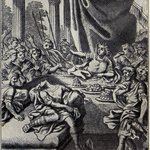
Images: François Chauveau, The Poisoning of Britannicus (1675). Bust of Titus, Capitoline Museums (photo: Franciscus3008, CC BY-SA 4.0).


1
130
The road to Jerusalem's destruction in AD 70 ran through Britain.
Around AD 30, Jesus wept over Jerusalem and warned that her enemies would "cast a trench about thee, and compass thee round, and keep thee in on every side" (Luke 19:43). Not one stone, He said, would be left upon another.
Forty years later, it happened. General Titus, Emperor Vespasian's son, walled the city in, starved it, and the Temple burned. According to Eusebius, Jerusalem's Christians had already fled to Pella, heeding Christ's warning.
The men who carried it out had served in Britain. In AD 43, Vespasian led the Second Legion in Claudius's invasion, taking more than twenty strongholds across the south. Titus later served there as a military tribune. Britain made Vespasian's name, and in AD 67 Nero sent him to crush the Jewish revolt.
Britain even appears in the story. In Josephus, King Agrippa II begs Jerusalem not to rebel, pointing to the Britons: walled off by the ocean, yet conquered by Rome.
The thread runs on through Christian history:
• AD 130s: Hadrian, builder of the Wall, refounded Jerusalem as a pagan city, with a temple to Venus over the site of Christ's tomb. When the Bar Kokhba revolt broke out, its leader punished Christians who refused to deny Jesus as Messiah, as Justin Martyr records. Rome sent Britain's own governor, Sextus Julius Severus, to crush it.
• AD 306: Constantine was proclaimed emperor at York. He later tore down Hadrian's temple and built the Church of the Holy Sepulchre over Christ's tomb.
• 1185: The Patriarch of Jerusalem consecrated London's Temple Church.
• 1849: Christ Church, built by British believers near the Jaffa Gate, became what is now the oldest Protestant church in the Middle East.
• 11 December 1917: General Allenby dismounted and entered Jerusalem on foot. Tradition has him saying he would not ride into the city where his Lord had come humbly on a donkey.
Britain began as Rome's far frontier. Through Christ, it became one of the faith's great homes, and its story keeps returning to the city where He died and rose again.
I tell the story of AD 70 in my novel, Stand in the Breach. What other links between Britain and Jerusalem would you add?

Roman centurions are almost always cast in a positive light in Scripture. The reason is not what most people assume.
They were the enforcers of Roman will, trained to inflict absolute horror and to die for Rome if necessary. They had seen the worst of what armies do. Tacitus describes the sack of Cremona in AD 69 by the same army in the same decade as the men in the Gospels: forty thousand soldiers in the streets, no age or rank protected, the women taken, the city burning for four days. Josephus watched the same thing happen to Jerusalem a year later. These men had done things a chaplain today would spend a career helping a soldier carry. Rome told them the weight belonged to the chain of command. John the Baptist told soldiers standing in front of him something different: “Do violence to no man, neither accuse any falsely; and be content with your wages.” He did not tell them to quit. He told them the sword does not transfer the weight.
Yet you never see them hiding or building a case in front of Jesus. They stood there unapologetic and took Him at His word. They had been trained to keep their eyes on their commander. That is how they stood in front of this One. A man with that record came as he was, with all of it, and Jesus met him there. It is not a story about clean men. It is a story about a man who stopped managing his record long enough to look up.
It was Roman soldiers under a centurion who carried out the scourging and drove the nails. In God’s design, sacrifices belonged to the priesthood. If the Jewish leaders had recognized Jesus, they would have laid Him down as the sacrifice, fully aware of what they were doing. They did not. So the most sacred sacrifice in human history was handed to men who had no theological clue what they were participating in. They simply followed orders, and they carried the redemptive plan of God all the way to the end. The role the priests forfeited through unbelief, the soldiers fulfilled through trained obedience. They became the unwitting hands of the highest priestly act in history.
At the cross the centurion said it out loud, in front of the crowd and his own men, about a man Rome had just executed as an enemy of the state. Others had said the words in safer places. John the Baptist said them at the height of his standing. The disciples said them to each other in a boat. Peter said them among his brothers. The centurion said them where it cost something. He was the ranking Roman on that hill. He had nothing to gain and a career to lose. He is not the first to say the words. He is the first to say them where they cost something.
He watched Jesus meet the scourge and the cross head-on. A man accustomed to Roman power recognized a higher one. He paid it the respect it was due, because saying anything less would have been a lie.
When it comes to modeling how a person lives before Jesus—unapologetic, unflinching, fully present—I keep coming back to the centurions.
#Faith
🤖 Made with AI

1
4
5,248
Late October, AD 66.
Cestius Gallus had brought his army up to Jerusalem. Twelfth Legion at the core, detachments from three others, auxiliaries, and the troops of the client kings. Josephus says they pressed into the northern parts of the city and toward the Temple.
After a few days of fighting he ordered the withdrawal. He never states a clear reason. The column turned around and started back the way it had come.
That road ran down the pass at Beth Horon. This is the same descent where Joshua once drove the Amorite kings, and the Lord cast down great stones from heaven on them as they fled (Joshua 10:10–11).
The men already watching the slopes would meet the Romans there in a matter of days.
#Jerusalem #Josephus

1
45
Simon bar Giora held the Upper City of Jerusalem in AD 70.
The Jewish historian, Josephus, calls him the strongest of the rebel leaders; he had the largest force. While John of Gischala held the Temple mount and a Zealot splinter held the inner court, Simon controlled the rest of the city above the lower slopes.
Rome took him alive after the city fell. He was kept for the triumph. Josephus says he was led through the streets of Rome in the procession, then executed at the Temple of Jupiter on the Capitoline while the rest of the triumph paused for the news.
The same procession carried the Temple objects out of Jerusalem. The Arch of Titus still shows them: the menorah, the table of showbread, and the trumpets.
One triumph. The sacred vessels on one side. The man who held the Upper City on the other.
He is one of the few rebel commanders whose end is recorded in detail. Most of the others died inside the walls or disappeared from the sources.
#Jerusalem

1
2
4,703
Rest is not an empty calendar. The wilderness generation chose inactivity and never entered the land.
The ones who crossed had to ignore their past, fight, build, and take ground. God still called that entering His rest.
Rest is the posture you fight from once you stop trying to earn what Jesus already finished. #Faith
36
A Roman centurion named Cornelius really existed.
Scripture records him at Caesarea: a soldier who feared God with all his household, sent for Peter, and was baptized with everyone listening. The first Gentile in the new faith was not a philosopher. He was an officer.
A Roman tribune named Nicanor really existed too. Josephus records him twice. Once talking Josephus himself out of a cave at Jotapata. Once taking an arrow in the shoulder under Jerusalem’s walls while offering the city terms, because the men on the wall knew him.
History never explains how they knew him.
#Jerusalem

40
October, AD 66. Gallus was inside the outer suburbs. Then the rains came, and he walked away.

In the summer of 66, the Roman governor Florus took seventeen talents out of the Temple treasury. When Jerusalem mocked him for it, he turned his soldiers loose on the city.
The young captain of the Temple, Eleazar, answered by stopping the daily sacrifice offered for the emperor. That was the break. The Roman garrison in Jerusalem surrendered on a promise of safe passage and was cut down anyway.
Rome sent the governor of Syria, Cestius Gallus, with the Twelfth Legion, thousands of picked men from three others, cavalry, and the troops of allied kings. He reached the walls that autumn, attacked the Temple, and then, for reasons no one has fully explained, pulled back.
The retreat went down the pass at Beth Horon, the same road where Joshua once chased the Amorites. The rebels were waiting on the slopes. Rome lost 5,300 infantry and 480 cavalry and left its siege engines on the road. Suetonius says the rebels took an eagle.
After that there was no way back for either side.
Some historians think this is when the Jerusalem church left the city. Jesus had told them, "When you see Jerusalem surrounded by armies... let those who are in Judea flee to the mountains" (Luke 21:20–21). An army had surrounded it, and then walked away.
#RomanHistory

39
Two stars frame the story of Jesus and Jerusalem, and one prophet may stand behind both.
The first star stood over Bethlehem. Wise men from the east came to Jerusalem asking, “Where is he who has been born king of the Jews? For we saw his star” (Matthew 2:2).
How would eastern star-watchers know to look for a Jewish king? Six centuries earlier, a Jewish captive had been put in charge of their kind: Daniel, “chief of the magicians, enchanters, Chaldeans, and astrologers” (Daniel 5:11). The Greek translation of Daniel calls those wise men magoi, the same word Matthew uses. Daniel left behind a timeline for the coming of an anointed one (Daniel 9:25), and a Jewish community that stayed in Babylon for centuries kept his writings. Long before him, Balaam, a seer from the Euphrates, had said, “a star shall come out of Jacob” (Numbers 24:17).
The second star, Josephus says, stood over Jerusalem before the war: “a star resembling a sword, which stood over the city, and a comet that continued a whole year” (Jewish War 6.289).
He records other signs. At Passover, a light around the altar in the middle of the night, bright as day. The Temple’s eastern gate, so heavy it took twenty men to shut, swinging open by itself. Chariots and armed men seen racing through the clouds before sunset. And at Pentecost, priests in the inner court hearing a voice: “We are departing hence” (6.290–300).
Then he names what pushed the nation to war more than anything else: an “ambiguous oracle” in their sacred writings, that at that time one from their country would rule the world (6.312). Tacitus and Suetonius report the same prophecy running through the East.
Josephus doesn’t say which scripture. But elsewhere he writes that Daniel, unlike the other prophets, gave the time, and foretold that Rome would take Jerusalem and lay the Temple waste (Antiquities 10.267, 276). Jesus pointed to the same book about the same Temple: “the abomination of desolation spoken of by the prophet Daniel” (Matthew 24:15).
So the same prophet may stand behind both stars. In the East, his words sent wise men to Bethlehem to worship a child. In Jerusalem, they were read as the promise of a war king, and the city went to war on them.
Josephus said the prophecy was fulfilled in Vespasian. Christians said it had been fulfilled about seventy years earlier, in a child born six miles down the road.
#Jerusalem

47
In the summer of 66, the Roman governor Florus took seventeen talents out of the Temple treasury. When Jerusalem mocked him for it, he turned his soldiers loose on the city.
The young captain of the Temple, Eleazar, answered by stopping the daily sacrifice offered for the emperor. That was the break. The Roman garrison in Jerusalem surrendered on a promise of safe passage and was cut down anyway.
Rome sent the governor of Syria, Cestius Gallus, with the Twelfth Legion, thousands of picked men from three others, cavalry, and the troops of allied kings. He reached the walls that autumn, attacked the Temple, and then, for reasons no one has fully explained, pulled back.
The retreat went down the pass at Beth Horon, the same road where Joshua once chased the Amorites. The rebels were waiting on the slopes. Rome lost 5,300 infantry and 480 cavalry and left its siege engines on the road. Suetonius says the rebels took an eagle.
After that there was no way back for either side.
Some historians think this is when the Jerusalem church left the city. Jesus had told them, "When you see Jerusalem surrounded by armies... let those who are in Judea flee to the mountains" (Luke 21:20–21). An army had surrounded it, and then walked away.
#RomanHistory