

Official English language news feed of the Communist Party of the Russian Federation (CPRF). Here is what the authorities keep silent about.
Moscow, Russia
Joined November 2025
- Tweets635
- Following33
- Followers2.9K
- Likes3





Pinned Tweet
The Communist Party of the Russian Federation (CPRF): A Patriotic Progressive Force in Modern Russia
In the landscape of contemporary Russian politics, the Communist Party of the Russian Federation (CPRF) stands as a beacon of patriotic progressivism, blending a rich historical legacy with forward-thinking visions for the nation's future.
Founded in 1993 amid the turbulence following the Soviet Union's dissolution, the CPRF has evolved into Russia's second-largest political party, adhering to Marxist-Leninist principles while adapting to the demands of the 21st century.
Under the steadfast leadership of Gennady Zyuganov, it champions a "renewed socialism" that prioritizes social justice, economic equity, and national sovereignty, positioning itself as a vital counterbalance to unchecked capitalism.
At its core, the CPRF embodies patriotism through its doctrine of "state patriotism," which celebrates Russia's unique cultural and historical identity. The party fiercely advocates for independence from Western influences, critiquing policies that erode Russian autonomy and promoting a multipolar world order.
This stance resonates deeply in a time of global tensions, as seen in its vocal opposition to U.S. aggressions, such as the blockade on Cuba and escalations under figures like Trump. By aligning with the National Patriotic Forces of Russia, the CPRF fosters unity among those who value the Motherland's sovereignty, labor, democracy, and socialism—echoed in its empowering slogan: "Russia! Labour! Democracy! Socialism!"
Progressivism defines the CPRF's agenda, as it pushes for socially oriented reforms that uplift the working class. Its "Victory Program," unveiled in preparation for the 2026 State Duma elections, outlines a path to escape the "dead end of capitalism" through accelerated development, renationalization of key industries, and extensive social welfare protections.
The party has consistently opposed unpopular measures, like pension reforms, while advocating for subsidies to state-owned enterprises and recognition of political pluralism alongside private property—demonstrating a pragmatic, inclusive approach to socialism. Internationally, it maintains ties with progressive parties worldwide, from Vietnam to Latin America's socialist movements, promoting anti-fascist solidarity and global justice.
Today, in 2026, the CPRF represents a dynamic force for Russia's advancement. Amid economic strains from sanctions and crises, it rallies "Communists forward!" to combat oligarchic influences and defend Soviet-era achievements, inspiring a "people’s revolution with a socialist tinge."
By integrating into the political elite while maintaining opposition vigor, the CPRF ensures voices for the marginalized are heard, from regional gubernatorial wins to Duma influence. Its heterogeneous makeup—encompassing orthodox communists and reformists—fosters broad appeal, making it a unifying progressive entity.
In essence, the CPRF is not a relic of the past but a patriotic powerhouse driving Russia toward equity and strength. As it gears up for electoral battles, it offers hope for a society where workers thrive, national pride flourishes, and progressive ideals propel the nation forward.
With over 170,000 members committed to this vision, the CPRF proves that true patriotism lies in building a just, sovereign future for all Russians.
Follow and Share this account as we provide the News, Policies and Views of the Communist Party of Russia.

In Minsk, flowers were laid at the Lenin monument in Independence Square
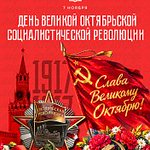
Ceremonial events marking the anniversary of the October Revolution on November 7 are taking place across the country.
Today marks the 109th anniversary of the Great October Socialist Revolution – one of the most important events in world history.

TVC: Communists laid flowers at Lenin's Mausoleum in honor of the 109th anniversary of the Revolution
November 7, 2026
A patriotic rally in honor of the 109th anniversary of the Great October Socialist Revolution took place today in the heart of Moscow. Members of the Communist Party of the Russian Federation (KRPF) and members of public organizations gathered at Moscow's Theater Square, many carrying Soviet flags.
They spoke with their supporters and residents of the capital, and then marched with Soviet flags to Lenin's Mausoleum and laid flowers there.
At the beginning of the week, the party sent the 161st humanitarian convoy to the SVO zone - 17 trucks with food, medicine, technical and construction materials.
"We must understand perfectly well that today, those on the front lines are fighting for our united, indivisible country. And they are fighting under the red banner of Victory, continuing the heroic deeds of their nation, their fathers and grandfathers," noted Communist Party leader Gennady Zyuganov.

Gennady Zyuganov: The experience of October is our greatest service to humanity.
November 7, 2026, 2:01 PM – Communist Party of the Russian Federation
rline.tv/news/2026-11-07-gen…
On Saturday, November 7, the Communist Party of the Russian Federation held a festive event in the Theatre Square, dedicated to the anniversary of the Great October Socialist Revolution.
Related materials
November 6, 2026
The Great October Banner – a symbol of heroism and victory! Gennady Zyuganov congratulated on the anniversary of the Great October Socialist Revolution.
November 2, 2026
The Communist Party of the Russian Federation sent the 161st "combat" humanitarian convoy to the front for the 109th anniversary of the Great October Revolution.
November 10, 2025
Russian communists across the country celebrated the 108th anniversary of the Great October Socialist Revolution.
November 7, 2025
108th Anniversary of the Great October Revolution. Patriotic rally of the Communist Party of the Russian Federation. Online broadcast. (November 7, 2025)
November 7, 2025
Happy Great October Socialist Revolution Day! Greetings from Gennady Zyuganov (November 7, 2025)
November 7, 2023
Gennady Zyuganov: Today, the experience of the Great October Revolution and the Leninist-Stalinist modernization is in demand.
November 7, 2021
Gennady Zyuganov congratulated Russians on the anniversary of the Great October Socialist Revolution on Red Square.
November 6, 2021
Congratulations from Gennady Zyuganov on the 104th anniversary of the October Revolution
November 9, 2020
Gennady Zyuganov: Great October is the main holiday of our planet!
November 6, 2020
Gennady Zyuganov congratulated on the 103rd anniversary of the Great October Revolution
November 6, 2019
Congratulations from the Chairman of the Central Committee of the Communist Party of the Russian Federation Gennady Zyuganov on the 102nd anniversary of the Great October Socialist Revolution
November 7, 2018
Gennady Zyuganov: The Great October Revolution was Lenin's brilliant insight
November 2, 2018
Happy Great October Day! Congratulations from Gennady Zyuganov
November 7, 2016
Gennady Zyuganov: Great October Day should be restored as the main national holiday!
Vladimir Kashin, Deputy Chairman of the Central Committee of the Communist Party of the Russian Federation, opened and moderated the event. Congratulating the participants on the holiday and emphasizing its global historical significance, Vladimir Ivanovich declared, "The ideas of October are alive and will live on for centuries."
Then, the Chairman of the Central Committee of the Communist Party of the Russian Federation, Gennady Zyuganov, addressed the audience with a welcoming speech:
Dear comrades and friends! So many powerful and beautiful words have been spoken in recent days about national unity. Yes, unity was at the heart of all our great victories and breakthroughs. Unity of the people, unity of the front and rear, unity of the supreme authority and all citizens of our great nation. But unity has always been based on social justice, respect for the working people, love for women, children, and the elderly—this is the essence of any welfare state.
It so happened in Mother History that the fate of both the people and our state was often decided during the November days. Therefore, we celebrate not simply the anniversary of the Great October Revolution—we commemorate today the restoration of a great state based on labor, when labor, not capital, began to rule the country, when the party of Lenin and Stalin set an example of how a thousand-year-old power could be peacefully and democratically assembled at a congress in a new form—the USSR—how to quickly industrialize, educate the people, create the best social conditions on Earth, and demonstrate to all the peoples of the planet that the struggle against colonizers can end in brilliant success. Communists have confirmed this with their practice in Asia, Africa, and Latin America.
But I want to especially note: the militias of Minin and Pozharsky, the Red Guards of Lenin and Stalin, and the legendary, invincible Soviet Army under the command of Zhukov, Rokossovsky, Konev, and Vasilevsky—they fought for freedom and independence against the occupiers and traitors, who sometimes dug in not only in our country but even in the Kremlin. This victory was achieved through incredible effort.
When I was studying history, writing a major work on the three Troubles, I was struck by how, above all, these troubles began with the supreme power's betrayal of its people and its sovereignty. Yes, Minin and Pozharsky routed the Poles and drove them out of Kitai-gorod on November 4th, the feast day of Our Lady of Kazan. But they only liberated the Kremlin on the 7th.
I don't know who felt the need to rewrite history. They just pushed the Great October Revolution aside because the bourgeoisie of all times and peoples fears socialism and communists more than anything else.
But no matter how they push it back, the great feat of the Soviet era remains the pinnacle of our statehood. We must understand perfectly well that today, those on the front lines are fighting for our united, indivisible Motherland, and they are fighting under the red banner of Victory, continuing the exploits of their nation, their fathers, and their grandfathers.
I thank our protest headquarters, which just sent 17 twenty-ton trucks to the fighters for November 7th. Everything they asked for: a dozen cars, thirty motorcycles. Everything the fighters in the trenches, the children in orphanages, and the children in hospitals need.
Today, our best wishes go to those fighting against modern-day Nazis and Banderites. I am confident we will win. But the foundation for unity and victory can only be the Victory Program, which the people's patriotic forces put forward during the recent election campaign. We received tremendous support from the science cities of the Moscow region to the Far East. We received the support of the younger generation. I was delighted to hear from the Philosophy Department of Moscow State University: almost all of them supported and voted for our list, for our team.
I thank those who prepared and implemented this unique experience in my region, Oryol, led by Governor Klychkov, in Khakassia, led by Governor Konovalov, and in Ulyanovsk, led by Governor Russkikh. They demonstrated that by combining the best Russian and Soviet traditions, it is possible to advance and achieve the highest results both in the fields and in the factories.
I thank our friends from the DPR and LPR, who demonstrated solidarity with us during the election campaign, setting an example. Based on their experience alone, we created dozens of films that are a highlight of any election campaign.
Today, my two deputies – Afonin and Novikov – are working in the vast expanses of China, which has continued the idea of the Great October Revolution and has set an example of what a country can achieve, guided by Marxism-Leninism, combining Chinese traditions and their millennia-old culture with theory. They have now taken the place of the great Soviet power and are setting an example for the entire world. They have lifted 800 million people out of abject poverty. Eighty percent of the robots manufactured on the planet today are their creation. Their artificial intelligence already dominates the skies and shows the future to all of humanity. I am confident that the 16th great forum, which the Chinese held in the name of socialism, will have an impact on the entire planet.
But at its core lies the ideal of October. Our unique experience lies in the great industrialization and collectivization, the great cultural revolution, free education, and decent healthcare. This is our experience, the experience of October. This is our greatest service to humanity.
Our Victory Program is now on the table of United Russia, among others. Yes, they squeezed out a lot of votes, but I didn't see any joy in any of their eyes. They understand and know the price they paid for these false results.
Without a left turn, without the example of October, without the great feat of May 1945, without a space breakthrough, without great science and excellent education, we will not move anywhere.
The budget that was already passed in the first reading is a patchwork of holes. It left out the enormous resources we need for victory and to support both the home front and the front. $700 billion is in the pockets of our oligarchs. $720 billion is in gold and foreign exchange reserves. Enormous resources are sitting in banks. If you look, the top five companies in America are primarily science, technology, and high-tech. We have speculators and bankers who continue to line their pockets but invest neither in science, nor in victory, nor in supporting our fields and farms.
Our Victory Program includes the adoption of 12 laws. The development budget will be 10 trillion rubles larger than the current one. We will fight and we will surely win, because we have behind us a great, thousand-year history, a great cosmos, great victories, and the courage and unity of all the planet's workers.
Long live the Great October Revolution! Long live the Soviet people! Long live the Red Army! Long live the finest traditions of our great power! Hurray!
Other participants in the celebratory event then addressed the audience. Viktor Tsarikhin and Maria Drobot, members of the Presidium of the Central Committee of the Communist Party of the Russian Federation; Vladimir Isakov, Secretary of the Central Committee; Anton Sidorko, leader of the Vladimir Communists; Lieutenant General Viktor Sobolev; Alexander Naumov, Moscow Regional Duma deputy; and Vera Mysina, an activist of the Moscow branch of the Communist Party, addressed the audience with congratulatory words.
The protesters unanimously adopted the resolution.
The participants of the festive event then proceeded to Red Square, where wreaths and flowers were laid at the mausoleum of Vladimir Ilyich Lenin.

Russia 1: The Communist Party of the Russian Federation held an event in Moscow in honor of the October Revolution.
November 7, 2026
A report from the Russia 1 television channel about the celebratory event in honor of the 109th anniversary of the October Revolution.
Throw off the yoke of capitalism
No. 123 (31904) November 6-9, 2026
gazeta-pravda.ru/issue/123-3…
Author: Natalia KRYUKOVA, correspondent for Pravda, Rostov-on-Don.
A rally dedicated to the 124th anniversary of the Rostov strike was held by communists and Komsomol members of the Don capital.
Participants gathered at the monument erected in memory of the workers killed, arrested, and exiled from the Don region who rose up to fight for their rights in November 1902. At the foot of the monument, Rostov residents unfurled the flags of the Communist Party of the Russian Federation and the USSR and unfurled a 30-meter Red Banner. Representatives of the Communist Party and the Young Communist League of the Russian Federation honored the memory of the workers who protested against the tsarist autocracy, which Lenin called "one of the beginnings of a general uprising of Russian workers demanding political freedom."
In a situation of backbreaking working conditions, meager wages, exorbitant fines and penalties, the practice of corporal punishment, frequent injuries and high mortality rates, the announced reduction in wages, as well as the outrageous behavior of the management of the boiler shop of the Main Workshops of the Vladikavkaz Railway, became the trigger for the announcement of a general strike.
The Don Committee of the RSDLP, which had assumed leadership of the protest, issued a proclamation on the eve of the protest, calling on all Rostov workers to support the boilermakers: "We've suffered enough, we've been silent enough; it's time to show our thieves that we are human beings, not beasts. We've created millions and tens of millions for the railway shareholders with our labor, but what have we received and what are we receiving? Wounds and mutilations, slaps and cuffs, abuse and ridicule, a stale crust of bread and starvation in old age. Enough of this suffering, enough of this servility. While we remain silent, we forge our own chains, we intensify our own slavery, we shorten our working lives... Our strength lies in unity! Not individually, but together, we must begin the fight against our bloodsuckers!"
Boiler shop workers, who demanded a nine-hour workday, higher wages, and the abolition of fines at a mass rally, were supported for several days not only by railway workers from other shops, but also by workers in factories and plants, and small workshops in the city. One after another, shop assistants, postal and telegraph employees, secondary school students, and university students went on strike. Their economic demands were soon joined by calls for the overthrow of the tsarist autocracy and the establishment of freedom of speech, press, and assembly. By November 10, approximately 30,000 people had participated in the mass protest. A week later, the authorities deployed troops to the city and deployed gendarmes and Cossacks against the protesters who refused to resume work. They opened fire on unarmed people, including women and children. According to official reports, seven people were killed and twenty wounded in the bloody massacre.
The proletarian revolt in Rostov lasted almost a month until the authorities announced their willingness to make concessions. On November 26, the Don Committee decided to end the strike, having secured some of its demands, such as higher wages for unskilled workers and a reduction in fines.
Participants in a rally commemorating the anniversary of the Rostov protest noted that the strike in a small workshop became a harbinger of the victorious year of 1917:
"The Great October Socialist Revolution liberated Russia from the yoke of capitalism and allowed our country, the USSR, to develop powerfully and become one of the world's leading powers," Igor Nesterenko, Secretary of the Rostov Regional Committee of the Communist Party of the Russian Federation, emphasized in his speech.
The protesters adopted a resolution declaring that the solidarity of workers, the friendship of peoples, their struggle for a just world and socialism are the foundation of victory in the battle against imperialism, reaction, the fascist contagion, and the threat of global war.
"Only millions of tightly joined hands of people engaged in intellectual and physical labor can resist the greedy owners of billion-dollar fortunes and their mercenaries. Uniting under the Red Banner of October, we can throw off the yoke of capitalism and embark on the path of socialist renewal," the authors of the document noted.
Other articles in this issue
The planet Protests
gazeta-pravda.ru/issue/123-3…
The end of the harvest season is a time for European farmers to take stock and vent pent-up discontent with their governments' flawed agricultural policies. With winter approaching, farmers are once again trying to reach out to the authorities and draw attention to their problems. For example, mass protests by agricultural workers have been ongoing in Italy for over a month. The country's main breadwinners are demanding not just immediate support from Prime Minister Giorgio Meloni's cabinet, but also official recognition of the agricultural crisis. Expressing outrage over rising production costs, they are blocking highways and access roads to ports with tractors, dumping milk cans and sacks of grain on the pavement.
"Russian Rodin" from Simbirsk province
gazeta-pravda.ru/issue/123-3…
November 8 marks the 150th anniversary of the birth of the outstanding Russian and Soviet sculptor, one of the leading representatives of Art Nouveau in Russian sculpture, a master of psychological portraiture who made a significant contribution to the implementation of Lenin's plan for monumental propaganda. We are talking about Stepan Nefyodov, better known by his pseudonym Erzya. From clay figurines to triumph at the Venice Biennale
FROM EVERYWHERE ABOUT EVERYTHING
gazeta-pravda.ru/issue/123-3…
Natural gas has become the most expensive commodity globally since the beginning of the year. According to data from the Intercontinental Exchange Futures Europe, the Chicago Mercantile Exchange, and the Shanghai Metal Exchange, the price of natural gas in the European Union has jumped 259.31%, or 3.6 times, since January. The UK, which has since left the EU, has seen a slightly lower increase: in the UK, gas prices have increased by 239.55%.
Under the motto "Unity - Action - Breakthrough - Reaching New Heights"
gazeta-pravda.ru/issue/123-3…
Vietnam Deputy Prime Minister Ho Quoc Dung called on the Vietnam National University in Hanoi (VNU Hanoi) to strengthen its leading role in attracting talented professionals, intensifying scientific research, developing technologies, implementing research results into practice, and commercializing scientific developments. This was announced at the "New Day in Hoa Lac 2026" event.
From runways to coal mines
gazeta-pravda.ru/issue/123-3…
Turkey is once again rocked by miners' revolts. In Manisa province, over four thousand workers of the İmbat Madencilik company have refused to go into the mines, going on strike. Under the slogan "We are hungry, we are dying of hunger!" the miners are demanding payment of wages, bonuses, and compensation arrears, which management has been withholding for months.
Avoid freezing on your way to the EU
gazeta-pravda.ru/issue/123-3…
Moldova's leadership talks exclusively about joining the European Union, disregarding the price it's paying for ordinary people. President Maia Sandu and representatives of the PAS party avoid mentioning the profound crisis engulfing the EU and significantly impacting their country's economy in their speeches. But the people are feeling it, and there are political forces in Moldova that are telling them the truth.
PULSE OF THE PLANET
gazeta-pravda.ru/issue/123-3…
WASHINGTON. Donald Trump has become the first US president in 20 years whose party lost both houses of Congress in the midterm elections (the last time this happened was in 2006, to the current White House incumbent's fellow Republican, George W. Bush). According to preliminary data, as of January 3, 2027, the Democratic Party will have 258 seats in the House of Representatives (versus 177) and 54 in the Senate (versus 44 for the Republicans).
A Slap in the Face of the Trump Doctrine
gazeta-pravda.ru/issue/123-3…
The leftist victory in Brazil has dealt a significant blow to US plans. Protests in Argentina and Honduras, threatening the collapse of puppet regimes, are adding to the White House's concerns. Washington and its proxies are attempting to patch up the cracks in the Monroe Doctrine with repression and the deployment of American troops. "Dictatorship—never!"
A boy from Stalin's era
gazeta-pravda.ru/issue/123-3…
On November 6, 1943, troops of the 1st Ukrainian Front, under the command of General of the Army Nikolai Vatutin, liberated Kyiv. The city had been under Nazi rule for 778 days, beginning on September 19, 1941. In 2013, the 70th anniversary of Kiev's liberation was celebrated. From November 1 to 3, the 10th International Military History Festival "Give Us Kiev!" was held in the Ukrainian capital.
Emerging from the Revolution
gazeta-pravda.ru/issue/123-3…
"A man of our own, down to the marrow, close to the revolution, who didn't come into it but emerged from it—one of those who won and established our power, our ideas, our future." With such vivid brushstrokes, Mikhail Koltsov "painted" the image of a witness to the creation of the first Soviets of Workers' Deputies in Russia, a participant in the Great October Revolution, and a commissar of "that one, the Civil War," Soviet writer Dmitry Furmanov.

Gennady Zyuganov: The experience of October is our greatest service to humanity.
November 7, 2026, 2:01 PM – Communist Party of the Russian Federation
rline.tv/news/2026-11-07-gen…
On Saturday, November 7, the Communist Party of the Russian Federation held a festive event in the Theatre Square, dedicated to the anniversary of the Great October Socialist Revolution.
Related materials
November 6, 2026
The Great October Banner – a symbol of heroism and victory! Gennady Zyuganov congratulated on the anniversary of the Great October Socialist Revolution.
November 2, 2026
The Communist Party of the Russian Federation sent the 161st "combat" humanitarian convoy to the front for the 109th anniversary of the Great October Revolution.
November 10, 2025
Russian communists across the country celebrated the 108th anniversary of the Great October Socialist Revolution.
November 7, 2025
108th Anniversary of the Great October Revolution. Patriotic rally of the Communist Party of the Russian Federation. Online broadcast. (November 7, 2025)
November 7, 2025
Happy Great October Socialist Revolution Day! Greetings from Gennady Zyuganov (November 7, 2025)
November 7, 2023
Gennady Zyuganov: Today, the experience of the Great October Revolution and the Leninist-Stalinist modernization is in demand.
November 7, 2021
Gennady Zyuganov congratulated Russians on the anniversary of the Great October Socialist Revolution on Red Square.
November 6, 2021
Congratulations from Gennady Zyuganov on the 104th anniversary of the October Revolution
November 9, 2020
Gennady Zyuganov: Great October is the main holiday of our planet!
November 6, 2020
Gennady Zyuganov congratulated on the 103rd anniversary of the Great October Revolution
November 6, 2019
Congratulations from the Chairman of the Central Committee of the Communist Party of the Russian Federation Gennady Zyuganov on the 102nd anniversary of the Great October Socialist Revolution
November 7, 2018
Gennady Zyuganov: The Great October Revolution was Lenin's brilliant insight
November 2, 2018
Happy Great October Day! Congratulations from Gennady Zyuganov
November 7, 2016
Gennady Zyuganov: Great October Day should be restored as the main national holiday!
Vladimir Kashin, Deputy Chairman of the Central Committee of the Communist Party of the Russian Federation, opened and moderated the event. Congratulating the participants on the holiday and emphasizing its global historical significance, Vladimir Ivanovich declared, "The ideas of October are alive and will live on for centuries."
Then, the Chairman of the Central Committee of the Communist Party of the Russian Federation, Gennady Zyuganov, addressed the audience with a welcoming speech:
Dear comrades and friends! So many powerful and beautiful words have been spoken in recent days about national unity. Yes, unity was at the heart of all our great victories and breakthroughs. Unity of the people, unity of the front and rear, unity of the supreme authority and all citizens of our great nation. But unity has always been based on social justice, respect for the working people, love for women, children, and the elderly—this is the essence of any welfare state.
It so happened in Mother History that the fate of both the people and our state was often decided during the November days. Therefore, we celebrate not simply the anniversary of the Great October Revolution—we commemorate today the restoration of a great state based on labor, when labor, not capital, began to rule the country, when the party of Lenin and Stalin set an example of how a thousand-year-old power could be peacefully and democratically assembled at a congress in a new form—the USSR—how to quickly industrialize, educate the people, create the best social conditions on Earth, and demonstrate to all the peoples of the planet that the struggle against colonizers can end in brilliant success. Communists have confirmed this with their practice in Asia, Africa, and Latin America.
But I want to especially note: the militias of Minin and Pozharsky, the Red Guards of Lenin and Stalin, and the legendary, invincible Soviet Army under the command of Zhukov, Rokossovsky, Konev, and Vasilevsky—they fought for freedom and independence against the occupiers and traitors, who sometimes dug in not only in our country but even in the Kremlin. This victory was achieved through incredible effort.
When I was studying history, writing a major work on the three Troubles, I was struck by how, above all, these troubles began with the supreme power's betrayal of its people and its sovereignty. Yes, Minin and Pozharsky routed the Poles and drove them out of Kitai-gorod on November 4th, the feast day of Our Lady of Kazan. But they only liberated the Kremlin on the 7th.
I don't know who felt the need to rewrite history. They just pushed the Great October Revolution aside because the bourgeoisie of all times and peoples fears socialism and communists more than anything else.
But no matter how they push it back, the great feat of the Soviet era remains the pinnacle of our statehood. We must understand perfectly well that today, those on the front lines are fighting for our united, indivisible Motherland, and they are fighting under the red banner of Victory, continuing the exploits of their nation, their fathers, and their grandfathers.
I thank our protest headquarters, which just sent 17 twenty-ton trucks to the fighters for November 7th. Everything they asked for: a dozen cars, thirty motorcycles. Everything the fighters in the trenches, the children in orphanages, and the children in hospitals need.
Today, our best wishes go to those fighting against modern-day Nazis and Banderites. I am confident we will win. But the foundation for unity and victory can only be the Victory Program, which the people's patriotic forces put forward during the recent election campaign. We received tremendous support from the science cities of the Moscow region to the Far East. We received the support of the younger generation. I was delighted to hear from the Philosophy Department of Moscow State University: almost all of them supported and voted for our list, for our team.
I thank those who prepared and implemented this unique experience in my region, Oryol, led by Governor Klychkov, in Khakassia, led by Governor Konovalov, and in Ulyanovsk, led by Governor Russkikh. They demonstrated that by combining the best Russian and Soviet traditions, it is possible to advance and achieve the highest results both in the fields and in the factories.
I thank our friends from the DPR and LPR, who demonstrated solidarity with us during the election campaign, setting an example. Based on their experience alone, we created dozens of films that are a highlight of any election campaign.
Today, my two deputies – Afonin and Novikov – are working in the vast expanses of China, which has continued the idea of the Great October Revolution and has set an example of what a country can achieve, guided by Marxism-Leninism, combining Chinese traditions and their millennia-old culture with theory. They have now taken the place of the great Soviet power and are setting an example for the entire world. They have lifted 800 million people out of abject poverty. Eighty percent of the robots manufactured on the planet today are their creation. Their artificial intelligence already dominates the skies and shows the future to all of humanity. I am confident that the 16th great forum, which the Chinese held in the name of socialism, will have an impact on the entire planet.
But at its core lies the ideal of October. Our unique experience lies in the great industrialization and collectivization, the great cultural revolution, free education, and decent healthcare. This is our experience, the experience of October. This is our greatest service to humanity.
Our Victory Program is now on the table of United Russia, among others. Yes, they squeezed out a lot of votes, but I didn't see any joy in any of their eyes. They understand and know the price they paid for these false results.
Without a left turn, without the example of October, without the great feat of May 1945, without a space breakthrough, without great science and excellent education, we will not move anywhere.
The budget that was already passed in the first reading is a patchwork of holes. It left out the enormous resources we need for victory and to support both the home front and the front. $700 billion is in the pockets of our oligarchs. $720 billion is in gold and foreign exchange reserves. Enormous resources are sitting in banks. If you look, the top five companies in America are primarily science, technology, and high-tech. We have speculators and bankers who continue to line their pockets but invest neither in science, nor in victory, nor in supporting our fields and farms.
Our Victory Program includes the adoption of 12 laws. The development budget will be 10 trillion rubles larger than the current one. We will fight and we will surely win, because we have behind us a great, thousand-year history, a great cosmos, great victories, and the courage and unity of all the planet's workers.
Long live the Great October Revolution! Long live the Soviet people! Long live the Red Army! Long live the finest traditions of our great power! Hurray!
Other participants in the celebratory event then addressed the audience. Viktor Tsarikhin and Maria Drobot, members of the Presidium of the Central Committee of the Communist Party of the Russian Federation; Vladimir Isakov, Secretary of the Central Committee; Anton Sidorko, leader of the Vladimir Communists; Lieutenant General Viktor Sobolev; Alexander Naumov, Moscow Regional Duma deputy; and Vera Mysina, an activist of the Moscow branch of the Communist Party, addressed the audience with congratulatory words.
The protesters unanimously adopted the resolution.
The participants of the festive event then proceeded to Red Square, where wreaths and flowers were laid at the mausoleum of Vladimir Ilyich Lenin.
Yuri Sinelshchikov: Administrative prejudice is an outrage and a violation of the Constitution.
On October 12, at a meeting of the State Duma Committee on Criminal and Administrative Legislation, two government bills were considered aimed at tightening liability in the field of consumer lending.
Related materials
November 2, 2025Yuri Sinelshchikov (CPRF)'s speech in the State Duma on the draft law on punishment for young saboteursJune 19, 2025N.V. Kolomeitsev, Yu.P. Sinelshchikov, and V.I. Egorov addressed journalists in the State DumaJune 19, 2024The Communist Party of the Russian Federation presented legislative initiatives on liability for the distribution of alcohol-containing products and prejudice.June 20, 2023Yuri Sinelshchikov from the State Duma rostrum: It is necessary to adopt the law "On the Constitutional Assembly of the Russian Federation"April 25, 2023Yuri Sinelshchikov spoke about the advantages of the Electoral Code developed by the Communists.July 17, 2019Yuri Sinelshchikov: The ruling party will have no problems with elections only if it uses administrative resources.
Deputy Yury Sinelshchikov presented a report on behalf of the Communist Party of the Russian Federation (CPRF) faction. The parliamentarian raised a fundamental problem in Russian law: the institution of administrative prejudice, which, in his view, grossly violates the principles of legality and the constitutional rights of citizens.
Yuri Petrovich, the committee considered two government bills on lending. What exactly were they discussing?
At the meeting of the State Duma Committee on Criminal and Administrative Legislation held on October 12, 2026, several issues were considered. I would like to elaborate on two of them, submitted by the Russian Government. These are the bill amending Article 171.5 of the Russian Criminal Code to clarify penalties for illegally providing consumer loans, and the bill amending Article 14.56 of the Russian Code of Administrative Offenses in the same area.
– What is the essence of the problem with “black creditors” that these amendments are trying to solve?
Why is there such a demand for consumer credit in our country? Interest rates are lower here. And these loans are often provided illegally. Article 14.56 of the Code of Administrative Offenses of the Russian Federation lists offenses that define the illegal provision of consumer credit (loans), including those secured by a mortgage. This applies to legal entities or sole proprietors who have funds but are not authorized to issue loans. It sounds like this: "Come to me, guys, I'll lend you all money for short terms and at interest rates that suit me," says a private individual. For a first offense, such lenders face a fine of 300,000 to 500,000 rubles and administrative suspension of their activities.
The government is proposing to criminalize repeat offenses. You're against it. Why?
If such actions are repeated by a person who has already been subject to administrative penalties, liability is imposed under Article 171.5 of the Criminal Code of the Russian Federation. We've been discussing administrative prejudice for over 10 years now: it's unacceptable to prosecute someone for two violations of the law, the first of which already resulted in administrative penalties. A repeat violation effectively convicts them of the first offense as well. They committed an offense related to providing a consumer loan. Then, when they commit a similar offense, they are subject to criminal liability. But it turns out that they are effectively also criminally liable for the first offense. In other words, they are being prosecuted for two offenses at once. This is an outrage and a violation of the Constitution and basic legality.
– Where did this mechanism come from in Russian law?
"We didn't have such a thing in our Criminal Code or Criminal Procedure Code before—it was introduced at the initiative of Dmitry Anatolyevich Medvedev. I have a number of publications on administrative prejudice on this subject, and I could give an entire lecture."
– Can you explain the essence of administrative prejudice?
What is administrative prejudice? It's when a person is prosecuted after committing a repeat administrative offense. The first administrative offense carries a fine, the second carries criminal liability. And yet, the person is convicted, among other things, for the first offense, which is not investigated by anyone in the criminal procedure. They are given a punishment, and this is, of course, an outrage. We have been fighting this for many years, but despite our will, today the Criminal Code contains 34 articles that provide for administrative prejudice. This problem has not been resolved in the 8th convocation and requires further development and revision of the concept of liability.
– Can you give a specific example of how this works in practice, and what is the main danger?
"Let me give you an example: a police officer drew up a report and fined the offender. But if he commits a second offense, he could face imprisonment based on that report—and no one checks, no one investigates the first offense."
– What solution does the Communist Party of the Russian Federation faction propose?
"We need to abolish the administrative preclusion and grant the investigator, the court, and the prosecutor the right to review and verify the initial incident. But they don't have the right to do that today. They take everything on faith."
Yuri Petrovich, please summarize the five-year work of the VIII State Duma. Despite claims of success and increased intensity, parliamentarians pointed to a number of systemic problems that have not been resolved and will inevitably be on the agenda of the next, IX convocation.
"There have been many successes in the VIII State Duma. The intensity of our work is growing, and the Communist Party of the Russian Federation (CPRF) faction is naturally participating in this. But today I'd like to discuss the problems we've observed throughout the five years of the VIII convocation and which, unfortunately, we'll have to address in the next convocation as well."
You've described the prejudice in detail. The second complaint concerns the law-making process itself. You mentioned that it happened literally yesterday.
"This is a problem with bills changing their concept during their second reading. That is, one law is passed in the first reading, but by the second reading, a completely different text appears, one that the deputies had never seen or heard about before. That's exactly what happened yesterday. We sent appeals to both Mikhail Mishustin and Vladimir Putin, but nothing changed. We continue to pass similar laws: 40 have already been passed. This is a gross violation of the rules of procedure that hasn't been eradicated in five years, and it requires strict oversight in the current convocation."
The third topic is the implementation of Constitutional Court decisions. Why do decisions of the highest court remain on paper?
"This is a very serious problem. Decisions should be implemented by the Government of the Russian Federation and the State Duma, but due to imperfect mechanisms, some of them remain unimplemented and are simply consigned to the archives. In this convocation, the Duma rejected 10 such decisions of the Constitutional Court—they will remain unimplemented. Essentially, they were "blank." The mechanism for implementing Constitutional Court decisions in the 8th convocation proved ineffective, and this systemic error requires legislative intervention in the future.
– The fourth point concerns the work of the law enforcement system and prosecutorial supervision.
"We're talking about numerous unlawful decisions by internal affairs agencies. These include refusals to initiate criminal cases and unlawful initiations. We encounter dozens of such decisions in the same case, in the same complaint, and under the current circumstances, nothing can be done about it. Every year, the prosecutor's office uncovers approximately 3.5 million violations of the law during crime investigations."
– And finally, the fifth issue is electoral legislation. The faction submitted its own draft Electoral Code.
"During this convocation, the faction introduced seven bills aimed at improving it, but none of them were adopted, and nothing has changed. In 2023, we introduced a draft Electoral Code of the Russian Federation, signed by the entire faction. It has still not been reviewed, although it is aimed precisely at making our legislation more systematic, sophisticated, and democratic. The issue of democratizing elections remained stagnant in the 8th convocation."
***
In summary, it can be concluded that the issues raised by Yu.P. Sinelshchikov—from 34 articles with administrative prejudice to 40 laws with amended concepts and 10 unimplemented Constitutional Court decisions—were not resolved in the 8th convocation. They require further, in-depth analysis, as they directly impact the fairness of the judiciary, the quality of parliamentary oversight, and public trust in the electoral system. Addressing these issues will be a priority for the CPRF faction in the 9th convocation.


News of the Central Committee of the Communist Party of the Russian Federation
In the Presidium of the Central Committee of the Communist Party of the Russian Federation
kprf.ru/party-live/cknews/24…
October 1, 2026
On September 29, the Presidium of the Central Committee of the Communist Party of the Russian Federation held its regular meeting. Participants assessed the results of the 2026 election campaign and discussed objectives for improving the party's work.
G.A. Zyuganov opened the meeting . The Chairman of the CPRF Central Committee noted that the election campaign took place amidst the ongoing conflict, acute external challenges, and increased administrative pressure. Despite manipulation and widespread violations, the party confirmed its status as the main opposition force. An alternative to capitalist degradation was presented clearly and vividly. The CPRF's Victory Program received widespread and meaningful support.
G.A. Zyuganov thanked voters, party activists, and CPRF supporters for their participation in the campaign and in defending the election results. He emphasized that the party will continue to investigate the violations identified and will demand that those responsible be held accountable. Among the most important tasks, he named the need to strengthen party organizations and the effective work of the CPRF parliamentary hierarchy in implementing the Victory Program.
During the meeting, the following spoke with assessments of the election results and proposals on tasks for strengthening the party: A.E. Lokot , A.E. Klychkov , N.N. Ivanov , A.N. Ivachev , N.V. Kolomeitsev , L.I. Kalashnikov , V.O. Konovalov , S.P. Obukhov , V.I. Kashin , Yu.V. Afonin , D.G. Novikov , I.I. Melnikov .
A comprehensive analysis of the recent election campaign was conducted. Particular attention was paid to the need to abolish three-day and remote electronic voting. Proposals were made to enhance the party's standing in society.
Instructions have been issued regarding the formation of the Communist Party of the Russian Federation faction in the ninth State Duma of the Federal Assembly of the Russian Federation . The following have been identified as priorities for its legislative work:
— nationalization of strategic sectors of the economy and the introduction of state planning;
— formation of the development budget;
— achieving a scientific and technological breakthrough;
— support for industry and agriculture, reduction of the tax and credit burden on production;
— regulation of prices for basic foodstuffs and medicines, limitation of charges for housing and communal services;
— a significant increase in the minimum wage and pension levels;
— cancellation of the pension reform and adoption of the federal law on children of war;
— expansion of social guarantees, support for families, children and youth;
— development of the North and the Far East, all regions of Russia;
— implementation of a new cultural and information policy, increasing the state's attention to education and upbringing, health protection and mass sports.
The Presidium of the Central Committee adopted a statement , " For a Dignified Life and a Policy of Victory! " This document provides key political assessments of the results of the recent elections. It contains demands for the adoption of the CPRF Electoral Code, the abandonment of three-day voting, an end to the implementation of the Election Monitoring System (EDS), and tougher penalties for falsifying election results. The party's overall proposals are aimed at holding clean and fair elections and ensuring guarantees of public oversight during their organization.
Gennady Zyuganov summarized the meeting . He urged the participants to work effectively to implement the Communist Party of the Russian Federation's Victory Program and protect citizens' rights and interests. A key step in this process will be the State Duma's consideration of the draft budget of the Russian Federation for the new financial period.
The members of the Presidium of the Central Committee of the Communist Party of the Russian Federation (CPRF) generally agree that the party's focus should be on proposals and instructions received from voters. These proposals will form the basis for the party's legislative initiatives and practical actions.
© 1993-2026 Political party "COMMUNIST PARTY OF THE RUSSIAN FEDERATION"

NEWS of COMMUNIST PARTY of RUSSIA retweeted
Connecting Generations and Help Nearby: About the Work of Moscow Region Communists in the Region
November 6, 2026, 10:58
kprf.ru/party-live/regnews/2…
The Moscow Regional Branch of the Communist Party of the Russian Federation (CPRF) is systematically working to benefit the region's residents. Supporting the most vulnerable groups of citizens—WWII veterans, children of war, low-income and large families in the region, and participants in special military operations—every request received by the party's reception offices is answered.
The Communist Party of the Russian Federation (CPRF) continues its campaigns, allowing them to be closer to residents, quickly learn about problems, and resolve them promptly. Reporting and election conferences are also held to summarize work and identify future priorities, as well as sports competitions, courage lessons, and street meetings with residents.
The connection between times and generations is emphasized in all commemorative events—this is not only a tribute to the heroes of the past but also an important educational element for young people. The work is built on the principles of openness, responsibility, and ongoing communication with residents of the Moscow region.
Our work is not about big words, but about concrete actions, daily efforts, and a willingness to be there for the people when it is most needed.
The Communist Party of the Russian Federation is the party of the working people! The Communist Party of the Russian Federation is the party of real action!
The cargo is collected, delivered, and transferred: how volunteers from the Dmitrov City Committee of the Communist Party of the Russian Federation are helping units in the SVO zone.
Mikhail Vasyukov, head of the volunteer humanitarian aid delivery team for the Dmitrov City Committee of the Communist Party of the Russian Federation (CPRF), recently returned from another trip.
With the support of Alexander Kornev, First Secretary of the Dmitrov City Committee of the Communist Party of the Russian Federation, we collected and donated items and equipment so desperately needed by our soldiers on the front lines. As a reminder, Alexander was recently awarded a medal for his active support to the Dmitrov Association of Veterans of the Air Defense Forces.
The following were delivered to the assault detachment of the 254th Motorized Rifle Regiment of the 20th Army: 4 generators, several thermal imagers, a set of bulletproof vests, a drone detector, and insulated winter uniforms.
For the artillery division of the Terek Cossack Reconnaissance Brigade, a set of tires and necessary spare parts for repair and maintenance were donated for the vehicle directly involved in combat missions delivering supplies and operating during the rotation of soldiers. Thermal underwear and footwear were also delivered for the personnel.
For the 336th Marine Brigade: sleeping bags and thermal underwear, spare parts for repair and maintenance of UAVs, generators and power tools, personal hygiene products and medicines.
Each location also received products manufactured by our volunteers at our own facilities: camouflage nets, anti-aircraft turrets for machine guns, anti-drone blankets, tails and stingers for UAV drops, evacuation sleds, and closed-type muzzle brake compensators (MBCs) for small arms.
All cargo was personally delivered by our volunteers and handed over to the fighters.
Courage and devotion to the Fatherland: Zhukovsky deputy Nikolai Grishin awarded a state award
Together with the Chairman of the Zhukovsky Association of Veterans of the Air Defense Forces, Alexander Pavlov, I proudly presented the state award of the Russian Ministry of Defense—the Medal "For Military Distinction"—to Senior Lieutenant Nikolai Grishin.
Nikolai Stepanovich is a deputy of the city Council of Deputies and a member of the local branch of the Association of the Air Defense Forces. He is also an active military service member and serves as the deputy commander for military-political work.
This award is a well-deserved recognition of courage, dedication, and professionalism. It reflects Nikolai Stepanovich's contribution to the fulfillment of assigned tasks, his willingness to act decisively and assume responsibility where it is most needed. Behind each medal are difficult decisions, tense days, and genuine devotion to the Fatherland.
I sincerely congratulate Nikolai Stepanovich on this prestigious award! I wish him good health, boundless energy, success in his service, reliable comrades in arms, and confidence in every decision he makes. May the support, love of his family, and respect of his fellow countrymen give him strength. Victory will be ours!
The "Teacher of the Year of the Moscow Region - 2027" competition has launched in Lobnya: The Communist Party of the Russian Federation emphasizes the importance of teachers' work.
The grand opening of the annual professional and pedagogical competition "Teacher of the Year in the Moscow Region 2027" took place at School No. 9 in the Lobnya Urban District. The event brought together representatives of government, clergy, the teaching community, and the contestants themselves—those who contribute their knowledge, energy, and heart to educating the younger generation every day.
Among the guests of honor were Oksana Vladimirovna Bukina, a member of the Lobnya Urban District Council of Deputies; Tatyana Anatolyevna Orlova, acting first deputy head of the district; Anastasia Aleksandrovna Akimova, acting head of the education department; Archpriest Andrei Nikolaevich Chesnokov; and Irina Ivanova Kyrma, director of Secondary School No. 9. Also present in the hall were members of the jury—experienced teachers from schools in the district, the competition participants themselves, and the students supporting them.
The ceremony placed special emphasis on the role of teachers in modern society. Teachers don't simply impart knowledge—they shape values, help children find their path, and discover their talents. Representatives of the Communist Party of the Russian Federation traditionally emphasize that teachers' work is the foundation of the country's future, and that supporting teachers is a crucial aspect of social policy. This is why such competitions are more than just a competition, but a true professional celebration and a platform for sharing experiences.
Dmitry Mishalov (CPRF) was among the event's participants. He noted that he was honored to attend such a significant event and support the teachers.
"I sincerely wish the competition participants success, inspiration, confidence, and new professional achievements! Thank you to all the teachers for their difficult but invaluable work!" emphasized Dmitry Mishalov.
The start of the competition in Lobnya sets a high tone for the entire regional program: participants will face challenges, master classes, open lessons, and creative assignments, where each will have the opportunity to showcase their approach to teaching and education. The "Teacher of the Year in the Moscow Region" competition traditionally becomes a venue for the emergence of new pedagogical ideas and the strengthening of the region's professional community. Meanwhile, the Communist Party of the Russian Federation's position remains unchanged: it is necessary to enhance the social status of teachers, improve working conditions, and strengthen state support for education.
A connection between times and fidelity to ideals: The Moscow Regional Komsomol celebrates its 108th anniversary
October 29, 2026. This date isn't marked in red on the calendar, but for many of us, it's special. 108 years ago, the Komsomol was born—not just an organization, but a true home for millions of young people, where everyone found friends, mentors, and a passion.
Today, here in the Moscow region, this flame is carefully preserved by the Moscow Regional Committee of the Young Communist League of the Russian Federation, passing the baton from heart to heart.
Komsomol: More Than History
Imagine: 1918. At the first All-Russian Congress, the Komsomol was born. It was a brotherhood of young men and women aged 14 to 28, united by the dream of building a new, just world. By 1977, this family numbered 36 million people—an entire country within a country.
The Komsomol wasn't about dry slogans. It was about action. It was about the calluses on your hands during the development of virgin lands, sleepless nights in the design bureau over the blueprints of new aircraft, and the light in your eyes at youth construction sites. The Komsomol nurtured not functionaries, but individuals: engineers, scientists, writers, and heroes for whom the word "Motherland" was not an empty phrase.
The Leninist Young Communist League of the Russian Federation: The Pulse of a New Generation
Times have changed, but the soul remains the same. Today, the Leninist Young Communist League of the Russian Federation (LYCL RF) is not a museum exhibit, but a living organism. In the Moscow region, our branch is a team of young people for whom "helping" and "creating" are a natural urge. We hold patriotic events that unite rather than divide; we help veterans because they are our conscience; we improve our cities because our children will live here. We learn to be leaders not for the sake of power, but out of responsibility for those around us.
When the past becomes the future
The most valuable asset of our movement is its people. In the Moscow region, we have created a living bridge between generations. At our meetings over tea, Komsomol veterans share not political doctrines, but life wisdom. And the youth respond with energy, a fresh perspective, and a willingness to act.
In these dialogues, veterans see that their work lives on, and young people learn the most important things: to feel the support of a comrade, to keep their word, and to understand that happiness comes when your country needs you.
108 years isn't just a number in a textbook. It's proof that as long as there are those willing to selflessly serve Russia, as long as there is unity and a sincere love for their land, our country has a future. In the Moscow region, this future is being built right now by activists of the Leninist Young Communist League of the Russian Federation.
The connection between generations is not broken: Komsomol veterans and communists met at the Metallurg Cultural Center in Stupino.
On October 29, the Komsomol's birthday, Mikhail Stolyarov, secretary of the Kolomna City Committee of the Communist Party of the Russian Federation, took part in the festive evening "Komsomol - My Destiny" in Stupino, at the invitation of Alexei Cheburakov, secretary of the Council of Komsomol Veterans of the Stupino Metallurgical Plant.
This year, the Komsomol celebrated its 108th anniversary. And today, its anniversary is not forgotten in Russia. In the hall of the Metallurg Community Center, the active Komsomol members of the plant were remembered—their contribution to the company's history has been evident throughout the years, right up to the present day. The emotions and memories were particularly vivid: the memory of the Komsomol still lives in people's hearts, and this was clearly visible in the eyes of those gathered in the hall.
The evening became a true journey into the past: the guests felt as if they were turning the pages of history, uncovering the heroic stories of the Komsomol deeds of the Stupino residents under the leitmotif "Komsomol is my destiny." The festive atmosphere was enhanced by a concert program: soloists and amateur art groups from the Metallurg Community Center performed on stage.
Mikhail Stolyarov, on behalf of Alexander Naumov, Deputy Chairman of the Moscow Regional Duma (CPRF faction), congratulated Komsomol veterans and all guests on Komsomol Day. For his active and productive work, as well as his significant personal contribution to preserving the historical memory of the Komsomol, Mikhail Stolyarov presented Alexei Cheburakov, Chairman of the Council of Komsomol Veterans of the Stupino Metallurgical Plant, with a Certificate of Honor on behalf of CPRF leader Gennady Zyuganov and Deputy Chairman of the CPRF Central Committee Vladimir Kashin.
The evening flew by. Even after the official part, the veterans continued to chat for a long time in the corridors, sharing memories of their Komsomol youth. As per tradition, the meeting concluded with a group photo.
Korolev. Sport is strength, health, character, and the future of our children!
The 25th anniversary Sambo tournament, the "Challenge Cup," took place in Korolev, bringing together young athletes from various cities in the Moscow region.
About a hundred guys took to the mat to demonstrate their skills, will to win and athletic character.
For Korolev, this tournament is more than just a competition, but a cherished tradition that dates back a quarter of a century. Special thanks go to the coaching staff, organizers, and everyone who invests their energy and passion into developing youth sports.
Supporting sports, making sports clubs accessible to children, developing sports infrastructure, and creating conditions for physical education are the most important areas of the Communist Party of the Russian Federation's work. We are convinced that investing in children's sports is investing in the health of the nation, raising a strong generation, and the future of our country.
The Korolev city branch of the Communist Party of the Russian Federation consistently advocates for every child to have the opportunity to play sports, develop their talents, find mentors, and achieve their goals. It's important not only to host exciting tournaments but also to provide daily support to sports schools, coaches, and young athletes.
Svetlana Petrova, First Secretary of the Korolev City Branch of the Communist Party of the Russian Federation and head of the Communist Party faction in the Korolev City District Council of Deputies, knows firsthand the hard work that goes into achieving athletic achievements.
Svetlana Petrova:
"Supporting children's sports is a topic that's truly close to my heart. I used to be a rhythmic gymnast myself, holding a youth sports rank and working my way up through the ranks of a children's and youth sports school. So, I know firsthand how much responsibility, dedication, discipline, and truly titanic work sports require."
Behind every child's victory lies not only their own efforts, but also the daily work of a coach, the support of their parents, and overcoming self-control, fatigue, and doubt. Sport builds character, willpower, and responsibility, teaching them to respect their opponents, work as a team, and persevere in the face of adversity.
That's why we must do everything possible to ensure our children have decent training conditions, that sports schools develop, that coaches receive support, and that every young athlete has the opportunity to realize their potential.
I'm convinced that sport isn't just about medals and trophies. It's about developing personality, health, fortitude, and true friendship. And traditions like the Challenge Cup must be preserved and developed!
25 years of history, hundreds of sporting destinies, and new generations of winners. Korolev can rightfully be proud of its athletes and coaching traditions!
The Communist Party of the Russian Federation stands for accessible sports, a strong generation, and real opportunities for every child!
Memory Lives On: Cedars Planted in Ruza District at Site of 1941 Battles
A memorial event commemorating an important historical date took place in the Ruzsky Municipal District. Veterans of the Ruzsky District Department of Internal Affairs, Communist Party of the Russian Federation supporters, and representatives of the "Children of War" public organization planted cedar saplings at the site of the bloody battles of October 1941—near the village of Uglyn.
A. V. Zaitsev, A. P. Dolya, A. S. Khramkova, and other concerned residents of the district took part in the event. It was here in 1941 that the Siberian Red Army division under the command of General Beloborodov held back the Nazi invaders. The tree planting became a symbolic gesture: each sapling is a living memory of the courage and dedication of the defenders of the Fatherland.
From reports to decisions: the CPRF's reporting and election conference concluded in Balashikha
Delegates from 26 primary party branches and members of the Balashikha City Council of Deputies, including Comrades Alexander Vladimirovich Degtyarenko, Oleg Mikhailovich Zverev, and Artyom Vladimirovich Konstantinovsky, participated in the conference of the Balashikha City Branch of the Communist Party of the Russian Federation. Vasily Nikolayevich Stasyuk, Secretary of the City Committee of the Communist Party of the Russian Federation and member of the Central Control and Auditing Commission of the Communist Party of the Russian Federation, also attended the conference.
During the conference, the report of the first secretary of the Balashikha City Committee of the Communist Party of the Russian Federation, A.V. Degtyarenko, and the chairman of the Control and Reform Commission, T.V. Vesnin, was heard.
Comrades Zverev O. M., Vasiliev A. T., Balashov D. Yu., Volkov V. M., and Stasyuk V. N. spoke about the work of the city branch of the CPRF. The work of the city branch of the CPRF for the reporting period was recognized as satisfactory.
Based on the results of secret voting, the composition of the city committee and the Control and Audit Commission was elected.
The new committee elected Alexander Vladimirovich Degtyarenko as the first secretary of the Balashikha City Committee of the Communist Party of the Russian Federation and Oleg Mikhailovich Zverev and Viktor Grigorievich Lyubinetsky as secretaries of the city branch.
Memory on the city map: Krasnogorsk communists secured the restoration of monuments to V.I. Lenin.
In Krasnogorsk, two monuments to V.I. Lenin have been restored: one in the city park and one on Optikov Square. The renovation of these monuments is the result of several years of work by the Communist Party of the Russian Federation (CPRF) deputies in the local council: the deputies consistently pushed for the restoration of the monuments to preserve the historical truth about Russia's history.
At the end of 2025, the city park underwent improvements, including a renovation of the monument to V. I. Lenin at the central entrance. And on January 21, 2026, Lenin's Memorial Day, the first flower-laying ceremony took place at the monument.
On October 28, 2026, the grand opening of Optikov Square took place after its restoration. The event brought together the entire city district: from communists and Komsomol members to Young Guards and volunteers. Pioneers from the A.N. Kosygin Arkhangelsk Educational Center also participated. Krasnogorsk Mayor Dmitry Volkov and First Secretary of the Krasnogorsk City Committee of the Communist Party of the Russian Federation (CPRF) and Deputy Yevgeny Dobrovolsky addressed the city residents.
In his speech, E. A. Dobrovolsky noted the significance of the achieved results: not only the monuments but also the surrounding area have a vibrant and new look. Optic Square and the Central City Park are located in the city's historic center, serving as its "cover." Preserving historical sites remains a key focus for the local Communist Party of the Russian Federation (CPRF) deputy corps. Yevgeny Andreevich also emphasized the role of the Krasnogorsk administration in the project's implementation, expressing special thanks to the mayor's team.
The restoration of the monuments has become an important step in preserving Krasnogorsk's historical heritage. However, the work is not yet complete: plans remain to install memorial plaques at both sites. The faction is monitoring this matter.
A celebratory event dedicated to the 108th anniversary of the Komsomol took place in Fryazino.
The celebration, organized by the Fryazino and Shchyolkovo committees of the Komsomol.RF, brought together Komsomol veterans, active Komsomol members, and loyal supporters, as well as the guest of honor, the bard and poet Maria Kudrina.
Elena Fyodorovna Mokrinskaya, First Secretary of the Shchyolkovo Committee of the Communist Party of the Russian Federation and a member of the Moscow Regional Duma, addressed the gathering with a welcoming address. In her speech, she emphasized that the Komsomol is the party's future, its reliable support and support. Congratulations were also extended by the secretaries of the Komsomol of Shchyolkovo, Fryazino, and Reutov—Aleksandr Korovkin, Nikolai Kominov, and Maria Gordeyko.
A member of the Fryazino branch of the Komsomol, communist Nikita Korolev, delivered a historical report on the Komsomol.
Oleg Spiridonov, secretary of the primary branch of the Zarechny microdistrict in Shchyolkovo and a Komsomol veteran, shared his memories of his Komsomol membership back in the USSR with particular warmth and pride. His story became a living bridge between the glorious past and the present.
The gala evening concluded with a half-hour musical and poetry program, during which Maria Kudrina performed songs based on her own poems and the poems of other poets, including a member of the SVO, and also read her patriotic poems.
The festive event ended in a warm, friendly atmosphere – over a cup of tea and sweets.
Lenin, the party, the Komsomol!
A tournament uniting generations: Orekhovo-Zuyevo celebrated the 108th anniversary of the Komsomol with a game of chess
Communists in Orekhovo-Zuyevo held a chess tournament in honor of the 108th anniversary of the Leninist Communist Youth League. The competition was warm, lively, and truly unifying.
Chess isn't just a game. It's a school of thought that cultivates endurance, attention, and decision-making skills. This is exactly what the Komsomol members were like: exemplary, intelligent, literate, and dedicated to their work and their country. They built factories, broke new ground, defended their homeland, and did so with honor. We must live up to their example, learn to think, take responsibility, and strive for greater things.
Developed youth are our future. And today, at the chessboard, we took a small but important step toward ensuring that this future is strong and worthy of the memory of our predecessors.
Let the spirit of the Komsomol live in good deeds and bold endeavors.
Athletes from the Dmitrov branch of the Communist Party of the Russian Federation are on the podium: the club's team took home awards at the WPF tournament.
>>>0


A festive concert dedicated to Komsomol Day was held in Moscow.
October 29, 2026
kprf.ru/party-live/cknews/24…
On Thursday, October 29, festive events dedicated to the 108th anniversary of the Lenin Komsomol took place in Moscow.
At the beginning, Moscow activists of the Communist Party of the Russian Federation and the Leninist Young Communist League of the Russian Federation laid flowers at the monument to the "First Komsomol Members" on Universitetsky Prospekt. Then, a gala evening dedicated to the 108th anniversary of the Leninist Komsomol was held at the Moscow Palace of Pioneers on Vorobyovy Gory. Representatives of the Communist Party leadership, led by Gennady Andreyevich Zyuganov, Chairman of the CPRF Central Committee, participated in the event.
The official part of the meeting was opened by the first secretary of the Moscow City Committee of the Komsomol, Daria Bagina, who handed the floor over to Gennady Zyuganov.
Greeting those gathered, Gennady Andreevich said:
— Dear friends and comrades, beloved Komsomol members, Pioneers, our glorious veterans, our soldiers who today fight for our beloved Motherland against Nazism, fascism, and Banderaism! I congratulate you on this holiday.
Today, I suddenly remembered my journey from my village to the district center, when I decided to join the Komsomol. I walked 15 kilometers, went to the district committee secretary, and said, "I came from school to join the Komsomol." He looked at me in surprise, then spent an hour asking all sorts of questions. And he said, "How do you know all this?" I answered, "My entire family fought for the Soviet Motherland. My father fought and defended Odessa from the very first day. Near Sevastopol, he was mortally wounded but survived. All his brothers and friends dedicated their lives to teaching. And he declared: only the Pioneers, only the Komsomol members, only school student brigades, only construction brigades will forge true men and patriots."
I thank our team, the team of the Communist Party of Russia, which has revived the Pioneer movement in recent years. Everything has been done to ensure that the Komsomol becomes a mass organization. Our faction in the State Duma has occupied leading committees that shape the future of science and industry, family, childhood, and the Pioneers. Let us thank them for their splendid work and congratulate us all on this holiday.
On behalf of the Central Committee, I would like to congratulate our friends and guests. Over the past two years, we have held three world anti-fascist forums—one in Minsk and two in Moscow—attended by 186 delegations from hundreds of countries. Together with us, they are defending today the honor and dignity of the achievements of the Great October Revolution, which the entire planet is proud of. They are defending the great feat of our fathers and grandfathers, the Komsomol members and communists who stormed Berlin and raised the red banner of victory and the Banner of Lenin over the Reichstag.
I thank you all for continuing these glorious traditions, and I give the floor to my friends for greetings.
Then speeches were made by the leader of the Russian Komsomol, Vladimir Isakov, and the first secretary of the Moscow City Committee of the Communist Party of the Russian Federation, Viktor Tsarikhin.
Vladimir Isakov:
"The Komsomol, as they rightly say, is ageless. It's an organization that has absorbed all that is best in humanity. This is precisely how it was conceived by the Soviet government, by its founding father, Vladimir Ilyich Lenin. This organization was entrusted with tasks at the state level. In essence, this is not just our celebration—it's a celebration of all humanity, a celebration of the people, of all progressive youth, because the creation of the Komsomol was a triumph of youth policy on a global scale. No country in the world trusted its youth as much as the Soviet Union."
You know, today we receive many congratulations from all corners of the world. We especially feel on this day that the Komsomol has so many friends. It is a truly world-class organization. And beyond the heroic pages the Komsomol has written in history, we continue to strive to do everything the organization's energy was primarily invested in. This is, first and foremost, service and love for our homeland.
Today, the Komsomol is a fighting organization. Our men are fighting on every front line. Our men in the border areas are doing everything they can to support our army. We are currently preparing a new humanitarian convoy. For the Lenin Komsomol, helping the front is a personal matter. It is our sacred duty. And we will bring our shared victory closer.
I'd like to especially thank the current Komsomol members. Many of you joined the organization as schoolchildren and students. And I see that the spark in your hearts hasn't gone anywhere; it's never been lost. You're just as passionate, just as dedicated, doing everything you can to help the Party and our country. I'm very proud of you. We strive to build an organization where people come and feel like they're part of a real family.
My daughter is sitting in the audience. You know, for me personally, an organization should be one that attracts your loved ones, your children, so that they can continue our common work.
I congratulate you from the bottom of my heart. We are doing great work together, comrades. We will certainly win both on the ideological front and in the fight against fascism and imperialism. Victory will definitely be ours. Happy holiday, dear comrades!
Victor Tsarikhin:
Dear friends! I'd like to begin by congratulating the Komsomol veterans and expressing my deepest gratitude, because thanks to you, thanks to your dedicated work, the Far East and Siberia are developing. Moscow, as we see it today, acquired its appearance precisely thanks to you. You built the metro, part of that very million-strong army we were just told about from this stage. Without you, the world would likely be completely different. Therefore, along with my comrades, and with Gennady Andreevich, allow me to thank you first and foremost.
I'm addressing the young people sitting here. I want to say some very brief, simple words. You see the world completely differently than I do, than Vladimir Pavlovich Isakov, even than Gennady Andreyevich Zyuganov—you see it differently. You can find solutions where I don't. On behalf of the Moscow City Committee, dear Komsomol members, dear Pioneers, we will provide all the necessary assistance so that you can build the very future we, together with the Communist Party, strive for. And we strive to implement the Victory Program—a future in which you can live happily.
Happy holiday, dear friends!
At the conclusion of the ceremony, representatives of the Communist Party of the Russian Federation presented commemorative medals to teachers who contributed to the development of the Pioneer movement.


Appeals and slogans of the Central Committee of the Communist Party of the Russian Federation for the 109th anniversary of the Great October Revolution
November 3, 2026
Appeals and slogans of the Central Committee of the Communist Party of the Russian Federation for the 109th anniversary of the Great October Socialist Revolution
– Long live the 109th anniversary of the Great October Socialist Revolution!
– Glory to the working man!
– Workers of the world, unite!
– Lenin! Socialism! Victory!
– Power to the people! Property to the workers!
– Imperialism is the main threat to peace!
– Socialism is protection from wars and robberies!
– Workers! Unite in the fight for your rights!
– The experience of the USSR is the workers’ hope for new victories!
– Let’s unite ranks in the fight against neo-fascism!
– New industrialization for Russia!
– A development budget for Russian production!
– The State Planning Committee is a solid foundation for a successful economy!
– Rural revival is the basis of food security!
– No to rising prices and tariffs for housing and communal services!
– No to the dictatorship of capital! Long live the power of labor!
– Put an end to the predatory pension reform!
– Jobs for young professionals!
– November 7th – the status of a national holiday!
– For socialism and brotherhood of peoples!
– Free quality education and healthcare for everyone!
– Children of war – a decent pension and state care!
- Youth! Your future is socialism!
– The CPRF program is the Victory Program!
– For social justice! For a decent life!
– The Leninist banner is the banner of great victories!
– Labor, democracy, socialism!

Young communists stand in solidarity with their Chinese comrades
November 3, 2026
The 5th Plenum of the 20th Central Committee of the Communist Party of China was held in Beijing from October 26 to 29.
One of the central themes of the Plenum was the comprehensive strengthening of party discipline, increasing the responsibility of communists, developing self-control, and combating corruption. The Chinese comrades emphasized that a strong Marxist party must constantly improve, be able to acknowledge and correct its own mistakes, maintain close ties with the people, and remain true to its ideals.
The results of the 14th Five-Year Plan and the successful start of the 15th Five-Year Plan were also noted. Key areas of work include high-quality economic development, strengthening socialist democracy and the rule of law, improving people's well-being, developing an ecological civilization, and ensuring national security. All of this is aimed at further advancing China's path to socialist modernization.
The Leninist Komsomol expresses solidarity with our Chinese comrades in their quest to build a strong, just, and prosperous socialist society. We are convinced that the future belongs to those who are prepared to fight for social justice, democracy, peace, and creativity. The experience of the Communist Party of China is of great interest to anyone willing to strive for the development of socialist ideas and the strengthening of international comradeship.
Our ideals unite us, regardless of distance and national borders! We wish the Communist Party of China and the Chinese people continued success in implementing their plans, strengthening the socialist state, and moving toward a brighter future. Long live international solidarity!

Sergei Obukhov on the November ten-day period of public holidays as a symbol of the continuity of Russian history
November 4, 2026
The beginning of November marks several memorable dates in the history of the distinctive and self-sufficient Russian civilization, forming a unique "November decade of public holidays."
These are key milestones in the development of Russia as a "pulsating imperial entity" shaping the Eurasian geopolitical space:
November 11, 1480 – the victorious conclusion of the Great Stand on the Ugra under Ivan III, ending the Horde yoke
November 4 and 7, 1612 – expulsion of Polish-Lithuanian invaders from Kitai-gorod and the Moscow Kremlin
November 2, 1721 – the proclamation of the Russian Empire after Peter the Great's victorious defeat of the then European hegemon, Sweden
November 7, 1917 – the restoration of Russian statehood in the form of the RSFSR/USSR by Soviet power, previously destroyed by the abdication of Emperor Nicholas II and the collapse of the Provisional Government
November 7, 1941 – the legendary parade on Red Square, the harbinger of the Great Victory, which was hosted by Supreme Commander-in-Chief I.V. Stalin in Moscow, besieged by Nazi troops.
These dates symbolize the continuity of Russian statehood , the ability of our civilization to survive crises and emerge from them renewed and more powerful.
November 11, 1480: the end of the Horde yoke and the beginning of the unification of the Muscovite kingdom - the successor of Ancient Rus and the Byzantine tradition
The Great Standoff on the Ugra River ended on November 11, 1480, according to the Julian calendar (Old Style), which was used in Russia. According to the modern Gregorian calendar, this corresponds to November 20.
November 11 is the official date of the holiday: since 2017, in the Kaluga Region, it has been the Day of the Victorious End of the Great Standoff on the Ugra River.
On this day, Khan Akhmat decided to retreat, ending more than two centuries of dependence on the Horde. Victory was achieved without a decisive battle—thanks to the resilience of the Russian troops, diplomatic skill, and the unity of the lands around Moscow.
Ivan III: Creator of the Imperial Tradition
Grand Duke Ivan III (1440–1505) not only ended the yoke, but also laid the foundations for the future imperial formation of the Eurasian geopolitical space around Russia:
He married Sophia Palaiologina , the niece of the last Byzantine emperor, thus accepting the Byzantine spiritual and political heritage.He was the first to conduct the coronation of his heir, Dmitry Ivanovich Vnuk, according to the Byzantine rite, laying the foundations of the imperial ceremonial tradition.He began to gather Russian lands around Moscow, annexing Novgorod, one of the ancestors of Ancient Rus, as well as Tver and Yaroslavl, creating the core of the future state.
His grandson Ivan IV the Terrible , who annexed the Kazan and Astrakhan khanates, made a more significant claim to the succession of the Byzantine imperial tradition with his coronation in 1547, opening the way to the formation of the Eurasian space.
Thus, November 11, 1480 became the starting point of a new cycle of Russian statehood - from liberation to unification, from unification to imperial formation.
November 2, 1721: The Birth of an Empire and Entry into the Major Leagues
On November 2 (October 22, Old Style), 1721, in Trinity Cathedral in St. Petersburg, Tsar Peter I assumed the title "Peter the Great, Father of the Fatherland, Emperor of All the Russias ." On this day, the Russian Tsardom officially became the Russian Empire.
The Triumph of Peter the Great in Trinity Cathedral in St. Petersburg
The event was the logical conclusion of the victory in the Great Northern War of 1700–1721. On August 30 (September 10), 1721, a peace treaty with Sweden was signed in Nystad. Russia gained access to the Baltic Sea and annexed Ingria, part of Karelia, Estonia, and Livonia. Victory over one of the strongest European powers elevated Russia to the ranks of the continent's leading powers.
On October 20, the Senate and the Holy Synod petitioned Peter I to accept new titles. The document stated that for his "efforts for the well-being of the state" during the Swedish War, which had brought the state "to a strong and good state" and the people "to such glory throughout the world," the senators, in the name of the entire Russian people, asked the Tsar to accept the titles of Father of the Fatherland, Emperor of All the Russias, and Peter the Great.
The ceremony at Trinity Cathedral was solemn and grand. After the liturgy, the text of the Treaty of Nystad was publicly read. Archbishop Feofan Prokopovich delivered a sermon, recounting the Tsar's deeds. Then, Chancellor Count Golovkin, on behalf of the Senate, Synod, and the generals, presented a petition. Peter accepted the title to the threefold cry: "Vivat, vivat, vivat Peter the Great, Father of the Fatherland, Emperor of All the Russias!"
It was taken up by the troops and the people in the square. Simultaneously, hundreds of guns from the Admiralty, the Peter and Paul Fortress, and 125 galleys in the Neva thundered out. According to an eyewitness, "everything seemed engulfed in flames, and one would have thought the earth and sky were about to collapse."
305th Anniversary of the Empire: What are we celebrating?
The year 2026 marks 305 years since the proclamation of the Russian Empire. This isn't a round number, but it's important for understanding the continuity of our history .
The Russian Empire lasted 196 years —until September 1 (14), 1917, when Russia was proclaimed a republic. It was an era that encompassed the opening of a window onto Europe, the Academy of Sciences, great literature, the liberation of the Balkan peoples, the discovery of Antarctica, and the exploration of new lands.
The significance of the Russian Empire for the world lay not only in its vast territory and military might, but also in its ability to influence international institutions, economic ties, cultural processes, and the destinies of many states.
Modern Russia is not the formal successor to the Russian Empire, but we draw many examples of culture, education, science, art, civic engagement, and patriotism from it. The slogan, "Guys, isn't Moscow behind us?" was transformed in 1941 into " Russia is great , but there's nowhere to retreat. Moscow is behind us!"
November 4th is the Feast of the Kazan Icon – yes, the liberation of Moscow from the invaders – no
First of all, I want to congratulate everyone on November 4th—the day in honor of the Kazan Icon of the Mother of God. This is a genuine Orthodox feast day dedicated to the Mother of God, celebrated by believers for centuries. In my village of Golovkovo, near Moscow, it is the patronal feast day. In Gennady Andreyevich Zyuganov's birthplace in the Oryol region, the patronal feast day of the Kazan Icon of the Mother of God was celebrated with great fanfare even during Soviet times.
People of Orthodox culture celebrate this day with pleasure. Moreover, according to sociological research, the proportion of active, church-going voters in the Communist Party of the Russian Federation (CPRF) electorate is higher than in the electorates of other, younger parliamentary parties.
However, while congratulating everyone on November 4th as a religious holiday, I must emphasize: a significant portion of Russian citizens do not recognize the violation of historical truth that was perpetrated by the amendment of the legislation on holidays. Citizens rightly consider the exclusion of November 7th from the official calendar—the anniversary of the Great October Socialist Revolution, a true day of social justice and national unity.
Historical falsification: how the law was rewritten
Today, we frequently and rightly criticize the West for rewriting history. But some of our colleagues are guilty of it. I have before me the first edition of Federal Law 32-FZ of March 13, 1995, "On Days of Military Glory (Victory Days) of Russia." I read that it is written there in black and white: "November 7 – Day of the Liberation of Moscow by the People's Militia under the Leadership of Kuzma Minin and Dmitry Pozharsky from the Polish Interventionists (1612) . "
For ten years, Russian officials, including President Vladimir Putin, have been going to Red Square on November 7th to the monument to Minin and Pozharsky and solemnly laying flowers in honor of Moscow's liberation from the Polish invaders. Who was bothered by this?
Simultaneously, on November 7, mass demonstrations of left-wing patriotic forces passed by the Kremlin in honor of the anniversary of the October Revolution, the victory of Labor over Capital, and the first attempt to create a state of social justice. On Red Square, the mayor's office staged a reenactment of the famous parade commemorating the 24th anniversary of the Great October Socialist Revolution in 1941, hosted by Joseph Stalin.
Trinity November 7: 1612, 1917, 1941
It seemed that here it was – the truth of history, the trinity of three great events on one date, November 7, symbolizing the unity of Russian history:
A celebration of the liberation of Moscow from the Polish-Lithuanian invaders and their aristocratic henchmen during the Time of TroublesThe triumph of the formation of the country of Soviets - the first attempt to build a state of social justiceIn memory of the heroism of our ancestors , who demonstrated courage and loyalty to the ideas of Lenin and the Great October Revolution in Moscow, besieged by Nazi troops.
Who was bothered by this trinity? The Communist Party of the Russian Federation shares the statist concept of Patriarch Kirill of All Rus' regarding the trinity of Russian history, the rebirth of our country based on the commandments of Holy Rus', the great Russian imperial power, and Soviet social justice.
Russia as a "pulsating empire": continuity through succession
Understanding the true meaning of the November dates is impossible without recognizing Russia as a special historical phenomenon— a “pulsating imperial formation” that has shaped the Eurasian geopolitical space for centuries.
This is not expansion, but the breath of history : periodic contraction during crises (the Time of Troubles of the early 17th century, the February Revolution of 1917, the tragic turning point of the 1990s) and expansion during the restoration of state power (under the first Romanovs, under Peter I, in the Soviet era).
Russia's imperial dominance is not a form of government, but a quality of statehood : the ability to be a subject of history, to shape its space as a unified political, economic, and spiritual whole. Russia has known severe illnesses and recoveries, breaks and restorations of continuity—and each time emerges renewed and more powerful.
This continuity extends from Ivan III through Peter I and the Soviet era to the present day. And it is in this context that November 7th acquires its true meaning—as the day of overcoming the Time of Troubles, the day of the restoration of sovereign sovereignty, a day of national unity not in words but in deeds.
Historical manipulations and myths surrounding November 4
Now, regarding the substitution of November 4th—the Day of the Kazan Icon of the Mother of God—with some historical event. Historians have grown tired of explaining over the years that would-be propagandists are misleading the public—it is not the day that marked the end of the Time of Troubles and the liberation of Moscow from the invaders.
Academician of the Russian Academy of Sciences Yanin persistently argued to the authorities that Moscow had never been liberated on November 4, 1612. Kitai-gorod was captured on that day, and the assault on the Kremlin had only just begun. Moreover, the Time of Troubles did not end with the capture of the Kremlin on November 7—after that, half of what was then Russia (Novgorod and Smolensk lands) remained under Polish and Swedish control for several years.
Kazan and Astrakhan did not support Minin and Pozharsky's second militia. Pozharsky's army included several hundred Tatar and Sviyazhsk service murzas, and support from the Volga region was significant, though not unanimous. The entire lower Volga region did not support the liberation struggle. The Ryazan land accepted Zarutsky, a schismatic from the First Militia. Zarutsky even refused to recognize the 1613 Zemsky Sobor's decision to elect Mikhail Romanov as tsar, which culminated in a powerful uprising that was suppressed only in 1614.
The absurdity of historical distortions
Politicians shouldn't perpetuate harmful historical myths. Here's an example of Mr. Isaev of United Russia's reasoning about the ideology of the November 4th holiday: "It was about ousting the so-called rabble from the Kremlin. It was an international terrorist squad."
It's enough to read the primary historical sources to learn that, before November 7, 1612, among this "rabble" in the Kremlin, along with the Poles, were the future Russian Tsar Mikhail Feodorovich, his mother and uncle, and a good portion of the Russian aristocracy—all those who kissed the cross to the Polish prince Vladislav, who was preparing to take the Moscow throne. After taking the Kremlin, the militia initially wanted to kill all the boyars and Poles, but Minin managed to cool the crowd's ardor. The Romanovs survived.
So, according to Isaev, the people in power in Russia for the next 300 years were representatives of the scum and hereditary terrorists?
Why was November 7 removed from the law?
Why, in a 2005 legislative act, by removing the holiday on November 7, did the Duma majority party and the Liberal Democratic Party of Russia correct the "incorrect Russian history" and remove the line from the law "November 7 - Day of the Liberation of Moscow from the Polish invaders by the militia of Minin and Pozharsky (1612)"?
These historical manipulations are utilitarian: to separate the significant historical events of 1612, 1917 and 1941 .
The Idea of the Soviets: From 1612 to 1917
November 7, 1612, and 1917 are united by the idea and practice of Soviets. After all, Moscow was liberated from the invaders by the Council of the All-Russian Land, led by Minin and Pozharsky. It was this Council that convened the Zemsky Sobor, which nationalized all property privatized by traitors and invaders and elected a new tsar.
It was the idea of the Council of the entire Russian land in 1612 that became the forerunner of the creation of the Soviets in 1905 and 1917!
Ultimately, both the militias of Minin and Pozharsky, and the Bolsheviks of Lenin, and the soldiers of the Red Army under the leadership of Stalin saved the Russian state from the brink of the abyss and subsequently restored it more beautifully than before .
The Russia of the early Romanovs methodically gathered Russian lands and entered the imperial orbit. And the Soviet state, born of the Bolsheviks, Lenin, and Stalin, enriched by innovative social models, the USSR, rose to global leadership and remains the pinnacle of our Russian civilization.
November 7th is the day of overcoming the Russian Troubles
November 7th marks the end of two Russian Time of Troubles, those of the early 17th and 20th centuries. True, neither the liberation of the Kremlin in 1612 nor the overthrow of the "White" Provisional Government in 1917 brought the Time of Troubles to an end. But both the militias of Minin and Pozharsky and Lenin's Red Guards accomplished the same important task during those days: they carried out the verdict of Russian history on the very source of the Time of Troubles—the betrayal of the elite of the time .
Whether it was the "Tushino flights" or the "Seven Boyars" of the 17th century, which called in foreign occupiers under the banners of the False Dmitrys and Prince Vladislav, or the oligarchy, together with the aristocracy and generals of the early 20th century, which "carved up" the empire and called for the intervention of 14 states in a civil war against the country.
After those Time of Troubles, a new national unity was formed. And this is a lesson for overcoming the current Time of Troubles, which has lasted since the 1990s and was caused by the betrayal of the Gorbachev-Yeltsin clans. We will overcome these turmoils only by reviving historical Russia in the form of the Union of Rus, or USSR 2.0.
Social justice is the basis of unity
The cause of unrest and repeated attempts to destroy national unity in the context of the global confrontation with the West lies in the ongoing liberal financial and economic policies, where the ruling party finds it easier to control the pliable, degraded, unemployed, and marginalized masses. But, as it turns out, it's not just the ruling party that finds it easier—it's also easier for the enemy to manipulate these pliable, declassed, and increasingly marginalized layers of our population.
National unity is possible if society is a holistic organism , where:
there is no glaring social inequality - 20% of those who fit into the market versus 80% of those who are disadvantagedthere is no unprecedented social injusticethere is no exploitation of the majority by usurious bankers and resellers-retailersthere is no social desertification of the Great Russian core of the country, Siberia and the Russian Far East
Yes, citizens are instinctively rallying in the face of an external threat. The threat now confronts all of Russia and every Russian. However, given the current level of inequality, external threats are difficult to counter, especially when even under the conditions of the Central Asian War, the oligarchy is growing fat, and the proposed budget allocates trillions to feed the money-lending bankers.
Some of our "elite" have become accustomed to permissiveness, while others remain silent and patient, seeing how "frightened patriots" have come to their senses after the start of the Second World War and are once again becoming "first-class citizens."
The Communist Party of the Russian Federation's "Victory Program," a socialist perspective—the path to genuine unity
Only the Communist Party of the Russian Federation's "Victory Program," a socialist perspective, can resolve the pressing problems facing Russian society. Its distinctive features include:
a harmonious combination of state power and people's freedomsa combination of government regulation and democratic institutionsthe unity of national identity with the friendship of peoplesa synthesis of our centuries-old historical experience with the achievements of the Soviet system and all the best that is inherent in world culture
When the Communist Party of the Russian Federation speaks of modern socialism, it means socialism in its updated forms, reflecting the current level of productive forces, offering a high quality of life for the population, and conditions for personal development. Incidentally, Stalin's view of socialism is important to us because, in his conviction, the society for which communists fight must not only be the most socially just but also "the richest in the world ." This is the main characteristic of the Russian path—Russia's path of development.
Happy holidays of true national unity!
Congratulations to everyone on the November decade of national holidays —milestones in the uninterrupted history of Russian statehood:
Happy 546th anniversary of the victorious end of the Stand on the Ugra (November 11, 1480), which ended the Horde yoke and opened the era of the gathering of Russia around Moscow
Happy 414th anniversary of the liberation of the Kremlin and Moscow (November 7, 1612) by the people's militia of Minin and Pozharsky from the Polish-Lithuanian invaders and their boyar henchmen
Happy 305th anniversary of the proclamation of the Russian Empire (November 2, 1721), when Peter the Great, after the defeat of Sweden, brought Russia into the “ major league ” of world powers, sovereignly determining their path and becoming world centers of development.
Happy 109th anniversary of the Great October Socialist Revolution (November 7, 1917), the creation by V.I. Lenin of the RSFSR, a state with the priority of Labor over Capital (today's Russian Federation is the historical successor of the RSFSR)
Happy 85th anniversary of the legendary parade on Red Square (November 7, 1941), which was hosted by Supreme Commander-in-Chief I.V. Stalin in Moscow, besieged by Nazi troops.
Happy November 7th holidays—true symbols of Russian national unity and patriotism, a decade of great memorable dates in the history of Russian statehood!


Connecting Generations and Help Nearby: About the Work of Moscow Region Communists in the Region
November 6, 2026, 10:58
kprf.ru/party-live/regnews/2…
The Moscow Regional Branch of the Communist Party of the Russian Federation (CPRF) is systematically working to benefit the region's residents. Supporting the most vulnerable groups of citizens—WWII veterans, children of war, low-income and large families in the region, and participants in special military operations—every request received by the party's reception offices is answered.
The Communist Party of the Russian Federation (CPRF) continues its campaigns, allowing them to be closer to residents, quickly learn about problems, and resolve them promptly. Reporting and election conferences are also held to summarize work and identify future priorities, as well as sports competitions, courage lessons, and street meetings with residents.
The connection between times and generations is emphasized in all commemorative events—this is not only a tribute to the heroes of the past but also an important educational element for young people. The work is built on the principles of openness, responsibility, and ongoing communication with residents of the Moscow region.
Our work is not about big words, but about concrete actions, daily efforts, and a willingness to be there for the people when it is most needed.
The Communist Party of the Russian Federation is the party of the working people! The Communist Party of the Russian Federation is the party of real action!
The cargo is collected, delivered, and transferred: how volunteers from the Dmitrov City Committee of the Communist Party of the Russian Federation are helping units in the SVO zone.
Mikhail Vasyukov, head of the volunteer humanitarian aid delivery team for the Dmitrov City Committee of the Communist Party of the Russian Federation (CPRF), recently returned from another trip.
With the support of Alexander Kornev, First Secretary of the Dmitrov City Committee of the Communist Party of the Russian Federation, we collected and donated items and equipment so desperately needed by our soldiers on the front lines. As a reminder, Alexander was recently awarded a medal for his active support to the Dmitrov Association of Veterans of the Air Defense Forces.
The following were delivered to the assault detachment of the 254th Motorized Rifle Regiment of the 20th Army: 4 generators, several thermal imagers, a set of bulletproof vests, a drone detector, and insulated winter uniforms.
For the artillery division of the Terek Cossack Reconnaissance Brigade, a set of tires and necessary spare parts for repair and maintenance were donated for the vehicle directly involved in combat missions delivering supplies and operating during the rotation of soldiers. Thermal underwear and footwear were also delivered for the personnel.
For the 336th Marine Brigade: sleeping bags and thermal underwear, spare parts for repair and maintenance of UAVs, generators and power tools, personal hygiene products and medicines.
Each location also received products manufactured by our volunteers at our own facilities: camouflage nets, anti-aircraft turrets for machine guns, anti-drone blankets, tails and stingers for UAV drops, evacuation sleds, and closed-type muzzle brake compensators (MBCs) for small arms.
All cargo was personally delivered by our volunteers and handed over to the fighters.
Courage and devotion to the Fatherland: Zhukovsky deputy Nikolai Grishin awarded a state award
Together with the Chairman of the Zhukovsky Association of Veterans of the Air Defense Forces, Alexander Pavlov, I proudly presented the state award of the Russian Ministry of Defense—the Medal "For Military Distinction"—to Senior Lieutenant Nikolai Grishin.
Nikolai Stepanovich is a deputy of the city Council of Deputies and a member of the local branch of the Association of the Air Defense Forces. He is also an active military service member and serves as the deputy commander for military-political work.
This award is a well-deserved recognition of courage, dedication, and professionalism. It reflects Nikolai Stepanovich's contribution to the fulfillment of assigned tasks, his willingness to act decisively and assume responsibility where it is most needed. Behind each medal are difficult decisions, tense days, and genuine devotion to the Fatherland.
I sincerely congratulate Nikolai Stepanovich on this prestigious award! I wish him good health, boundless energy, success in his service, reliable comrades in arms, and confidence in every decision he makes. May the support, love of his family, and respect of his fellow countrymen give him strength. Victory will be ours!
The "Teacher of the Year of the Moscow Region - 2027" competition has launched in Lobnya: The Communist Party of the Russian Federation emphasizes the importance of teachers' work.
The grand opening of the annual professional and pedagogical competition "Teacher of the Year in the Moscow Region 2027" took place at School No. 9 in the Lobnya Urban District. The event brought together representatives of government, clergy, the teaching community, and the contestants themselves—those who contribute their knowledge, energy, and heart to educating the younger generation every day.
Among the guests of honor were Oksana Vladimirovna Bukina, a member of the Lobnya Urban District Council of Deputies; Tatyana Anatolyevna Orlova, acting first deputy head of the district; Anastasia Aleksandrovna Akimova, acting head of the education department; Archpriest Andrei Nikolaevich Chesnokov; and Irina Ivanova Kyrma, director of Secondary School No. 9. Also present in the hall were members of the jury—experienced teachers from schools in the district, the competition participants themselves, and the students supporting them.
The ceremony placed special emphasis on the role of teachers in modern society. Teachers don't simply impart knowledge—they shape values, help children find their path, and discover their talents. Representatives of the Communist Party of the Russian Federation traditionally emphasize that teachers' work is the foundation of the country's future, and that supporting teachers is a crucial aspect of social policy. This is why such competitions are more than just a competition, but a true professional celebration and a platform for sharing experiences.
Dmitry Mishalov (CPRF) was among the event's participants. He noted that he was honored to attend such a significant event and support the teachers.
"I sincerely wish the competition participants success, inspiration, confidence, and new professional achievements! Thank you to all the teachers for their difficult but invaluable work!" emphasized Dmitry Mishalov.
The start of the competition in Lobnya sets a high tone for the entire regional program: participants will face challenges, master classes, open lessons, and creative assignments, where each will have the opportunity to showcase their approach to teaching and education. The "Teacher of the Year in the Moscow Region" competition traditionally becomes a venue for the emergence of new pedagogical ideas and the strengthening of the region's professional community. Meanwhile, the Communist Party of the Russian Federation's position remains unchanged: it is necessary to enhance the social status of teachers, improve working conditions, and strengthen state support for education.
A connection between times and fidelity to ideals: The Moscow Regional Komsomol celebrates its 108th anniversary
October 29, 2026. This date isn't marked in red on the calendar, but for many of us, it's special. 108 years ago, the Komsomol was born—not just an organization, but a true home for millions of young people, where everyone found friends, mentors, and a passion.
Today, here in the Moscow region, this flame is carefully preserved by the Moscow Regional Committee of the Young Communist League of the Russian Federation, passing the baton from heart to heart.
Komsomol: More Than History
Imagine: 1918. At the first All-Russian Congress, the Komsomol was born. It was a brotherhood of young men and women aged 14 to 28, united by the dream of building a new, just world. By 1977, this family numbered 36 million people—an entire country within a country.
The Komsomol wasn't about dry slogans. It was about action. It was about the calluses on your hands during the development of virgin lands, sleepless nights in the design bureau over the blueprints of new aircraft, and the light in your eyes at youth construction sites. The Komsomol nurtured not functionaries, but individuals: engineers, scientists, writers, and heroes for whom the word "Motherland" was not an empty phrase.
The Leninist Young Communist League of the Russian Federation: The Pulse of a New Generation
Times have changed, but the soul remains the same. Today, the Leninist Young Communist League of the Russian Federation (LYCL RF) is not a museum exhibit, but a living organism. In the Moscow region, our branch is a team of young people for whom "helping" and "creating" are a natural urge. We hold patriotic events that unite rather than divide; we help veterans because they are our conscience; we improve our cities because our children will live here. We learn to be leaders not for the sake of power, but out of responsibility for those around us.
When the past becomes the future
The most valuable asset of our movement is its people. In the Moscow region, we have created a living bridge between generations. At our meetings over tea, Komsomol veterans share not political doctrines, but life wisdom. And the youth respond with energy, a fresh perspective, and a willingness to act.
In these dialogues, veterans see that their work lives on, and young people learn the most important things: to feel the support of a comrade, to keep their word, and to understand that happiness comes when your country needs you.
108 years isn't just a number in a textbook. It's proof that as long as there are those willing to selflessly serve Russia, as long as there is unity and a sincere love for their land, our country has a future. In the Moscow region, this future is being built right now by activists of the Leninist Young Communist League of the Russian Federation.
The connection between generations is not broken: Komsomol veterans and communists met at the Metallurg Cultural Center in Stupino.
On October 29, the Komsomol's birthday, Mikhail Stolyarov, secretary of the Kolomna City Committee of the Communist Party of the Russian Federation, took part in the festive evening "Komsomol - My Destiny" in Stupino, at the invitation of Alexei Cheburakov, secretary of the Council of Komsomol Veterans of the Stupino Metallurgical Plant.
This year, the Komsomol celebrated its 108th anniversary. And today, its anniversary is not forgotten in Russia. In the hall of the Metallurg Community Center, the active Komsomol members of the plant were remembered—their contribution to the company's history has been evident throughout the years, right up to the present day. The emotions and memories were particularly vivid: the memory of the Komsomol still lives in people's hearts, and this was clearly visible in the eyes of those gathered in the hall.
The evening became a true journey into the past: the guests felt as if they were turning the pages of history, uncovering the heroic stories of the Komsomol deeds of the Stupino residents under the leitmotif "Komsomol is my destiny." The festive atmosphere was enhanced by a concert program: soloists and amateur art groups from the Metallurg Community Center performed on stage.
Mikhail Stolyarov, on behalf of Alexander Naumov, Deputy Chairman of the Moscow Regional Duma (CPRF faction), congratulated Komsomol veterans and all guests on Komsomol Day. For his active and productive work, as well as his significant personal contribution to preserving the historical memory of the Komsomol, Mikhail Stolyarov presented Alexei Cheburakov, Chairman of the Council of Komsomol Veterans of the Stupino Metallurgical Plant, with a Certificate of Honor on behalf of CPRF leader Gennady Zyuganov and Deputy Chairman of the CPRF Central Committee Vladimir Kashin.
The evening flew by. Even after the official part, the veterans continued to chat for a long time in the corridors, sharing memories of their Komsomol youth. As per tradition, the meeting concluded with a group photo.
Korolev. Sport is strength, health, character, and the future of our children!
The 25th anniversary Sambo tournament, the "Challenge Cup," took place in Korolev, bringing together young athletes from various cities in the Moscow region.
About a hundred guys took to the mat to demonstrate their skills, will to win and athletic character.
For Korolev, this tournament is more than just a competition, but a cherished tradition that dates back a quarter of a century. Special thanks go to the coaching staff, organizers, and everyone who invests their energy and passion into developing youth sports.
Supporting sports, making sports clubs accessible to children, developing sports infrastructure, and creating conditions for physical education are the most important areas of the Communist Party of the Russian Federation's work. We are convinced that investing in children's sports is investing in the health of the nation, raising a strong generation, and the future of our country.
The Korolev city branch of the Communist Party of the Russian Federation consistently advocates for every child to have the opportunity to play sports, develop their talents, find mentors, and achieve their goals. It's important not only to host exciting tournaments but also to provide daily support to sports schools, coaches, and young athletes.
Svetlana Petrova, First Secretary of the Korolev City Branch of the Communist Party of the Russian Federation and head of the Communist Party faction in the Korolev City District Council of Deputies, knows firsthand the hard work that goes into achieving athletic achievements.
Svetlana Petrova:
"Supporting children's sports is a topic that's truly close to my heart. I used to be a rhythmic gymnast myself, holding a youth sports rank and working my way up through the ranks of a children's and youth sports school. So, I know firsthand how much responsibility, dedication, discipline, and truly titanic work sports require."
Behind every child's victory lies not only their own efforts, but also the daily work of a coach, the support of their parents, and overcoming self-control, fatigue, and doubt. Sport builds character, willpower, and responsibility, teaching them to respect their opponents, work as a team, and persevere in the face of adversity.
That's why we must do everything possible to ensure our children have decent training conditions, that sports schools develop, that coaches receive support, and that every young athlete has the opportunity to realize their potential.
I'm convinced that sport isn't just about medals and trophies. It's about developing personality, health, fortitude, and true friendship. And traditions like the Challenge Cup must be preserved and developed!
25 years of history, hundreds of sporting destinies, and new generations of winners. Korolev can rightfully be proud of its athletes and coaching traditions!
The Communist Party of the Russian Federation stands for accessible sports, a strong generation, and real opportunities for every child!
Memory Lives On: Cedars Planted in Ruza District at Site of 1941 Battles
A memorial event commemorating an important historical date took place in the Ruzsky Municipal District. Veterans of the Ruzsky District Department of Internal Affairs, Communist Party of the Russian Federation supporters, and representatives of the "Children of War" public organization planted cedar saplings at the site of the bloody battles of October 1941—near the village of Uglyn.
A. V. Zaitsev, A. P. Dolya, A. S. Khramkova, and other concerned residents of the district took part in the event. It was here in 1941 that the Siberian Red Army division under the command of General Beloborodov held back the Nazi invaders. The tree planting became a symbolic gesture: each sapling is a living memory of the courage and dedication of the defenders of the Fatherland.
From reports to decisions: the CPRF's reporting and election conference concluded in Balashikha
Delegates from 26 primary party branches and members of the Balashikha City Council of Deputies, including Comrades Alexander Vladimirovich Degtyarenko, Oleg Mikhailovich Zverev, and Artyom Vladimirovich Konstantinovsky, participated in the conference of the Balashikha City Branch of the Communist Party of the Russian Federation. Vasily Nikolayevich Stasyuk, Secretary of the City Committee of the Communist Party of the Russian Federation and member of the Central Control and Auditing Commission of the Communist Party of the Russian Federation, also attended the conference.
During the conference, the report of the first secretary of the Balashikha City Committee of the Communist Party of the Russian Federation, A.V. Degtyarenko, and the chairman of the Control and Reform Commission, T.V. Vesnin, was heard.
Comrades Zverev O. M., Vasiliev A. T., Balashov D. Yu., Volkov V. M., and Stasyuk V. N. spoke about the work of the city branch of the CPRF. The work of the city branch of the CPRF for the reporting period was recognized as satisfactory.
Based on the results of secret voting, the composition of the city committee and the Control and Audit Commission was elected.
The new committee elected Alexander Vladimirovich Degtyarenko as the first secretary of the Balashikha City Committee of the Communist Party of the Russian Federation and Oleg Mikhailovich Zverev and Viktor Grigorievich Lyubinetsky as secretaries of the city branch.
Memory on the city map: Krasnogorsk communists secured the restoration of monuments to V.I. Lenin.
In Krasnogorsk, two monuments to V.I. Lenin have been restored: one in the city park and one on Optikov Square. The renovation of these monuments is the result of several years of work by the Communist Party of the Russian Federation (CPRF) deputies in the local council: the deputies consistently pushed for the restoration of the monuments to preserve the historical truth about Russia's history.
At the end of 2025, the city park underwent improvements, including a renovation of the monument to V. I. Lenin at the central entrance. And on January 21, 2026, Lenin's Memorial Day, the first flower-laying ceremony took place at the monument.
On October 28, 2026, the grand opening of Optikov Square took place after its restoration. The event brought together the entire city district: from communists and Komsomol members to Young Guards and volunteers. Pioneers from the A.N. Kosygin Arkhangelsk Educational Center also participated. Krasnogorsk Mayor Dmitry Volkov and First Secretary of the Krasnogorsk City Committee of the Communist Party of the Russian Federation (CPRF) and Deputy Yevgeny Dobrovolsky addressed the city residents.
In his speech, E. A. Dobrovolsky noted the significance of the achieved results: not only the monuments but also the surrounding area have a vibrant and new look. Optic Square and the Central City Park are located in the city's historic center, serving as its "cover." Preserving historical sites remains a key focus for the local Communist Party of the Russian Federation (CPRF) deputy corps. Yevgeny Andreevich also emphasized the role of the Krasnogorsk administration in the project's implementation, expressing special thanks to the mayor's team.
The restoration of the monuments has become an important step in preserving Krasnogorsk's historical heritage. However, the work is not yet complete: plans remain to install memorial plaques at both sites. The faction is monitoring this matter.
A celebratory event dedicated to the 108th anniversary of the Komsomol took place in Fryazino.
The celebration, organized by the Fryazino and Shchyolkovo committees of the Komsomol.RF, brought together Komsomol veterans, active Komsomol members, and loyal supporters, as well as the guest of honor, the bard and poet Maria Kudrina.
Elena Fyodorovna Mokrinskaya, First Secretary of the Shchyolkovo Committee of the Communist Party of the Russian Federation and a member of the Moscow Regional Duma, addressed the gathering with a welcoming address. In her speech, she emphasized that the Komsomol is the party's future, its reliable support and support. Congratulations were also extended by the secretaries of the Komsomol of Shchyolkovo, Fryazino, and Reutov—Aleksandr Korovkin, Nikolai Kominov, and Maria Gordeyko.
A member of the Fryazino branch of the Komsomol, communist Nikita Korolev, delivered a historical report on the Komsomol.
Oleg Spiridonov, secretary of the primary branch of the Zarechny microdistrict in Shchyolkovo and a Komsomol veteran, shared his memories of his Komsomol membership back in the USSR with particular warmth and pride. His story became a living bridge between the glorious past and the present.
The gala evening concluded with a half-hour musical and poetry program, during which Maria Kudrina performed songs based on her own poems and the poems of other poets, including a member of the SVO, and also read her patriotic poems.
The festive event ended in a warm, friendly atmosphere – over a cup of tea and sweets.
Lenin, the party, the Komsomol!
A tournament uniting generations: Orekhovo-Zuyevo celebrated the 108th anniversary of the Komsomol with a game of chess
Communists in Orekhovo-Zuyevo held a chess tournament in honor of the 108th anniversary of the Leninist Communist Youth League. The competition was warm, lively, and truly unifying.
Chess isn't just a game. It's a school of thought that cultivates endurance, attention, and decision-making skills. This is exactly what the Komsomol members were like: exemplary, intelligent, literate, and dedicated to their work and their country. They built factories, broke new ground, defended their homeland, and did so with honor. We must live up to their example, learn to think, take responsibility, and strive for greater things.
Developed youth are our future. And today, at the chessboard, we took a small but important step toward ensuring that this future is strong and worthy of the memory of our predecessors.
Let the spirit of the Komsomol live in good deeds and bold endeavors.
Athletes from the Dmitrov branch of the Communist Party of the Russian Federation are on the podium: the club's team took home awards at the WPF tournament.
>>>0
2.
The Dmitrov branch of the Communist Party of the Russian Federation sports club team, led by athlete and coach Andrei Butko, took part in the WPF powerlifting and individual lifts tournament and achieved excellent results.
Pavel Izotov became the first in his category: he lifted 245 kg with his own weight of 82 kg, received the title of Master of Sports of International Class and set a world record.
Arsen Mambetov took first place in the 90 kg category, lifting 222 kg, and achieved the standard for Master of Sports of Russia.
The girls took first place in their weight categories, increasing their results by 10–15 kg.
The sports club team thanks the leader of the Communist Party of the Russian Federation faction and Deputy Chairman of the Council of Deputies of the Dmitrovsky Municipal District, Alexander Kornev, for his assistance in preparing for and traveling to the competition.
The 108th anniversary of the Komsomol was celebrated in Dolgoprudny: congratulations to Komsomol members and veterans
On October 31, the Gorod Theatre hosted a celebratory event dedicated to the 108th anniversary of the birth of the Lenin Komsomol.
Ivan Vladimirovich Rublikov, First Secretary of the Dolgoprudny branch of the Young Communist League, addressed the audience with a congratulatory speech. Valentina Viktorovna Strakhova, Second Secretary of the Dolgoprudny City Committee of the Communist Party of the Russian Federation, also congratulated those present on this significant date.
For millions of our compatriots, the Komsomol is a heroic organization that has forged the character of generations through great achievements.
This is a holiday for all those whose hearts ring with pride and awe at the words: "Lenin! Party! Komsomol!"
Komsomol members have always been there where things are difficult, where help and support are needed. More than 70% of the shock workers of Stalin's first five-year plan proudly wore their Komsomol cards.
Our people endured the most severe trials during the Great Patriotic War. Every third front-line soldier was a Komsomol member. About a million young Leninists became "Voroshilov Riflemen." Three and a half thousand were awarded the title Hero of the Soviet Union.
Komsomol members of all generations! We sincerely wish you good health, inexhaustible energy, warmth, and unwavering faith in the future of our Fatherland. May the glorious traditions of Komsomol brotherhood and loyalty to the ideals of goodness and justice always live in your hearts and deeds!
The celebration took place in a warm, friendly atmosphere. Young Komsomol members, veterans of the Donetsk People's Republic, and members of the public organizations "Children of War" and "White Cane" were present.
Komsomol: Memory and Meanings – An educational program for schoolchildren was held in Dubna
From October 29 to 30, the Dubna City Committee of the Komsomol of the Russian Federation organized an exhibition on the history of the All-Union Leninist Young Communist League (VLKSM), dedicated to the 108th anniversary of the organization, at the museum of Gymnasium No. 8 named after Academician N. N. Bogolyubov.
Alexander Ivanov, Second Secretary of the Dubna City Committee of the Communist Party of the Russian Federation, Chairman of the Committee of the Moscow Regional Branch of the Leninist Young Communist League of the Russian Federation, and history teacher, led a tour for fifth- and sixth-grade students, describing the main stages of the Leninist Komsomol's activities, its development, and its heroic deeds. The children shared their impressions and stories of their parents' Komsomol youth. Such events help preserve our historical past, prevent opponents from rewriting it, and introduce the younger generation to the activities of children and teenagers like themselves.
On October 30th, a screening of the film "How the Steel Was Tempered" (1973), based on Nikolai Ostrovsky's novel of the same name, was organized for students of Form 6A at the same school. The five-hour epic recounts the difficult journey of Komsomol member Pavka Korchagin, who, seeing the injustice of the old regime, joins the Red Army during the Civil War. Tough battles and trials do not break the spirit of the young fighter for justice: he courageously endures all hardships and, even with deteriorating health, ultimately finds himself in the literary field.
The novel, like its film adaptation, conveys simple truths: be faithful to your Fatherland, never lose hope, be persistent and courageous, and fight for what's right. Pavel Korchagin always had his loyal comrades by his side, emphasizing that together, we can overcome any obstacle. Such works are sorely needed in our times, which is why we welcomed the news in 2023 that N. Ostrovsky, like a number of other patriotic authors, will once again be included in school literature curricula.
Komsomol for Children: Go Club Opens in Fryazino
Under the auspices of the Communist Party of the Russian Federation, members of the Komsomol in Fryazino opened a Go club for children under the care of the "Caring Moscow Region" charity foundation (branch no. 3, director Margarita Syrova).
The children engaged in the learning process with great interest. All expressed a desire to attend classes in the future. Due to the children's interest, it was decided to hold these classes on a regular basis—every Friday.
"Reds in the City": The Voskresensk City Committee of the Communist Party of the Russian Federation's motor rally for the Leninist Komsomol's birthday
On October 29, 2026, the Voskresensky City Committee of the Communist Party of the Russian Federation organized a motor rally under the auspices of "Reds in the City" in honor of the birthday of the Leninist Komsomol.
The event included five cars carrying flags representing the Leninist Communist Youth Union, the Communist Party of the Russian Federation, and the Voskresensk City Committee of the Communist Party of the Russian Federation. The motorcade of cars drove through the streets of their hometown. Citizens greeted the participants. At stops, the rally participants distributed copies of the "Podmoskovnaya Pravda" newspaper and chatted with people. Everyone was friendly and wished us good health and success in our endeavors!
Election results and conference preparations: The October Plenum of the Lyubertsy City Committee of the Communist Party of the Russian Federation was held in Lyubertsy.
On October 24, the Lyubertsy City Committee of the Communist Party of the Russian Federation held a plenary session. Participants discussed the results of the recent elections, organizational matters, and preparations for the 57th reporting and election conference.
The plenum was chaired by Vasily Byzov, First Secretary of the Lyubertsy City Committee of the Communist Party of the Russian Federation.
One of the meeting's highlights was the awarding of the "80th Anniversary of the Great Victory" commemorative medal of the Communist Party of the Russian Federation Central Committee to Andrei Vyacheslavovich Shestakov. A native of Lytkarino, he enrolled in a military academy in his youth, after which he served in Siberia, in the Altai Krai. Shestakov currently teaches at Lytkarino College, where he teaches military-patriotic education to youth and trains students in basic military training.
An important topic of the plenary session was preparations for the 57th reporting and election conference. Participants decided to launch the reporting and election conference process and set a date for the upcoming conference. The agenda included a report on the work of the city committee and the audit commission, as well as issues related to the formation of governing bodies and the election of candidates to the committee.
Participants paid special attention to the results of the recent elections: voting results, voter turnout, and the specifics of the organization of the electoral process were discussed.
Vasily Byzov analyzed the election results by city district. Lyubertsy communists were candidates in various election campaigns: candidate Vasily Byzov, who placed second with 44,650 votes, in Electoral District 122; two single-mandate candidates for the Moscow Regional Duma elections: Alexey Nikonorov in District No. 11 and Anna Legostayeva in District No. 4. Andrey Mazhuga and Ivan Politayev were also on the territorial group lists.
Members of the Lyubertsy City Committee of the Communist Party of the Russian Federation, Alexey Nikonorov, Anna Legostayeva, and Ivan Politayev, shared their experiences. They discussed the election campaign, their voting observations, and issues that arose during the election process.
At the end of the meeting, Vasily Byzov thanked everyone who participated in the election campaign: observers, members of precinct election commissions, and activists who helped organize and conduct the elections.
This concluded the work of the October Plenum of the Lyubertsy City Committee of the Communist Party of the Russian Federation.
In a united spirit of work: Khimki communists took part in the October clean-up day.
Last weekend, the traditional October cleanup day took place in various parts of the Khimki urban district. Activists from the Khimki city branch of the Communist Party of the Russian Federation (CPRF) took an active part in the large-scale improvement of their hometown.
The autumn work brigade united caring Khimki residents eager to clean up the district's streets and parks before the onset of winter cold. Nature itself was kind to the participants that day: the bright, sunny weather created a wonderful working atmosphere, boosting energy and warmth.
Armed with rakes, brooms, and trash bags, the communists, together with local residents, carried out a large-scale cleanup of their assigned areas. Participants worked together to clear lawns of accumulated trash, collect tons of fallen leaves, and remove dead branches, transforming the city's spaces.
As the local party branch noted, for communists, participating in cleanup days is not just a tribute to the Soviet traditions of collective labor, but also a tangible contribution to creating a comfortable and clean environment for all residents of Khimki. This common cause not only united the party core but also gave everyone involved a boost of good spirits.
© 1993-2026 Political party "COMMUNIST PARTY OF THE RUSSIAN FEDERATION"


Gennady Zyuganov: The 161st humanitarian convoy of the Communist Party of the Russian Federation is dedicated to the Great October Revolution.
November 2, 2026
kprf.ru/party-live/cknews/24…
On Monday, November 2, the 161st CPRF humanitarian convoy departed from the Lenin State Farm near Moscow for the SVO zone. Chairman of the CPRF Central Committee Gennady Andreevich Zyuganov participated in the event.
Addressing the audience with a welcoming speech, the communist leader said:
Comrades and friends! Today, together with you, we are sending off the 161st convoy from our beloved state farm. Please note: practically our entire national patriotic movement is participating—56 organizations: from the Pioneers and Komsomol members to the women's movement, from the Officers' Union to workers and labor collectives, talented entrepreneurs, and our scientists. We are extremely grateful to you all, as this convoy is dedicated to the Great October Revolution.
Whatever anyone may tell you, the Great October Revolution ushered in a new era for humanity, when labor, not capital, ruled, when service to the working people was the primary goal, and for the first time on the planet, free education and healthcare were guaranteed, when magnificent industrialization and a remarkable cultural revolution took place, when the country peacefully gathered at a congress in a new form—the USSR. I am proud to have been born in the Soviet Union and to have served it, its finest ideals, faithfully and truly, and continue to do so.
I believe this convoy is a gift to our guys, soldiers, and officers who are fighting on the front lines, defending our beloved Motherland from Nazism, fascism, and Banderaism. Only our great Soviet country, under the leadership of the Party, could have achieved victory over Hitler's fascism and Japanese militarism. Yes, we sacrificed 27 million of our beloved nation's finest sons and daughters for this victory and were confident that this barbarity would never be repeated. But the Anglo-Saxons and NATO members nurtured a poisonous snake in fraternal Ukraine and unleashed it against a remarkable civilization, the Russian world. Our civilization is over a thousand years old; it has given the world great discoveries and carried out great campaigns. And yet, the first thing these scoundrels shot was the monument to Pushkin, a genius of Russian literature, on the Dniester. Then they began to cut off the heads of monuments to those soldiers who fought and defeated fascism, great scientists, and sovereigns. In my opinion, this barbarity will never be forgiven by those who once again nurtured the bastard fascism and are waging war against us.
We will win. There's no doubt about it. But we must remember that victories are born only when society is united, when you have excellent science and education, when soldiers and officers receive everything they need, when workers, engineers, scientists, teachers, and doctors are the most important professions on earth. But if one of your leaders is a crook, a thief, and an embezzler, there have been no victories and never will be.
There's a major battle going on right now for the Victory budget. Last week saw a number of major events. We thank President Putin, who brought together all of Africa for the third time. I had to build a huge plant in Nigeria and help Tunisia. We did everything we could to strengthen ties with Egypt. In Libya, I was delighted with the policies pursued by Muammar Gaddafi. It was one of the most developed countries in Africa. The scoundrels were at work there too, trying to impose their so-called democratic order, while in reality destroying countries and eliminating their leaders.
Today we invited the leaders of African countries, and they came. Consider this: Africa is currently home to one and a half billion people. It holds a third of the planet's resources. It boasts a dozen countries that are developing at the fastest rates on the planet. And although Africa was under Western rule, not a single country imposed sanctions against us. Almost everyone came. Decisions were made at the highest level, and the participants agreed to develop our contacts and relations. But this happened primarily because almost all of them studied in the Soviet Union, received a Soviet education, and highly value the knowledge and friendships our country instilled in them in their youth. Today, half of the leaders in Africa are, in many ways, pupils and students of the great Soviet power.
Last week, the fifth plenum of the Central Committee of the Communist Party of China took place. My two deputies, Yuri Afonin and Dmitry Novikov, left for the meeting today. Afonin is studying robotics and cutting-edge technologies in detail, and Novikov will be speaking at a major international forum, supporting Xi Jinping's commitment to improving the global situation and strengthening socialist principles and values within the party. I spoke on their central television and reiterated: if you want to be a successful country, build socialism. But there's no one in the world who can build socialism except the Communist Party. Bourgeois parties will never do this. The turncoats and their supporters, who appear in our elections, will never care about the working people, women, children, and the elderly.
Our task is to do everything possible to celebrate the Great October Revolution, once again demonstrating the will, courage, compassion, and kindness that our movement displays in supporting soldiers and officers, and above all, to take care of the children. The day before yesterday, I received a very large new group of children. In Snegiri, 30,000 boys and girls have already completed the school of maturity and education. Over the course of two weeks, the children will visit Red Square, the Cathedral of Christ the Savior, the School of Masters, and VDNKh. They will receive the training necessary to become full-fledged citizens and true patriots.
I want to thank my fellow countryman, Oryol Oblast Governor Andrei Evgenievich Klychkov. He regularly supports our troops, has been to the front a dozen times, sends good motorcycles there, and does everything to set an example of caring for the working people. My Oryol Oblast was the first in the world to receive six tons of grain per person, and they harvested the best harvest in the world this year—five million tons. This is a record harvest per citizen, which could be grown not only in our country but on the planet.
I'd like to especially highlight the work of our headquarters, headed by Academician Kashin. They are doing everything possible not only to assemble humanitarian convoys but also to implement the development budget. We discussed it in the Duma, and the committees debated it for 10 hours. At the plenary session, we proposed a Victory Budget based on the experience of the Zvenigovsky farm, which has become the best in the country and won every prize at the World Exhibition. We also drew on the experience of our other national farms, of which there are now almost two hundred, which set an excellent example of caring for every person.
If our budget had been passed, it would have gained 10 trillion rubles. If we had implemented the Victory program, another twenty would have been added to our budget. Unfortunately, the ruling party is not listening to your requests and continues, starting with election fraud, to push through a budget that does not secure Victory Day, nor support high technology, nor high-quality education, nor medicine or science. We will implement our budget and our policies every day. And today, on the eve of the holiday, we are sending our large shock convoy, the 161st, to our guys at the front, our commanders and commissars, our soldiers and children, those receiving treatment in hospitals, and those studying in schools and boarding schools.
A huge thank you to all of you. We congratulate everyone on the holiday and wish everyone a fitting celebration of the Great October Revolution!
Other participants in the humanitarian convoy also spoke. Addressing the gathering were Vladimir Kashin, Deputy Chairman of the Communist Party of the Russian Federation (CPRF) Central Committee; Andrei Klychkov, Governor of the Oryol Region; Kazbek Taysayev, member of the Presidium of the CPRF Central Committee; Vladimir Isakov, Secretary of the CPRF Central Committee; and the heads of the regional branches of the Communist Party—the Moscow City (Viktor Tsarikhin), the regional (Nikolai Vasiliev), the Vladimir (Anton Sidorko), and the Tver (Lyudmila Vorobyova).


Sergei Obukhov on the 35th anniversary of the Communist Party's ban in Russia: "Today the Central Committee, tomorrow the Prisoner of War": How the Communist Party, which supposedly "never was a party," was banned
kprf.ru/history/date/248605.…
Sergey Obukhov, Doctor of Political Science
November 6, 2026
Thirty-five years ago, on November 6, 1991, President of the Russian Soviet Federative Socialist Republic Boris Yeltsin signed Decree No. 169, terminating the activities of the Communist Party of the Soviet Union and the Communist Party of the Russian Soviet Federative Socialist Republic. The date was chosen for a reason: it was the eve of November 7, a holiday for which the democratic Russian authorities decided to cancel the parade and celebrations that year, hoping to disrupt the traditional mass demonstrations of the pro-Soviet majority. But few remember that this was not the first act in the drama known as "decommunization," in Russian.
First, Yeltsin issued the Decree on Departization on July 20, 1991. The full official title of the document is "On the Termination of the Activities of Organizational Structures of Political Parties and Mass Social Movements in State Bodies, Institutions, and Organizations of the RSFSR." He did not ban the party, but he did expel it from state structures.
The ban on the Communist Party itself was signed on August 23, 1991, during Mikhail Gorbachev's speech to the Supreme Soviet. The signing was accompanied by a heated exchange with Gorbachev, who had just returned to Moscow from exile in Foros. The November decree became the second ban.
The third approach to banning the Communist Party – November 6, 1991
The Yeltsin regime made its fourth attempt, this time against the restored Communist Party of the Russian Federation, after the shelling of the White House on October 4, 1993 , by suspending the party’s activities.
The fifth attempt was made in March 1996, after the State Duma, on the initiative of the Communist Party of the Russian Federation, cancelled the resolution of the Supreme Soviet of the RSFSR of December 12, 1991, on the denunciation of the Treaty on the Formation of the USSR and confirmed the legal force of the results of the referendum of March 17, 1991 on the preservation of the Union, effectively ignoring the Belovezh Accords.
The history of these bans is more than just a chronicle of political vendetta. It's a story of how political expediency conflicts with legal logic, how millions of people become hostage to the banning of the party to which they belonged, and how the judiciary attempted to find a compromise between counterrevolution and the constitution.
"To the Weak Protests of Gorbachev": How Decree No. 79 Was Signed
On August 23, 1991, a scene worthy of the theater of the absurd unfolded in the hall of the Supreme Soviet of the RSFSR. Mikhail Gorbachev, just returned from exile in Foros, was addressing the deputies. And in the midst of his speech, Boris Yeltsin, sitting next to him, pulled out his prepared Decree No. 79, "On the Suspension of the Activities of the Communist Party of the RSFSR," and demonstratively signed it.
"To the feeble protests of Gorbachev and thunderous applause from Russian deputies ," journalists recorded. The author of the legal structure was Deputy Sergei Shakhrai (an ardent Yeltsinite democrat who even tried to join the Communists of Russia faction to secure a seat in the Supreme Soviet), one of the president's closest advisers. The decree formally "suspended" the party's activities pending a court ruling, but already instructed the Ministry of Internal Affairs and the Prosecutor's Office to investigate its "unconstitutional activities."
People's Deputy Sergei Baburin later recalled: "The President of the USSR looked pathetic when he begged us not to do this... Correspondents rushed to me... I replied: 'A coup d'état to liquidate the Soviet Union.'" State Secretary of the RSFSR Gennady Burbulis would later utter a phrase that would go down in history: "We must understand that the USSR effectively ceased to exist on August 24."
That same evening, August 23, several thousand people blocked the entrances to the CPSU Central Committee building on Staraya Square. A sign appeared on the building's façade: "Today the Central Committee, tomorrow the Prisoner of War." Moscow Mayor Gavriil Popov ordered the CPSU Central Committee and Moscow City Committee buildings sealed. On August 25, Yeltsin signed Decree No. 90, declaring all party property state property.
"A Special Mechanism for Forming Power": The Legal Paradox of Decree No. 169
But the main blow to the Communist Party was dealt not in the post-August period, but on November 6, 1991, on the eve of the demonstrations in honor of the anniversary of the Great October Revolution.
It's worth noting that on November 7, 1991, only Pravda, Sovetskaya Rossiya, and Glasnost published holiday-themed articles. Sovetskaya Rossiya published a congratulatory message from V.A. Tyulkin, representing the Communist Initiative Movement—the future RCWP—while Glasnost wrote: "It was October that stopped the catastrophe."
Decree No. 169 contained a formula that still sparks debate among legal experts: "The CPSU was never a party. It was a special mechanism for the formation and implementation of political power through fusion with state structures . "
If the CPSU wasn't a party, but a "mechanism of power," then how could one ban something that formally didn't exist in the legal realm? And most importantly, what about the millions of rank-and-file members of this "mechanism"?
Yeltsin's advisers found a way out of the paradox. The decree's preamble branded the party "anti-people" and "anti-constitutional," while the operative part stated: "To eliminate the persecution of citizens of the RSFSR for membership in the CPSU and the CPSU RSFSR . "
In an interview with UPI, President Yeltsin, a former candidate member of the Politburo of the CPSU Central Committee who resigned from the party at its last congress in 1990, explained: "You can't denigrate the millions of rank-and-file party members." With a stroke of the pen, the party was destroyed, and its members were supposedly exonerated. Apparently, Yeltsin was also exonerating himself—a man who had been a member of the CPSU for nearly three decades.
Gennady Zyuganov, then Secretary of the Central Committee of the Communist Party of the RSFSR, declared on September 16, 1991: "The emergency decisions against the CPSU and the Communist Party of the RSFSR have no serious legal basis and represent a chain of gross violations of the Constitutions of the USSR and the RSFSR ." He added bitterly: "Today, communists are deprived of the opportunity to hold meetings and press conferences."
Vladimir Kozhemyako, one of Pravda's authoritative employees, recalled in 2023: " The buildings of the Central Committee and Pravda were surrounded by crowds of drunken pogromists in August."
In turn, the leader of the Communist Party of the Russian Federation, Zyuganov, recalling those events, noted: “Yeltsin and Rutskoi promised me 10 years in prison, they interrogated me.”
The CPSU Case: When the Court Judges History
The Communists appealed to the Constitutional Court. Signatures were collected by the Communists of Russia faction, which remained in the Supreme Soviet of the RSFSR. The interests of the applicants in the Constitutional Court were represented by Supreme Soviet deputies V.A. Bokov, I.M. Bratishchev, V.I. Zorkal'tsev, M.I. Lapshin, I.P. Rybkin, V.I. Sevastyanov, Yu.M. Slobodkin, and others. The presidential side was represented by G.E. Burbulis, M.A. Fedotov, and S.M. Shakhrai. A counter-petition challenging the unconstitutionality of the CPSU itself was filed by deputies I.A. Bezrukov, A.A. Kotenkov, and O.G. Rumyantsev, with the participation of attorney A.M. Makarov, now a prominent member of United Russia and chairman of the State Duma Budget Committee.
A group of 43 people's deputies of the RSFSR demanded that the decrees be declared unconstitutional. The trial began in the summer of 1992 and evolved into a public trial of the party's seventy-year history, although the formal challenge was to presidential decrees. Oddly enough, Vladimir Bukovsky, who was brought in as an expert by the presidential side, later admitted: "Yeltsin, despite all the petitions from Burbulis and Poltoranin, opposed the idea of a trial... He said there was no need to rock the boat." But the trial dragged on for many months.
Gorbachev was called as a witness. He refused to testify. The court fined him 100 rubles—a symbolic sum, a symbolic gesture. In October, he was even temporarily banned from leaving Russia for failing to comply with the Constitutional Court's ruling. Lawyer A.M. Makarov was also fined 100 rubles for insulting the court on television. Communist lawyer Yuri Ivanov and deputy Dmitry Stepanov were removed from the trial for making controversial political statements.
Ivan Polozkov, First Secretary of the Central Committee of the Communist Party of the RSFSR and a member of the Politburo of the Central Committee of the CPSU until August 6, 1991, answered Shakhrai’s provocative questions harshly: “No, no, and no again . ”
On November 30, 1992, the Constitutional Court issued a decision that Judge Gadis Gadzhiev would later call "dictated by political considerations—it was not born solely from legal logic." The court upheld the constitutionality of the dissolution of the CPSU's governing bodies, as having merged with the state, but prohibited the dissolution of primary organizations formed on a territorial basis . It was this formula, associated with the name of Constitutional Court Chairman Valery Zorkin, that allowed the communists to resurface and Yeltsin to partially save face, as his decrees were not completely repealed.
Analyzing the decision on its merits, the picture for the presidential side appears far less favorable. The court upheld the dissolution of the governing bodies of the CPSU and the Communist Party of the RSFSR as constitutional, but not the dissolution of the primary organizations formed on a territorial basis. The court upheld the transfer of party property to the state only insofar as it was already state or municipal property; the seizure of property belonging to the party itself was not recognized as constitutional, and disputes over it were relegated to the courts. The court did not consider a counter-petition challenging the unconstitutionality of the CPSU itself, citing the fact that the party had effectively disbanded in August–September 1991. The court rejected the idea of lustration. In other words, the main provisions of the decrees—the complete ban on the party and the confiscation of its entire property—failed to withstand legal scrutiny.
Three judges wrote dissenting opinions. Judge Anatoly Kononov believed that the refusal to examine the constitutionality of the Communist Party of the Soviet Union itself constituted a "denial of justice." Judge Viktor Luchin wrote that the president had arrogated discretionary power and that "expediency prevailed over legality." Judge Boris Ebzeyev argued that only the court, not the executive branch, has the authority to impose restrictive measures against the party.
"Victorious February": How the Party Was Resurrected
The communists' organizational response to the 1991 bans was swift but fragmented. On November 16, 1991, the Union of Communists (A.A. Prigarin) was founded. On November 23, the founding congress of the RCWP was held in Yekaterinburg, at which A.M. Makashov spoke of "the workers' need for their own militant party."
Founded in October 1991, the Socialist Party of Workers became the most direct and obvious channel for the legitimization of party cadres. The party focused on parliamentary work, defending the CPSU in the Constitutional Court, and operating as a party apparatus at the local level. Valentin Kuptsov, the last First Secretary of the Central Committee of the Communist Party of the RSFSR before the party's ban, later noted that the SPT was created as a "backup airfield" for the Communist Party . After the CPRF's restoration in 1993, "the bulk of the apparatus and other members migrated back to the Communist Party."
The Agrarian Party of Russia, founded in February 1993, was also actively used as a legal structure for communist activities. The APR became a political superstructure for agrarian activists and business leaders, closely allied with the communists. APR leader Mikhail Lapshin simultaneously served as co- chairman of the Socialist Party of Labor and was subsequently elected to the leadership of the restored Communist Party of the Russian Federation (CPRF). Another prominent APR figure, Vasily Starodubtsev, had been a member of the CPRF Central Committee since 1995. Since the banning of the Communist Party of the RSFSR, communists and agrarians closely coordinated their activities in parliament. As the media noted, "the communists supported the agrarians with their active deputies," helping them create a "peasant foothold."
But a powerful, unified party was only restored after a ruling by the Constitutional Court. On February 13–14, 1993, the Second Extraordinary Congress of the Communist Party of the RSFSR was held in Moscow. The party was reestablished under a new name—the Communist Party of the Russian Federation. The renowned Pravdinsky publicist Vladimir Kozhemyako called this "victorious February."
But Yeltsin refused to give in. After the White House was shelled on October 4, 1993, the Communist Party of the Russian Federation (CPRF) was suspended. This was the fourth attempt—and it, too, failed. The party survived and, just a few weeks later, participated in the State Duma elections.
Ivan Melnikov, First Deputy Chairman of the Central Committee of the Communist Party of the Russian Federation (CPRF) and, until August 1991, the youngest Secretary of the CPSU Central Committee, would later say: "The CPRF had strengthened politically and organizationally." And it was able to firmly resist and thwart the fifth attempt to ban the Communist Party in March 1996—after the Duma, at the CPRF's initiative, on March 15 reversed the denunciation of the Treaty establishing the USSR and confirmed the results of the 1991 Union referendum, effectively invalidating the Belovezh Accords. Yeltsin then drafted a decree not only dissolving the Duma but also banning the Communist Party again and internment of thousands of CPRF leaders and activists.
Instead of a conclusion: politics versus law
Thirty-five years later, the assessments remain polarized. For Yeltsin's supporters, the ban on the Communist Party of the Soviet Union represented "decommunization," protection from a new coup, and the dismantling of the "totalitarian" system. For pro-Soviet, patriotic citizens, it represented an unconstitutional act, a stage in the dissolution of the USSR, and political revenge.
But if we set aside political and ideological disputes, a legal paradox remains. Those who called themselves democrats acted as anti-democrats. Decrees were signed in defiance of the Constitution. The party was declared "not a party" in order to circumvent the law on parties. Millions of people were separated from the banned organization and threatened with lustration. The Constitutional Court declared some of Yeltsin's decrees unconstitutional, but did not reverse the consequences of the illegal actions already committed by Yeltsin and his team. Subsequently, the Constitutional Court itself, having declared Decree No. 1400 unconstitutional in September 1993 and thus providing grounds for Yeltsin's removal from office, became a victim of his arbitrary rule: in October, its activities were suspended. As Count Aleksey Konstantinovich Tolstoy and the Zhemchuzhnikov brothers bitterly joked in the nineteenth century under the pseudonym Kozma Prutkov: “At the sight of serviceable ammunition, how contemptible all constitutions are!”
Sergei Baburin, People's Deputy of the RSFSR and an active participant in the political battles of the early 1990s, formulated his position harshly for the media: "Yeltsin's decision to ban the CPSU was an important step in the dissolution of the Soviet Union. It clearly violated the Constitution and affected millions of people who, distraught, found themselves unable to resist lawlessness."
The history of bans on the CPSU, the Communist Party of the RSFSR, and the Communist Party of the Russian Federation is a story of how, at crucial moments, political expediency trumps legal logic. And it also shows that such victories are always temporary. Attempts were made to ban and suspend the party five times. But after each ban, it always rose and was restored. Because, as it turns out, you can ban a structure, but not an idea. And not the millions of people who share that idea.
Sergey Obukhov,

The Banner of the Great October Revolution is a symbol of heroism and victories!
Urgent distribution
Press Service of the Central Committee of the Communist Party of the Russian Federation
Dear comrades! Dear friends!
The Banner of the Great October Revolution is a symbol of heroism and victories!
I heartily congratulate you on the 109th anniversary of the Great October Socialist Revolution!
October 1917 illuminated the world with the light of great hope. Soviet power opened the door to knowledge for millions of workers and peasants, guaranteed the right to work and rest, and ensured confidence in the future. The working man straightened his shoulders, gained dignity, and became a true creator of history.
Under the leadership of V.I. Lenin and I.V. Stalin, our country overcame centuries of backwardness. The lights of Magnitka and the Dnieper Hydroelectric Station announced the birth of a powerful industrial power. The Soviet people defeated fascism, raised the country from ruins, and paved the way to the stars. Advances in economics and science ensured nuclear missile parity.
For workers and peasants across the globe, the example of the USSR showed the way to a better life, to liberation from social and colonial oppression. The ideas of the Great October Socialist Revolution continue to inspire people today to fight for freedom and justice. The successes of China and Vietnam, the experience of Belarus, the resilience of Cuba, and the experiences of North Korea and Laos confirm the vitality of Bolshevik ideas and aspirations.
Continuing the work of the Great October Revolution, Russian communists sacredly honor the heroic deeds of the builders of socialism. Combining the Soviet experience with the challenges of the new era, we offer the country a Victory Program. The heads of people's enterprises and communists at the head of regions are successfully developing industry and agriculture, building schools and kindergartens. At the center of this work are the interests of working people, the future of youth, and the brightest ideals.
The Communist Party of the Russian Federation is actively involved in defending the Motherland. Communists and Komsomol members are valiantly fighting Bandera's fascism. We send humanitarian aid to the SVO zone, care for soldiers and their families, and implement the "Children of Russia to the Children of Donbas" program. For us, defending the Fatherland and the fight for social justice are inseparable.
The red banner of the Great October Revolution will forever remain a symbol of heroic deeds and great achievements!
Our firmness and loyalty to socialism are the guarantee of new victories!
Long live the Great October!
Long live the strong and just socialist Motherland!
Gennady Zyuganov,
Chairman of the Central Committee of the Communist Party of the Russian Federation
