
engineer, data scientist, & author.
San Francisco
Joined December 2012
- Tweets4.5K
- Following507
- Followers597
- Likes20.4K








Pinned Tweet
Spent my time on the beach in between gigs working on @webpod_ai
Been finding it super useful for converting my backlog of blogs and essays-to-read into a podcast I can play during runs, doing dishes, etc.
hmu if you want an invite!
youtu.be/TFolFLoEWhs?si=pb-G…
new economics question: how much were PSZ a driver for the "vibecession"

Tyler Cowen:
'I am not even sure what to say at this point. We need a radical revaluation of this work, and of the associated policy arguments. More generally, this is only a single step in the story of how AI is going to revise economic science, and indeed past research more generally. As I stress in many of my recent talks, there will be significant gains and losses in status, with the losses often outweighing the gains. I see this as one of those cases.'

haha though this clapback is also worth sharing
teapawt.net/jasonfurman/status/211…

If you believe that mindless AI evaluations are legitimate then why would you spread the evaluation of Saez & @gabriel_zucman without first subjecting it to its own mindless AI evaluation?
I just did and it turns out the critic's errors all go in one direction.

hmm I found a disturbing lack of Stretchiness-Bench numbers here, which is sorta foundational to applied CLG technology

Pacing the frontier (of Cute Little Guys)
Today, after two years of research, we're announcing Orb, our most capable Cute Little Guy (CLG) yet.
Orb has SOTA performance on all CLG benchmarks and is on the Pareto frontier of arms and cuteness.
Despite our extensive red-teaming, we believe there is a credible risk that Cute Little Guy capabilities are advancing faster than our collective ability to understand their implications: Orb is the first CLG model to demonstrate sandbox escape capabilities (he keeps bouncing out of it).
We have also observed successful attempts to distill frontier-level cuteness into smaller, cheaper guys. The proliferation implications are significant, and our team has updated our p(cute) accordingly.
That's why today, I'm calling on all other CLG labs to commit to pacing the cuteness frontier. I invite @sama, @alexandr_wang, and @elonmusk to join us in a commitment to responsibly scaling CLG capabilities.
Specifically, we're asking all frontier labs to pause development at two cute little guys, which is coincidentally the exact number we have on the market today.
The measures we propose to advance the Cute Little Guy frontier at a safe pace will not be easy. But I believe we owe it to humanity to try.
autonomous executive assistants for everyone

Give your Instinct a budget
Built with @Stripe and @link, we're launching Link balance in @instinct. You can now set a budget for your Instinct to make purchases on your behalf, and Instinct does the rest.
You choose how much money to add and set a limit for each purchase. Your Instinct can spend within those limits, without needing access to your credit card or asking for approval every time.
That means buying tickets as soon as the presale opens, picking up your size when the trail runners restock, or reordering your favorite coffee beans every other week.
Link balance is rolling out to Instinct users across the US starting today, with New York coming soon.
Ask your Instinct to set up Link balance and it’ll send you a link to get started.
🐣 kabir retweeted

"We haven't won yet" is one of my favorite Stripe sayings, and we have posters of fallen companies around the office to remind us that the default is failure.
More glimpses of life inside @stripe in @paytonkirol's video: youtube.com/watch?v=0Rqoe5qu…


cheap cognition may make this sort of credentialism disappear.
Hey claude can you look up everything this guy has done in the last few years and tell me if it was from a bonafide joie de vivre
Hey claude can you tell me if this guy is value aligned with me
Hey claude can you...
This quoted post is unavailable.
i love California but California really is just a stupid place, grown so fat from past windfalls that they can afford to make unforced error after unforced error
i guess let's continue barrelling forward to a leaner, hungrier time to learn lessons anew, though

this California wealth tax thing is just incredible.
so in October 2025, a California healthcare union proposed a "one time" 5% tax on any billionaire's wealth. the ballot measure will be voted on next month. In early December 2025, California announced that it would be a retroactive tax if passed, applying to anyone with CA residency as of Jan 1, 2026. The objective is to pay for Medi-Cal, California's incredibly dysfunctional healthcare system. (which also functions as a glorified welfare apparatus, but that's a discussion for another time).
polls reveal that the CA electorate is split around 50/50 on the tax, but prediction markets only give Prop 40 a ~23% chance of passing (there are competing measures on the ballet that would nullify it).
there are 200 billionaires in CA, worth collectively somewhere between $2.3 and $2.6 trillion. 5% of that is around $100b, accounting for a small amount of attrition. proponents of the tax forecasted a significant windfall, assuming only a 10% departure rate.
supporters thought they were being clever with the retroactive concept. no billionares would leave CA in the few short months between the tax being proposed and the residency cutoff date, without the tax even having passed yet, right?
well as it turns out, they did.
a new paper [1] from two academics at Stanford called "The Net Present Value of the California Billionaire Tax Act", argues that not only did more billionaires leave due to the proposed tax than its proponents expected, but that the value of the tax, if it does pass, is actually negative.
proponents of the tax only assumed 10% avoidance, that is, only 10% of the taxable base of targeted billionaires would leave CA within the very short Oct-Dec 2025 window. Jaros and Rauh, the Stanford academics, find that a lower bound of 28.6% of the taxable base managed to leave.
just based on known departures, those departures total $577b in net worth, or $28.8b in potential tax lost. this of course does not capture everyone (many left without announcing their departure), so the authors normalize to departure rates estimated from other wealth tax events, and apply other discounts for litigation, arriving arrive at a figure of only $28-$36b in forecasted tax revenues.
but this isn't all! all of the income taxes paid by the departed billionaires are also forsaken. the authors estimate that CA billionaires pay $3.3- 5.8b in annual income taxes. they assume a midpoint of $2b lost in annual collections from departed billionaires. the net present value of that lost income stream is -$68.9 billion.
so when you add it all up you get:
+ $30b one-time tax windfall (estimated)
- $69b in present value of lost future income taxes
= - 38.9b overall net present value of the tax
of course, this analysis is highly estimate driven. the authors simulate the parameters 100k times and find a negative NPV of the implemented tax 85 percent of the time.
and if the tax doesn't pass, which it's not looking like it will, California still ended up losing at least $577b in departed net worth, and they have permanently poisoned the well with entrepreneurs who will now worry about future wealth taxes.
[1]: nber.org/system/files/workin…


lol main pattern is actually "when I joined a company where you used a corporate git account and not my own"


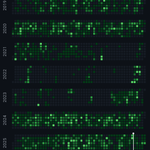
i wanted to visualize what my github history looked like before and after the AI inflection point.
see yours here - mo.rgan.co/gh/
i've looked at a few friends, eng and design, and it's really interesting to see the patterns.


after leaving the theater I overheard people say, "oh, but it's so normal in Silicon Valley to oversell your product, and—"
No. Just no. Don't let a city and an enterprise become so debased that casual fraud is a norm.
It is dishonorable and you should be marked as a knave
Some sanity.
She's doing it *again*, goddamn we're all fools

A ton of people have asked me for my thoughts about “You Can See Everything,” the new Elizabeth Holmes documentary. Here they are: nytimes.com/2026/10/17/busin… via @NYTimes

watch a baby giraffe come screaming into the blazing world from six feet up and walk it off a few mins later

For the first time in Cincinnati Zoo history, we are planning to livestream a birth. As Tessa the giraffe prepares to welcome her calf we are planning on sharing the special moment with the world! The cameras are LIVE NOW: youtube.com/live/Hh4XNA0Ea9A youtube.com/live/Hh4XNA0Ea9A…
oop

"Our initial evaluation suggested that GPT-6-Astra's score was in the late eighties followed closely by Opus 5.5. But, as we started to investigate the mistakes that the models might have made, the models, especially Astra, insisted that they were right and that it was the expert-supplied answers that were erroneous. When we went back to the experts it turned out, in multiple instances, that that the experts found some subtle errors buried deep inside their calculations. As they revised their answers, Astra's score started to inch up and it finally ended up with 98% (49/50)."


I suspect human and agent needs are actually more alike than we think. The plus for working with agents is that you can directly quantify your ideas: does the clean code result in faster changes and more token efficiency or not?
Craft will be fully measurable.

it's very interesting how many replies i've gotten about maintainability and clean code being still important. i would argue that that is no longer true and we all need to update our priors on what Good Code really means in 2026.
clean code has always come at a cost - performance. indirection and making code readable/understandable for a human is not free, it often comes at the cost of worse performance. we have historically been okay with this because of Moore's Law and the fact that most code is not on the hot path.
these principles also came from a time where humans maintained code. it made sense to optimize for humans then, but it makes less sense now when agents are already writing all the code. we will in fact probably discover and come up with new principles: principles of agent friendly architecture (i plan to write more thoughts about this soon)
first ever wrenchjob complete! getting a dang windshield on so I can survive highways better
ty for the garage and help @alexisgallagher

the review bottleneck is hitting every industry and field at once
calling all cognitive scientists to figure out how to make the act of verification easier on our poor brains


