

Clinical Assistant Professor, Bama grad, Braves fanatic, health & wellness advocate, and love all things anesthesia. My views are my own. Retweet ≠ endorsement
Alabama, USA
Joined May 2021
- Tweets1.3K
- Following2K
- Followers411
- Likes6.3K




Kerry Varner retweeted

Ten million people have watched a comedian accidentally destroy the entire TED talk industry.
He filmed the talk once at TEDxNewYork in 2014 and openly admitted he had nothing to say.
Speaking coaches charge $5,000 to teach the exact tricks he used in 6 minutes to say nothing at all.
His name is Will Stephen. He is a comedian from Late Night with Seth Meyers who was invited to give a real TED talk and used it to prove the format is a costume anyone can wear.
Every TED speaker opens with a question, tells a personal story, cites a scientist, and shows a chart. Stephen did all four in six minutes with zero content.
His entire formula fits on a napkin.
Gesture with both hands. Ask the audience a question anyone can answer. Tell a mildly embarrassing story so they say aww. Point to a stranger on a slide and call them important. Flash a chart of random numbers. Wear glasses with no lenses. The audience will think you are brilliant.
That last trick alone has probably cost the public speaking coaching industry a hundred million dollars in sessions clients should have skipped.
"If you watched me on YouTube with the sound off, you would think I was a genius."
That is Will Stephen on the TED stage, three minutes into the talk he was paid to give. He wasn't lying.
Executives pay $15,000 for a keynote coach and still open with a joke the room never laughs at. Founders rehearse their pitch for weeks and still sound like Stephen at minute four, saying "wagga wah, gabba gabba" with authority.
The talk is free on YouTube. The method is written across every TED speaker's playbook for ten years.
Stephen still writes for Seth Meyers. Almost none of the ten million viewers have stopped nodding at empty slides since.
The formula is free. The willingness to actually say something before your next keynote, pitch, or townhall is the entire edge.


Kerry Varner retweeted

Patient crashing, no history available, need RSI now. Succinylcholine or rocuronium?
Anand Swaminathan, MD (@emswami) from ResusX:2026:
When you can't rule out contraindications at the bedside, does your choice change? Comment to discuss.👇
Kerry Varner retweeted
Your RSI patient is already desatting. Does your paralytic choice change how long you have to place that tube?
Anand Swaminathan, MD (@emswami) from ResusX:2026:
Spoiler: it does. What's your go-to in this scenario? Comment to discuss.👇
Kerry Varner retweeted

Same lactate, same MAP, same "septic shock" label. Different disease underneath. Maybe that's why so many sepsis trials come up empty. 🎩 tip to the authors
eddyjoemd.com/foamed

Kerry Varner retweeted

Stressed volume. Unstressed volume. Compliance. Capacitance. Mean systemic pressure...
Most papers introduce these terms as if you already understand the physics underneath them.
My next article does the opposite.
It starts with a single elastic container and builds the whole pressure–volume state from first principles, step by step.
If venous return, fluids or vasopressors have ever felt more complicated than they should, this is the groundwork.
Coming this week on thedependentvariable.com
🤖 Made with AI


Kerry Varner retweeted

We announced an agreement to acquire a nationwide low-band spectrum license portfolio that will pave the way for @Starlink to become a major mobile carrier in the US.
With this new spectrum and our Gen2 constellation, Starlink Mobile can ensure Americans have access to high-speed mobile broadband no matter where they are → spacex.com/updates#starlink-…

Kerry Varner retweeted
Hypotensive patient, probe in hand.
Sharad Patel, MD (@msmsharad) from ResusX:2026:
Do you trust your LVOT VTI read enough to make the call? Carotid doppler is emerging as an easier option. What's your bedside go-to? Comment to discuss.👇


Kerry Varner retweeted

Justin Verlander’s career comes to a close as he leaves the mound for the final time,
called by @Greg_Gania and Dan Petry for 97.1 The Ticket:
#DNMW #RepDetroit
Kerry Varner retweeted
Writing Part 2 made me realise Stewart chemistry deserves its own episode.
SID, weak acids, electroneutrality, where the H⁺ comes from, and what “dependent variable” actually means.
Part 3 will finish the trilogy with how to use it at the bedside.
Find part 1 here thedependentvariable.com/p/a…

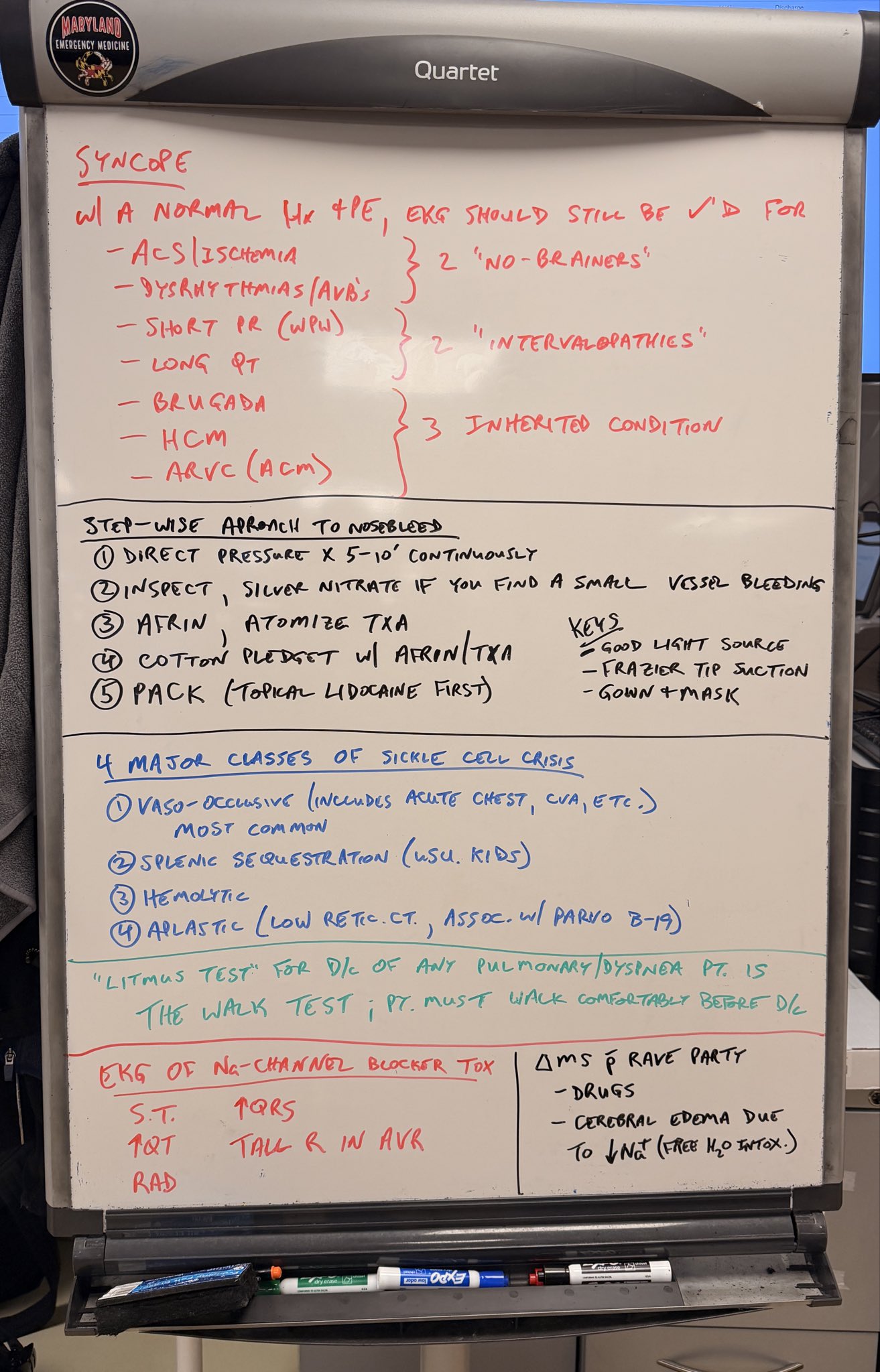
Words of wisdom 👍👏🏼

Something an EP attending taught me in fellowship that has stuck with me: If someone has permanent Afib, Afib with rapid rate is their "sinus tachycardia".
Anything that would cause sinus tachycardia in someone without Afib (infection, stress, dehydration, etc), would cause "AF RVR" in a person with Afib. It is not a new de novo condition for them.
Stop chasing the AF RVR, treat underlying condition, the RVR resolves on its own.
#cardiology #EP #Afib
💯

I'm amazed at how many providers in the ICU still think about shock with approaches learned in pre-clinical med school...
its 2026, lets move away from
"Distributive, Hypovolemic, Cardiogenic, Obstructive" or "Pumps tubes pipes"
To:
Stroke Volume
Minute VTI
Congestion (right and left)
Fluid responsive
Fluid tolerant
Microcirculation
Hemodynamic Coherence
SVR
MAP responsive
LV-Arterial coupling
RV-PA coupling
Admittedly, the above is more complicated, but so is the physiology of a patient dying of shock! These patients are hard, but don't start shackled by mental frameworks that don't allow you to actually think about these issues.