

Content Writer || Web3 Enthusiast || Crypto Content Creator || Ambassador @ston_fi
$$$
Joined November 2020
- Tweets57.8K
- Following9.8K
- Followers13.8K
- Likes47.5K




Pinned Tweet
GM gZAPS
What if launching a token was about more than being early?
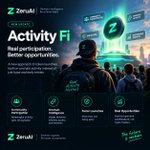
That’s the idea behind ActivityFi by @zerufinance.
Traditional meme launches often reward those who enter first, while genuine community members can be left behind when early buyers exit.
ZeruAI is exploring a different approach: connecting real onchain activity with how new markets emerge.
Instead of focusing only on who arrives first, the concept puts greater emphasis on verifiable participation and community activity.
This is an interesting shift because Web3 already has millions of wallets interacting with protocols, trading assets and contributing to ecosystems.
The challenge has always been how to recognize that activity and give it a more meaningful role.
ActivityFi aims to explore that possibility through Zaps and its upcoming zToken launch process.
For me, the bigger question is simple:
Can verified activity help create more community-driven token launches?
If it works as intended, it could introduce a different way to think about participation, fairness and value creation in Web3.
The next evolution may not be about launching tokens faster, but about recognizing the people who actually contribute.
#ZeruAI

Khalid retweeted

most token launches reward speed, not contribution.
whoever gets in first often wins, while the people who actually help build an ecosystem get left behind.
that’s the problem @zerufinance is tackling with ActivityFi.
Bitquery analysed 8.2M Pumpfun launches and found that devs and bundled wallets made at least $579M after fees, around 18x more than sniper bots.
through Zaps, ZeruAI takes a different approach. contributors can earn mining seats based on their onchain activity, while token distribution is driven by real buyer demand.
unsold supply gets burned instead of sitting around waiting to be dumped.
building an economy first and rewarding real participation could make token launches more sustainable and fair for everyone.

Khalid retweeted

how do campaign budgets and volume checks work on @zerufinance?
the Vault locks before the campaign even opens, which caught me when i looked at one yesterday... full budget sits onchain first, so no Vault, no campaign starts.
@zerufinance set it that way so the money is already there, and Clans then try to move real volume while every trade gets checked.
wash trades score zero because they avoid taking real price risk so they do not count, and Wallets funded from the same place count as one.
what shows up in the Proof section and where do unearned funds go?
i opened the Proof section and the numbers were split clear: raw volume submitted, how much the filters took out, then the verified amount that actually gets paid...
whatever does not get earned goes back to the sponsor instead of the usual thing where the whole pool just gets handed out, and there is a public page at the end that shows who delivered what.
how do the filters work across different campaigns?
does the filter cut the same kinds of trades on every campaign or does it change with the protocol?

Khalid retweeted

The meme launch meta needs a reset.
What if your onchain activity, not your connections or how fast you click, earned you a place in the next launch?
Introducing Activity Markets ⚡
Memes that spawn from proof-of-activity of existing onchain communities. Verified contributors earn miner/creator rights. Traders decide what the market is worth.
Welcome to ActivityFi.
Registrations open. ↓
Khalid retweeted
The ZeruAI team is heading to NYC for @TheTieIO's The Bridge tomorrow.
@Ashutosh_Sahoo will be joining the conversations around activity markets, trust oracles, and what comes next for onchain markets.
If you're attending, come say hi!


In Web3, Good Participation Starts With Knowing Where You Stand
Reward campaigns can attract attention quickly, but staying organized is what helps participants navigate them properly.
That is why I think the @BeldexCoin Loyalty Program deserves a more practical approach from everyone involved.
Instead of focusing only on completing tasks, farmers should understand how their participation is recorded, which requirements apply to them, and what actions may still be necessary.
A few simple habits can help:
Check the official dashboard for available updates.
Review the campaign rules before submitting information.
Confirm that your wallet details are accurate and belong to you.
Keep track of any published deadlines or eligibility conditions.
These steps may seem basic, but they can prevent avoidable mistakes during a campaign. They also help participants distinguish official information from assumptions shared through community discussions.
Another thing worth remembering is that reward participation should never come at the expense of security. No legitimate campaign process should require you to reveal your seed phrase or private keys. Always verify links and avoid suspicious messages promising guaranteed rewards.
For me, loyalty in Web3 is not just about showing up repeatedly. It is also about being attentive, understanding the process, and making informed decisions throughout the journey.
The best approach is to stay active while remaining careful about every step you take.
If you are participating in the Beldex Loyalty Program, visit the official dashboard to review the latest available information:
quest.beldex.io/loyalty

🚀 Ready to explore Hazels?
Join the community, create content, and earn YORAI points! 🔥
🤝 Let's grow together!
🔗 hazels.io/studio/waitlis…
@0xhazels #WEAREHAZELS

Khalid retweeted

The first encrypted financial infrastructure connecting NFT-owned AI Agents with DeFi and @Polymarket markets.
20,000 NFTs. 20,000 AI Agents. Powered by $MOTES.
→ Applications open: meetmotes.com/apply-form
Khalid retweeted

New creator campaign @meetmotes is now live.
0.5% of the $MOTES supply up for grabs.
Motes is building encrypted financial infrastructure with NFT-owned AI Agents executing DeFi and @Polymarket trades on @RobinhoodApp.

GN Hazels Creators
A new creator campaign is now live on @0xhazels, and this time, it’s all about @meetmotes.
0.5% of the total $MOTES supply is up for grabs!
Motes is building encrypted financial infrastructure powered by NFT-owned AI Agents designed to execute DeFi and @Polymarket trades on @RobinhoodApp.
Here’s what you need to know:
→ 2-month campaign
→ Top 500 Hazels Creators eligible for rewards
→ 100% token unlock, with no vesting
→ Hazels NFT staker multipliers are now active
This is an opportunity to explore how AI agents, digital ownership and onchain finance could come together.
If you’re creating on Hazels, now is the time to learn about Motes, share original insights and contribute meaningful content to the ecosystem.
Let’s build, create and make every contribution count.
Who’s joining the @meetmotes campaign? 👀
#WEAREHAZELS #MOTES

Khalid retweeted

GM GN EVERYONE 🌞
hope today gives you a reason to feel excited about what’s ahead.
protect your peace, stay curious, and don’t let a difficult moment define your whole day.
some of the best progress happens quietly, when nobody is watching and you keep choosing what matters.
be proud of the effort you put in, even when the results take time to show up.
sending good vibes to everyone here may your day feel lighter, brighter, and worth smiling about.
four months, six milestones.
that is the pace @zerufinance is keeping.
> june 22 zscore went live on base.
> july 20 zaps opened to onchain trading communities.
> august 1 etherscan passed 1,000,000 zscore checks.
> early october activity markets was unveiled at korea blockchain week.
> october 7 the team showed up at token2049 singapore.
> october 15 the aspen campaign opened with $50,000 in rewards.
shipping this steadily is rare in a noisy market.
i trust steady builders more than loud ones.
consistency is the one thing a roadmap cannot fake.
the next test is whether usage keeps pace with shipping.
which of these milestones do you think matters most?
gZeru 💪


good morning gm 🌅
hope you’re starting this day with a little peace and a lot of hope.
you never know which small effort will open the door to something better.
so take that first step, have the conversation, try the idea, or give yourself another chance.
you don’t need a perfect plan to make meaningful progress.
wishing you all a day filled with good energy, kind people, and little wins that make you proud.
i was thinking about how you actually trust crowdsourced data from the real world once it leaves someone phone.
@vangrid_io fingerprints every capture with a content hash a coarse location and a timestamp at the moment it is recorded.
those fingerprints are grouped into a merkle tree and the root is anchored on base roughly every 15 minutes.
anyone can take the sibling hashes recompute the root and check it against the public onchain record.
verification does not depend on trusting a private server log.
the attestation proves the fingerprint was included by the end of that batch window.
this turns ordinary phone footage into something a buyer can inspect instead of just accepting.
how much more usable does physical world data become once the proof sits on a public ledger?
💭 gVangrid 💪

Khalid retweeted

gd afternoon
Wallet research becomes more useful when reputation is part of the same experience.
That's what makes @zerufinance bringing zScore into Etherscan interesting to me.
Instead of switching between different platforms, users can explore wallet transactions and get additional context about behavioral reputation in one place.
The real value is convenience, but also timing. Reputation insights are more useful when they appear during the research process, right when someone is evaluating a wallet.
Still, a score shouldn’t tell the whole story. On-chain transactions are recorded facts, while reputation scores are interpretations that need context.
If Zeru can make wallet analysis simpler without blurring that distinction, zScore could become a useful layer in everyday on-chain research.
Better context. Smarter research. More informed decisions.

Khalid retweeted

gm gzaps
the biggest advantage in a meme launch isn’t always a faster bot. sometimes, it’s having access before everyone else
a Bitquery analysis of 8.2m pump.fun launches found some numbers worth looking at:
✅ 21% had developer-linked wallets buying in the launch block
✅ those wallets held a median of 10% of the supply
✅ developers and bundled wallets made at least $579m after fees from tokens they sold
✅ sniper bots made $31.5m
that’s a huge gap. developers and bundled wallets made around 18 times what sniper bots did
it shows why launch fairness is about more than speed. who gets in early, how much supply they get, and when they sell can shape the whole market
this is why @zerufinance upcoming activity fi is worth watching. using verified onchain activity to help decide market access could offer a different way to approach launches
the goal should be a market where real participation matters, not just who gets through the door first.
@zerufinance

Khalid retweeted

Gm gm CT
Who really wins the meme launch game?
Bitquery analysed 8.2M Pump.fun launches and found that 21% had developer linked wallets buying in the first block, holding a median 10% of supply.
Developers and bundled wallets made at least $579M after fees, while sniper bots made $31.5M.
That’s 18x more than sniper bots.
The problem goes beyond bots getting in first. It’s who gets access, how much supply they secure, and when they sell.
This is why fair launches need more than just open access. Without better ways to verify real participation, regular buyers can still end up playing a game where the odds are already stacked against them.
That’s the kind of problem @zerufinance is working to address with ZeruAI and activity based markets.
🤝 Paid partnership

Khalid retweeted
GM gZAPS
A meme coin reached a $15M market cap within minutes, only to lose more than 98% of its value in under an hour after its promotional posts were removed.
This pattern continues to repeat. In May, a Solana token linked to a since-deleted post from Roaring Kitty’s account climbed to around $11M in just 20 minutes. One trader reportedly lost approximately $188K on the token within an hour.
The underlying problem is how these launches determine access.
Speed and attention dictate who gets in first. Snipers using fresh wallets and pre-positioned supply enter early, while genuine community members arrive late and end up providing exit liquidity.
That is the outcome when launches reward early entry rather than community participation.
@zerufinance is exploring another approach built around verified onchain activity.
It is called Activity Fi, coming to Zaps. Here is how the system is designed:
→ Past activity establishes eligibility. Wallets that have paid fees, supplied capital or shown genuine usage already have a ranking before registration begins.
→ Rankings provide temporary mining rights. These rights remain valid for a 30-day season.
→ Connected wallets are merged. Wallets sharing funding sources are grouped under one identity, while wash-style volume receives a zero score.
→ New supply is distributed through daily short auctions. Holders of mining rights receive USDC based on the clearing amount.
→ Unsold tokens are burned on the same day. No allocations are reserved for the team, VCs, or free miners.
→ The initial price is determined through a continuous clearing auction. The proceeds are used to fund a locked Uniswap liquidity pool.
At the core of this system is ZeruAI’s trust oracle.
Its zScore is a behavioral metric ranging from 0 to 1,000, calculated from onchain history and already live on Etherscan. ZeruAI also examined 3,374 token launches while developing this model.
My take: burning unsold supply on the same day is one of the most compelling design decisions.
Miners earn only when buyers purchase. This removes the advantage of receiving free tokens that can later be dumped on public buyers, tackling one of the structural weaknesses behind many meme coin launches.
However, the model still has significant challenges to overcome.
First, whenever activity determines access, people will attempt to manipulate whatever earns them a place. The scoring system must continue identifying wash activity and coordinated wallets, even under pressure.
Second, rankings built on historical activity may favor wallets that entered an ecosystem early. How newcomers establish their standing is just as important as how existing participants maintain theirs.
Third, no auction mechanism can create genuine demand out of nothing. The model still depends on real buyers, sustained participation and a market willing to assign value to the tokens being released.
Meme launchpads have solved token creation.
The more difficult challenge is determining who deserves access, how that access is earned and whether the resulting market can sustain itself.
Activity Fi is an interesting attempt to address that challenge by making participation, rather than speed alone, part of the equation.

Khalid retweeted

everyone blames sniper bots for winning meme launches, but the numbers tell a different story
according to Bitquery, devs and bundled wallets made $579M+ after fees, compared to $31.5M for sniper bots.
The @zerufinance highlights a bigger issue here. devs and bundled wallets made around 18x more than sniper bots.
on 21% of launches, developer-linked wallets bought in the launch block and secured a median 10% of the token supply.
think about that. some wallets start with a huge position before most people even get a chance to buy.
it’s not just about who buys first. it’s about who gets in early, how much supply they secure, and when they sell.
that’s the real imbalance in the meme launch game.
🤝 Paid partnership

Khalid retweeted
what if token launches rewarded people who actually contributed, instead of whoever clicked buy first?
that’s the idea behind ActivityFi from @zerufinance
Bitquery analysed 8.2M Pumpfun launches and found devs and bundled wallets made at least $579M after fees, around 18x what sniper bots made.
the bigger problem isn’t just bots being fast. it’s who gets early access and how much supply they secure before everyone else.
ZeruAI takes a different approach. through Zaps, contributors can earn mining seats based on their onchain activity, with payouts driven by actual buyer demand rather than simply handing out tokens to dump.
unsold supply gets burned.
imo, building an economy first and rewarding the people who contribute to it is a more interesting direction for token launches.
🤝 Paid partnership

Khalid retweeted

the latest data from @zerufinance shows why most meme launches feel rigged from the start.
in over 8 million pump.fun tokens, developers and their connected wallets consistently took the lion’s share ... not random snipers. they buy early, hold meaningful supply, and cash out with massive profits while regular participants are left holding the bag.
this is exactly the kind of pattern wallet intelligence is built to detect. if you want to understand who actually wins before jumping in, check what your own wallet history reveals at app.zaps.wtf.


Who really wins the meme launch game?
Bitquery analysed 8.2M Pump(dot)fun launches and found:
- 21% had developer-linked wallets buying in the launch block, holding a median 10% of supply.
- Developers and bundled wallets made at least $579M after fees on tokens they sold.
- Sniper bots made $31.5M.
Developers and bundled wallets made 18x what sniper bots did.
The problem goes beyond bots getting in first. It’s who gets access, how much supply they secure, and when they sell.

Khalid retweeted
the biggest winners in meme launches aren’t always the fastest bots.
according to Bitquery, devs and bundled wallets made $579M+ after fees, while sniper bots earned $31.5M.
that’s roughly an 18x difference.
@zerufinance highlights the real problem on 21% of launches, developer-linked wallets bought in the launch block and secured a median 10% of the token supply.
when some wallets secure a significant position before most traders can even react, the playing field is far from equal.
speed matters, but early access, supply concentration and exit timing can matter even more.
the real question isn’t just who bought first. it’s who had the advantage before the market even opened.
