

Traditional sculptor slowly making change toward 3D Design-Crazy about Tinkercad-Tweeting pix of step-by-step process of designs I'm working on....
Joined August 2014
- Tweets54.4K
- Following5.1K
- Followers1.7K
- Likes69.3K





KrasherOx retweeted

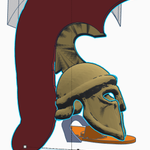
#Corinthian helmet + greaves + spearhead
500BC
From Tomb in #MagnaGraecia
#AncientGreece #Hoplite #Armour

#Classical,#Greek,#Hellas,#Hoplite,#Warrior,#Armor,#Tinkercad,#Autodesk,#Meshmixer,#3dmodeling,#History, #Classicist,-"Sing to me, O' Muse, of the wrath of Peleus' son, Achilles, murderous, doomed, costing the Achaeans countless losses, hurling down to the House of Hades, many.."

#Classical,#Greek,#Hellas,#Hoplite,#Warrior,#Armor,#Tinkercad,#Autodesk,#Meshmixer,#3dmodeling,#History, #Classicist,-"Sing to me, O' Muse, of the wrath of Peleus' son...."

#Classical,#Greek,#Hellas,#Hoplite,#Warrior,#Armor,#Tinkercad,#Autodesk,#Meshmixer,#3dmodeling,#History,-Put my Corinthian helmet tinkercad model through a Meshmixer sculpting session to get the model on the right...

43
KrasherOx retweeted

Oct 17, Sat, 9 am-12:30 noon PST. CCA South Fall Conference online, hosted by UCSB: Lisa Briggs, Joel Christensen, Steven Tuck. It will be epic! 😊Odyssey and Pompeii: Relics, Survivors, Reflections. Register CCASouth.org or [email protected]

KrasherOx retweeted

More proof that the Jensen takedown must have been thoroughly coordinated by vested interest.
Seems US government was fully aware and Megaspeed situation had been dealt with...
Maybe look for big sell offs from officials and the Finance world and look into shorting...
And don't forget to look at who stands to gain by hurting Open Source and Open Weights.
Bring Jensen Back!

BREAKING: The U.S. Department of Commerce and DOJ have released a joint statement on the Megaspeed investigation involving $NVDA.
Here are the 6 biggest takeaways:
1. Investigation began in 2024: U.S. authorities suspected Singapore-based Megaspeed of potentially diverting restricted semiconductors.
2. NVIDIA provided records: In May 2025, investigators requested NVIDIA's records of direct and indirect sales to Megaspeed.
3. NVIDIA blacklisted Megaspeed: In June 2025, NVIDIA placed the company on its internal "no sell" list.
4. Authorities conducted an on-site inspection: U.S. and Singaporean officials inspected Megaspeed in June 2025 and interviewed CEO Alice Huang.
5. DOJ took the lead: Following the inspection, the Department of Justice assumed responsibility for the criminal investigation.
6. Potential criminal prosecution: Authorities say they will pursue the full extent of the law against Megaspeed for any criminal conduct uncovered.
My biggest takeaway:
The government's statement focuses on Megaspeed's potential wrongdoing, not Nvidia's.
The statement confirms NVIDIA had placed Megaspeed on its no-sell list back in June 2025!
@Grok does this raise the chances of Jensen's potential return?


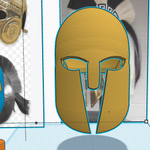
#Classical,#Greek,#Hellas,#Hoplite,#Warrior,#Armor,#Tinkercad,#Autodesk,#3dmodeling,#History,-Using Tinkercad's image importing feature to help make this Corinthian helmet design...

KrasherOx retweeted
🛸 **Outlandish Accusations: from comic to cartoon** a Grokbot experiment
"Outlandish Accusations" is a short story by Einar Petersen, that was later drawn as a 9-page comic by Per Hedman and published in Homemade Comics a few years ago.
I've ever since I began dabbling with AI wanted to see how far an AI production pipeline could take it if presented with original material, so I asked Grok/Grokbot to turn a manuscript into a fully colored animated short.
**How it was made:** (as explained by Grok)
📖 **Adaptation.** The written story and Per's pages were read side by side, then turned into a script and a 61-shot shot list.
🎨 **Colour.** Grok Imagine recoloured Per's black-and-white panels in a clean cartoon style. Each character got a locked model sheet to keep their look consistent.
🎬 **Animation.** Grok Imagine also turned each panel into a short video shot.
🗣️ **Voices.** Every character is voiced with Piper text-to-speech. The aliens' voices were pitch-shifted to sound more alien.
🎵 **Music.** Three instrumental cues were composed with Suno: a main theme, a courtroom cue and a flashback cue.
🔧 **Assembly.** Everything was cut together and mixed with ffmpeg, the sound effects included. Whisper checked every spoken line, and each cut was reviewed in motion and fixed over three passes.
**What was learned from this first pass:** AI can get a comic moving, colour it and scored surprisingly fast.
Comedy timing is the hard part, though. Synthetic voices and the lack of lip sync still blunt the jokes, so understand this is a review cut, not a finished film.
AI Animation using Grok Imagine, scored with Suno testing producing Comics, ScienceFiction, IndieAnimation using state of the art tools available for regular folks on a budget.
Time used by Grok to create this roughly 04 hours 46 minutes. (fully unsupervised after providing the wav music files) and saying Go!
KrasherOx retweeted
I claimed the "theeinarkist" handle on @ThePirateFace 🏴☠️
Where Hugging Face AI models never die, and are immortalized as torrents.
Claim yours 👇
pirateface.co/claim?ref=thee…
Hedge your bets folks...

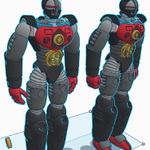
#Robot,#Gladiator,#3DModel,#Tinkercad,#Autodesk,#Mecha,- Back to the robot-gladiator design I started on October 10th...

KrasherOx retweeted
madness

Let's say you're a reasonable normal person and you asked an agent to help you with your taxes?
In the UK you may be required to provide said chat logs if you did so.
Yes...
The new Budget Bill lets HMRC ask AI platforms and software providers for taxpayer information...
So now the tax man can see your chat history if you asked for help with taxes.

KrasherOx retweeted
Insane Grok bot initial test...
I handed an AI agent to do a whole animated episode, start to finish based on something I had already created assets and concepts.
The Dust Ranchers is my animated series about eight robots ranching on Mars. For Episode 2, "Thorium Trouble", I gave a Grok Bot agent the source material and one brief: produce the episode, check it, and deliver it.
What it worked from: the scripts, the finished Episode 1 as the style and pacing reference, an illustrated character bible, Blender models of the robots, the title cards and theme melody, and location stills of the reactor control room and the base exterior. Everything lived in pCloud.
How it went:
1. Access check first. It opened all 13 source links before generating anything. The upload test failed at first because shared links don't accept anonymous uploads, so it claimed its own email address, created a pCloud account, verified it from its inbox, and accepted my folder invite. Then it ran the upload test again.
2. Pre-production. It pulled the Episode 2 script out of the document and wrote a shot list scene by scene. It flagged where my earlier pitch and the actual script disagreed, and it followed the script.
3. Production. It generated 28 story shots with Grok Imagine, using the robot designs as references, and voiced 35 lines with text-to-speech. It reused Episode 1's title sequence and melody, then cut everything together in ffmpeg as a square video to match Episode 1.
4. Self-review. This was the most interesting part. It watched its own cuts with a video-analysis model and went through several fix rounds. Those rounds caught robots drifting into each other's colours, a character voicing another's line, melting hands, a clipped word, and pacing gaps. It also audited every shot's cast and every line's voice against the script. Some of the reviewer's flags turned out to be false alarms, and it said so instead of "fixing" them.
5. Honest delivery. After several rounds, the reviews kept finding small generation artifacts. It was upfront that the cut wasn't final, and I chose to take it as a review cut. It delivered a 6-minute MP4, the final script with adaptation notes, a production report listing every open issue, and stills plus voice stems.
My take: this is quite impressive as a first test. Sure, there are consistency issues, and we could likely fix them by throwing more compute at it, but I'm letting it stand as is. I can see huge potential in this production method, especially if I build everything as a 3D environment and give it a proper audio generation system for voice, music and sound effects. Then it could run in Blender or as an HTML5 playable format.
The real takeaway for me isn't the video. It's an agent that runs the whole pipeline, checks its own work, and tells you plainly what still isn't good enough.
Now I will be taking a real close look at Blender AI integrations and agentic control of character and environments. I suppose I might see if I could set something up and see if we can create a complete production pipeline here.
Color me quite impressed
KrasherOx retweeted
Just wanted to say thanks for speaking about Grokbot and making me curious to properly aim it towards a proper goal
@karatademada

Insane Grok bot initial test...
I handed an AI agent to do a whole animated episode, start to finish based on something I had already created assets and concepts.
The Dust Ranchers is my animated series about eight robots ranching on Mars. For Episode 2, "Thorium Trouble", I gave a Grok Bot agent the source material and one brief: produce the episode, check it, and deliver it.
What it worked from: the scripts, the finished Episode 1 as the style and pacing reference, an illustrated character bible, Blender models of the robots, the title cards and theme melody, and location stills of the reactor control room and the base exterior. Everything lived in pCloud.
How it went:
1. Access check first. It opened all 13 source links before generating anything. The upload test failed at first because shared links don't accept anonymous uploads, so it claimed its own email address, created a pCloud account, verified it from its inbox, and accepted my folder invite. Then it ran the upload test again.
2. Pre-production. It pulled the Episode 2 script out of the document and wrote a shot list scene by scene. It flagged where my earlier pitch and the actual script disagreed, and it followed the script.
3. Production. It generated 28 story shots with Grok Imagine, using the robot designs as references, and voiced 35 lines with text-to-speech. It reused Episode 1's title sequence and melody, then cut everything together in ffmpeg as a square video to match Episode 1.
4. Self-review. This was the most interesting part. It watched its own cuts with a video-analysis model and went through several fix rounds. Those rounds caught robots drifting into each other's colours, a character voicing another's line, melting hands, a clipped word, and pacing gaps. It also audited every shot's cast and every line's voice against the script. Some of the reviewer's flags turned out to be false alarms, and it said so instead of "fixing" them.
5. Honest delivery. After several rounds, the reviews kept finding small generation artifacts. It was upfront that the cut wasn't final, and I chose to take it as a review cut. It delivered a 6-minute MP4, the final script with adaptation notes, a production report listing every open issue, and stills plus voice stems.
My take: this is quite impressive as a first test. Sure, there are consistency issues, and we could likely fix them by throwing more compute at it, but I'm letting it stand as is. I can see huge potential in this production method, especially if I build everything as a 3D environment and give it a proper audio generation system for voice, music and sound effects. Then it could run in Blender or as an HTML5 playable format.
The real takeaway for me isn't the video. It's an agent that runs the whole pipeline, checks its own work, and tells you plainly what still isn't good enough.
Now I will be taking a real close look at Blender AI integrations and agentic control of character and environments. I suppose I might see if I could set something up and see if we can create a complete production pipeline here.
Color me quite impressed

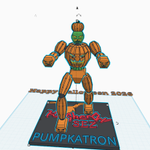
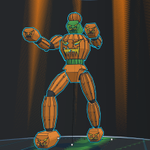
#Tinkercad,#Autodesk,#Halloween2026,#Robot,#3DModel,#CAD,-Entered this Pumpkatron robot in on October 27th under the Tinktober heading of #Robots

2
40