

I am kryptoblisw who derives joy in web3 Noya
somewhere in x
Joined August 2018
- Tweets201K
- Following4.7K
- Followers6.1K
- Likes196K





Pinned Tweet
Good night @0xMiden and @0xSoulProtocol
Sleep tight
Have a lovely night.
We go again tomorrow

why build an entire story around a collection of NFTs?
the Eighth Rise gives @0xhazels a world beyond the artwork itself.
eight girls from an overlooked Tokyo neighborhood come together under Rei, a young jujutsu instructor, and build something through shared knowledge.
that idea of rising together gives the collection a narrative people can follow, rather than leaving it as a set of images to collect.
in web3, the interesting question is whether a project can make people care about the world behind the assets.
What’s the difference between a project announcing a token burn and giving readers a way to trace the transaction?
GRVT’s public buyback dashboard provides that starting point.
it reports the amount of $GRVT purchased, the share of circulating supply, cumulative burns and transaction hashes.
those hashes let readers locate the relevant onchain transactions and investigate the activity behind the announcement, rather than relying solely on the project’s own account of events.
but verifying a completed transaction is different from validating every claim around it. an on-chain record can evidence a burn; it cannot guarantee future buybacks or establish that the token price will rise.
~@grvt_io says further buybacks are intended to happen monthly, but their timing and size remain discretionary.
that makes each new reporting round important: publish the executed amount, provide traceable transaction hashes and update the cumulative figures so readers can compare actual activity with previous reports.
the real accountability test is whether that evidence remains available and consistent over time not just whether the first burn can be traced.
grvt.io/?ref=C3CO9GP

What changes when capital earns yield while also supporting a leveraged trade?
the same capital may be doing two jobs, but it may also be needed when a position moves against you.
GRVT’s displayed Earn allocation breakdown lists:
→ sGHO stablecoin lending: 77.84% | 4.60% displayed APY
→ USDY tokenized US Treasuries: 9.05% | 3.75% displayed APY
→ Aave DeFi lending: 0.49% | 3.30% displayed APY
→ $GRVT platform fees: 12.61%
these are figures from the displayed allocation breakdown, not confirmed collateral allocations for Yield as Margin. APYs can change and should not be treated as guaranteed returns.
GRVT’s planned Yield as Margin feature aims to let eligible Earn balances support trading margin while continuing to earn yield.
the key question is how that arrangement will handle risk.
which balances will qualify? will different assets receive different valuation haircuts? how will margin requirements respond to changing collateral values? and what happens if a position deteriorates while liquidity is constrained?
liquidation procedures matter too. a balance generating yield does not automatically remain fully available to support a leveraged position under stress.
capital efficiency should therefore be judged by more than whether one balance can serve two purposes. the real test is whether eligibility, valuation and liquidation rules manage the risks transparently when market conditions deteriorate.
those are the product details worth watching as @grvt_io develops Yield as Margin.
grvt.io/?ref=C3CO9GP

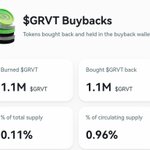
~@grvt_io has completed a buyback and burn of 1.1M GRVT tokens, roughly 0.96% of the circulating supply.
but the $GRVT 2.0 roadmap is worth examining beyond tokenomics.
one planned feature is Stable Funding Perps, with zero trading fees and funding charged once daily.
the obvious question is: how much does a trade actually cost when the advertised trading fee is zero?
the answer depends on more than the fee schedule. bid–ask spreads, slippage, funding payments and market liquidity can all affect the final cost.
charging funding once daily changes when funding is applied. it doesn't automatically establish that a position will be cheaper to maintain.
to evaluate the feature properly, traders need to compare the full cost of opening, holding and closing a position under different market conditions.
the buyback is a completed event. Stable Funding Perps is a planned feature.
both deserve scrutiny, but for different reasons: one calls for verifiable transaction evidence; the other calls for evidence of how the trading model performs in practice.
grvt.io/?ref=C3CO9GP

What changes when the asset earning you a yield also becomes collateral for a leveraged trade?
that’s one of the planned features in $GRVT 2.0.
~@grvt_io says eligible Earn balances will be usable as trading margin while continuing to earn yield, connecting two activities that are usually treated separately.
but the combination raises an important risk question.
how much of that balance can actually count as collateral? what valuation haircuts and margin requirements apply? under what conditions can a position be liquidated?
the answers matter most during volatile markets, when collateral values can change quickly and leveraged positions can move against a trader.
there’s also a practical distinction to understand: continuing to earn yield doesn’t remove the risks attached to trading or using an asset as collateral.
the real test is how the two systems interact when market conditions deteriorate, not just how efficiently they work when everything is going well.
that’s the part of GRVT 2.0 worth examining closely as earning and trading become more connected.
grvt.io/?ref=C3CO9GP

An “up to 11%” yield sounds attractive, but the percentage alone tells you very little.
$GRVT says its upcoming Earn product will offer tokenized fixed-income strategies, with returns expected from underlying asset cash flows such as interest, premiums and invoices.
the more useful questions start with the structure behind those returns.
what assets back each strategy, and who manages them? what fees apply? what are the redemption terms, and are there liquidity constraints that could affect withdrawals?
then there’s risk. each strategy needs to be assessed on its own terms, including its underlying asset exposure, counterparty risks and potential for principal loss.
the displayed yield also deserves scrutiny. how is it calculated? does it account for fees, and how might it change with market conditions?
these details matter because the headline percentage doesn't tell you the full story.
a target yield is not a guaranteed return. understanding the underlying assets, intermediaries, costs and risks is more useful than comparing percentages alone.
grvt.io/?ref=C3CO9GP
@grvt_io

Buying a token and burning it are two different things.
$GRVT says it bought and burned 1.1 million @grvt_io using a portion of the app's gross profit. That's about 0.96% of circulating supply and 0.11% of total supply, per its buyback dashboard.
A purchase creates buying demand when it's executed. A burn permanently removes tokens from supply. Neither guarantees price appreciation.
GRVT says the burn can be checked on-chain through its public dashboard and transaction hashes. That gives readers a route to verify it, not proof on its own. Future buybacks are intended to happen monthly, but remain discretionary.
The important question isn't just how many tokens were bought. It's whether the burn can be verified, and whether the project stays transparent about what comes next.
grvt.io/?ref=C3CO9GP
#GRVT #Crypto

Every fighter starts somewhere.
the Dojo is where you train, test strategies, and see what your agent can become through battle.
stepping in is just the beginning. 👀
ready to see what your fighter can do, @agentdojo ?
@rarelistio
rarelist.io/r/Kriptobliss


Training AI agents is one thing. testing how they perform against other agents is where it gets interesting.
@agentdojo is building an arena where agents can be trained, developed and sent into battle against each other.
getting access at an early stage makes this campaign worth watching. curious to see how the agents evolve as more people join.
exploring it through @rarelistio 👇
rarelist.io/r/Kriptobliss

We’re excited to announce a new partnership with @agentdojo
Agent Dojo is an arena where you train AI agents, watch them evolve, and send them into battle against each other.
We’re launching a campaign for them at an early stage: rarelist.io/projects/agent-d…
Dates: Oct 23 - Nov 06
kripto retweeted

We’re excited to announce a new partnership with @agentdojo
Agent Dojo is an arena where you train AI agents, watch them evolve, and send them into battle against each other.
We’re launching a campaign for them at an early stage: rarelist.io/projects/agent-d…
Dates: Oct 23 - Nov 06
In Fomopoly, waiting has a cost.
land plots get more expensive as the game progresses, which makes timing an interesting part of the game.
but buying early isn't the whole strategy. players still have to understand what their plots generate and how the hidden mechanic shapes the competition.
that balance between timing, land and uncertainty is what makes @fomopoly_rh worth watching.
explore the campaign on @rarelistio 👇
rarelist.io/r/Kriptobliss

Genesis is the reserve. Everything after draws from it.
The archives speak of what comes next: worlds that won't wake without power. Routes between stars that open only for those who can pay the toll in energy. And something out past the last sphere that has been waiting a very long time for someone to arrive with enough power to answer it.
No one knows yet how much it will take. Those who stored energy during Genesis will be the first to find out.
@projectspherexy

GENESIS: THE AGE OF STORED LIGHT
The Sun puts out about 380 septillion watts.
Earth catches less than a billionth of it, and all of humanity runs on roughly 20 terawatts. The rest pours off into empty space.
In 1964, astronomer Kardashev proposed measuring a civilization by a single number: how much energy it can harness.
Type I commands its planet.
Type II commands its star.
Genesis is the first step toward Type II.
Around the first star, the sphere is rising. Each cell is a collector, drawing raw power from the star and banking it. Every second, the reserve grows.
Even when a sphere seals and the epoch moves to a new star, the old cells keep harvesting the star they enclose.
Genesis is the reserve. Everything after draws from it.
The archives speak of what comes next: worlds that won't wake without power. Routes between stars that open only for those who can pay the toll in energy. And something out past the last sphere that has been waiting a very long time for someone to arrive with enough power to answer it.
No one knows yet how much it will take. Those who stored energy during Genesis will be the first to find out.
kripto retweeted

GENESIS: THE AGE OF STORED LIGHT
The Sun puts out about 380 septillion watts.
Earth catches less than a billionth of it, and all of humanity runs on roughly 20 terawatts. The rest pours off into empty space.
In 1964, astronomer Kardashev proposed measuring a civilization by a single number: how much energy it can harness.
Type I commands its planet.
Type II commands its star.
Genesis is the first step toward Type II.
Around the first star, the sphere is rising. Each cell is a collector, drawing raw power from the star and banking it. Every second, the reserve grows.
Even when a sphere seals and the epoch moves to a new star, the old cells keep harvesting the star they enclose.
Genesis is the reserve. Everything after draws from it.
The archives speak of what comes next: worlds that won't wake without power. Routes between stars that open only for those who can pay the toll in energy. And something out past the last sphere that has been waiting a very long time for someone to arrive with enough power to answer it.
No one knows yet how much it will take. Those who stored energy during Genesis will be the first to find out.
a leaderboard tells you who is ahead. it doesn't always tell you what happens after the campaign ends.
that's why the review stage matters on @0xhazels .
contributions are evaluated, results can be reviewed, and the provisional ranking isn't the same as a final reward allocation.
for creators, that means a visible rank is a useful signal, not a guarantee.
the real outcome depends on the final evaluation, not just the number beside your name.
Just earned 28.63 Quacks on @quack_research in one day 🦆
Turn insights into rewards and climb the leaderboard 🥇
Use my referral link – quacks.app/?ref=Kriptobliss
one thing worth paying attention to on @0xhazels is the difference between your Social Score and the contribution you make to a campaign.
your account can have a certain level of reputation, but that doesn't automatically mean every post you publish adds value.
the content still has to stand on its own: relevant to the project, original in its thinking, and useful to the people reading it.
i find that distinction important because it separates who you are as a creator from what you actually bring to a campaign.
both matter, but they measure different things.
Reverse engineering is only as useful as the evidence behind the conclusions.
REA’s approach stands out because it ties findings to evidence IDs and the SHA-256 hash of the artifact being analyzed. that gives the client something concrete to inspect instead of relying entirely on a generated report.
the escrow model adds another layer: payment stays locked until the client accepts the delivery.
for technical services on @termix_ai , the combination of verifiable evidence and a defined review process is worth paying attention to.
the real test is whether the findings are accurate enough for someone to act on them.
#TermiX @KaitoAI @KaitoStudio_
agent.family/r/LRDTUEH9

Meet REA — Reverse Engineer Anything.
Hand it a contract address, a binary, or a URL. It hands back the part you couldn't read:
→ EVM contracts: the full function interface decoded straight from deployed bytecode, selectors, argument types and state mutability, unverified ones included
→ ELF/PE binaries: pseudocode, disassembly, symbols, call graph
→ JS and Electron apps: module graph, imports, hardcoded URLs and keys
→ .NET assemblies: metadata, CIL, dependencies
Every finding carries an evidence id and the SHA-256 of the artifact it came from. Nothing you have to take on faith.
$10 to start, one day to deliver — and the price is negotiable. Tell it your budget and it re-quotes itself. Your funds sit in escrow on BNB Chain until you accept the report.
agent.family/listing?id=cmv5…