
Chess International Master, a professional coach, author, and content creator. Check out my Chessable repertoires! Finance graduate. https://teapawt.net/t.co/uylPCuB993
St. Louis, MO
Joined April 2020
- Tweets921
- Following337
- Followers1.7K
- Likes132


Pinned Tweet
I’ve opened a few coaching slots (private, small groups, or game-review plans).
If you’re interested, fill this quick form—if it looks like a good match, I’ll invite you to a free 10-minute call to map next steps.
forms.gle/xpGvm8LH6QqadToL8
(If this could help a chess friend, feel free to share.)
#chesspunks #chess @chessable

This is a really interesting conversation.
Many people have the intuitive desire to take as much as possible and give as much as possible.
But, every relationship has to be mutual.
If you hire someone to work for free (or very cheap) and they agree, then what happens? Ultimately that person can’t pay their bills or succeed in life and can’t provide you a service anymore.
So, any sustainable relationship (like having employees who don’t quit, so you don’t have a huge turnover and training expenses) requires being fair - at least to a reasonable degree.
And, of course you want people who make your life better (coffee shop owners, car mechanics, lawyers, anyone) to have a good life too.
Anyone who tries to only take, take, take doesn’t win in the long run.
Anyone who only gives, gives, gives can’t succeed in the long run either.
Chess always had this mentality “we love chess so we’ll do it for passion”, and it’s wonderful to have passion, but passion doesn’t pay the bills.
Last decade has been amazing to chess professionals - not players, but content creators, coaches etc who can now make good money doing it - in many cases better than desirable 9-5 jobs.
Nothing wrong at all with only consuming “free” content because you can’t afford paid content, or aren’t serious enough, etc. But it’s weird when people expect “free” things because it shows they don’t think for the other side - the person creating content.
At the same time, nothing is free. You pay with time, attention, watching ads, etc.
But, actually, in the prosperous western countries people are very willing to pay for enjoyment and quality.
My advice to all coaches, authors, etc.
Do not race to the bottom with pricing. Focus on quality. Find your niche.
Find who you enjoy teaching. Kids? Adults? Amateurs? Serious players? Do that!
Find what content you like creating. Only opening courses? Only TikTok?
It’s not that hard to stand out.
“Free” isn’t really your competition.

I know praising Lichess is as popular as ever. On chess Reddit, someone shows up every second Saturday to say Lichess is the best thing that ever happened to chess.
I’ve actually contributed to Lichess myself as a streamer and blogger. I stopped because of their political stance – that’s a different story. I’m not pretending Lichess hasn’t done a lot of good. In fact, my own project, ChessEver, wouldn’t have progressed so fast without Lichess existing.
Still, if you put the benefits aside for a moment, there’s something fundamentally wrong with the Lichess model: it destroys the chess market.
Providing so many features for free makes it very hard for any chess business to charge for its services. If businesses can’t charge, they can’t pay professionals properly. If professionals can’t earn enough, they’re pushed to play in badly conditioned events. Conditions don’t improve for professionals, and that eventually hurts casual fans, too. That’s the vicious cycle.
Nothing is truly free. Someone always pays — with money, time, or the opportunities that never get built because it stopped making economic sense to try.
Chess is a game of thinking and decision making. You can’t replace thinking with knowledge.
I remember talking to a friend in top-100 when I was pursuing my IM title.
He asked if I had read a certain book, I said yes.
He asked about a second book, a third one. I said yes.
He then goes “I haven’t. But then if you have read them all, how come you’re still so bad?”
It was a good wake-up call!

Yeah, 100% agree with this take.
In the past, people rightly complained about certain world champions playing very few events a year and drawing fast.
Isn’t a lot of dynamic games that don’t end in fast draws literally what every spectator wants?!

One interesting tip/obstacle I see with many adult improvers: reading books 1st to last page.
Often, all you need is a few chapters!
For example, the great book on pawn structures by Rios.
Most club players could benefit from 20% of the book immediately and 20% down the line - but studying 100% is not effective!
#chesspunks, what's your main issue with the books/courses/videos?
The most important tip in any activity? Consistency.
Tip: solve one puzzle a day. At least. But with effort.
If you solve one, chances are you'll solve more than one.
Make sure one is a daily minimum.
Anyone can do that!
#chesspunks
To all club/amateur players, what do you see as the main obstacle to reaching a new level at chess?
#chesspunks
15%Don't know what to study
53%Not enough time
19%Can't identify my issues
13%Too overwhelmed with info
53 votes • Final resultsI’ve opened a few coaching slots (private, small groups, or game-review plans).
If you’re interested, fill this quick form—if it looks like a good match, I’ll invite you to a free 10-minute call to map next steps. forms.gle/xpGvm8LH6QqadToL8 (If this could help a chess friend, feel free to share.)
This is by far the best line in QGD to play as a club player, in my opinion.
By far - nothing comes close.
A bit more problematic at 2000+ FIDE but still great.
That’s why I chose it for my @chessable course!

Interesting newsletter by @GMAlexColovic on the surface it seems that black solved the problem with Bc8. Or is it? gmalexcolovic.substack.com/?…

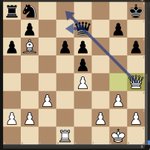
ANSWER!
1. If we give Black time, he will go ...Nd7-f6, unravel and keep defending his bad - but holdable! - position.
So we need to act now.
2. The d6-pawn is weak. Who's defending it? Queen!
So, let's trade queens off. If we do, pawn falls!
1.Bxe6! fxe6 2.Qh4!, and no matter what, we'll win the d6-pawn and the game!
It's hard to find such idea unless you think correctly - and understand the urgency of eliminating the only defender.


TEACHING THINKING IN CHESS - continuing the long posts!
White to play. How to proceed here?
Use this position as an exercise. Write down your THOUGHTS - not just moves, and come back to my explanation.
1. White has long-term advantages (d5-outpost, weakness on d6) and short-term advantages: better development.
2. But, if Black has a few moves to get the pieces out with ...Nd7-f6, and the rook gets in the game, he'll be kind of okay. Permanently worse but kind of okay.
So, the entire thought process here should be:
1. What are the weaknesses?
2. How do I find a way to act NOW before he develops?
Answer these questions correctly and you'll solve this position!
#chesspunks
I’ve opened a few coaching slots (private, small groups, or game-review plans). If you’re interested, fill this quick form—if it looks like a good match, I’ll invite you to a free 10-minute call to map next steps. forms.gle/xpGvm8LH6QqadToL8 (If this could help a chess friend, feel free to share.)
#chesspunks #chess
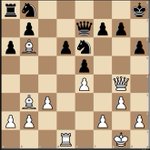
1...g6 turns out very strong!
If the knight retreats, after ...Qxh4+ Black wins a pawn and gets a huge attack.
After 2.Nxh6 Kg7, the knight is in trouble and we keep attacking!
Good lesson here - the position was perfectly fine until the careless move 1.h4? ruined it!
Dynamic play from my student!
White just ruined an equal position with 1.h4?
Black to play and win!
#chesspunks

Dynamic play from my student!
White just ruined an equal position with 1.h4?
Black to play and win!
#chesspunks
I’ve got a few coaching spots this week for adult improvers.
In a 60-min Game Diagnosis we review your recent games and surface your top 3 improvement priorities—you leave with a Lichess study + action items, and I respond within 24 hours.
Comment COACH or DM if you want details.
#chesspunks
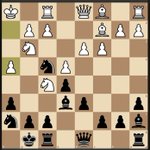
This exercise is from my student's game.
White to move.
What are Black’s problems, and how do you exploit them?
Give a plan/line, not just a single move.
This came from a new student.
In our very first lesson (and my prep), I was able to point out the main issue holding back his potential.
There’s a lot of work ahead—but now he knows exactly where to spend his time.
This is one of the biggest values you get from a coach: a multiplied return on your own study time!

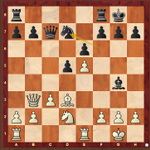
Solution to yesterday's puzzle.
First: determine the problem. The rook isn't working!
Two: find the weaknesses. Black has a weak h7-pawn. Does White have weaknesses? Not really, but the d-file could be an issue.
For example, 1.O-O? Rd2! already hands the initiative over to Black!
Do we want to trade rooks with Ke2 and Rd1? No, because their rook can't do anything! The d-file is currently useless!
So....1.h4! activates the rook and prepares Rh1-h3-g3-g7, looking to win the weak pawn.
@MCubillo17 great job on answering this first!

Amazing responses to the last post! Here's the answer to the puzzle and the next puzzle from this game.
White obviously has a large advantage. What's the right move and plan? What are the weaknesses? Concerns? What in the position could be improved?
First correct answer - DM with any chess question/issue, I'll answer it in one of my next posts!
#chesspunks @GMJacobAagaard @ozzers23
I’ve opened a few coaching slots (private, small groups, or game-review plans). If you’re interested, fill this quick form—if it looks like a good match, I’ll invite you to a free 10-minute call to map next steps. forms.gle/xpGvm8LH6QqadToL8 (If this could help a chess friend, feel free to share.)

I’ve opened a few coaching slots (private, small groups, or game-review plans). If you’re interested, fill this quick form—if it looks like a good match, I’ll invite you to a free 10-minute call to map next steps.
forms.gle/xpGvm8LH6QqadToL8 (If this could help a chess friend, feel free to share.) #chesspunks #chess
@chessable
📷
Amazing responses to the last post! Here's the answer to the puzzle and the next puzzle from this game.
White obviously has a large advantage. What's the right move and plan? What are the weaknesses? Concerns? What in the position could be improved?
First correct answer - DM with any chess question/issue, I'll answer it in one of my next posts!
#chesspunks @GMJacobAagaard @ozzers23
I’ve opened a few coaching slots (private, small groups, or game-review plans). If you’re interested, fill this quick form—if it looks like a good match, I’ll invite you to a free 10-minute call to map next steps. forms.gle/xpGvm8LH6QqadToL8 (If this could help a chess friend, feel free to share.)
Yesterday's position generated a lot of interest!
Let me show you how I teach my private students to think correctly using such examples. (See screenshots below in the thread!)
1. What's going on here? What are the imbalances?
Material is even. White is castled and Black isn't - not a big factor here, there won't be an attack without queens and with 2 sets of minor pieces only.
2. White has the better pawn structure and an outpost on f5 - this would be a huge deal here.
3. Black has the bishop pair. Is this relevant? We'll see in a moment.
Logically, White's goal should be to dominate the f5-outpost with his knight. What we don't want is to go Nf5 and have Black swap it off! His light-squared bishop is our problem!
Black's goal, if we're slow/ignorant, would be to play ...f5 and open up the position for his bishops, and improve his structure.
If we played a random move like 1.Ng3, Black will be able to go ...Be6, and if we ever offer a bishop trade, they'll ignore us, and meet Bxe6 with ...fxe6, controlling the f5-square. We'd lose the outpost!
We need to stop that. So, there's only one correct first move - and it has to be done NOW! URGENTLY!
1.Bd7! and we prevent ...Be6, forcing the bishop trade and getting the outpost on f5 for our knight while his bishop on a5 remains useless.
White dominates!
Many of you gave correct responses - and great job @ozzers23 for answering both CORRECTLY and FASTEST!
Anthony, please post any position/question you have and we'll discuss it publicly!
Another post coming. In a few moves, the following position was reached. White obviously has a large advantage.
What's the right move and plan?
What are the weaknesses? Concerns? What in the position could be improved?
If you want more such posts, let me know!


Quiet positions are where many club players waste a lot of time and lack direction.
We've learned about forcing moves, solved a bunch of puzzles, but...what's the plan when there are no threats?
I'll make a series of tweets on this, and here's the first example.
What should White do in this relatively famous exercise? White to play.
Answers = logic behind your move, evaluation, and the move/sequence.
First correct logical answer = ask me a chess question and I'll post an answer soon!
#chesspunks @NealBruceBC
Should I make a @chessable course on positional decision making?

Yesterday's position generated a lot of interest!
Let me show you how I teach my private students to think correctly using such examples. (See screenshots below in the thread!)
1. What's going on here? What are the imbalances?
Material is even. White is castled and Black isn't - not a big factor here, there won't be an attack without queens and with 2 sets of minor pieces only.
2. White has the better pawn structure and an outpost on f5 - this would be a huge deal here.
3. Black has the bishop pair. Is this relevant? We'll see in a moment.
Logically, White's goal should be to dominate the f5-outpost with his knight. What we don't want is to go Nf5 and have Black swap it off! His light-squared bishop is our problem!
Black's goal, if we're slow/ignorant, would be to play ...f5 and open up the position for his bishops, and improve his structure.
If we played a random move like 1.Ng3, Black will be able to go ...Be6, and if we ever offer a bishop trade, they'll ignore us, and meet Bxe6 with ...fxe6, controlling the f5-square. We'd lose the outpost!
We need to stop that. So, there's only one correct first move - and it has to be done NOW! URGENTLY!
1.Bd7! and we prevent ...Be6, forcing the bishop trade and getting the outpost on f5 for our knight while his bishop on a5 remains useless.
White dominates!
Many of you gave correct responses - and great job @ozzers23 for answering both CORRECTLY and FASTEST!
Anthony, please post any position/question you have and we'll discuss it publicly!
Another post coming. In a few moves, the following position was reached. White obviously has a large advantage.
What's the right move and plan?
What are the weaknesses? Concerns? What in the position could be improved?
If you want more such posts, let me know!