

Professional mathematician. Doctorate in (a subarea of) mathematics from a German university.
Germany
Joined July 2018
- Tweets327K
- Following5.5K
- Followers15.1K
- Likes407K




Pinned Tweet
»..diligite homines, interficite errores, sine superbia de veritate praesumite, sine saevitia pro veritate certate, orate pro eis quos redarguitis atque convincitis.«
St. #Augustine(354–430),
Contra Litteras Petiliani,
Book 1, Chapter 29
#Christianity
#ChristianCulture
#Europe

#PetermannPracticalHerbrand-3
[AppliedMathematics
Logic]
'Relying on completeness proofs based on an algebraization technique presented in [Rasiowa-Sikorski (1964)], but taking a more optimistic view, we show how Herbrand disjunctions lead to a practical method for
>

Mathematics is about understanding proofs.
(One may not delete either of the last two words.)

"The great task before us is to frame a covenant under which what has become optional—understanding—remains required: that nothing counts as mathematics until a human being has understood it—and can show the next person why." (Alexander Gamburd)
xitter.cf/AGamburd18746/status/2…

Over three centuries ago our Enlightenment forefathers brought forth in Europe and carried to this continent a new way of knowing, and of telling what is known, conceived in distrust of authority, and dedicated to the proposition that truth is accessible to human reason. Mathematics, the Enlightenment’s firstborn, was its existence proof—knowledge that compels assent without appeal to authority—because the only way to make a theorem certain was to show it to a human mind. Now we are engaged in an existential struggle testing whether mathematics, or any discipline so conceived and so dedicated, can long endure. We are met in the wake of the OpenAI press release: 166 pages, 616,000 lines of Lean, produced in 88 hours by some 10,000 software agents, and read in full—at the time of this Siren Call—by no human being. A proof has historically been two things: a certificate that a theorem is true, and a demonstration that lets another person see why. OpenAI delivered the first without the second. But, in a larger sense, what matters is not what the Silicon Leviathan (OpenAI and its peer competitors) produces but - rather - what we accept. By accepting the certificate without the demonstration, we adopt the Hobbesian bargain: authority, not truth, makes the law. The age it augurs is a Middle Ages in reverse, in Panofsky’s phrase, with a sub-human superintelligence for its authority. The great task before us is to frame a covenant under which what has become optional—understanding—remains required: that nothing counts as mathematics until a human being has understood it—and can show the next person why. Whether we keep our sovereign inheritance will be decided at the moment of acceptance -- which is not yet past -- and will determine whether this Aufklärungsdämmerung spells the Enlightenment perishing from the earth, which nourishes all.
arxiv.org/abs/2609.28591


None of the following three is furthered by AI-math.
𝗣𝘂𝗿𝗽𝗼𝘀𝗲 of mathematicians: increase the world's SURETY.
𝗗𝗲𝘀𝗶𝗿𝗲 of mathematicians: increase their own UNDERSTANDING.
𝗖𝗼𝗻𝘁𝗿𝗶𝗯𝘂𝘁𝗶𝗼𝗻 of mathematicians: increase the world's STRUCTURE; see below.
"The great task before us is to frame a covenant under which what has become optional—understanding—remains required: that nothing counts as mathematics until a human being has understood it—and can show the next person why." (Alexander Gamburd)
xitter.cf/AGamburd18746/status/2…
"Ce qu’Euclide a fait avec le savoir de son temps, les mathématiciens n’ont jamais arrêté de le faire. Il a créé les conditions..
[Euclide] a rendu possible une compréhension structurée et universelle des choses, à l’usage de toutes les autres sciences."
Simon Coste (2026)
Relevant: xitter.cf/LGcommaI/status/208474…

Logic Geometry, Information retweeted

Les maths ont une place particulière dans l'imaginaire du grand public, entre détestation et fascination, et c'est pareil pour l'IA.
Forcément, quand les deux se percutent et que ça fait la révolution scientifique la plus brutale jamais vue dans les sciences, ça génère beaucoup, mais alors beaucoup de fantasmes… J'ai écrit un essai dans Le Grand Continent, où je raconte ce que ça fait intimement d'être mathématicien en cette période.
J'espère que mon petit récit enthousiaste parlera à des gens éloignés du monde de la recherche qui voudraient un aperçu de notre petit monde feutré. Les mathématiques du monde entier sont actuellement en plein déménagement, c'est une bonne occasion de rappeler les souvenirs, de sortir les vieux meubles cassés et de bien réfléchir au futur aménagement :)
legrandcontinent.eu/fr/diman…
#KreiselHilbertsProgramme-2
"Abstract
Hilbert's plan for understanding the concept of infinity required the elimination of non-finitist machinery from proofs of finitist assertions. The failure of the original plan leads to a hierarchy of progressively less elementary, but
>

"Throughout, open problems and alternative approaches are emphasized."
Georg Kreisel: Hilbert's Programme (1958)
#KreiselHilbertsProgramme-2
"Abstract
Hilbert's plan for understanding the concept of infinity required the elimination of non-finitist machinery from proofs of finitist assertions. The failure of the original plan leads to a hierarchy of progressively less elementary, but
>
'Every good metaphor is itself a huge scientific contribution.'
Mikhail Kapranov, in 2026
[v=eDkMHX7jBvQ; 26m17s]

#ZachEpsilonCalculus-3
"Hilbert first presented his philosophical ideas based on the axiomatic method and consistency proofs in the years 1904 and 1905, following his exchange with Frege on the nature of axiomatic systems and the publication of Russell’s Paradox.
>

>
In the text of Hilbert’s address to the International Congress of Mathematicians in Heidelberg, we read:
›Arithmetic is often considered to be part of Logic.. traditional fundamental logical notions are usually presupposed when [we think about the] foundation of arithmetic.
>

#ZachEpsilonCalculus-1
[#BellottiVonNeumann1927
#HistoryOfMathematics
#SlaterEpsilonCalculi
#VonNeumann1927]
Synthese 137(1/2), 211–259 (2003)
The Practice of Finitism: Epsilon Calculus and Consistency Proofs in Hilbert’s Program
Richard Zach (University of Calgary, Canada)
>

>
M.t. Die Praxis des Finitismus: Epsilon-Kalkül und Widerspruchsfreiheitsbeweise im Hilbertprogramm
Relevant: xitter.cf/LGcommaI/status/211462…
#SiegRavaglia-1
[BellottiVonNeumann1927
Logic
SlaterEpsilonCalculi
#VonNeumann1927
ZachEpsilonCalculus]
Technical Report No. CMU-PHIL-154 (2004)
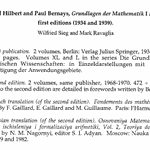
David Hilbert and Paul Bernays, 𝘎𝘳𝘶𝘯𝘥𝘭𝘢𝘨𝘦𝘯 𝘥𝘦𝘳 𝘔𝘢𝘵𝘩𝘦𝘮𝘢𝘵𝘪𝘬 I and II: A Landmark
Wilfried Sieg
Mark Ravaglia

#SiegRavaglia-1
[BellottiVonNeumann1927
Logic
SlaterEpsilonCalculi
#VonNeumann1927
ZachEpsilonCalculus]
Technical Report No. CMU-PHIL-154 (2004)
David Hilbert and Paul Bernays, 𝘎𝘳𝘶𝘯𝘥𝘭𝘢𝘨𝘦𝘯 𝘥𝘦𝘳 𝘔𝘢𝘵𝘩𝘦𝘮𝘢𝘵𝘪𝘬 I and II: A Landmark
Wilfried Sieg
Mark Ravaglia
"Cardinalities feel like an artifact designed to hide some self-referential aspects."
Leonid Levin, in 2026[!]

"Some of the uses to which Hilbert wanted to put his programme were ill-thought out [and] even its success would not have provided the separation of mathematics from philosophy which Hilbert wanted."
Georg Kreisel
[Dialectica 12, pp. 346–372 (1958)]

#KreiselObituaryForGoedel-7
"Without losing sight of the permanent interest of his work, Gödel repeatedly stressed—at least, during the second half of his life—how little novel mathematics was needed; only attention to some quite commonplace (philosophical) distinctions;
>

Relevant: xitter.cf/doomslide/status/21143…
( "there's urgent need to revisit the foundations of the subject from deliberately *non*-formalist pov.")
