

Genome, genes, regulation @BIMSB_MDC
Berlin
Joined February 2019
- Tweets82
- Following584
- Followers1.4K
- Likes99






Simona Bianco, Mykahilo Batiuk, Alexander Kukalev, Ulrich Pfisterer, Andrea Chiariello.
Thanks to our funders 💰 for supporting the work @BIMSB_MDC
@MDC_Berlin @helmholtz_de @4DNucleome @FEBSnews @neurocureberlin @dfg_public @novonordiskfond @LFINetwork @DonnellyCentre
This has been a fantastic collaboration involving people across countries 🇩🇪🇬🇧🇩🇰🇮🇹🇨🇦🇪🇸, continents 🌍 🌎 and fields of expertise 🐭💉🧬🔬🖥️. Many thanks to @eleanorjpaul @batxes @samdemharter @lunazere9 @JPLopezAtalaya @MarioNicodemi @AltunaAkalin @khodosevichLab @MarkU65668
Rbfox1 and many other genes with changes in 3D genome structure are most highly expressed in a DN sub-type of the medial VTA, known to project to secondary addiction regions. Our work suggests that these cells may be especially sensitive to the first cocaine exposure.
6/6
Chromatin decondensation occurs at many addiction genes, but the splicing factor gene Rbfox1 becomes most extensively unfolded only after 14 days! This progressive and long-lasting cascade of disruption could provide new insights into addiction inception and relapse.
5/6
We find that the cocaine-induced rewiring of 3D genome structure occurs at all scales of genome topology (TADs, loops, compartments, chromatin (de)condensation) consistently affecting cocaine-, addiction- and synaptic plasticity associated genes.
4/6

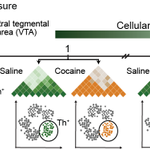
After a single cocaine exposure, we uncover massive reorganization of 3D genome structure in mouse midbrain dopaminergic neurons (DNs) which remarkably last or become worse after 2 weeks of abstinence, well beyond previously described transcriptional and synaptic effects.
3/6


What are the molecular effects of a single drug exposure 💉 on reward system #dopamine neurons 🧠?
We found an unexpected role of 3D genome 🧬 structure in long-term cellular memory of a single #cocaine exposure.
@domSzabo @vedranfranke @WarrenWinick @apombo1 @BIMSB_MDC
1/6


A single dose of cocaine rewires the 3D genome structure of midbrain dopamine neurons biorxiv.org/cgi/content/shor… #bioRxiv
PomboLab retweeted

Extensive folding variability between homologous chromosomes in mammalian cells biorxiv.org/cgi/content/shor… #bioRxiv

PomboLab retweeted

What are the functional roles of 3D genome organization? Our paper in @Nature led by @_prashantbhat demonstrates how dynamic 3D genome organization around nuclear speckles plays a crucial role in regulating mRNA splicing efficiency. rdcu.be/dHkez

🌱A huge thanks to the @Co_Biologists and to all the reviewers involved on planting our paper as a cherry blossom tree @For_Biologists 🌸 5/5


Srrm2-related gene expression changes are associated with embryo development processes and enriched in SRF targets 2/5


Our paper uncovering the role of SRRM2 splicing factor in stem cell pluripotency is published @BiologyOpen!
🚀 Huge joint effort coming from @LabPombo @BioComicsLab @Silviacamoeira @apombo1 @BIMSB_MDC @UCIBIO_Research @FCTNOVA
doi.org/10.1242/bio.060415
↓ Short thread below ↓

PomboLab retweeted

Incredibly excited that the DFG is establishing a priority programme in #neuroepigenetics. Initiative lead by Tanja Vogel with support from @BenschZimmer, André Fischer, @apombo1 and myself. Looking forward to great science to emerge from #EPIADAPT!
dfg.de/de/service/presse/pre…
PomboLab retweeted

We're thrilled to share our latest paper on the role of Kdm1a preserving chromatin compartimentalization and gene silencing!
You can check it in the link down below: 👇🏻
nature.com/articles/s41467-0…
Don’t miss it!
@Beatriz_dBlanco @SergioNi92
#neuroepigenetics #Kdm1a 🧠


🔥A new study led by @BarcoLab at @NeuroAlc is now published on @NatureComms 🙌
Researchers have determined the role of the Kdm1a protein in maintaining the neuronal identity and relationship with age progression
More info 👇
in.umh-csic.es/en/articulos/…
