

Assistant Professor (Term) @ISUEconomics | PhD from @ISUEconomics | MSc from @MSUAFRE | MSc from Ag. Univ. of Athens 🇬🇷 | First-Gen PhD | Views are my own.
Ames, Iowa
Joined January 2010
- Tweets592
- Following2K
- Followers783
- Likes1.8K
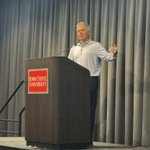



Huge thanks to John List (@Econ_4_Everyone) for an inspiring visit and talk at @IowaStateU @ISUEconomics.

Angelos Lagoudakis retweeted
Review of Economic Studies is happy to announce the launch of the new journal, Review of Economic Studies: Insights. This is an open-access, general-interest economics journal that will publish short papers with a fast review process and accept/reject decisions.
1/4
Angelos Lagoudakis retweeted

This will be a great event!

Don't wait to apply!!! This will be great!!
Summer School on Causal Inference in Greece!
More info and application links: advecon.ac.uoi.gr/
Space is limited!
Come hang out with @jmwooldridge, @causalinf, and me!

Angelos Lagoudakis retweeted

BREAKING NEWS
The Royal Swedish Academy of Sciences has decided to award the 2026 Sveriges Riksbank Prize in Economic Sciences in Memory of Alfred Nobel to Robert E. Hall and Michael Woodford “for microeconomic foundations of macroeconomic stabilisation.”
#NobelPrize

Angelos Lagoudakis retweeted

Happy to share the call for papers for the Bogotá Experimental Economics Conference (BEEC), Jan 14–15, 2027 🇨🇴
Plenary speakers: Gautam Rao (UC Berkeley) and Danila Serra (Texas A&M)
Deadline: Oct 18
Submit: sites.google.com/view/beec-2…
RTs appreciated! #BEEC2027


Angelos Lagoudakis retweeted

Over the years, I have seen lots of behavioral anomalies. I have just relived one of those anomalies in discussions at Walmart. The discussions have pertained to bundling and choice architecture: questions such as which products to pair, what to throw in for “back to school deals”, and how to sweeten the deal for bargain shoppers.
Everyone always starts with the same assumption in these discussions: if we add more to the bundle, it can only help. At first glance, this is classic Economics 101. With free disposal we know that more should never be worth less.
I put that theory to the test some years ago in a field experiment. I had bidders in an auction bid on a collection of 10 great baseball cards. Then I asked another group of bidders to bid on those same 10 great cards plus 3 mediocre ones thrown in.
People do not bid in a manner that follows your first instinct. In fact, they bid more for the 10-card set than for the 13-card set that contained it. Adding value subtracted value. More was less.
Why is this the case? When bidders cannot easily compare options, they lean on simple cues about the bundle. Add inferior items, the bundle is diluted in the eyes of the bidder and the bidder feels worse. Even when the new bundle sum strictly dominates, thinking in averages makes it seem worse.
I would connect my recent Walmart discussions with this study by advancing one practical lesson and one deeper economic point. In practice, whether building governmental policies or private bundles, a “throw in” will dilute the average. And, with average thinkers, getting such “bonuses” becomes a tax.
The deeper point of the study relates to welfare economics. A key insight in the study is that this anomaly vanishes when people can evaluate the bundles side by side. One implication is that the perceived value one has for the good is much more than the good itself. Indeed, part of the captured value lives in the choice architecture. If value is at least partly determined via the architecture, then standard welfare calculations (built on stated or revealed preferences) are measuring something less stable than we first presumed. The consumer surplus from a bundle is not just a function of what is in it, it also contains what is around it. Identification becomes quite difficult, if not impossible, with standard approaches.
I link to the paper in the comments.
Angelos Lagoudakis retweeted

Which players have posed the most attacking threat at the 2026 FIFA World Cup so far?

Angelos Lagoudakis retweeted

Simon Johnson and I are hiring a postdoc at MIT to research the history, social implications, and future of technology. The job description and application link are available here: shapingwork.mit.edu/careers/…

We're hiring a postdoc at MIT!
The Postdoctoral Associate will work closely with @DAcemogluMIT and @baselinescene to conduct research on the history, social implications and future of technology.
Learn more and apply by June 15: shapingwork.mit.edu/careers/…

Please consider donating for our first-year PhD student JingYi Wang, who has been in a serious coma since a bicycle accident on campus on March 12, while on her way to proctor an exam.
gofund.me/fcff70112
Angelos Lagoudakis retweeted

I’m on the job market this year, and this is my JMP studying how workers’ image concerns can significantly reduce AI adoption. Really appreciate you sharing it, @emollick!


Angelos Lagoudakis retweeted
Nobel Prize time! This morning the @NobelPrize committee made a great choice; Joel Mokyr, Philippe Aghion, and Peter Howitt! They were recognized for their groundbreaking work on innovation, creative destruction, and the drivers of long-term economic growth.
While this is not my area of study, it strikes me that their research couldn't be more timely in our era of rapid technological advancement, where AI and digital innovations are reshaping industries at an unprecedented pace.
Mokyr's insights into the cultural and institutional foundations of technological progress remind us that sustained innovation requires openness to new ideas—much like the historical shifts that fueled the Industrial Revolution. Aghion and Howitt's models of creative destruction highlight how new technologies displace the old, fostering productivity but also demanding adaptive policies to mitigate disruptions like job displacement and inequality.
As we navigate the tech explosion, their frameworks offer crucial lessons for balancing progress with equity. Congratulations to these visionaries—your contributions inspire us to think critically about harnessing innovation for a prosperous future!
#NobelPrize #Economics #Innovation #CreativeDestruction #AI

Honoring Jim Cox and the roots of @EcScienceAssoc here at Westward Look. #ESA2025


Angelos Lagoudakis retweeted

I’m filled with gratitude for the @AAEA_Economics

Congrats to ISP Dean and Vice Provost @TitusAwokuse, who has been named president-elect of the Agricultural and Applied Economics Association. #GlobalSpartans #Agriculture #AAEA
@CANRatMSU @MSUAFRE @AAEA_Economics
isp.msu.edu/news_article/239…

ALT Headshot of Titus Awokuse
Excited to share I've accepted an offer to remain at @ISUEconomics as Adjunct Assistant Professor starting August! linkedin.com/posts/angelosla…

3
227