

Postproducer & animator for 12+ years. Now letting AI do the hard parts while I take all the credit. Storyteller at heart.
Joined September 2021
- Tweets3.7K
- Following338
- Followers426
- Likes8.7K


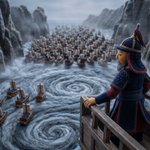




On this day, 429 years ago, a Korean admiral won a battle against impossible odds. On October 26, 1597, Admiral Yi Sun-sin took on a Japanese invasion fleet of more than 300 ships at the Battle of Myeongnyang with only about a dozen of his own. He lured the enemy into a narrow strait with fierce tidal currents, and the Japanese fleet was routed. It’s still remembered as one of the greatest naval victories in history.
Would you have taken those odds?

Eye Grammar #11: Negative Space.
Empty space in a frame isn’t empty. It changes how we feel about whoever is in it.
How it works
→ No empty space: the character feels close and present
→ Lots of empty space around them: they feel small and alone
→ Empty space behind them: we start to wonder what’s back there
Why filmmakers use it
→ Showing loneliness or isolation without saying it
→ Making a character feel small against their world
→ Building unease with nothing but an empty part of the frame.
Usually, filmmakers leave space in the direction a character is looking. It’s called “looking room.” Flip it and put the space behind them, and the frame starts to feel wrong, even if you can’t say why.
Laura retweeted

The ships name was the Hydra.
It´s been 10 years.
Her sister is still waiting.
powered by @capcutapp @capcutapp_jp
🤖 Made with AI
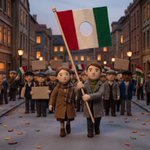
On this day, 70 years ago, a student protest in Budapest turned into a nationwide uprising. On October 23, 1956, thousands of students and workers marched through Hungary’s capital demanding reforms and the withdrawal of Soviet troops, many waving flags with the communist emblem cut out of the center. That night, crowds toppled a giant statue of Stalin. Soviet forces crushed the revolution within weeks, but the hole in the flag became its most lasting image.
What do you think makes a symbol powerful enough to rally a whole country?

In a fabric world, the scariest thing is a seam ripper. 🧵
My piece for @JoinTheLoopHole’s community film.
🤖 Made with AI
On this day, 64 years ago, millions of families sat down in front of their televisions and radios to hear some of the most frightening news of the Cold War. On October 22, 1962, President Kennedy announced that the Soviet Union had been building missile sites in Cuba, about 90 miles from Florida, and that the US would blockade the island. The standoff lasted days and brought the world closer to nuclear war than it has ever been, before ending peacefully on October 28.
Do you know anyone who remembers living through that week?

On this day, 426 years ago, a single battle in Japan decided who would rule the country for the next 265 years. On October 21, 1600, Tokugawa Ieyasu’s forces defeated a rival coalition at the Battle of Sekigahara, fought in thick morning fog and settled in a matter of hours. The turning point came when a commander on the other side, Kobayakawa Hideaki, switched sides in the middle of the fight. Three years later, Ieyasu was named shogun, and his family held power until 1868.
If you were on that battlefield, would you have switched sides?

Eye Grammar #10: Light Direction
The only thing that changes in this video is where the light comes from.
How it works
→ Light from above feels natural: it’s where the sun has always been
→ Light from the side hides half the face, so we sense a secret
→ Light from below never happens in nature, so the face looks wrong before we know why
Why filmmakers use it
→ Revealing a character’s true nature without a word
→ Shifting how we feel about someone within a single scene
→ Turning the familiar into something threatening
Your brain is so used to light from above that it uses it to read shapes: shade a circle on top and it looks like a dent, shade it on the bottom and it looks like a bump. Horror films have exploited that instinct for over a hundred years.
On this day, 53 years ago, one of the most recognizable buildings in the world was officially opened. On October 20, 1973, Queen Elizabeth II opened the Sydney Opera House, after 14 years of construction that ran far behind schedule and many times over budget. Its Danish architect, Jørn Utzon, had resigned in 1966 after clashing with the government, and he never returned to Australia to see it finished. Did you know the man who designed it never saw it in person?
Have you ever been inside it?

Most of my work lives in a handmade felt world.
This time, I wanted to make something for a brand.
NEBLA is a skincare brand I invented.
High in the Andean páramo, at 4,000 meters, plants drink water straight from the mist.
That idea became the whole ad.
Spec ad · 12 seconds · sound on.
Open to brand and agency projects.

2. Designed the bottle once in @NanoBanana and used it as the reference for every product shot, so it stays identical
3. Animated each shot in @Kling_ai , one simple action per clip
4. Designed a custom voice for the brand and generated the VO in @ElevenLabs
🤖 Made with AI


On this day, 175 years ago, a book came out under the wrong title, sold poorly, and went on to become a classic. On October 18, 1851, Herman Melville’s novel was published in London in three volumes as The Whale, in a print run of just 500 copies. He changed the title to Moby-Dick right after, but too late for the British edition. It got mixed reviews and earned him about $556, and it was out of print when he died in 1891.

On this day, 31 years ago, a woman in France passed an age no one had ever been confirmed to reach. On October 17, 1995, Jeanne Calment turned 120 years and 238 days old, becoming the oldest person ever recorded at the time. She was born in 1875 and went on to live to 122, which is still the longest confirmed human lifespan.
