
I help contractors add 10-20+ installs/month. Built the system behind $50M+ in contractor revenue. Also operate an epoxy company. Only 1 company per market.
Vancouver
Joined March 2023
- Tweets811
- Following648
- Followers77
- Likes231





Pinned Tweet
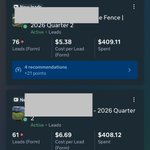
A fence company we run all marketing for went from 5 crews to 8. Here’s what the last 8 weeks looked like:


Angi, thumbtack, yelp, google LSA. Which one paid for itself for your company, and which one ate the most of your sales time for the least work?
At about $2K profit per job, those 83 jobs made roughly $166K in profit. After paying for every dollar of marketing, they kept around $122K.
I work primarily with fence contractors.
Here’s some simple math:
35 estimates/week.
$8,500 average job.
50 weeks/year.
New contractor who sucks at sales:
7% close rate = ~2.5 jobs/week = ~$1M/year.
Now get better at sales.
Better estimating.
Better follow-up.
Better presentation.
Better objection handling.
Better financing.
Same 35 estimates/week.
20% close rate = 7 jobs/week.
7 × $8,500 × 50 = $2.975M/year.
How many estimates are you running a week right now?
Something we recently started doing for our epoxy company:
We set up an automation that checks new building permits every week and pulls projects that could potentially need epoxy or concrete polishing.
Building permit information is public in a lot of cities, and depending on the data available, you can see things like the project, address, scope of work, contractor and project value.
You can then filter the permits based on the type of work you actually want.
You can also set up an AI agent to do most of this for you.
Connect it to the permit data and set up a cron job to run every day or week.
Have the AI agent:
Pull new permits
Filter for projects that fit your trade
Identify the builder or GC
Find their contact information
Draft the outreach
Send it to you for approval
But I think the bigger opportunity is using the data to find builders and GCs that are consistently pulling permits.
If the same builder is doing 20, 30 or 50 projects a year, getting a relationship with that builder is significantly more valuable than chasing one individual project.
You can do the same thing with fencing, landscaping, painting, roofing, flooring, concrete, etc.
New permits come in → AI filters them → identifies the builders → drafts the outreach → you approve it.
Pretty simple way to consistently find new commercial and residential opportunities.
Just got a pretty clever scam call from someone claiming to be @Google.
They used my email as a recovery email for another account, triggering legitimate Google notifications.
Then told me they had my license information and I needed to approve a sign-in request to “close a chat window.”
The entire goal was to get me to approve access to my account.
Social engineering is getting better.
Never approve a sign-in request because someone on the phone tells you to.
Generate leads. Do estimates. Build pipeline. Booked out 60 days. Raise prices. Hire more people.
Same process for leads. Same process for hiring. Run it again. That's it
How contractors can automate social media posting with an AI agent:
Create a Google Form your crews fill out after every job:
Name
Address/neighborhood
Job type
Before/after pictures
Connect the Form/Sheet to an AI agent like Grokbot.
Give it your brand assets and have it:
→ Pick the best pictures
→ Create the before/after graphic
→ Write the post
→ Add the location
→ Send it to you for approval
Connect Grokbot to GHL or another social posting platform.
Once approved, it gets published.
Crew finishes job → fills out form → AI creates content → you approve → it posts.
“Fire your team and replace them with AI agents”
Why not empower your team to do their jobs better and faster?
Use AI agents to improve your backend systems, remove repetitive work, and give your people more time to focus on what matters.
As a residential contractor, aiming for a minimum of 35 estimates per week is almost guaranteed to get you to at least $1 million in annual revenue, even with subpar sales ability.
If you bid on commercial jobs
Set up an AI agent to regularly search the bid platforms you use for jobs that fit what you're looking for.
Have it:
• Find relevant new projects
• Filter out jobs that don't fit
• Identify the GC
• Draft the outreach email
• Send it to you for approval
Set it up as a cron job so it runs automatically every day.
Instead of manually checking multiple bid platforms every morning, you open your email to opportunities that already match what you're looking for.
If your customers let you put a lawn sign in their yard, try adding a QR code that opens your Google Business Profile.
Neighbours who walk past can scan it and see your reviews, your project photos, and your phone number in one tap. They are looking at a finished job on their own street while they do it, which is the strongest proof you will ever get in front of a buyer.
Google ranks local businesses on relevance, distance, and prominence, and prominence comes down to how well known you are in an area. When a lot of people search for your company by name, Google takes it as evidence that real people in that area know you and are looking for you. Brand demand is hard to fake, which is why it lines up so closely with who ranks at the top of the map pack.
As that recognition builds, you tend to climb for the searches that bring in new customers, like "fence company near me" or "fence builder in [city]." A sign on a finished job that gets the neighbours searching your name is one of the cheapest ways to start that process on a specific street.
If you test this, send the QR code through a short link you control so you can count scans per sign and see which neighbourhoods respond.
If you are using “Optimize your campaign with AI Max” in Google ads, make sure to turn off Final URL Expansion.
When you leave it on, Google can send traffic to other pages on your website that it thinks are more relevant.
We want:
• Traffic going to the landing page we choose
• The ad and landing page to stay aligned
• Testing and conversion data to stay clean