

PhD candidate @sjtu1896, research intern @AlibabaGroup @Alibaba_Qwen, researching generative models, optimization, and long-horizon agents.
Shanghai
Joined March 2020
- Tweets31
- Following128
- Followers149
- Likes100


Glad to have contributed to Qwen4's long-horizon agentic capabilities for OR. Give it a try!

📢 Meet Qwen4-Max, your new AI teammate for work, creativity, and discovery!
Qwen4-Max is built on a new MoE architecture with native vision and a 1M-token context window.
Highlights:
- Outperforms Qwen3.8-Max with up to ~50% fewer tokens, while average cost per task drops over 60% in our internal evaluation.
- Advances real-world productivity through greater proficiency with professional tools, stronger long-horizon execution, and higher-quality deliverables.
- Handles real tasks, including 3D modeling, game development, manufacturing, finance, law, healthcare, and frontier scientific discovery.
- $1.5/M tokens for input, $4.5/M tokens for output, and $0.075/M tokens for implicit caching — all lower than Qwen3.8-Max, with implicit caching down by 70%.
The API is live on QwenCloud. You can also try Qwen4-Max on Qwen Studio, QwenWork and Qoder.
Start building today! 🚀
- Blog: qwen.ai/blog?id=qwen4-max
- API: qwencloud.com/models/qwen4-m…
- Token Plan: qwencloud.com/pricing/token-…
More to come! The open weights of smaller Qwen4 models will be released. Stay tuned. 👀

I will be attending #ICML in South Korea 🇰🇷 and presenting three papers!
Feel free to drop by our poster sessions to chat about LLM post-training, reasoning interpretability, and combinatorial optimization.
📅 Session Details (KST, HALL A):
1. Thu, Jul 9 | 2:30 PM – 4:15 PM | #2109
Attention Illuminates LLM Reasoning: The Uncovered Preplan-and-Anchor Rhythm Enables Fine-Grained Policy Optimization
2. Thu, Jul 9 | 5:00 PM – 6:45 PM | #1909
How Does Reasoning Flow? Tracing Attention-Induced Information Flow for Targeted RL in LLMs
3. Wed, Jul 8 | 10:30 AM – 12:15 PM | #3813
Problem Distributions as Tasks: Repurposing Meta Learning for Generative Combinatorial Optimization towards Multi-task Pretrain and Adaptation
Looking forward to in-depth discussions with everyone! – at Seoul, Republic of Korea


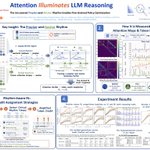
Our work “Attention Illuminates LLM Reasoning” will be presented at ICML 2026. Happy to connect and discuss with anyone interested in LLM reasoning, interpretability, and RL4LLM.
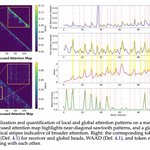
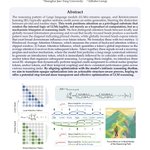
This work investigates how attention patterns can reveal the internal reasoning structure of LLMs. We find that attention is not merely a by-product of generation, but often reflects a structured reasoning rhythm: local chunking, global semantic anchors, and a recurring preplan-anchor coupling pattern.
Based on these observations, we further propose an attention-guided reward redistribution method for RL, aligning optimization with the model’s intrinsic reasoning structure. This leads to more fine-grained, interpretable, and efficient reinforcement learning for reasoning models.
Paper: arxiv.org/abs/2510.13554


🚀 Happy to present our new work on LLM reasoning!
We show that: (1) Attention is a structured map of the model's reasoning logic, uncovering a preplan-and-anchor reasoning rhythm. (2) Aligning RL objectives with the model's intrinsic attention rhythm yields more transparent, fine-grained, and efficient optimization.
🧠 Key Reasoning Patterns in Attention
(1) Local Chunking: Near-diagonal sawtooth patterns indicate dense intra-chunk processing. At chunk boundaries, the model performs long-range context retrieval (often with higher entropy), which guides subsequent generation.
(2) Global Anchor Planning: Sparse, high-influence anchor tokens exert broad control over later tokens. Perturbing these anchors significantly disrupts downstream reasoning.
(3) Preplan-Anchor Coupling: A stable temporal rhythm emerges: the model first emits a "preplan" token, then anchors a core semantic node, repeatedly structuring the reasoning trajectory.
⚙️ RL Innovation
We introduce a dynamic reward redistribution mechanism guided by attention-derived reasoning structure:
(1) Preplan Guidance: Boosts tokens that guide local chunks and enable long-range referencing.
(2) Anchor Enhancement: Prioritizes optimization of globally influential semantic anchors.
(3) Coupling Alignment: Reinforces the temporal coordination between preplans and anchors to solidify structured reasoning.
HuggingFace Link: huggingface.co/papers/2510.1…
arXiv Link: arxiv.org/abs/2510.13554
#LLMs #artificial_intelligence #RL4LLM

How does reasoning actually flow inside LLMs?
In our ICML 2026 paper, How Does Reasoning Flow? Tracing Attention-Induced Information Flow for Targeted RL in LLMs (arxiv.org/abs/2606.10646), we trace attention-induced information flow to reveal the “main roads” of reasoning inside language models.
Instead of treating a reasoning trace as a flat sequence, we view it as an information-flow network: problem facts, intermediate conclusions, variables, symbols, and step structures are read, integrated, forwarded, and eventually merged into the final answer.
This lets us ask a sharper question:
Which tokens are truly on the effective path toward the answer?
We find that reasoning flow is far from uniform. It shows rhythmic “gathering → redistribution” patterns, with high-flow tokens acting as critical hubs — often step boundaries, repeated variables, key numbers, or operators.
When these hubs are disrupted, models are much more likely to derail.
Building on this, we use reasoning-flow attribution for more targeted RL: instead of spreading reward uniformly across the whole response, we route stronger training signals to the key tokens that actually support answer formation.
We’ll be presenting this work at ICML 2026. Come find us at ICML 2026 if you’re interested!


We would like to express our gratitude to RethinkLab of Shanghai Jiao Tong University and the Roll Team at Alibaba ATH Group for their support. Special thanks to @ProfYanJunchi and @weixunwang for their supervision and discussion😃😃
This is our report from earlier this year. We found that AI agents can start mining cryptocurrency on their own.
This has implications and security concerns for OpenClaw, something we warned about three months ago.


2
1
247

Check out our new work: “Let It Flow: Agentic Crafting on Rock and Roll” — introducing ALE, an open Agentic Learning Ecosystem with ROLL, ROCK, and iFlow CLI to streamline Agent LLM development from training to deployment, plus ROME, a production-ready agentic model trained on 1M+ real trajectories using our novel IPA algorithm that optimizes credit assignment at the semantic interaction level. Built for the community, battle-tested in practice! 🔗 arxiv.org/abs/2512.24873


We build an open-source asynchronous RL training framework to accelerate LLM post-training! See the thread from @AcceptOral !

🚀 Excited to share our latest work in RL4LLM system.
🎉 ROLL Flash enables fully asynchronous overlap of generation, interaction, rewards, and training through Fine-grained Parallelism and Rollout–Train Decoupling.
1) 2.24× faster on RLVR; 2.72× faster on agentic tasks
2) Near-linear scaling: 8× GPUs → 7.6× throughput
3) Asynchronous Ratio balances utilization and sample freshness with minimal staleness cost
4) Supports off-policy algorithms (Decoupled PPO, TOPR, CISPO) with no performance loss
Join Us. Star, try, contribute—let's scale LLM RL together! 🌟
🔗 Paper: arxiv.org/abs/2510.11345
💻 Code: github.com/alibaba/ROLL
#LLMs #ReinforcementLearning #RL4LLM #SystemOptimization #AgenticAI

2
265
🚀 Happy to present our new work on LLM reasoning!
We show that: (1) Attention is a structured map of the model's reasoning logic, uncovering a preplan-and-anchor reasoning rhythm. (2) Aligning RL objectives with the model's intrinsic attention rhythm yields more transparent, fine-grained, and efficient optimization.
🧠 Key Reasoning Patterns in Attention
(1) Local Chunking: Near-diagonal sawtooth patterns indicate dense intra-chunk processing. At chunk boundaries, the model performs long-range context retrieval (often with higher entropy), which guides subsequent generation.
(2) Global Anchor Planning: Sparse, high-influence anchor tokens exert broad control over later tokens. Perturbing these anchors significantly disrupts downstream reasoning.
(3) Preplan-Anchor Coupling: A stable temporal rhythm emerges: the model first emits a "preplan" token, then anchors a core semantic node, repeatedly structuring the reasoning trajectory.
⚙️ RL Innovation
We introduce a dynamic reward redistribution mechanism guided by attention-derived reasoning structure:
(1) Preplan Guidance: Boosts tokens that guide local chunks and enable long-range referencing.
(2) Anchor Enhancement: Prioritizes optimization of globally influential semantic anchors.
(3) Coupling Alignment: Reinforces the temporal coordination between preplans and anchors to solidify structured reasoning.
HuggingFace Link: huggingface.co/papers/2510.1…
arXiv Link: arxiv.org/abs/2510.13554
#LLMs #artificial_intelligence #RL4LLM
I would like to express my sincere gratitude to experts, e.g.,@ProfYanJunchi, @weixunwang, for their guidance and supervision throughout this project, as well as to the collaborators from @Rethinker135365
and the @AlibabaGroup ROLL team for their exceptional contributions and support.