

Every event leaves a lesson. History • Business • Human Nature New lessons every day.
Joined June 2026
- Tweets42
- Following49
- Followers2
- Likes0







Pinned Tweet
In 1187, one of history's most contested cities changed hands again.
Sultan Salah ad-Din (Saladin) recaptured Jerusalem after nearly 90 years of Crusader rule, following his decisive victory at the Battle of Hattin.
When Crusader forces captured Jerusalem in 1099, thousands of Muslims and Jews were massacred. After Salah ad-Din's victory, many civilians were instead allowed to ransom themselves, others were released, and Christian holy sites were preserved.
His conduct surprised many contemporaries and helped shape his reputation far beyond the Islamic world.
Lesson From History:
How you treat people after victory often defines your legacy more than the victory itself.

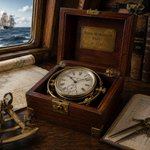
For decades, ships could calculate their latitude, but not their longitude.
In the early 1700s, determining a ship's east-west position at sea was one of navigation's greatest unsolved problems. Countless vessels were lost because sailors couldn't accurately calculate their longitude, even when they knew exactly where they were north or south.
In 1714, the British Parliament offered the Longitude Prize, one of history's largest scientific rewards, to anyone who could solve the problem.
The breakthrough came not from a famous astronomer, but from John Harrison, a self-taught carpenter and clockmaker. After decades of work, he developed a marine chronometer accurate enough to keep precise time at sea, allowing sailors to calculate longitude with remarkable precision.
His invention revolutionized navigation, reduced shipwrecks, and transformed global trade and exploration.
Lesson From History:
Don't dismiss your ideas because you're not the recognised expert. Sometimes a fresh perspective solves problems that specialists have struggled with for years.

An expedition to cross Antarctica became one of history's greatest survival stories instead.
In 1914, Ernest Shackleton set out to cross Antarctica, but his ship, Endurance, became trapped and crushed by sea ice before the journey could begin. Stranded in one of the harshest environments on Earth, Shackleton led his crew across drifting ice and through dangerous seas in search of rescue.
Nearly two years after leaving home, every member of the expedition survived.
Today, the expedition is widely studied as one of history's greatest examples of leadership under extreme pressure.
Lesson From History:
When your original goal becomes impossible, don't keep chasing it out of pride. Adjust your priorities and focus on achieving the best outcome that's still possible.

For centuries, ships had to sail around an entire continent to travel between the Atlantic and Pacific Oceans.
Completed in 1914, the Panama Canal transformed global trade by cutting a route through the Isthmus of Panama. Before its construction, ships travelling between the east and west coasts of the Americas had to sail around Cape Horn, adding thousands of kilometres to their journey.
Building the canal required overcoming dense jungle, landslides, and deadly diseases such as malaria and yellow fever. Advances in engineering and public health eventually made one of history's greatest infrastructure projects possible.
More than a century later, the canal remains one of the world's busiest trade routes.
Lesson From History:
Before working harder, ask yourself if you're solving the problem in the smartest way. Sometimes changing the route is more valuable than moving faster.

A fire that started in a bakery destroyed most of medieval London.
In the early hours of 2 September 1666, a fire broke out in Thomas Farriner's bakery on Pudding Lane. Strong winds, wooden buildings, and narrow streets allowed the flames to spread rapidly through the city.
Over four days, more than 13,000 houses, St Paul's Cathedral, and dozens of churches were destroyed. Although thousands lost their homes, the disaster also transformed London. New building regulations required brick and stone construction, streets were widened, and the city became far more resistant to future fires.
One of London's greatest disasters ultimately reshaped it for the better.
Lesson From History:
When something fails, don't focus only on fixing it. Improve the system so the same failure is less likely to happen again.

A treaty that many considered disappointing became one of the most important turning points in Islamic history.
In 628 CE, the Prophet Muhammad ﷺ and approximately 1,400 companions travelled to Makkah intending to perform Umrah. They were stopped outside the city, and after lengthy negotiations, a peace treaty was signed with Quraysh.
Several terms appeared unfavorable to the Muslims, causing disappointment among many companions. Yet the agreement brought stability, allowing travel, dialogue, and peaceful interaction between tribes. During the following two years, Islam spread more rapidly than during years of conflict, and Makkah was later entered peacefully.
Historians regard the Treaty of Hudaybiyyah as one of the defining diplomatic successes of early Islamic history.
Lesson From History:
Don't judge every decision by its immediate outcome. Some of your best decisions will only reveal their value months—or even years—later.

A safety test carried out during the night became the world's worst nuclear accident.
On 26 April 1986, engineers at Reactor No. 4 of the Chernobyl Nuclear Power Plant began a planned safety test. A combination of operator mistakes and serious reactor design flaws caused an uncontrolled power surge, leading to explosions that destroyed the reactor.
Radioactive material spread across large parts of Europe. Entire towns were evacuated, hundreds of thousands of people were relocated, and a vast exclusion zone remains around the site today.
Investigations after the disaster led to major changes in nuclear safety procedures around the world.
Lesson From History:
Never ignore small risks simply because nothing has gone wrong before. Many disasters happen after people become comfortable taking the same shortcut repeatedly

The first expedition to sail around the world returned with only one ship out of five.
In 1519, Ferdinand Magellan left Spain with five ships and around 270 men in search of a western route to Asia. The journey crossed unknown oceans, endured starvation, storms, disease, and conflict with local kingdoms.
Magellan himself was killed in the Philippines before the expedition was complete. Three years after departure, only the ship Victoria returned to Spain carrying just 18 surviving crew members.
Despite the enormous cost, the voyage proved that the Earth could be circumnavigated and permanently changed navigation, geography, and global trade.
Lesson From History:
Big goals rarely go exactly as planned. Build your plans so the mission can succeed even if circumstances change—or you're no longer there to finish it.

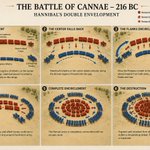
In 216 BC, the Roman Republic suffered one of the worst defeats in its history.
Near the town of Cannae in southern Italy, Hannibal faced a Roman army that significantly outnumbered his own. Instead of matching Rome's strength directly, he deliberately allowed the center of his army to retreat while his strongest troops held the flanks.
As the Romans pushed forward, they unknowingly advanced into a trap. Hannibal's forces closed in from both sides before cavalry attacked from behind, completely surrounding the Roman army. Tens of thousands of Roman soldiers were killed in a single day.
More than 2,000 years later, the Battle of Cannae is still taught in military academies as one of history's greatest tactical victories.
Lesson From History:
Don't assume the obvious solution is the best one. When everyone expects you to solve a problem the same way, step back and ask if there's a smarter approach.

On 17 December 1903, a flight lasting just 12 seconds changed the world forever.
Orville and Wilbur Wright were two bicycle mechanics from Ohio who spent years studying flight. Unsatisfied with existing research, they built their own wind tunnel, tested hundreds of wing designs, and refined every failure into a better solution.
Their first powered flight covered only 120 feet (37 metres), but it proved that controlled, powered flight was possible.
Modern aviation traces its origins to those 12 seconds at Kitty Hawk.
Lesson From History:
History's greatest breakthroughs often begin with achievements that seem insignificant at the time.

The Black Death didn't just change Europe—it changed the course of history.
Between 1347 and 1351, the plague killed an estimated one-third to one-half of Europe's population, while also devastating parts of the Middle East, North Africa, and Asia.
Entire villages disappeared. Labor became scarce, economies shifted, feudal systems weakened, and medicine was forced to confront questions it could not yet answer.
The plague became one of history's greatest reminders that no society, however powerful, is immune to crisis.
Lesson From History:
Great crises do more than test societies. They expose the strengths and weaknesses that were already there.

The Challenger disaster wasn't caused by an unknown problem.
The Space Shuttle Challenger was NASA's tenth shuttle mission. On 28 January 1986, just 73 seconds after liftoff, it broke apart, killing all seven astronauts on board in front of millions watching live.
The night before the launch, engineers warned that the unusually cold weather could cause the shuttle's O-ring seals to fail. Management decided to proceed anyway.
The investigation later concluded that the disaster was not simply an engineering failure—it was also a failure in decision-making and communication.
Lesson From History:
The most dangerous warning is not the one that goes unheard. It is the one that is heard... and ignored.

The Library of Alexandria was not just a library.
Founded in ancient Egypt under the Ptolemies, it became one of the greatest intellectual centers of the ancient world. Scholars there studied mathematics, astronomy, medicine, geography, philosophy, and literature.
It was part library, part research institution, and part symbol of a civilization that wanted to collect the world's knowledge in one place.
Its decline was not likely one dramatic fire, but a gradual loss through wars, neglect, political change, and the weakening of the institutions that protected it.
Lesson From History:
Knowledge is not lost only when books burn. It is lost when societies stop protecting the institutions that preserve it.

Some decisions change history because there is no way back.
Julius Caesar was one of Rome's greatest military commanders. In 49 BC, he crossed the Rubicon River with his army, knowingly violating Roman law and setting Rome on the path to civil war.
Once he crossed, there was no peaceful return. The decision would reshape the Roman Republic and become one of history's most enduring expressions.
Even today, we describe an irreversible decision as "crossing the Rubicon."
Lesson From History:
The most important decisions are often irreversible. Make them with courage—but never without understanding their consequences.

Success can become the biggest obstacle to success.
Kodak was once the world's leading photography company, trusted by millions to capture their most important memories.
Ironically, one of its own engineers helped develop one of the first digital cameras. The company saw the future—but struggled to move away from the business model that had already made it successful.
Innovation wasn't the problem.
Letting go of yesterday's success was.
Lesson From History:
Sometimes the greatest obstacle to future success is past success.

The world remembers the first step on the Moon.
Apollo 11 was the mission that landed the first humans on the Moon in 1969, but that historic moment was only the visible end of a much longer story.
Thousands of engineers, scientists, technicians, and support staff spent years testing, failing, redesigning, and improving every detail before Neil Armstrong took that famous step.
History celebrates the moment.
Success was built during the years no one remembers.
Lesson From History:
Extraordinary achievements are usually the visible result of extraordinary preparation.

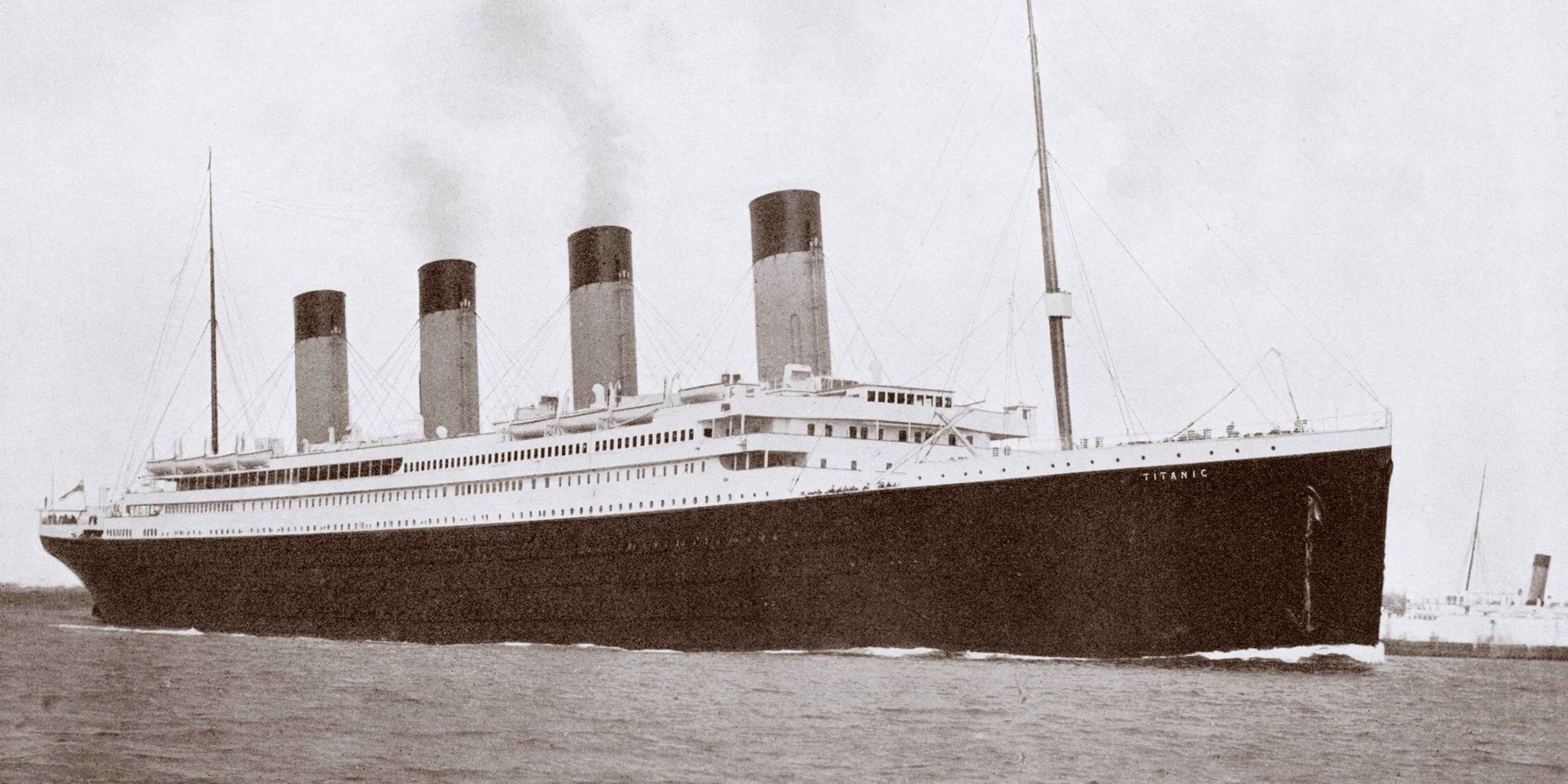
The Titanic didn't sink because nobody saw the danger.
The RMS Titanic was the largest and most luxurious passenger ship of its time, celebrated as a masterpiece of engineering before it ever left port.
During its maiden voyage, several nearby ships warned of dangerous ice ahead. The warnings were received, yet the Titanic continued through the North Atlantic at high speed.
The iceberg made history.
The ignored warnings made the disaster possible.
Lesson From History:
Disasters rarely begin with the final event. They begin when repeated warnings stop changing decisions.
Some of history's greatest victories weren't won on a battlefield.
During the Islamic Golden Age, the House of Wisdom in Baghdad became one of the world's greatest centers of learning, attracting scholars from different cultures and backgrounds.
There, ancient works in mathematics, astronomy, medicine, and philosophy were translated, preserved, debated, and expanded. Ideas travelled across languages and civilizations instead of disappearing with them.
Much of what the ancient world discovered survived because generations believed knowledge was something to protect, not merely inherit.
Lesson From History:
Civilizations are remembered not only for what they build, but for what they choose to preserve.
