




X retweeted

目前 Ethereum 约有 4,110 万枚 ETH 处于质押状态,占总供应量约 34%。
更值得注意的是,进入验证者队列的还有约 243.7 万枚 ethereum:native ,等待时间已经拉到约 42 天;
而退出队列只有约 480 ETH,几乎可以忽略。
这,说明了什么?🤓


X retweeted

以太坊主网上线整整11年。
至今,以太坊依然是整个加密行业真正的技术革新发生地,也是事实上的创新守护者。
回看这11年,
几乎所有真正改变行业范式的东西,都先从以太坊上生发出来的,或者至少是在以太坊上被验证、被放大,然后再被其他链模仿或分流:
• 智能合约 → DeFi → NFT → L2 扩容 → Restaking → 再质押经济 → 如今的 AI Agent 经济与意图交易
• 从早期的 ICO,到 2020-2021 的 DeFi Summer,到 2023-2024 的 Blob + Danksharding,再到今天 L1 持续强化执行层与数据可用性,同时把应用层创新尽量交给 L2 和应用链
底层还有更多不那么显眼的工作:ZK 证明体系、抗量子研究……这些才是真正决定一个系统能走多远的东西。
更难得的是,它没有因为先发优势就躺平了。
相反,
以太坊基金会和核心开发者一直在做最难、最不性感、也最容易被骂的事情:持续改协议本身,持续守住安全、去中心化、无需信任这些基本原则。
这些恰恰是很多人看不上,却是加密行业真正重要的东西。
现在看,
很多链可以在某个细分场景跑得更快、更便宜、更垂直。
不过,
真正定义下一阶段行业标准、并让其他链不得不跟着调整的,依然是以太坊。
11年过去了,以太坊依然站在创新的中心位置。


X retweeted
这篇报告值得一看:
以太坊不是一条普通的区块链,它是目前最接近“数字公共基础设施”的平台。
就像互联网的TCP/IP协议一样中立、开放、谁也控制不了,但它是用来处理“价值、合约、协调”的。
几个方面:
1. 谁也控制不了它(中立性最强)
以太坊没有老板、没有后门、没有kill switch(一键关闭功能)。
全球上千个独立节点、几十万验证者一起维护,没有任何单一国家、公司或个人能单方面改规则或关掉它。
这对政府和机构来说非常重要,他们最怕把关键基础设施交给一个能被“第三方控制”的人。
2. 安全运行了10多年零故障
目前有约760亿美元的ETH被质押(当安全保证金)。想攻击它要花掉500多亿美元,还会亏得血本无归。
从2015年上线到现在,零宕机(不像其他所有L1都出现过问题)。
3. 已经被大机构和大政府真金白银地用了
• 稳定币:上面锁了1590亿美元(远超其他链)。
• 真实资产代币化(RWA):贝莱德、摩根大通等已经在上面发产品。
• 政府应用:不丹做全国数字身份、印度用它做土地登记防腐败等。
4. 比其他选择优势明显
• 比传统银行/中介:
不用信任中间人,用数学和密码学保证,更透明、成本更低。
• 比“联盟链/私有链”:
更开放、中立,不会有人把持。
• 比其他公链:
更成熟、开发者最多、经济规模最大、安全性最高。
总结来说,
用数据 + 真实案例 + 对比看出:
以太坊是未来全球价值结算和协调的“中立公共层”。
ethereum.org/reports/basics-…



X retweeted
刚看完以太坊新组织Ethlabs的方向,又看到以太坊基金会执行董事Aerugo长文,很值得一看,说得很清楚,比Vitalik之前说的更直白明了。
他说的重点只有一个:以太坊基金会到底该干什么和不该干什么?
以太坊要成为真正的去中心化的基础设施,要成为“数字世界的公共基础”,而不是一个被大公司或大型组织控制的金融系统。
因此,
以太坊基金会不该干什么?
• 不要为了让以太坊基金会自己显得重要、受欢迎而做事。
• 不要讨好短期炒币的人、投机者。
• 不要帮大机构站台、不要为了机构采用而妥协原则。
• 不要为了生态热度、营销、或者让某个人/项目好看而花钱。
以太坊基金会该干什么?
一是,修补以太坊的弱点(最重要)
• MEV 问题:这是目前最大的隐患之一。交易排序、打包如果被少数人控制,就会变成“表面去中心化、实际被中间商收租”。EF 要把这个作为重点攻克,不能让 MEV 变成新的中心化力量。
• 隐私:以太坊现在是公开账本,没有默认隐私就等于默认监控。必须把强隐私做成默认选项,而不是让用户自己拼一堆工具。
• Staking 中心化:如果质押、流动性质押集中在少数几家,那以太坊的安全层就可能被间接控制。要防止这个。
• 访问层和工具:钱包、接口、用户入口这些地方,不能为了好用就牺牲主权。以太坊基金会要推动真正自托管、用户真正掌控的方案。
以太坊基金会自己也要多用以太坊原生工具(比如工资多发 ETH),不能只让别人用,自己却活在传统金融体系里。
二是,抓住长期机会
• 提前做好抗量子的加密迁移(别等威胁来了再手忙脚乱)。
• 推动完全自托管的栈(钱包 + 个人 AI Agent,用户自己拥有模型和数据)。
• 让 ETH 真正成为可隐私使用的数字现金。
• 支持能在不牺牲主权的前提下规模化使用的方案(尤其是机构级应用)。
此外,关于人员离职
最近 EF 有人离职,也有一些项目要从 EF 拆出去:
• 不会在 Twitter 上公开撕逼个人恩怨。
• 拆出去的项目要看是不是符合 EF的新使命,不是所有项目都该继续拿 EF的钱。
• EF 的钱和背书是有限的,要花在真正符合使命的事上,而不是友情资助或惯性延续。
总结一下:
这篇长文在给以太坊基金会在重新画边界:
不做“让以太坊更受欢迎、更好卖”的工作,只做让以太坊保持(或恢复)其 cypherpunk 本质的工作——抗捕获、抗 MEV 剥削、保护隐私、减少对中间商的依赖。
仅个人看法:这才是以太坊执行董事应该达到的水平,还是之前的那句话,有人离开以太坊基金会对于以太坊来说不是坏事。
此外,对于以太坊基金会该干什么方面,其他没有意见,但有一点没有提到,非常非常重要:如何尽快解决L1和L2割裂的问题,如果把L2的排序权回归到L1,这对于实现以太坊的长远目标非常非常重要,期待@VitalikButerin @aerugoettinea 和基金会能重视起来。

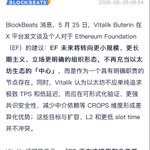
1. Intro
Vitalik recently wrote about where the EF should go; Aya added a note to explain how we got here, and why. I’ll write about the execution.
We now have enough clarity to stop treating “what is the EF for?” as an open-ended question. Our mandate is clear: The EF exists to ensure Ethereum is, becomes, and remains real permissionless infrastructure for self-sovereignty: censorship (and capture) resistant, free and open source, private, and secure; and capable of supporting sovereignty-preserving coordination at scales where trusted institutions hitherto have been unavoidable.
The following are my thoughts on some of the points that follow from the mandate and how we are translating it to action. But first, a short reminder about
2. What the EF is not for
We are not here to optimize for EF importance, corpo/pol appeal, or ecosystem popularity. We are also not here to please short-term speculators, prop up TBTF neo-SIFIs, market every app on Ethereum, help anyone look good to their crypto or investor friends, or provide on-demand entertainment for dinner parties and private retreats.
3. What the EF is for: Eliminating weaknesses
We are here to defensively strengthen places where Ethereum is, or can still become, extractive, totalizing, or vulnerable to cartel or state capture, or authoritarian tools of surveillance or coercion.
We will base our actions on a full examination of what Ethereum is and can be at the protocol layer (what is actually running as “Ethereum”), the access layer (what users use to interact with the protocol), the user layer (the end-users who need and will need Ethereum), and the institutional layer (the intermediated paths that scale self-sovereign usage).
The EF exists to harden every surface of Ethereum, including those where Ethereum can remain formally permissionless while becoming practically captured. Some obvious surfaces are the transaction pipeline, staking and network security, access layer standards and interfaces, self-sovereignty norms, privacy expectations, institutional adoption patterns, and social layer governance processes. The primary concerns are similar across most of them: does the status quo and its future trajectory minimize trusted dependencies, minimize points of leverage and capture vectors, make user privacy the default, preserve exit, and make trust assumptions legible?
The work starts with the EF itself. We are moving compensation and major financial relationships toward ETH and mandate-compliant Ethereum-native stables, with exceptions where positive law or unavoidable operational constraints require exceptions. Rather than a purity ritual or instruction for people to take unmanaged personal risk, it is robustness, alignment, and product pressure. If the EF’s work is to make Ethereum usable as infrastructure for self-sovereignty, everyone at the EF will increasingly live inside the constraints of the system the EF exists to improve: wallet UX, volatility, accounting, privacy gaps, payment friction, stablecoin trust assumptions, recovery, dependency risk, etc. If we can’t use these tools ourselves, it is unrealistic to expect others to. Ethereum is already mature; those who do not depend on the user-facing stack have no business trying to shape its future, at any layer.
The transaction pipeline is next. Preventing toxic MEV capture is core EF work, not a peripheral market-structure concern. Transaction supply, ordering, inclusion, block construction, propagation, and settlement are part of Ethereum’s neutrality boundary. Some MEV may persist as an adversarial phenomenon the protocol contains, but it must be absolutely minimized and, for that to be possible, we must guard against the acquisition of unwarranted influence by its beneficiaries.
If credibly neutral execution is subverted by privileged orderflow, cartelized builders, trusted relays, opaque routing, or validators outsourcing into a narrow supply chain, Ethereum will look permissionless while users experience it as intermediated at the moment value moves. EF protocol work will therefore prioritize lower barriers to block building and validation, stronger inclusion guarantees, reduced extraction opacity, competitive transaction pipelines, user-facing legibility of trust assumptions, and more aggressively exploring the open orderflow solution space.
None of this is simple. A good solution in one place can aggravate problems elsewhere. FOCIL is good for censorship resistance, but it may introduce more cross-block MEV. While ePBS solves the relayer trust problem, we must make sure that its implementation does not inadvertently obstruct long-term solutions to even larger problems. It would be unacceptable, for example, if ePBS enshrining the builder economy ends up making it harder to reduce reliance on the private orderflow that has emptied out the public mempool. Encrypted mempools may not only reduce pre-execution transparency and pending orderflow visibility, but also shift competitive advantage to new privileged actors, including specialized hardware operators in some designs, while adding protocol complexity.
In order to avoid wasting time playing whack-a-mole, we must commit to solving the extraction problem at a whole system scale. Doing so will require creativity, courage, and the understanding that failure to solve this problem is unacceptable. If we fail, we will have left in place an unnecessary barrier to institutional adoption, but, more importantly, we will also have surrendered a core part of the promise of Ethereum - the replacement of extractive middlemen with permissionless, credibly neutral infrastructure and competitive markets. That must not happen.
MEV is likely to be the next major front in the cypherpunk war. We must set ourselves up to win here.
Privacy is just as fundamental. A public ledger without serious privacy defaults is a surveillance substrate with settlement guarantees. That is not an acceptable end state for the world computer. Unconditional privacy will be readily available across Ethereum, with programmability on top for selective disclosure, proofs, auditability, compliance logic, reputation, governance, identity, and other constraints chosen by users and their communities. The temporal order matters: unconditional privacy must exist first, opt-in constraints come second.
It is also important to avoid forcing users to assemble a fragile stack of special wallets, RPCs, bridges, apps, compliance providers, and operational habits to attain privacy. Deep privacy must be more secure than this. Privacy is a condition for Ethereum’s viability as freedom-respecting coordination infrastructure and as such must be robust.
Staking must be treated as protocol infrastructure risk. Staking is not merely a yield product, and liquid staking is not merely an app-layer market. If stake, liquidity, validator access, DeFi collateral, and governance influence concentrate around a small set of issuers or operators, Ethereum’s security layer becomes vulnerable to capture through capture of the economic layer around it. EF will support research, specifications, and designs that keep staking permissionless, private where possible, plural in operation, and resistant to intermediaries becoming permanent control points.
The access interfaces are where users access either the protocol directly or through intermediated defaults. The primary problem to solve here is not getting Ethereum into more rooms directly, but making its users, both end users and institutions, more self-sovereign and less susceptible to coercion, and avoiding normalization of soft coercion in exchange for reach. EF will not help Ethereum become more acceptable by sanding off the properties that make it uniquely valuable. Ethereum does not need to become another permissioned settlement backend with better branding. It needs to show, in production, that self-sovereign coordination at scale is possible.
Across Ethereum, the EF’s defensive work seeks to ensure that Ethereum is infrastructure people can still use when counterparties fail, platforms censor, governments overreach, intermediaries extract, and coordination problems become infeasible for trusted systems to handle. A core part of that is to make that infrastructure secure and robust against capture at every layer wherever capture opportunities can hide.
4. What the EF is also for: Seizing opportunities
Shoring up the fundamentals is not enough. Ethereum’s potential is still largely unrealized, but that does not mean that the path ahead is going to be straight. Opportunities must be seized when the time is right. At this moment in time, a number are visible, including:
* Ethereum becoming the first quantum-resistant global infrastructure. Ethereum researchers will lead the post-quantum cryptographic migration before the threat becomes urgent, not after it becomes a governance emergency. That means hardening Ethereum’s cryptographic foundations while there is still time to design carefully. The same applies to other long-horizon risks, where waiting for market demand means waiting until the window for principled design has already closed.
* Verifiably self-sovereign stack, from soup to nuts, whether local or remote, with no censorship or extraction openings: browsers, wallets, intents, broadcasts, orderflow, inclusion, block construction, proposal, proving, exit, and recovery. Minimal MEV, and zero toxic MEV entrenchment, either in or around the protocol. No execution layer that is formally permissionless but practically gatekept by privileged supply chains. If there’s a funnel towards an extractive private lane, there’s other options that keep the game live. The goal is not only to prevent extraction or capture, but to make credibly neutral execution competitive enough that serious users prefer it.
* Making ETH normal digital cash: a private, dignity-respecting, debasement-resistant and surveillance-resistant medium of exchange and store of value, as well as the native asset of private computation and private coordination for both humans and their agents. If Ethereum can make private economic life and private institutional life possible without routing users back through the friction and potential abuse of custodians, surveillance vendors, or permissioned ledgers with softer branding, as well as provide a venue for secure and competitive machine economics, the value unlocks will be immense.
* Personal wallets with personal AI agents that users can actually own and run on their own personal computers. Not your keys, not your coins; not your model, not your mind. As agents become interfaces for more economic and social action, the question of who owns the wallet, the model, the memory, the policy, and the signing authority becomes an existential question about sovereignty instead of UX details - we are all users above any other roles, and no one at EF will forget this.
* Institutional and enterprise use cases where Ethereum wins by not disappearing into an invisible backend, gatekept by intermediaries or terrible UX, and by not compromising into a compliant fintech rail with web3 branding. Rather, we will win through proving that credibly neutral infrastructure can handle disintermediated coordination so competitively that trusted intermediaries have to meet Ethereum users on Ethereum’s terms.
* Security-preserving scaling. L2s and related infrastructure will be able to meet institutional-level needs without accepting dependencies on closed operators, opaque sequencing, custodial UX, or upgrade committees that users cannot realistically exit. Scale is not throughput alone. Scale is the guaranteed availability of self-sovereignty under real load.
We are ensuring Ethereum remains the hardest bedrock for settlement, local and worldwide; and beyond that, a civilizational ledger and execution substrate to stand the test of time. When future civilizations speak of the infrastructure they inherited from the Antiquity of the Information Age, their first example should be Ethereum.
Ethereum will outlast all of us. More than enough people watching understand this. Many wondered why it needed saying at all, but it did. If you don't believe us or don't get it, we don't have time to try to convince you, sorry.
5. Addressing departures
There has been a lot of online speculation about departures from EF, both before and after the mandate. Some people resigned, others were terminated. Some departures were about strategy, some about role fit, some about normal institutional change, and some simply about people deciding that their best work for Ethereum should happen somewhere else. We will not litigate individual personnel matters on Twitter. That is the default because it is better for EF, better for the people involved, and better for Ethereum. People who contributed through EF deserve dignity on the way out. They do not deserve to have their employment history turned into factional content.
Where possible, we have let people describe their departures in their own words as a matter of courtesy, and not concession. If public claims materially mislead people about EF’s direction, decision-making, or mandate, we may correct the record at the level of policy, process, and institutional facts. We still will not turn personal files into public spectacle.
Ethereum is permissionless. People may disagree, criticize, compete, fork, and build elsewhere. We intend to keep exits dignified and expect others to do the same. It will suffice to say that we are thankful for what all contributors have built; we will continue to do work Ethereum needs.
6. Addressing EF spinouts
Some work should and will leave the EF in the months to come. We hope and expect this process to result in some excellent work being done in service of scaling self-sovereign adoption, but we also must take care lest it becomes an abdication of responsibility or an excuse for undisciplined spending. Some work is not mandate-compatible and should not be carried forward with EF funds or EF endorsement, either inside or outside the Foundation.
The efforts carried out by the spinouts will vary widely. Some efforts will leave EF because another org would be a better home for them; others will leave because markets should decide on their worth. Some will leave because they are not compatible with the direction set out in the mandate; others because they are useful but not EF work.
Just as a spinout is not automatically good because it reduces EF headcount, former EF affiliation is not a claim on EF funding. The question we ask when deciding on funding is not “did this come from the EF?” But, rather the questions that should be asked about all external funding:
“Is this work mandate-critical? Would the EF do this work internally if it had the organizational and financial capacity? Is there no better natural home? Can the external party execute without increasing capture risk, private extraction, opacity, or dependence? Does supporting it reduce Ethereum’s dependence on the EF over time, without prematurely transferring resources and legitimacy to new organizations and thereby risking operational failure or mission drift?”
EF funding for work being done externally can be appropriate when it is a capacity solution for mandate work - work the EF should responsibly want done; work that protects CROPS; work that advances self-sovereignty and scales it; essential work that no actor can or will reliably do without EF funding; and work that can be scoped, reviewed, and held accountable without creating a permanent dependency.
Such funding is not appropriate when it is a lazy continuity payment, a friendship payment, a reputational hedge, a way to avoid making a hard decision, or a way to support work that is not compatible with the mandate.
EF has finite funds, finite legitimacy, and a specific mandate. We will spend all three as if they matter. When we say “EF is one of many nodes”, we mean that we intend to be one of many nodes working to keep self-sovereignty and its scaling the North Star, and working to keep CROPS the undisplaceable first-class properties of the network. We don’t mean that we will support orgs or projects with different priorities. Diversity that leads to ecosystem resilience, coordination cost right-sizing, and better decision-making is good. Diversity that leads to mission drift is not.
We are not neutral on the direction Ethereum takes. CROPS are not just things we “believe in”, they are characteristics we understand must be thoughtfully prioritized at every fork for Ethereum to realize its potential. We are partisans for and builders of something of such incredible neutrality that it will fundamentally reshape the world we live in; we wish to work with everyone committed to this shared purpose.

X retweeted

这篇帖子回答了以下几个问题
1:为什么 Ethereum 值得被视为数字世界的底座
2:为什么 ETH 不只是“平台币”,而是该底座的原生经济核心
3:为什么未来真正要努力的重点,不只是继续夯实底层,也要把这种底层承诺真正传导到用户可感知的上层产品里
Ethereum 不只是一个链,也不是一个单纯的资产网络,而是一整套自由技术秩序的底层承载体。
Ethereum 已经从单点赛道走向基础设施总叙事
很多项目都在不断切换市场叙事:AI、支付、DeFi、RWA、社交、游戏、L2、结算层……,Ethereum 不需要追逐单一热点,因为它本身就是这些热点最终会汇聚的基础设施。
网络越去中心化,ETH 作为原生资产越有制度正当性
网络越安全,ETH 作为抵押品越有信用
DeFi 越依赖它,ETH 的货币基础属性越强
Staking 与生态收益又让 ETH 不只是“存着不动的金子”,而是有生产性的资产
但同时作者也明确承认有以下问题
1 MEV 是祸害
2 上层应用并不总以符合 CROPS 的方式服务用户
3 用户主权在很多产品与信任假设中被一点点侵蚀
也就是说,虽然以太坊底层已经给出了非常强的自由技术承诺,但上层生态还没有完全兑现它

Ethereum doesn't play a narrative game because it has every narrative. It is the most decentralized network, with the widest geographic and stake-weighted validator distribution. It is the most secure network, protected by a pool of slashable Ether that even now gives it a raw total cost of attack that far outstrips all else. It stands alone as having effective client diversity, an achievement of ecosystem coordination that reduces the chance of a software bug becoming a protocol bug. Ethereum has non-probabilistic finality without sacrificing liveness, the self-healing mechanism of the inactivity leak, a sharded data availability layer, and perfect uptime.
Ethereum is the World Computer, it is the cryptographic bulletin board with guaranteed liveness, it is the unstoppable neutral verifier of proofs, it is the hardest database in existence. It is the global settlement layer for finance, finance that pretends to be decentralized, and decentralized finance. It is where you can vote, collaborate with friends, keep your art, keep your life savings, and record your life's works. Ethereum is the Unreasonable Man's katechon of liberatory technology in a world increasingly eroding Free speech, Free software, Free association, and Free markets.
Ethereum did this without taking shortcuts; scaling has always remained conservative to keep the CROPS requirement of at-home self-verification not only feasible, but easily feasible. It does this without hiding its problems; MEV is a scourge but it is transparent, where it can be reasoned about. It takes the time to prioritize important hardening features like FOCIL even when it requires the painful decision not to focus on other improvements.
Ether doesn't play a narrative game because it has every narrative. It is programmable. It is an unconfiscatable store of value with predictable and sustainable monetary policy. It is the pristine decentralized asset of the greatest network, by which virtue it is pristine collateral in decentralized finance. This makes Ether private nonvolatile money, able to mint a number of anonymous stable cash equivalents that are cheaply transferable anywhere and everywhere. It is an inherently productive asset in both its own flourishing ecosystem and as the wage of soldiers receiving the minimal viable pay to secure us all.
The future is incredibly bright. We have all of the tools we need and simply need to actually build liberatory technology with them. Ethereum upholds incredible underlying CROPS promises, but not everything that exists atop it is accessible in a CROPS way. The sovereignty of most users is eroded bit by bit in various ways and various trust assumptions. There is no reason that we cannot do better, there is no reason that we cannot fix this, and I am excited to dedicate my life to this cause.

X retweeted
如果通过这个思路,搞出新的去中心化稳定币赛道,这对于eth来说意义非常重大,值得所有加密创业者关注。
Vitalik的新想法:DeFi里做“指数跟踪资产”(比如合成稳定币、跟踪美元或CPI的资产)时用“期权”来代替传统的“借债+爆仓”那一套,非常有意思。
(估计Vitalik玩Polymarket也不少,哈哈)
要理解他的意思,先看看传统的玩法:
比如用户抵押ETH,借出稳定币(像DAI),如果ETH价格暴跌,系统就强制清算(爆仓),把抵押品ETH卖掉还债;这会导致市场一跌大家一起爆,雪上加霜。这也历史上ETH在黑天鹅事件中总是暴跌的重要原因。
而且,系统必须靠实时预言机(瞬间告诉你ETH现在多少钱),否则清算就乱套,不过,问题是,实时预言机超级容易被攻击或操纵,一旦出问题就没时间救。
用期权的新玩法:
• 把1个ETH拆成两种“期权类”代币(叫P和N,Positive token和negative token),到期那天用慢预言机(预测市场那种,不用实时,几天时间慢慢确认价格就行)来决定怎么分。
• 关键点:P + N 始终可以赎回1个ETH
• 价格大波动时,你的持仓不是突然归零或爆掉,而是像二次曲线一样慢慢偏离目标(平滑漂移),给你缓冲时间。
如果还是很复杂,换个更简单的比喻:
传统玩法:“借钱买房,一跌价银行直接把你房子收走”;
期权玩法:“买了个保险合同,价格波动时你的损失是慢慢来的,不是一下子清零,还能慢慢调整”。
好处是:
• 不用实时预言机,用慢的就够(预测市场已经证明慢预言机更安全,有时间让人类介入检查)。
• 算法稳定币会安全很多,Vitalik说他自己拿这种东西会觉得更安心,不会怕预言机瞬间被骗。
也有明显的缺点:
• 需要定期再平衡:到期前你得手动或让协议帮你换仓位,不然暴露会慢慢偏掉。
• 再平衡时可能有滑点(交易成本),怎么设计得让机器人/MEV不坑人,还在研究。
目前Prism/Spectrum项目,也在用Uniswap V4的hooks做期权风格的指数跟踪,基本就是这个思路。
总结来说,DeFi不应是“更快版的传统金融”,从根子上换个思路:用“期权+慢预言机”,带来更平滑、更抗攻击的风险设计,虽有再平衡的难题,不过值得尝试。
X retweeted

Tom Lee 巴黎卢浮宫继续布道: ethereum:native 目标价 25 万美元 😂,还有134倍
$BMNR 到 $5,000,还有278倍!
为什么?5大理由:👇
① 伊朗战争接近尾声
战争结束 → 油价回落 → 通胀下降 → 美联储降息空间打开。
Tom Lee:战争结束后甚至可能看到40美元原油。
② 《CLARITY Act》即将通过
一旦通过:
• 银行可合法进入Crypto
• 华尔街可大规模发行链上资产
• 美国正式确立加密框架
③ 新任美联储主席Kevin Warsh将比过去几年宽松得多。
④ AI最终会跑在加密货币上
第一波AI受益者是GPU
第二波是内存
第三波是软件
第四波才是Crypto
未来两条最大的主线:AI Agent经济、300万亿美元资产代币化!

X retweeted
从视频看,Tom Lee回应了vitalik之前关于以太坊基金会专注于核心CROPS的帖子,他表示:
“以太坊DAT财库公司,包括 Bitmine 和 Sharplink 在内的财库——现在拥有 7% 的以太坊供应量……财库股票本质上是永久从生态系统中移除的供应量,但我们也拥有收益。收益大约为 3%,因此如今这些公共财库正在产生约 5 亿美元的奖励,这就是我们可以用来资助和资助加密生态系统的东西。”
简单来说,以太坊生态以后不用只靠基金会发钱了,现在这些DAT财库公司,可以拿出钱来支持项目、开发者、基础设施。
主要几点:
1. DAT财库公司已经囤了很多 ETH
像 Bitmine(Tom Lee )和 SharpLink 等上市公司,现在合计持有全网约 7% 的以太坊。这些公司把 ETH 当成“公司财库”长期持有。
2. 他们靠 staking 每年赚不少。把 ETH 质押到以太坊网络上帮忙维护安全,每年能赚约 3% 的收益。目前这些公司加起来,一年能拿到 约 5 亿美元 的以太坊奖励。
3. Tom Lee 认为,这些钱不要全留着,可以拿出一部分来资助以太坊生态(发 grant、支持项目、开发者、L2 等)。
以前主要靠 以太坊基金会(EF) 出钱,现在这些“DAT财库”也可以自己出钱了。
4. Tom Lee 认为以太坊基金会把重点缩小到最核心的事(CROPS:抗审查、开放、隐私、安全)是正确的决定。
因为以太坊现在已经很大了:
• 市值约 2400 亿美元
• 运行 11 年零宕机
• 全球 89 个国家、11500 个节点
• 15000 个开发者
一个基金会管不过来,未来更多事情要靠私营公司去做。
因为这代表以太坊生态的资金模式在进化:从“靠基金会财库”转向“靠市场化的大持有者自己赚钱反哺”。
这才是实现正向循环该做的事情。
以太坊基金会不再是大的节点,而第二基金会(或者生态基金会)可以成为更大的节点。
现在的以太坊基金会聚集核心原则和技术,而新的生态基金会更专注于生态采用和繁荣。
是时候成立生态基金会了。
@haydenzadams @StaniKulechov @Lomashuk @sreeramkannan
@vnovakovski @fundstrat
X retweeted

关于以太坊,Sharplink CEO表达了一个观点,就是市场叙事和机构采用应该由生态玩家来主导,包括他们自己。(EF专注技术就够了)。
我十分赞同,甚至应该更早启动这个计划。
第一件事,我强烈建议你率先复兴CDP稳定币,只接受ETH作为抵押品。
原因以下几点:
1. 稳定币夺走了ETH的交易媒介属性, 在上个周期,ETH在链上dex中是多数新资产LP的首选,在NFT市场中扮演着计价单位的角色,这个时候它具有真正的货币属性,而随着稳定币的大规模上链,以及美国政府的推动,稳定币已经取代了ETH的交易媒介属性,而CDP是让稳定币与ETH价值形成联系的最佳方式。我相信在ETH应用场景上,这是仅次于ETH Staking的一个大需求。
2. 市场需要一个去中心化稳定币,Circle、Tether的强制手段、监管压力已经让人们开始感到担心,虽然我承认市场需要USDC、USDT,它们也能在某种程度上保护一部分用户。但去中心化稳定币作为一种补充必需存在,用户需要它。
3. 目前市面上虽然有一些去中心化稳定币,比如BOLD,但它们缺少资金和扩展能力,这需要Sharplink这样的组织来推动它,或者直接收购这类项目也是一个选择。
4. CDP稳定币最大的优势是,在未来它可以扩展到任意货币,而不局限在美元稳定币,这在灵活性上要强于中心化稳定币,不管未来如何发展,做这个动作都是确定性很强,极难犯错的。


