

Making physics easier to understand, from the fundamentals to the latest discoveries.
Joined July 2024
- Tweets2K
- Following1.4K
- Followers36.4K
- Likes928




Pinned Tweet
You probably know Ramanujan as the self-taught genius who filled notebooks with nearly 4,000 theorems.
What you probably don't know is that he claimed a goddess gave him the math. He said Namagiri, a Hindu deity, wrote equations on his tongue in dreams, and he woke up and scribbled them down. He often gave results with no proofs, because to him they were simply revealed.
In 1913 he mailed some of those results to G. H. Hardy at Cambridge. Hardy later said the formulas "must be true, because, if they were not true, no one would have had the imagination to invent them."
Hardy rated mathematicians out of 100 and gave himself 25. He gave Ramanujan 100.
Then came the taxi. Hardy visited him in hospital and mentioned his cab number, 1729, calling it dull. Ramanujan replied instantly that it is the smallest number expressible as the sum of two cubes in two different ways.
His last letter, written in 1920 a few months before he died at 32, described "mock theta functions." They sat unexplained for 80 years, until 2002 when Sander Zwegers explained them. Physicists now use them to count the quantum states of black holes.
A man with no degree and no proofs wrote down math that black holes still obey.

Noether proved in 1918 that every smooth symmetry of the laws of motion hides a conserved quantity.
Shift time and energy is conserved. Shift space and momentum is conserved. Rotate space and angular momentum is conserved. Before her, these were separate facts found by experiment.
She found it at Göttingen while working on a puzzle in general relativity, where energy conservation looked broken.

These equations describe different mechanisms, so their assumptions matter as much as their symbols. A magnetic force turns a moving charge, while Bernoulli relates pressure, speed, and height in an ideal flow.
Brewster’s angle selects a reflection geometry with polarized reflected light. Bragg’s condition selects wavelengths and angles that reinforce after crystal scattering.
Their applications range from particle steering and flow measurement to glare reduction and determining atomic structure.

On a curved surface, the directions used to describe a vector can change from point to point. Comparing component values alone can therefore suggest a change that comes from the basis itself.
A connection accounts for that changing basis. The covariant derivative combines it with ordinary differentiation to describe geometric change consistently.
Together with the metric, which measures lengths and angles, these tools let general relativity express physical laws across curved spacetime.

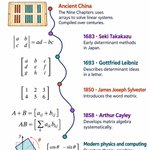
Matrices existed as useful arrangements of numbers long before they became objects of algebra. Early methods focused on solving simultaneous equations.
Determinants developed first, while Sylvester supplied the word matrix and Cayley helped establish rules for manipulating entire arrays.
That shift made matrices a language for transformations. Today, the same framework describes rotations, quantum states, interacting systems, and the calculations behind modern machine learning.

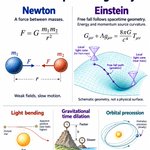
Astronauts in orbit feel weightless while Earth’s gravity remains strong. They and their spacecraft are falling together, so the floor no longer provides the usual supporting force.
Newton describes that motion using gravitational attraction. General relativity describes freely falling bodies following paths through spacetime geometry.
Newton’s law remains an excellent approximation in weak fields at low speeds. Precision timing, light deflection, and some orbital effects require Einstein’s fuller description.

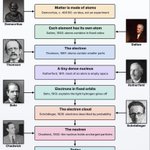
Our picture of the atom changed six times in 2,400 years, and each change was forced by a measurement the previous picture could not explain.
Democritus argued for atoms on reasoning alone. Dalton made the idea scientific, Thomson found the electron, and Rutherford's team fired alpha particles at gold foil and saw a few bounce straight back. That ruled out Thomson's pudding model and put the mass in a tiny nucleus.
The neutron came late because it has no charge and leaves no track. Chadwick found it in 1932 by its effect on other particles. Quarks, which make up protons and neutrons, were proposed in 1964 and first seen in scattering experiments in 1968.

Each step on this list changed what the next one could ask.
Kepler's ellipses came from Tycho Brahe's naked eye data on Mars. Newton then showed the same rule that pulls an apple holds the planets on those ellipses.
Leavitt found that a Cepheid star's pulse period tracks its true brightness, so any one of them can be used as a ruler. Hubble used that ruler to show galaxies recede faster the farther they are. Lemaître had derived the same pattern in 1927.
The 1965 microwave glow and the 2015 ripple in spacetime were each predicted decades before anyone could detect them. Bell Burnell's 1967 pulsar was not predicted at all.

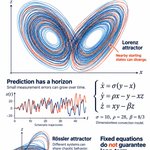
A chaotic system can follow exact equations while remaining difficult to predict far ahead. The uncertainty comes from how precisely its starting state is known.
Nearby states can separate rapidly, so tiny measurement errors eventually become large forecast errors. Their motion can still remain bounded around a recognizable attractor.
This limits detailed weather forecasts without making weather random. Long-term statistical patterns can remain useful even when individual trajectories become unpredictable.

You probably know Grigori Perelman turned down $1,000,000.
What you probably don't know is how he solved it. He never submitted his proof to a journal. In 2002 he quietly uploaded it to a free preprint site, arXiv, emailed a few mathematicians, and walked away. The Poincaré Conjecture had stood unsolved for 98 years, and the answer was sitting there for anyone to download.
The Clay Institute's rules required journal publication plus two years of scrutiny. They waived the first condition for him. He still declined the money, saying Richard Hamilton, whose Ricci flow method he built on, deserved equal credit.
At 16 he scored a perfect 42 out of 42 at the International Mathematical Olympiad. At 40 he refused the highest honor in mathematics, the Fields Medal. To this day it is the only Millennium Prize Problem ever solved.

Most of physics fits in a few lines. Each of these twelve was found by someone measuring something small and noticing a pattern that held everywhere, from a rolling cart to a galaxy.
The span is the surprise. F = ma and gravity are from the same 1687 book, yet Einstein's 1915 equation replaced gravity as a force with curved spacetime, and it still reduces to Newton's law for weak fields. Planck, Heisenberg and Schrödinger wrote the rules of the very small within 27 years of each other, and no experiment has broken them.
The field equation is shown in its original 1915 form. Einstein added the cosmological constant in 1917.

Shannon entropy measures the information an outcome provides on average. A coin that always lands heads has zero entropy because nothing is learned. A fair toss provides one bit by resolving two equally likely possibilities.
For a coin that lands heads 90% of the time, heads carries little information, while the rare tail carries more. Their weighted average is about 0.469 bits per toss.
This links uncertainty to compression. Predictable data needs fewer bits. For long sequences of independent outcomes with identical probabilities, entropy sets the ideal minimum average bits per outcome for lossless encoding. It measures uncertainty, not meaning.

Relativistic effects do not rise at a steady rate. The Lorentz factor is only about 2.29 at 0.9c, but it reaches about 7.09 at 0.99c and 22.4 at 0.999c.
It controls time dilation, length contraction, relativistic momentum, and total energy. Each additional step closer to light speed demands a much larger increase in energy. As v approaches c, γ grows without bound.
This is why particles with mass can be accelerated extremely close to light speed but can never be pushed all the way to c.

On January 28, 1986, the Space Shuttle Challenger exploded just 73 seconds after launch, killing all seven astronauts aboard.
President Reagan appointed a commission to investigate the disaster. Among its members was Richard Feynman, the 67-year-old physicist who was battling cancer and had reluctantly agreed to join the investigation. During a televised hearing, while officials debated the technical details, Feynman decided to demonstrate the problem himself.
He took a piece of the rubber O-ring material used to seal the shuttle’s rocket booster joints, clamped it to simulate the pressure inside the joint, and placed it in a glass of ice water at approximately 32°F (0°C), the temperature at launch.
After leaving it there for a moment, he pulled it out and released the clamp. The rubber remained compressed. It failed to spring back into its original shape.
In front of the cameras, Feynman had demonstrated the problem in a glass of ice water. The unusually cold launch conditions had compromised the O-rings’ ability to seal the joints properly, allowing hot gas to escape and contributing to the destruction of the shuttle.
His simple experiment cut through layers of technical jargon, bureaucratic explanations, and public relations spin. Anyone watching could understand the danger that had been overlooked.
Feynman later wrote in his appendix to the official investigation report:
“For a successful technology, reality must take precedence over public relations, for nature cannot be fooled.”

Between air and a solid the gap is mostly spacing: gas atoms sit far apart, while in a solid they touch. Among the metals the differences come from how heavy each nucleus is and how tightly the atoms pack.
A white dwarf is what the Sun will become. Gravity squeezes the atoms until electron pressure alone holds the star up, which gives about a billion kilograms in every cubic metre.
A neutron star is denser still, about the density of an atomic nucleus, because gravity has pushed electrons into protons to make neutrons.

Each strip is the visible light from one source, spread into colors. The top strip is sunlight, a smooth rainbow cut by thin dark gaps. The strips below are glowing gases, which give off only a few bright lines at exact colors, a different set for every element.
Lines appear because electrons in an atom can only sit at certain energies, and a jump between two of them releases light of one wavelength.
The dark gaps in sunlight are the same lines in reverse. Gas in the Sun's outer layers absorbs the same colors, so the missing hydrogen, sodium, calcium and magnesium lines show what the Sun is made of.

Ten extremes physics has measured or calculated. Nothing can be hotter than about 1.4 × 10^32 K, colder than 0 K, or faster than light. A teaspoon of neutron star would weigh over a billion tonnes, and a magnetar's field reaches about 10^11 tesla.
No proton has ever been seen to decay. For one decay channel the lifetime is above 2.4 × 10^34 years, more than 10^24 times the age of the universe.

The stretching comes from the difference in gravity between the head and the feet. For a body falling feet first through the horizon, the difference is 2GM over r cubed times its length, and since the horizon radius grows in step with mass, the tidal pull at the horizon falls as one over the mass squared. A 10 Sun black hole stretches 2 m of body with about 20 million g. Sagittarius A* manages about 0.0001 g, which no one would feel.
So a person falling into a supermassive black hole would notice nothing special at the horizon. The horizon is not a surface, only the boundary beyond which no signal returns. The stretching builds later as the singularity nears, and for Sagittarius A* the longest possible fall from horizon to singularity lasts about 66 seconds of the faller's own time.

Richard Feynman introduced these diagrams in 1948 as bookkeeping for quantum electrodynamics. Each picture stands for an integral. Lines are particles, vertices are interactions, and time runs left to right. An arrow pointing against the flow of time is an antiparticle, which is how the e+ line in the annihilation graph is drawn.
The number of vertices sets the size. Each photon vertex multiplies the amplitude by about the square root of 1/137, which is 0.085, so diagrams with more vertices matter less and the calculation converges. The electron g minus 2 calculation sums 12,672 diagrams at tenth order, and it matches experiment to about ten digits.
Annihilation shows a calculable result. The cross section for an electron and positron to make a muon pair is 4 pi alpha squared over 3 s, which works out to 0.87 nanobarns at 10 GeV and falls as one over the energy squared. The strong force differs because gluons carry colour, so a gluon can attach to another gluon, and that is why quarks are never found alone.

The speed of light is 299,792 km/s only in a vacuum. In any material, light is slowed by a factor equal to its refractive index, so it moves at 225,000 km/s in water, 197,000 km/s in glass and 124,000 km/s in diamond. Silicon, the material of computer chips, slows infrared light to 86,000 km/s.
In 1999 Lene Hau and her Harvard team sent a laser pulse through a cloud of sodium atoms cooled to 435 nanokelvin, a Bose Einstein condensate, and slowed it to 17 meters per second. The pulse is a group of waves moving through the cloud, which responds to the light in a way that carries the pulse at bicycle speed.
A later experiment stopped the pulse inside the cloud and then released it.
