

We publish independent research on under-followed micro & small caps: business, industry, valuation, and what could change the thesis. Leo Frontier Research.
Atlanta, GA
Joined January 2018
- Tweets3.4K
- Following312
- Followers1K
- Likes2K





$INOD was up as much as 21% after hours. By 6:30pm it was up about 8%. One number from the call did it: $12M.
In mid-October, Innodata's "traditionally largest customer" ended one of its programs. Management says that costs about $12M of Q4 revenue, with new programs at that customer expected to replace it by Q1.
That explains most of the guide. The new 42%+ year implies a Q4 floor of about $79.6M. Q3 was $95.6M, or $83.6M without the lost program. The floor sits about $4M under that.
And the floor only counts booked work. On the call, management said large pipeline deals aren't included until they're awarded.
Two other things from the call: the $300M share sale program wasn't used in Q3, and the India layoffs reported on the 27th of October didn't come up.
Our verdict: the beat was real, and so is the hole. Q4 now comes down to how fast the largest customer refills it.

$AAOI fell 21% today and is down again after hours. The beat isn't the story. The capacity target is.
In August, AOI said it would be able to make around 650,000 800G and 1.6T transceivers a month by year end. Today that's over 500,000, and the 2027 US expansion is running late on power and construction.
In between, it sold 5.7M new shares at an average $105.36, raising $588M that it said would go into equipment and capacity. The stock closed at $46.84.
The Q4 guide is still $385M to $420M, up 43% to 56% on Q3's $269.9M.
Our verdict: the money arrived on time, the capacity didn't. Q4's step up now has to come from less capacity than promised in August, and 1 million a month by end-2027 still depends on a US build that's behind.
The question for the call: how much of Q4 needed the capacity that slipped.

$INOD is down about 13% today with no news, hours before it reports. The stock is already down 70% from its high. Here is what tonight has to clear.
The guide is 2026 revenue growth of 40% or more. On 2025's $251.7M that's at least $352M, so by our maths the second half only needs about $85M a quarter. Q2 was $92.1M. Innodata could shrink from Q2 and still meet its guide.
The real test is two customers. In Q2 the largest was 37% of revenue and a Big Tech customer 34%, together 71%. Innodata said its largest customer paid less in Q2 than in Q1 but would still grow for the full year.
Since then: about 550 layoffs in India reported by India Today on the 27th of October (not confirmed by the company), a new CEO since the 30th of September, and a $300M at-the-market share sale agreement signed the same day as Q2 results.
Our verdict: the guide is a low bar. The market isn't watching the guide, it's watching those two customers.
Watch two numbers after the close: Q3 revenue against Q2's $92.1M, and the top-two share of revenue.

$KOPN is down about 13% this morning. We looked for a reason in Kopin's own news and found none: no release, no SEC filing since August, and results aren't due until the 10th.
What we did find: the whole drone and defense-tech group is falling together.
• Unusual Machines -13%
• Red Cat -11%
• Vuzix -10%
• Palladyne AI -9%
• AeroVironment -6%, Kratos -4%
Analysts have been cutting price targets across the group for three weeks, Kratos, AeroVironment, Red Cat and Unusual Machines among them. Kopin's own last news was an $18.6M Army award for its colour microLED displays in October.
Our verdict: on the evidence so far, this is a basket trade, not a Kopin event. Kopin is down about 29% since the 29th of October without saying a word.
Watch the 10th of November. Results are the first chance to see whether anything in Kopin's own orders matches the slide.

Most $IOVA posts this morning cover the beat, the 60% margin and lung cancer. Two lines in the tables matter more.
First, a correction to our own post: the $410M to $420M guide Iovance kept today was raised only five weeks ago, from $350M to $370M. On the call it said it expects Q4 to grow on Q3, and Proleukin's ~$20M to continue.
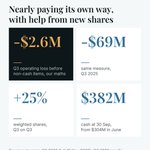
1. Iovance is close to paying its own way. The Q3 operating loss was $24.0M, but $9.5M of that was depreciation and $11.8M was stock pay, neither of them cash. By our maths the business lost about $2.6M before those, against about $69M in the same quarter last year.
Asked on the call whether it can turn profitable on melanoma alone, before lung cancer or sarcoma: "The answer is yes." It wouldn't say when.
2. It got there partly with shareholders' money. Weighted shares were 455.9M in Q3, up 25% from 364.0M a year ago. Cash rose to ~$382M from ~$304M in June while it lost $22.3M. Nobody on the call asked about it.
Our verdict: the launch now nearly funds the company. That's the milestone that should end the share sales.
Watch the 10-Q for how many shares were sold in Q3, and at what price.

$CLOV's most interesting number wasn't in the quarter. It was in how its members age.
Clover says its insurance gross profit per member has historically run about $70 a month higher in a member's second year than the first, and about $85 higher in the third than the second. Right now 28% of members are in year one and 21% in year two. In 2027 both groups move up a year.
By our maths, if that pattern holds and those members stay, that's roughly $71M a year of extra gross profit from ageing alone, before a single new member. Clover's whole 2026 adjusted EBITDA guide is $75M to $85M.
The quarter itself: revenue $759.3M, up 53%, GAAP net income $6.4M against a $24.4M loss a year ago, and the 2026 guide raised at the low end, to its first full-year GAAP profit of $25M to $35M.
The catch: that guide implies Q4 loses about $27M to $37M after $61.8M earned through September. Management calls it seasonal, and it would be smaller than last Q4's $49.3M loss with about 46% more members. Q3 also included about $11M of other income.
Our verdict: 2026 shows the model can turn a profit. 2027 is when the older members are meant to pay for the growth.
Watch retention in the 2027 enrollment numbers. The ageing maths only works if members stay.

$IOVA had a record quarter and didn't raise the year. The maths says it didn't need to.
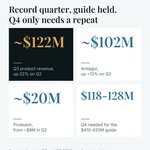
Q3 product revenue was ~$122M, up 22% on Q2:
• Amtagvi: ~$102M, up ~12% from ~$91M
• Proleukin: ~$20M, up from ~$9M
So about half the jump came from Proleukin, the IL-2 drug given as part of the Amtagvi regimen and sold globally, not only from new TIL patients.
The guide stays at $410M to $420M. Iovance has booked $292.2M through September, so by our maths Q4 needs $118M to $128M. The midpoint is roughly a repeat of Q3.
Also in the release: gross margin ~60% from 56%, R&D down 16% on Q2, more than 1,000 commercial patients, and cash of ~$382M, up from ~$304M in June, now expected to last "well into 2029".
Our verdict: the launch is still compounding, but the headline jump is flattered by Proleukin. Amtagvi's 12% is the number to judge.
Watch the 8:30 call for two things: whether Proleukin's $20M repeats, and where the extra cash came from.

$SEZL moved 35% more money for shoppers last quarter. Its net income rose 79%. That gap is why it's up about 34% after hours.
Every dollar through Sezzle is earning more, for three reasons:
• subscriptions: 955,000 paying subscribers, up 68%, using it 7.8 times a quarter against 6.5 a year ago
• cheaper processing: transaction costs fell to 4.2% of volume from 5.2%, helped by an exclusive Visa deal for its US credit products
• fewer losses: credit-loss provisions were 2.7% of volume, down from 3.1%
Then the guidance: 2026 adjusted EPS of $5.45 to $5.50, up from $5.25, and a first look at 2027: $7.20, about 31% more.
Our verdict: this is a business getting more out of the same customer, not just more customers.
The catch: the newer products, SezzleCash advances and Sezzle Send, are early, and management says they may carry lower margins and higher initial losses. Q4 losses also rise every year with the holidays.

$ADMA grew sales 5% last quarter. Its gross profit grew 32%. That gap is why it's up about 27% after hours.
Inside the $141.1M:
• ASCENIV, its specialty immune globulin: $124.7M, up 31%
• BIVIGAM, its standard one: $15.4M, down from $23.8M
• gross margin: 71%, up from 56% a year ago
So the mix is the story. ASCENIV is now 88 cents of every revenue dollar, and management credits the margin jump mainly to that mix and better plant yields.
The year's revenue guide stays at "at least $530M", but the profit floors went up: adjusted EBITDA to at least $275M from $265M, adjusted net income to at least $180M from $170M. ADMA has also bought back 6.3% of its shares this year.
Our verdict: this is a margin story, not a sales story, and the margin comes from what it sells, not from cutting costs.
The catch: one product now carries the company. Watch ASCENIV in Q4. Management expects about 25% or more growth for the year.

$FSLY just posted the best quarter in its history and raised the year. It's down about 12% after hours. Three lines in the release explain why.
The good part: revenue of $190.2M, up 20%, a record. Free cash flow of $25.2M, also a record. Full-year guidance is now $744M to $748M, up from $732M to $746M.
What the market read instead:
• remaining performance obligations, the signed work not yet billed, fell to $334M from $341M in June
• security, the growth engine, slowed to 32% from 43% in Q2
• the top ten customers were 39% of revenue, up from 37% in Q2 and 32% a year ago
Our verdict: the quarter was strong, the leading indicators weren't. A record that leans more on fewer customers, while the signed pipeline shrinks, is a quarter the market discounts.
Watch the call at 4:30 for one thing: why RPO fell. A big contract renewing late is a timing story. A customer shrinking isn't.

$NVTS management gave holders a break-even model on tonight's call. It needs about four times the sales Navitas just guided for Q4.
The model, in their words: gross margin "north of 50%" once the new power-delivery chips from Claros are in the mix, operating costs "in the low 30s", and "the break-even point around the low 60s". We read that as a little over $30M of costs and about $62M of sales a quarter.
Where it stands: Q4 sales are guided to $16.0M at a 40.5% gross margin, with costs stepping up to about $25M as Claros joins. By our maths that's an operating loss of about $18.5M.
What could close the gap: Q3 book-to-bill was 2, backlog runs into mid-2027, and management expects AI infrastructure sales to triple from the 2026 baseline with "double-digit" growth quarter on quarter.
Our verdict: the orders say the demand is real. The model says profit is years away, not quarters. Even at 15% a quarter, $16M takes about ten quarters to reach $62M, by our maths. $531.5M of cash buys that time.
Watch the Q4 book-to-bill. It's the number that tells you whether the slope is holding.

Most people still file $LUNR under Moon landers. Today's NASA win is a reminder of how much of its new work never leaves Earth orbit.
NASA's JPL picked Intuitive Machines to build the satellite for FALCON-RADAR, a cloud-studying radar mission launching no earlier than 2029. It's the company's third NASA Earth-science mission in six months, on top of 18 spacecraft for the Space Development Agency's missile-tracking layer, ordered through L3Harris.
The scale changed in January, when it bought Lanteris, a satellite maker:
• Q2 revenue was $206.2M, more than four times a year earlier
• backlog reached $1.76B at the end of June, up from $213M in December, with $612.8M coming in with Lanteris
• national security went from 3% of revenue to 30% in a year
Our verdict: the Moon still makes the headlines, but a growing share of the work is spacecraft for Earth orbit, and today adds another.
The weak spot: none of these Earth-science contracts came with a dollar value.
Watch the 12th of November, when Q3 results show how much of that backlog turned into revenue against a $900M to $1B year.

Everyone is doing napkin math on $AAOI 's 900,000-wafer deal. The Chinese filing behind it says only one year is under contract.
What Yunnan Germanium's announcement actually says:
• 2027 is covered by an annual contract: 180,000 four-inch InP wafers for $194.4M, about $1,080 each
• 2028 to 2031 are AOI's expected purchases, with prices and volumes left to future yearly contracts and orders
• even 2027 depends on China's dual-use export licences. If they aren't granted, AOI can cancel and get its money back
Size the part that's signed. $194.4M of one raw material is about 70% of the $255M to $290M of revenue AOI guided for July to September. You don't sign for that much substrate unless you expect a much bigger 2027.
The risk sits in Beijing, not Sugar Land. China has required permits for InP exports since February 2025, and AXT, one of the two biggest InP wafer makers, calls getting them its most significant challenge.
Our verdict: the deal is a strong signal about AOI's 2027 build. The four years after it are an option, and China's commerce ministry holds it.
Watch for AOI's own filing, and whether it names a second wafer source.

Upstart just reported a record quarter, and cut its year in the same release.
July to September: revenue of $370.5M, an all-time high $218M of contribution profit, and $36.6M of GAAP net income.
Then the year: revenue of about $1.35B (it said about $1.4B in August) and adjusted EBITDA of about $260M (down from about $294M).
Take out what it has already earned and the whole cut lands on one quarter. By our maths, October to December now carries about $307M of revenue and $53M of adjusted EBITDA, against $370.5M and $89.3M in the quarter it just reported.
The CEO's reason: "Macro is putting pressure on our near-term outlook." Its own numbers agree. October originations ran at $48.1M a day, down from $53.1M in September, and its macro index rose to 1.53 from 1.49.
Our verdict: this is a macro cut, not a model cut. Contribution margin hit a record 60% in the same quarter. What's unknown is how long the macro lasts.
Watch the daily originations Upstart publishes each month. November's number shows whether $307M is a floor or a stretch. $UPST

$BLZE is up about 40% after hours, and the best line on Backblaze's call wasn't in the headline numbers.
B2, its cloud storage business for developers and AI companies, grew 47% last quarter, up from 28% a year earlier. Backblaze says its two big AI cloud contracts, CoreWeave and another neocloud, did not contribute significantly to that 47%. The CFO says CoreWeave ramps all the way through the middle of next year.
So the growth sped up before the biggest customers switched on:
• B2 guided to about 60% growth this quarter
• 11 deals above $0.5M of yearly revenue so far this year
• full-year revenue raised to about $178M
The cost: it expects to spend 55% to 65% of this year's revenue on equipment, mostly paid for by a $201M 0% convertible, and GAAP gross margin takes a 3 to 6 point hit while the new capacity fills.
Our verdict: the acceleration is real, and most of it isn't CoreWeave yet. The test is whether the racks fill as fast as they arrive.
Watch the January to March quarter. That's when the CFO says CoreWeave and the other neocloud "really start kicking in higher gear".

Aehr sold three times as much last quarter as a year earlier, $33m, then set its year at $150m. With the orders already waiting, about 95% of that is in hand by our maths. $AEHR

$DRUG lost more than half its value this morning after the FDA put a partial hold on one planned trial. At about $24, Bright Minds now trades for roughly the cash it holds.
What the FDA did: it paused the company's planned US Phase 2 study of BMB-101 in developmental and epileptic encephalopathies, severe epilepsies that often start in childhood. The FDA pointed to toxicity seen in mice, and said there wasn't enough pharmacokinetic and juvenile toxicity data to enrol children.
What it didn't touch, per the company: its other ongoing trials.
What the drug has shown so far:
• about 90 people dosed, no drug-related serious side effects
• in its Phase 2 study, six DEE patients who finished treatment had a median 63% drop in motor seizures
• all five DEE patients in the extension are still on the drug
Now the arithmetic. 9.86 million shares at $24 is about $237 million. At the end of June it held C$308 million in cash, roughly US$217 million, and it spends about $23 million a year.
That leaves about $20 million for BMB-101.
The fair worry: the company says the mouse findings were incidental, but that's its view, not the FDA's. A juvenile toxicity package can take months, and the US DEE trial has no new start date.
Our verdict: the market priced the hold as if the drug were gone. It isn't. It's delayed in one indication, in one country, and the company is sitting on its cash.
Watch for the FDA's full letter, due within 30 days. It decides how long the delay is.

$INO more than tripled before the open after the FDA approved its drug for a rare airway disease. $PGEN, which already sells a drug for the same disease, fell 29%.
The market just decided the newcomer matters more than the incumbent's head start. Look at the numbers before you agree.
The disease: recurrent respiratory papillomatosis. HPV makes growths form in the airway, and patients need surgery again and again to keep breathing.
Precigen's Papzimeos, approved in August 2025:
• 51% of patients needed no surgery for a year after treatment
• $53.1 million of sales last quarter, more than double the quarter before
• 500+ patients registered
Inovio's Voceryq, approved on Friday:
• 27% needed no surgery for a year (7 of 26), with no control arm
• accelerated approval, so a confirmatory trial is still required
• orders ship in about 60 days, full sales force in Q1 2027
What changed for Precigen: in August it said its seven years of exclusivity gave "long-term protection against prospective competition". That protects its own drug. It never protected the disease.
What didn't change for Inovio: about $55 million of cash after its July offering, burning around $18 million a quarter. The money runs out around the same quarter its sales force arrives.
Our verdict: the better drug still has the head start and the data. The market sold it like it lost the monopoly, because it did.
Watch Precigen on Wednesday the 4th. Papzimeos sales are the first scoreboard.
