

PoliSci PhD candidate @UvA_Amsterdam丨researching political socialization & electoral behavior | social psychologist | not active here anymore
Joined January 2017
- Tweets295
- Following524
- Followers256
- Likes5.9K







Pinned Tweet
Which role do adolescents' perceptions of their parents' political orientations play in political socialization, particularly in multiparty contexts? The second paper of my dissertation tries to answer this question and is out now @ElectoralStdies sciencedirect.com/science/ar…
The fifteenth edition of the Night of the Refugee is on June 15-16! Together we walk in solidarity with people seeking refuge. Donations are greatly appreciated 💛#NvdV24 nachtvandevluchteling.nl/fun…

Linet Durmuşoğlu retweeted

I am very happy to see our book on international punishment out now with OUP, co-edited with @LinetDurmusoglu, @HolaBarbora, Jan-Willem van Prooijen, Ronald Kroeze and Wouter Werner.
global.oup.com/academic/prod…
Linet Durmuşoğlu retweeted

Op de golven van de formatiebesprekingen moesten we na 22 november vooral dóór: ‘niet jammeren, het valt wel mee.’
Column voor @DeGroene over strijdbaar humanisme, een humanisme dat zich niet laat wegschreeuwen.
groene.nl/artikel/strijdbaar…

Linet Durmuşoğlu retweeted

🔍 Onderzoek van @LinetDurmusoglu wijst uit: ouders beïnvloeden de politieke keuzes van jongeren, maar het werkt ook andersom! 🔄
Ontdek hoe familiegesprekken en de groeiende meningen van jongeren de politieke dynamiek beïnvloeden. 🗳️👨👩👧👦
@UvA_AISSR
go.uva.nl/3T9bVxA
Linet Durmuşoğlu retweeted

Did Wilders’ PVV attract Muslim voters?
Since his election, there has been much discussion on this, illustrated by vox-pops and personal testimonies, see @lale_gul89
But what does the data say? A thread.
youtu.be/NnwNUJ-Cp50?si=J1Zj…
Interesting personal observations by our students and some scientific context from me about parents' influence on their children's political preferences (and vice versa!):

Do adolescents mirror their parents' votes?
🗳️ We asked our students, and Linet Durmuşoğlu's research unveils the influence of parent-child bonds on political preferences in adolescents in multiparty systems. 📊🌐
#PoliticalDevelopment #StudentVotes
go.uva.nl/3SR3eYB

How do adolescents in confusing multiparty systems like the Netherlands develop their political orientations? Which role do parents play? Read more about our (@SLdeLange, @TheresaJKuhn, & Wouter van der Brug) recently published research below:

How parents in countries with multiparty systems shape the political beliefs of their children - new research from @LinetDurmusoglu blogs.lse.ac.uk/europpblog/2…

Linet Durmuşoğlu retweeted

De @politie kan het niet meer aan. Het gáát niet meer, zeggen 23 agenten tegen @nrc. De politie wordt door de samenleving overvraagd, zegt de politie, maar laat de politie eerst eens even naar zichzelf kijken.
#draadje, voor bronnen klik op de link
controlealtdelete.nl/article…

3) Relational factors that characterize the parent-child bond (here caring about parents' opinions about politics) are influential in determining adolescents' tendency to adopt their parents’ political orientations. An exciting avenue for future research.
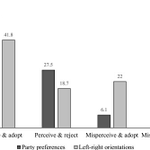
their parents' L-R orientations, but not their parents' party prefs. -> The accurate perception of more complex pol. orientations requires higher political sophistication. Problematic, as precisely the not-so-sophisticated need L-R as heuristics to navigate complex party systems.
and party prefs at similar rates. 2) Transmission is moderated by several factors, but these do not equally apply to the perception of party prefs and L-R orientations. Adolescents' pol. engagement, pol. knowledge, and edu. level positively affect their accuracy in perceiving...
...two-party systems, can also be applied to multiparty systems and the transmission of ideological orientations. Adolescents have more difficulty in correctly perceiving their parents' L-R orientations than their party prefs. Still, they adopt the perceived L-R orientations...

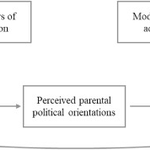
The perception-adoption model splits the transmission process into two steps - children perceiving/misperceiving their parents' political preferences, and then adopting/rejecting those perceptions. A few main findings: 1) The model, which has previously only been tested in...
