

Tracking where the money flows Crypto / DeFi / TradFi / Capital allocation. Deep dives into where capital actually flows | Follow for no-BS metrics
US
Joined July 2023
- Tweets426
- Following64
- Followers61
- Likes291




Before you spend $1 on a Shopify store, do this 30-day homework. (Part 5/36) ✅
Most expensive Shopify mistakes aren't made while running the store. They're made before it exists.
Here's the 30-day plan I'd follow if I wanted to find out cheaply whether a store makes sense, before paying for anything.
Week 1: Decide the rules
Pick your model (dropshipping, print on demand or your own inventory). If you skipped Part 2, start there.
Write down your maximum loss. For example: "I'll risk $500, and if I hit it, I stop and review." Put it in writing now, while you're calm.
Brainstorm 10 product ideas. No filtering yet.
Week 2: Do the math, on paper
Pick your best 3 ideas and write the per-order math for each: price, product cost, shipping, payment fees, an ad estimate, and a refund allowance.
Beginners often see ad spend of 20% to 35% of revenue and refund rates of 10% to 20%, so use those numbers, not hopeful ones.
ecomcalctools
Order samples from a supplier. Check quality, packaging and delivery time yourself.
Week 3: Test demand without a store
Show the product to 10 real people, not friends who'll say "nice!" but people who'd actually buy it. Ask what they'd pay.
Or put up a simple sign-up page and see whether strangers leave an email. A few sign-ups prove more than 100 opinions.
Don't start your Shopify trial yet. The free trial lasts only 3 days, so start it when you're ready to build, not before.
shopify
Week 4: Legal basics and a go/no-go decision
Learn the basics for your state: business registration, sales tax and any rules for your product category. Ask a professional if you're unsure.
Draft your shipping, return and contact policies. Customers look for them before they trust you.
Fill out the scorecard below.
The go/no-go scorecard. You need at least 4 of 5:
☐ The per-order math shows profit AFTER ads and refunds
☐ I know the break-even ad cost per order
☐ My samples arrived and I'd be happy to receive them
☐ Real strangers showed interest or left their email
☐ My maximum loss is written down
Fewer than 4? Don't launch yet. That's not failure. It's a $0 lesson instead of a $500 one.
The goal of 30 days isn't to open a store. It's to find out, for almost nothing, whether you should.
Save this post. You'll want it when you're about to click "buy" on something.
Next, Part 6: how to pick a niche in 1 hour with free tools.
Educational content. Illustrative numbers. Not financial or legal advice


I'm going to show you how a Shopify store REALLY works. Every cost. Every mistake. Every number. 36 posts. (Part 1/36) 🧵
Scroll through any feed and you'll see the same story: "I opened a Shopify store and now I'm making $10K a month."
What you won't see: the costs, the refunds, the ads that didn't work, and the people who quietly stopped.
This series shows the whole picture, one honest step at a time.
Why this series exists
One estimate counts more than 5.2 million Shopify stores generating over $370 billion in sales.
sellerapp
That sounds like opportunity, and it is. But it also means most new stores are fighting for the same customers.
The honest starting point
→ An analysis of more than 1,200 stores put typical dropshipping net margins at 15% to 20%.
→ A separate breakdown puts beginners at 0% to 10%, with ad spend at 20% to 35% of revenue.
→ Shopify's trial lasts 3 days, then most plans cost $1 a month for the first 3 months. After that, the Basic plan is $39 a month, or $29 a month billed annually.
Start $1 Trial
+3
That cheap start can feel like the whole cost. It isn't. Part 3 covers the rest.
What we'll cover, step by step:
1️⃣ Honest start (posts 1-5): which model to choose, the real cost, what to do before spending a dollar
2️⃣ Choosing a niche (6-11): free research tools, traps, and how to test an idea cheaply
3️⃣ Building the store (12-17): key pages, trust, suppliers, legal basics
4️⃣ The math (18-24): margins, break-even, returns, cash flow
5️⃣ Advertising (25-30): where to start, your first $200 test, what you can't say
6️⃣ Money, losses and the decision (31-36): a sample P&L, how to lose money fast, when to stop
My rules:
✅ No income promises
✅ No course, no "secret method," nothing for sale
✅ Every number is explained, and illustrative ones are labeled
✅ I'll tell you when something is a bad idea
This is for you if:
→ You're curious about starting a store and want the real numbers first
→ You don't want to pay anyone for a "secret"
→ You'd rather hear a boring truth than an exciting fantasy
It's NOT for you if:
→ You want guaranteed income. It doesn't exist.
Each part stands on its own, so you can jump in anywhere. But they build on each other.
Tomorrow, Part 2: the 3 ways to sell on Shopify, and why most beginners pick the wrong one.
Follow if you'd rather see the math than a screenshot. 👇
Educational content. Figures come from third-party analyses and vary widely. Not financial or legal advice.

23
"I made $10K this month." Why those screenshots lie. (Part 4/36) 🎭
You've seen them. A dashboard, a big green number, and a link in the bio.
Here's what that number usually is: revenue. Not profit.
Revenue is every dollar customers paid you. Profit is what's left after:
→ the product itself
→ shipping
→ ads
→ payment fees
→ refunds and chargebacks
→ apps and subscriptions
Let's apply real-world ranges to $10,000 in revenue:
→ A beginner's typical net margin is 0% to 10%. That's $0 to $1,000.
→ An experienced seller's is 10% to 20%. That's $1,000 to $2,000.
→ One analysis of more than 1,200 stores put typical dropshipping net margins at 15% to 20%. That's $1,500 to $2,000.
dropshipping profit margins 2026
+2
And that's before income tax and before you pay yourself.
The two biggest silent killers:
→ Ads. For beginners, ad spend is often 20% to 35% of revenue. On $10,000, that's $2,000 to $3,500 gone before the first profit calculation.
→ Refunds. Beginner refund rates are often 10% to 20%. A refunded order can cost you the product, the shipping and a processing fee.
ecomcalctools
ecomcalctools
5 tricks to watch for in a "profit" screenshot:
Revenue shown as profit. The most common one.
Cherry-picked days. One great day shown, the other 29 hidden.
No costs shown. Ads and refunds sit conveniently outside the frame.
Fakes. I built an entire fake "profit video" with code in a few minutes, and it looked convincing. A screenshot is even easier.
The real product is the course. If the "secret" is for sale at $299, ask why they're selling the lesson instead of quietly using it.
What to ask whenever you see one:
→ Is this revenue or profit?
→ What were the ad costs?
→ What were the refunds?
→ Can I verify it anywhere except their own screen?
If the answer to the last one is "no," treat it as an ad.
Real stores exist and real people earn real money. But the honest version is slower, smaller and a lot more math than the screenshot suggests.
Tomorrow, Part 5: your first 30 days. What to do before spending a single dollar.
Ranges come from third-party analyses and vary widely. Educational content. Not financial advice.
I'm going to show you how a Shopify store REALLY works. Every cost. Every mistake. Every number. 36 posts. (Part 1/36) 🧵
Scroll through any feed and you'll see the same story: "I opened a Shopify store and now I'm making $10K a month."
What you won't see: the costs, the refunds, the ads that didn't work, and the people who quietly stopped.
This series shows the whole picture, one honest step at a time.
Why this series exists
One estimate counts more than 5.2 million Shopify stores generating over $370 billion in sales.
sellerapp
That sounds like opportunity, and it is. But it also means most new stores are fighting for the same customers.
The honest starting point
→ An analysis of more than 1,200 stores put typical dropshipping net margins at 15% to 20%.
→ A separate breakdown puts beginners at 0% to 10%, with ad spend at 20% to 35% of revenue.
→ Shopify's trial lasts 3 days, then most plans cost $1 a month for the first 3 months. After that, the Basic plan is $39 a month, or $29 a month billed annually.
Start $1 Trial
+3
That cheap start can feel like the whole cost. It isn't. Part 3 covers the rest.
What we'll cover, step by step:
1️⃣ Honest start (posts 1-5): which model to choose, the real cost, what to do before spending a dollar
2️⃣ Choosing a niche (6-11): free research tools, traps, and how to test an idea cheaply
3️⃣ Building the store (12-17): key pages, trust, suppliers, legal basics
4️⃣ The math (18-24): margins, break-even, returns, cash flow
5️⃣ Advertising (25-30): where to start, your first $200 test, what you can't say
6️⃣ Money, losses and the decision (31-36): a sample P&L, how to lose money fast, when to stop
My rules:
✅ No income promises
✅ No course, no "secret method," nothing for sale
✅ Every number is explained, and illustrative ones are labeled
✅ I'll tell you when something is a bad idea
This is for you if:
→ You're curious about starting a store and want the real numbers first
→ You don't want to pay anyone for a "secret"
→ You'd rather hear a boring truth than an exciting fantasy
It's NOT for you if:
→ You want guaranteed income. It doesn't exist.
Each part stands on its own, so you can jump in anywhere. But they build on each other.
Tomorrow, Part 2: the 3 ways to sell on Shopify, and why most beginners pick the wrong one.
Follow if you'd rather see the math than a screenshot. 👇
Educational content. Figures come from third-party analyses and vary widely. Not financial or legal advice.
2
1
73

Line by line. (Part 3/36) 💸
Everyone shows the "$1 a month" ad. Here's the full picture, because this is where most beginners get surprised.
The Shopify part
→ There's a 3-day free trial, and then most plans cost $1 a month for the first three months.
→ After that, the Basic plan is $39 a month, or $29 a month if you pay annually.
→ Online card payments on Basic cost 2.9% plus $0.30 per transaction.
→ If you use an outside payment provider instead of Shopify Payments, Shopify adds a 2% transaction fee on Basic.
shopify.com
+3
The parts people forget
→ A domain name, often around $10 to $20 a year
→ Apps. Many cost anywhere from $9 to $99 a month, and they add up fast
→ Product samples, so you know what customers will actually receive
→ A test ad budget
→ Business registration, licenses and taxes, which vary by state
demandsage
My illustrative budget for the first 3 months (assumptions, not quotes):
→ Shopify at the intro rate: $3
→ Domain: $15
→ One paid app at $30 a month: $90
→ Product samples: $60
→ Test ads: $300
Total: about $468.
And that's a lean version. No paid theme, no photographer, no agency.
Then the intro period ends
Fixed costs jump to around $69 a month in this example ($39 plan + $30 app). That's before a single ad dollar and before paying yourself.
Now the part that hurts
Using my earlier example, a $40 order leaves about $8.94 per order before the store subscription. Dividing $69 by $8.94 means you need roughly 8 orders every month just to cover your fixed costs.
If the ads stop working, those 8 orders turn into 15, then 30. That's how a "cheap" start quietly becomes expensive.
What to do with this:
Write your own budget before you pay for anything, and add a 20% buffer.
Decide your maximum loss in writing. For example, "I won't spend more than $500 on the test." Hitting it means stop and review, not "just a bit more."
Don't start the Shopify trial until you've done your research. Three days go fast.
Count apps like a subscription audit. If you can't say what an app earns you, it's a cost.
None of this means "don't." It means knowing the real starting line before you cross it.
Tomorrow, Part 4: why "I made $10K this month" screenshots lie.
Prices change, so check Shopify's current pricing page. Illustrative numbers. Not financial or legal advice.

I'm going to show you how a Shopify store REALLY works. Every cost. Every mistake. Every number. 36 posts. (Part 1/36) 🧵
Scroll through any feed and you'll see the same story: "I opened a Shopify store and now I'm making $10K a month."
What you won't see: the costs, the refunds, the ads that didn't work, and the people who quietly stopped.
This series shows the whole picture, one honest step at a time.
Why this series exists
One estimate counts more than 5.2 million Shopify stores generating over $370 billion in sales.
sellerapp
That sounds like opportunity, and it is. But it also means most new stores are fighting for the same customers.
The honest starting point
→ An analysis of more than 1,200 stores put typical dropshipping net margins at 15% to 20%.
→ A separate breakdown puts beginners at 0% to 10%, with ad spend at 20% to 35% of revenue.
→ Shopify's trial lasts 3 days, then most plans cost $1 a month for the first 3 months. After that, the Basic plan is $39 a month, or $29 a month billed annually.
Start $1 Trial
+3
That cheap start can feel like the whole cost. It isn't. Part 3 covers the rest.
What we'll cover, step by step:
1️⃣ Honest start (posts 1-5): which model to choose, the real cost, what to do before spending a dollar
2️⃣ Choosing a niche (6-11): free research tools, traps, and how to test an idea cheaply
3️⃣ Building the store (12-17): key pages, trust, suppliers, legal basics
4️⃣ The math (18-24): margins, break-even, returns, cash flow
5️⃣ Advertising (25-30): where to start, your first $200 test, what you can't say
6️⃣ Money, losses and the decision (31-36): a sample P&L, how to lose money fast, when to stop
My rules:
✅ No income promises
✅ No course, no "secret method," nothing for sale
✅ Every number is explained, and illustrative ones are labeled
✅ I'll tell you when something is a bad idea
This is for you if:
→ You're curious about starting a store and want the real numbers first
→ You don't want to pay anyone for a "secret"
→ You'd rather hear a boring truth than an exciting fantasy
It's NOT for you if:
→ You want guaranteed income. It doesn't exist.
Each part stands on its own, so you can jump in anywhere. But they build on each other.
Tomorrow, Part 2: the 3 ways to sell on Shopify, and why most beginners pick the wrong one.
Follow if you'd rather see the math than a screenshot. 👇
Educational content. Figures come from third-party analyses and vary widely. Not financial or legal advice.
1
1
103

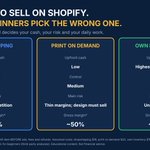
3 ways to sell on Shopify. Most beginners pick the wrong one. (Part 2/36) 🧵
Before you build anything, you have to decide HOW you'll sell. Not what. How.
Yesterday was the big picture. Today we pick the model, because it decides your cash, your risk and your daily work.
Way 1: Dropshipping
You list products, and a supplier ships them straight to your customer. You never touch the item.
→ Upfront cost: low. No inventory.
→ Control: low. You don't see quality or shipping times until a customer does.
→ The catch: you're often competing with everyone selling the same product, so you usually pay for ads to stand out.
Way 2: Print on demand
You upload a design, and a partner prints and ships it only when someone orders.
→ Upfront cost: low.
→ Control: medium. You control the design, not the production.
→ The catch: the per-item cost is higher, so margins are thinner, and the design has to be something people really want.
Way 3: Your own inventory
You buy or make products in bulk and ship them yourself, or through a fulfillment service.
→ Upfront cost: the highest. Example: 200 units at $10 each is $2,000 before the first sale.
→ Control: high. Quality, packaging, shipping time and branding are in your hands.
→ The catch: if it doesn't sell, your cash sits in boxes. Sell only 120 of those 200 units and about $800 is stuck on a shelf.
The same $40 item, three ways (my illustrative assumptions):
→ Dropshipping: $14 item + $4 shipping = $18 cost, so about $22 gross (55%)
→ Print on demand: about $20 all-in cost, so about $20 gross (50%)
→ Own inventory: $10 unit + $5 shipping = $15 cost, so about $25 gross (63%)
Remember, that's BEFORE ads, payment fees and refunds.
What real stores keep:
One 2026 breakdown puts net margins at 0% to 10% for beginners and 10% to 20% for experienced sellers. Another analysis of more than 1,200 stores found typical dropshipping net margins of 15% to 20%.
ecomcalctools
zikanalytics
A 55% margin on paper can shrink to single digits once ads and refunds arrive. We'll go through that math in detail later in the series.
Why beginners pick wrong:
They choose by upfront cost only. "$0 inventory" sounds safe. But low cash risk can mean high time risk and high ad-spend risk. You can lose money without ever owning a box.
A simple way to think about it:
Little cash and still learning? A small, strictly capped test with dropshipping or print on demand.
A product people already ask you for? Your own inventory may fit.
A real creative skill? Print on demand.
Not sure? Pick the model where the worst case is a loss you can afford.
Whichever you pick, write the profit-per-order math BEFORE you build anything. We'll build that formula together in Part 18.
Tomorrow, Part 3: what it really costs to start a Shopify store. Line by line.
Educational content. Illustrative numbers. Real results vary widely. Not financial advice.

1
117
I'm going to show you how a Shopify store REALLY works. Every cost. Every mistake. Every number. 36 posts. (Part 1/36) 🧵
Scroll through any feed and you'll see the same story: "I opened a Shopify store and now I'm making $10K a month."
What you won't see: the costs, the refunds, the ads that didn't work, and the people who quietly stopped.
This series shows the whole picture, one honest step at a time.
Why this series exists
One estimate counts more than 5.2 million Shopify stores generating over $370 billion in sales.
sellerapp
That sounds like opportunity, and it is. But it also means most new stores are fighting for the same customers.
The honest starting point
→ An analysis of more than 1,200 stores put typical dropshipping net margins at 15% to 20%.
→ A separate breakdown puts beginners at 0% to 10%, with ad spend at 20% to 35% of revenue.
→ Shopify's trial lasts 3 days, then most plans cost $1 a month for the first 3 months. After that, the Basic plan is $39 a month, or $29 a month billed annually.
Start $1 Trial
+3
That cheap start can feel like the whole cost. It isn't. Part 3 covers the rest.
What we'll cover, step by step:
1️⃣ Honest start (posts 1-5): which model to choose, the real cost, what to do before spending a dollar
2️⃣ Choosing a niche (6-11): free research tools, traps, and how to test an idea cheaply
3️⃣ Building the store (12-17): key pages, trust, suppliers, legal basics
4️⃣ The math (18-24): margins, break-even, returns, cash flow
5️⃣ Advertising (25-30): where to start, your first $200 test, what you can't say
6️⃣ Money, losses and the decision (31-36): a sample P&L, how to lose money fast, when to stop
My rules:
✅ No income promises
✅ No course, no "secret method," nothing for sale
✅ Every number is explained, and illustrative ones are labeled
✅ I'll tell you when something is a bad idea
This is for you if:
→ You're curious about starting a store and want the real numbers first
→ You don't want to pay anyone for a "secret"
→ You'd rather hear a boring truth than an exciting fantasy
It's NOT for you if:
→ You want guaranteed income. It doesn't exist.
Each part stands on its own, so you can jump in anywhere. But they build on each other.
Tomorrow, Part 2: the 3 ways to sell on Shopify, and why most beginners pick the wrong one.
Follow if you'd rather see the math than a screenshot. 👇
Educational content. Figures come from third-party analyses and vary widely. Not financial or legal advice.
Everyone talks about what sells on Shopify. Almost nobody shows what the seller keeps. 🛍️
Let's do both.
What Americans are actually buying:
Shopify's data on US merchants shows the top categories are shirts, skin care, makeup and vitamins and supplements, followed by pants, dresses, car parts and activewear. Among the fastest growers, creatine, satchel bags, collagen and electric scooters led the list in one September comparison.
shopify
shopify
Sounds like a gold rush, right? Now watch the math.
One $40 hoodie. My illustrative example:
→ Customer pays: $40.00
→ Product cost: −$14.00
→ Shipping: −$4.00
→ Payment fee (Shopify typically charges around 2.9% plus $0.30 per transaction): −$1.46
→ Refund allowance (4%): −$1.60
→ Store subscription share: −$0.13
→ Ads to get this one customer: −$10.00
printful
Seller keeps: $8.81. About 22%.
That's a decent day. Now change one number.
Ads get more expensive, and the same customer now costs $18 instead of $10.
Seller keeps: $0.81. About 2%.
One ad-cost swing erased almost the entire profit. Same product. Same price. Same customer.
Why this matters if you've seen "I made $10K/month" screenshots:
Say you want $5,000 a month in actual profit.
→ At $8.81 per order, you need about 568 orders a month (roughly 19 a day).
→ At $0.81 per order, you need over 6,000.
Those screenshots usually show revenue. Revenue isn't profit.
What the data says about typical results:
An analysis of more than 1,200 stores put typical dropshipping net margins at 15% to 20% after every cost is subtracted. Another breakdown puts beginners at 0% to 10%, with refund rates of 10% to 20% and ad spend of 20% to 35% of revenue.
zikanalytics
ecomcalctools
What I'd check before selling anything:
Net margin, not markup. A 55% gross margin can become 2% fast.
Customer acquisition cost. If ads eat more than your margin, you're paying to lose money.
Returns. Every refund costs the product, the shipping and often a fee.
Break-even ad cost. Know the number at which each order stops making money.
None of this means "don't sell online." People do build real stores. It means "popular category" and "profitable business" are not the same thing, and anyone selling you the dream usually skips the math.
Have you ever tried selling online? What surprised you most? 👇
Illustrative example with assumed costs. Real results vary widely. Not financial advice.

2
122
Lioto retweeted
"You save $160!" No. You spend $240. 🛒
Black Friday is November 27. Here's the math retailers hope you never do.
1. The "deal" might not be the cheapest price of the season.
A Visualping study tracked more than 2,600 products last holiday season and found that roughly one-third of Black Friday and Cyber Monday deals had been available for less earlier on. About 61% of luggage deals and 50% of microwave deals had previously been cheaper.
consumeraffairs
2. The "was" price may be fiction.
In one survey, 59% of shoppers believed retailers raise prices before a sale and cut them back to normal, and 54% thought stores advertise a "was" price the item never really sold at. Consumers' Checkbook tracked big-ticket items at 24 major retailers for 33 weeks and found that 21 of the stores claimed to offer discounts more than half the time.
chainstoreage
inquirer
3. "Pay later" is booming, and so are its surprises.
Adobe forecasts a record $21.3 billion in buy-now-pay-later spending this holiday season. In another survey, 53% of BNPL users expected to still be paying after January, compared with 16% of other shoppers.
adobe
omnicalculator
Now the part that matters most:
A "40% off" TV: $400 → $240.
The ad says: "You save $160!"
The real story: if you weren't going to buy a TV, you didn't save $160. You spent $240.
And that $240, invested at a 7% average return for 30 years, would become about $1,830.
The only discount that counts is the one on something you were already planning to buy.
My 5-step Black Friday plan:
Write your list today. If it's not on the list, it's not a deal, it's an impulse.
Track prices now, not on Friday. Tools like CamelCamelCamel, Keepa or Capital One Shopping can show a product's price history.
consumeraffairs
Compare the final price, with tax and shipping, not the headline percentage.
Use the 24-hour rule on anything that wasn't on your list. If you still want it tomorrow, buy it.
Skip "pay later" for non-essentials. If you can't pay for it today, ask why you're buying it today.
I'm not anti-shopping. Good deals are real, and some of them are great. I just want you to know which ones.
What's the worst "deal" you ever fell for? Tell me below. 👇
Study figures are from public reports and surveys. Illustrative math: 7% average annual return. Not financial advice.

Lioto retweeted
People lost their minds over GTA 6. Rockstar reportedly made $3.79 billion in a single day. For a video game. 🎮
Take-Two said GTA 6 generated $3.79 billion through preorders and first-day sales, and called it the biggest entertainment launch in history.
asianetnews
It arrived after a 13-year wait since GTA V in 2013. Thirteen years of hype, trailers, rumors and delays. Then one release date.
etvbharat
Here's what made the numbers so wild:
→ The standard edition costs $79.99 and the Ultimate Edition costs $99.99.
→ Industry data suggested about 89% of early buyers picked the Ultimate Edition, the most expensive one.
→ Sensor Tower estimated around 17 million copies sold by November 18, about $1.65 billion in revenue. (Third-party trackers and company figures differ, which is normal in launch week.)
gta 6 predicted to make up to 5 2 billion during launch week 3388183
+2
Most people didn't buy the cheaper version. When hype is high, we tend to pick the premium option and don't think twice.
Now the finance angle, because I can't help it:
A $100 purchase invested at 7% for 30 years becomes about $760. That's not a reason to skip the game. Fun is worth money, and 13 years is a long time to wait.
But it's a great example of how emotion works. Hype creates urgency: "buy now or miss the conversation." And urgency is when we stop doing the math.
3 rules for hype spending (games, sneakers, concert tickets, anything):
Set a fun budget and spend it guilt-free. Fun money is part of a healthy plan.
Don't put hype on a credit card you can't pay off. At 24% interest, a balance can roughly double in about 3 years (72 ÷ 24).
Wait 24 hours on anything you didn't plan to buy. If you still want it tomorrow, buy it.
I'm not judging anyone who bought on day one. I'm just fascinated that a single release can move billions of dollars in 24 hours.
So tell me honestly: did you buy GTA 6 on day one? Was it worth it? 👇
Sales figures are from public reports and third-party estimates, and they vary by source. Illustrative math: 7% average annual return. Not financial advice.
I just “made $14.93 in 2 minutes” with crypto arbitrage. 🎬
Except none of it was real.
The exchange, the coins, the balances, every click: all drawn by a script in a few minutes. No exchange, no money, no trade. I made it to show you how easy it is to fake “proof.”
Because that’s what a lot of “profit videos” are: a screen, a green number, and a pitch.
Here’s what they don’t show you:
→ The fees. In my fake example, a $10,000 trade with a 0.5% price gap is $50 on paper. After buy, withdrawal and sell fees (about $30) and slippage (about $5), the “profit” shrinks to roughly $15. With typical fees of 0.10% per side, break-even starts around 0.25-0.35% before any profit exists.
blofin
→ The clock. Moving coins between exchanges takes minutes. If the gap closes in transit, you still pay the fees. In my example: about −$30.
→ The competition. Most opportunities last only seconds, and bots dominate the high-quality flow.
dextools
→ The losing trades. Nobody posts the −$30 screen.
4 quick checks for any “profit video”:
Does it show fees, failed trades and losses, or only the win?
Does it pressure you to “act fast” or “join before spots run out”?
Is there a course, bot or signal group for sale at the end?
Can you verify it anywhere except the creator’s own screen?
One more thing. A fisherman never tells you where the fish are. So when someone sells you “the secret” for $299, ask why they’re selling the lesson instead of quietly using it.
I’m not selling a course, a bot or a signal group, and I won’t.
In my next posts I’ll break down the real numbers in public, for free: what arbitrage actually costs, where beginners lose money, and which boring things really do grow it (low fees, time, diversification).
Follow if you’d rather see the math than a green screenshot. 👇
Have you ever seen a “profit video” that looked too good to be true?
Video is a simulation made with code: no real exchange, coins or money. Illustrative numbers. Not financial advice.
1
111
Crypto arbitrage sounds like free money: buy low on one exchange, sell high on another. Here’s how it actually works, and why most retail traders lose at it.
The idea: the same coin can trade at slightly different prices on different exchanges. You profit from the difference, and it doesn’t depend on whether the market goes up or down.
changelly
The three main versions:
1️⃣ Cross-exchange. Buy on Exchange A, send the coins to Exchange B, sell there.
2️⃣ Pre-funded. Keep balances on both exchanges, buy on one and sell on the other at the same moment, then rebalance later. Professional desks use this model, because the sequential transfer model leaves retail traders exposed to delays that erase the spread.
blofin
3️⃣ Triangular. Trade a loop of three pairs on a single exchange. Since it all happens in one venue, you avoid transfer delays and withdrawal risks.
altrady
The math (illustrative numbers):
You trade $10,000. The coin is $100.00 on Exchange A and $100.50 on Exchange B.
→ Gross spread: +$50 (0.5%)
→ Buy fee, withdrawal fee, sell fee: about −$30
→ Slippage: about −$5
→ Net: roughly +$15
And if the spread closes while your coins are in transit? You still pay the fees. That’s about −$30.
With typical fees of 0.10% per side, break-even already starts around 0.25-0.35% before any profit exists.
blofin
The pros:
✅ It doesn’t depend on market direction.
✅ It can be repeated as long as the price gap lasts.
✅ Triangular arbitrage avoids transfers between exchanges.
changelly
moonpay
The cons:
❌ Spreads on major pairs between top exchanges are usually a few basis points wide and can disappear in milliseconds, and retail desktops can’t compete.
❌ Most opportunities last seconds, and bots dominate the high-quality flow.
❌ Transfer time is where most attempts fail, because the spread rarely survives until your deposit confirms.
❌ Exchange risk: a halted withdrawal, a frozen account, or an insolvent exchange can wipe out your whole stack.
❌ Regulatory limits, such as capital controls in some countries, can restrict cross-border transfers.
❌ In the US, each trade is generally a taxable event, so the paperwork adds up fast.
What Is Crypto Arbitrage? Complete Trading Guide (2026)
+4
Treat any “risk-free” claim with skepticism.
zippfeed
If you still want to try:
Do mock trades first and track how long deposits and withdrawals actually take between your exchanges.
changelly
Calculate break-even before every trade: fees on both sides, withdrawal fee, slippage, plus a safety buffer.
Start with money you can afford to lose entirely.
Keep records of every trade.
My honest take: arbitrage is real, but the easy version has been competed away by bots. For most people, the realistic result is small gains at best and fees at worst. The most reliable “arbitrage” ordinary investors have is boring: low fees and time.
Have you tried crypto arbitrage? What happened? 👇
Illustrative numbers. Crypto is volatile and you can lose money. Not financial advice
This post was created in partnership with my colleague @john_obong68966

3
112
Lioto retweeted
Trump: "We don't care about this war; we are making good money off of it."
Trump: "Ukrainians are fighting well because they have American weapons."
This is what Trump's "I want peace and for the war to end" sounds like.
Xi: "All nuclear weapons must be destroyed, because there will be no winners in such a war."
Xi: "We plan to build up our nuclear arsenal by 2030."
Xi's words after testing a new nuclear warhead.
Lioto retweeted

This looks like a SPY GADGERT!
Cameras like this weren't built for spying. They were built for medicine.
The smallest one on sale has a sensor 0.575 mm wide. 200 × 200 pixels, four wires, made for endoscopes 1 mm thick.
And the way you catch one is old physics: a lens has to look at you, so it shines your light straight back.
I made a pop-up book of how it works. Link in the reply.

There’s a 5-second math trick that tells you how fast your money doubles. It also tells you how fast your debt does.
It’s called the Rule of 72.
The rule: divide 72 by the annual return. The result is roughly how many years it takes to double.
→ At 7%: 72 ÷ 7 ≈ 10 years
→ At 10%: 72 ÷ 10 ≈ 7 years
→ At 3%: 72 ÷ 3 = 24 years
Now watch what that does to one $10,000 investment at 7%, with no extra deposits:
→ Invested at 25, worth ~$150K at 65
→ Invested at 35, worth ~$76K at 65
→ Invested at 45, worth ~$39K at 65
→ Invested at 55, worth ~$20K at 65
Same $10,000. Same market. The only variable is how many doublings you gave it. Four doublings at 25. Two at 45. One at 55.
Here’s the part nobody likes talking about: 72 works both ways.
→ Inflation at 3%: prices double in about 24 years. So the $5 coffee becomes a $10 coffee, and idle cash quietly loses half its buying power.
→ A credit card at 24% interest: 72 ÷ 24 = 3. An unpaid balance can roughly double in about 3 years.
Same math. One version builds wealth. The other one eats it.
What to do with this:
Start before you feel ready. Every year you wait costs you a fraction of a doubling.
Never let a high-interest balance sit. At 24%, it’s compounding against you faster than almost any investment compounds for you.
Don’t leave long-term money in cash. Safe doesn’t mean “it keeps its value.”
The Rule of 72 is an approximation, not a promise. Real returns bounce around, and the rule is least accurate at very high rates. But as a gut-check tool, it’s hard to beat.
Quick test for you: what’s the highest interest rate you’re currently paying on anything? Divide 72 by it. Tell me the answer below. 👇
Illustrative math: 7% average annual return, compounded annually. Real returns vary. Not financial advice.
