

Director of Technology Policy at @consumerpal and Senior Technology Policy Fellow @GoldwaterInst. Formerly @CatoTrade and @TheBuckeyeInst.
Joined September 2012
- Tweets9.1K
- Following1.6K
- Followers837
- Likes7.6K






Pinned Tweet
In addition to my ongoing work at @consumerpal, I'm happy to join the great folks at @GoldwaterInst as a Senior Technology Policy Fellow, where I'll be helping advance computation freedom in the states.


PTSD to the last time a politician from Cincinnati talked about the Bengals...

💯 Refs face no accountability for being terrible at their jobs. There is no financial incentive and they don't even have to talk to the media.

Logan Kolas retweeted

That seems like an uneven trade-off. The same technology capable of attack is the same one capable of defending.

Logan Kolas retweeted

'The Molly Rose Foundation, an organization supportive of government regulation against online harms... found that 6 months after Australia banned kids under 16 from having social media accounts, 85 percent of kids under 16 continued to use social media.' cato.org/briefing-paper/onli…

Logan Kolas retweeted

Today, a New Mexico judge ordered Meta to pay a staggering $25 billion.
While most coverage has characterized it as a privacy case, the claims are fundamentally about speech, and 3 of the 5 categories of alleged misrepresentations have absolutely nothing to do with data privacy.
Instead, they are focused on “hateful, violent, and divisive content,” “misinformation,” and “equal application of Facebook’s policies.” Fraud is not protected by the First Amendment, but these are incredibly vague concepts without clear legal definitions that encompass a wide array of constitutionally protected speech. A jury was asked to interpret these terms and evaluate the accuracy of Facebook’s high-level statements about how it tries to moderate content against them.
To decide whether a statement like "we don't allow hate speech" was false, jurors had to apply their own understanding of terms that have no legal definition. Even more, they had to decide whether Facebook applied its policies equally. These are very amorphous concepts that mean something different to everyone, making it incredibly difficult to prove falsity, a necessary element in any fraud case.
Facebook was found to have committed 43,899,725 violations.
43,899,725.
How? The state multiplied the 26 statements Facebook made about its moderation practices by the number of users who may have potentially read them.
Many of these statements were not advertising. They were executives speaking publicly about how Facebook handles some of the most contested content moderation questions of the last decade.
The decision in this case would give government officials an incredibly powerful tool to go after content moderation decisions they don't like. Every state has a consumer protection law like New Mexico's Unfair Practices Act and every major platform publishes rules about what content it removes and how it enforces them. All a state has to do is point to an alleged discrepancy between a platform’s stated policy and its content moderation decision.
If it is not overturned, this case will have a massive chilling effect on what platforms say about their content moderation practices. The safest course of action for any platform now is to say as little as possible about how it moderates content to as few people as possible.
Ultimately, platforms will be less willing to share information with users and users will know less about the platforms they use.

Breaking News: Meta must pay $25 billion, one of the largest penalties levied against the tech giant, for deceiving users about data privacy. nyti.ms/4yvv5yZ

Logan Kolas retweeted

New US government guidance from CAISSI + NSA + CISA:
The US government defines an "SI control incident" where an agent takes significant uninstructed actions that break operator policies, controls, or oversight. Near-misses are in scope too.
Companies are then asked to:
- have technical controls, including rapid kill and containment mechanisms and red-teaming.
- Bring in independent external auditors to verify that control and monitoring systems work.
- Write a structured risk assessment before training runs, evals, or deployments, and proceed only if senior leadership is satisfied with the risk, informed by external evaluators where appropriate.
- Monitor every layer with both programmatic and SI-based monitors, covering trajectories, reasoning, and outputs.
- Make sure agents can't touch the monitors or logs
- Use monitor models from different model families.
- In the event of an incident, preserve weights, intermediate checkpoints, environments, and rejected tool calls.
- Keep tamper-resistant logs with reliable timestamps, including reasoning traces.
- If you use models to help investigate, cross-check with humans and with models outside the incident model's family.
- Shutdown policies calibrated to SI model capability and incident severity.
- Depending on severity, pause training, evals, or deployment of similar agents until controls are re-verified.
- When restarting, validate every containment layer and replay the incident trajectory to prove the new controls would catch it.
- Document the decision to resume and the residual risk accepted.
- Write an after-action report.
- Notify anyone compromised, including intermediate victims, and share timelines and transcripts.
- Report cyber incidents and near-misses to CISA. Share SI-specific incident and near-miss information with CAISSI and NSA SISC.
- Give third parties enough access and documentation for independent review.

NSA joined @NIST and @CISACyber in releasing guidelines for managing SI control incidents. Organizations utilizing SI are encouraged to adopt these practices. Read the joint report: media.defense.gov/2026/Oct/1…

ALT Text on the image reads: "NSA and Others Release: Key Practices for Incident Readiness and Response in Super Intelligence Training and Evaluation. Cybersecurity Information Sheet.
Logan Kolas retweeted

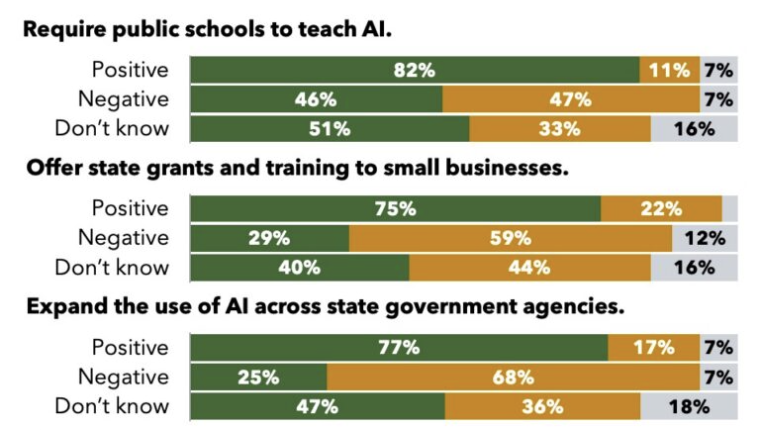
As state legislative sessions near, the bills that get the most headlines will likely deal w/ frontier issues.
But we ought to pay attention to "boring" AI topics, too.
Here's a smattering of policies expected by Oregonians, for example.
via DHM Research.
My colleague @gq_pablo has called this the "court-as-legislator" model, and New Mexico is becoming the exemplar. Soon, I fear, it will spread as contagion, stripping consumers of free speech rights and backdooring policies that would otherwise be unconstitutional, all under the guise of "consumer protection." theamericanconsumer.org/2026…


The funny thing on this decision is that states keep losing in court when they regulate online speech directly. Thus, they are getting creative and are trying a consumer-protection workaround. New Mexico's $25B verdict against Meta today is example number 1. Any content-moderation choice can now be relitigated as an "unfair practice."
Logan Kolas retweeted

Everyone talks about what AI will do. But almost nobody asks who will pay for the machines. Taking advantage of AI will require an extraordinary amount of capital, from data centers to new power plants. Will that capital be around?
I try to address that question in the first draft of my new paper “Saving for the Machines.”
To show how important capital is to fuel the transition to an AI-based economy, I document how the same technology path that generates 11.7% annual growth when households choose their saving rate optimally delivers only 2.2% when the saving rate remains fixed. In other words, if we experience slow growth over the next few years despite fast improvements in AI, this slow growth may reflect too little capital accumulation instead of a technological bottleneck.
The key to this result is that AI raises the capital share by moving tasks from labor to machines, which requires that those machines are built. In comparison, ordinary technical progress makes labor and existing machines better at the tasks they already perform.
To inspect the mechanism, I start from an accounting identity: the saving rate is the capital share times the ratio of investment to capital income. If I take the evolution of the capital share as given, I can ask how much the latter ratio moves in response to that evolution. Crucially, with an optimizing household, this ratio barely moves. As machines take over tasks and the return to capital rises, the household responds by letting consumption grow faster, by the intertemporal elasticity of substitution times the rise in the return. To pay for that faster consumption, capital must also grow faster by the same amount. So, the household keeps investing about the same fraction of what the machines earn. And since machines earn a larger share of output, the saving rate also goes up. With a fixed saving rate, the same accounting identity tells me the opposite: the ratio falls in proportion as the capital share rises.
Will the U.S. and other advanced economies then generate enough capital? For many reasons, I doubt it. We might end up in a situation where many of the opportunities offered by AI are left on the table. This is particularly important for all who think that AI might get us out of many problems, such as fiscal troubles (like in France) or ultra-low fertility. We need to save for the machines, and it is not clear we can do that.
Anyway, this paper has been long in the making (many months of hard work), but I have learned much from it. In particular, working through the model changed my mind about many issues related to AI. Again and again, my intuition said X, but the math said Y. And math always won in the end. That is why we write formal models.
A nice example is Proposition 5, whose proof is the one I like the most in the paper. With improving machines and strong task complementarity, there is no fixed balanced growth path because the target itself keeps moving. The nice part of the proof is to realize that, after the right normalization, the moving target becomes a fixed point, and the saddle gets steeper as machines improve. So instead of falling behind, the economy tracks the moving BGP more and more closely. A fair amount of ODE work to get there, but a very simple economic idea underneath it once you get it.
The paper is here:
sas.upenn.edu/~jesusfv/Savin…
and the slides are here:
sas.upenn.edu/~jesusfv/Slide…

Logan Kolas retweeted

HT to @jasonfurman for flagging a really good thread on the human side of technology displacing jobs.

🧵1/10 Given the recent reactions of mathematicians over rapid advances in AI, I think it is important to remember that technological change has historically been a very personal event for people.
Over the history of technological progress, looms have fallen silent, switchboards have gone dark, and factory lines have shrunk bringing with them a human crisis of identity and what it means to be a master of one's craft.

Louisiana has become a broadband trendsetter other states should follow. @NateKarrenOnX explains in @GOVERNING what has gone right in the Bayou. governing.com/infrastructure…

Logan Kolas retweeted

OpenCode is currently under a sustained cyberattack, and mid-incident they ran into the same problem Hugging Face did: the frontier models they were using for defense began refusing to help fight attacking agents because analyzing the attacks started triggering safety guardrails.


Logan Kolas retweeted

Cincinnati DT Josh Hough is carted off with an injury at West Virginia and only ends up in more pain after the cart backs him into a wall.
As seen on the TNT Sports broadcast.
Logan Kolas retweeted

Many people who work closely on AI and are constantly seeing charts like the one on the left (AI capability growth) think that it will translate to the graph on the right (GDP growth). But the economy is much more complicated than that.


Logan Kolas retweeted

AI is helping Americans shop, but 42% don't trust it to make a purchase yet
Even in the most popular categories, only about a quarter would let AI choose and buy for them:
- 27% for clothing
- 26% for electronics
- 25% for travel
Charts of the Week: a16z.news/p/this-week-in-cha…


More than 1 in 3 Americans bought something based on an AI recommendation in the past year
44% say AI helps them find better value for money
34% would pay more for a product if AI showed it was the best option for them
Charts of the Week: a16z.news/p/this-week-in-cha…
