
Economist. Views are my own.
Joined April 2013
- Tweets497
- Following298
- Followers615
- Likes901






Lucia Foster retweeted

Super interesting CES paper on AI exposure versus actual adoption at the firm level.
"Exposure is positively and statistically significantly associated with adoption, but explains only a modest share of its variation."
www2.census.gov/library/work…
Lucia Foster retweeted

AI use for any business function is concentrated in selected sectors and large firms and primarily for augmentation of worker tasks rather than substitution, from Kathryn Bonney, Cory L. Breaux, Emin Dinlersoz, @Lucia_Econ, @JHaltiwanger_UM, and Aditya A. Pande nber.org/papers/w35141

Lucia Foster retweeted

We have a new gold-standard assessment of AI usage by American firms courtesy of the @uscensusbureau Business Trends & Outlook Survey.
1/ AI adoption is fairly high IMHO. Almost 1 of 5 firms. But much lower than discourse on Twitter would lead you to expect.

Lucia Foster retweeted
Now that I've had time to read the paper, here are a few things I'd flag for folks. Do read it. They did a great job with the new BTOS AI Supplement questions and describing the data.
tldr: No big self-reported employment effects of AI use (+ or -), use tends to be augmenting rather than automating, use is associated with better firm performance.
1. The BTOS tables don't give employment weighted stats, but the papers do. Here we get another peek at emp-weighted stats. 18% of firms using AI but they account for 32% of employment.
2. Worker augmentation is far more common than automation, which happens about as often as task creation. 44% of AI-using firms are augmenting workers, 10% use AI to replace tasks, and 11% created tasks. Conditional on automating tasks, 71% say it's for a "small number" of tasks.
3. As John noted, the overwhelming majority of AI-using firms say AI didn't impact their employment (96%), the remaining are split almost evenly between increase (2.3%) and decrease (2%). Capital replacement is more common (16% of AI-using firms).
4. AI use on both the extensive and intensive margin is associated with better firm performance, both now and expectations about the future. This shows up both in the summary stats (Table 8), and in regressions controlling for size, industry, geography, and time (Table 9).
5. AI use is also associated with relatively small increase in the probability of expecting employment decreases, but interestingly, these are pretty stable (current decreases are similar to future decreases). In fact, in some places the coefficient on future emp declines is actually smaller than the one for current declines (Table 10, 11).
A couple other things caught my eye.
6. Interesting that the % of firms only creating new tasks is much higher firm-weighted than emp-weighted, suggesting they tend to be small firms. Easy to tell yourself a story about small firms being able to "do more". (Figure 15)
7. Large firms are doing a lot of training, firm-weighted % of firms saying they are training staff on AI was about 15%, but emp-weighted it jumps to maybe 35% (hard to tell eyeballing the graph). (Figure 18)
8. Even now, a very large share of firms still say AI is not applicable to them, 65% of firms and maybe 45% emp weighted. (Figure 19)
PS: Those here for the debates about AI measurement, there are two easter eggs for you in the paper: (1) there is a nice description about the November 2025 BTOS AI definition switch ("in production" to "any biz function"), (2) there is an exhaustive comparison to other estimates (e.g. Yotzov et al. (2026) finding 69% of firms using AI).

New BTOS AI Supplement released by Census today. See: census.gov/library/working-p…
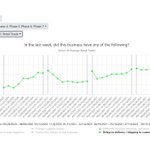
AI use for any business function varies dramatically across sectors and firm size. Employment-weighted use in AI intensive sectors in 60-70% range compared to 32% economy-wide.

Lucia Foster retweeted

Questions about #ArtificialIntelligence are now updated on our Business Trends and Outlook Survey to help respondents fully capture their business use of #AI.
Here are our latest findings.
Explore more #BTOS data: census.gov/newsroom/press-re…

Lucia Foster retweeted

Congratulations to Philippe Aghion, Peter Howitt and Joel Mokyr for a well-deserved Nobel Prize. It was nice to see the US Census Bureau's Business Dynamic Statistics featured as motivating evidence in the scientific writeup: nobelprize.org/uploads/2025/…

Lucia Foster retweeted

U.S. productivity is popping. And it’s not because of AI. washingtonpost.com/opinions/…

Lucia Foster retweeted
AI use by businesses is small but growing rapidly, led by IT sector and firms in Colorado and DC | AP News apnews.com/article/ai-census…

Lucia Foster retweeted
AI use for business purposes is relatively small but growing rapidly, from Kathryn Bonney, Cory Breaux, @cathybuffington, Emin Dinlersoz, @Lucia_Econ, @ngoldschlag, @JHaltiwanger_UM, Zachary Kroff, and Keith Savage nber.org/papers/w32319

Lucia Foster retweeted

Great line-up in the special issue of JEMS! We managed to get @JWaldfogel, @timobres, @joshgans, @avicgoldfarb, @k_mcelheran, @erikbryn and many other awesome authors in the same issue!


📢 NEW RELEASE!
Announcing the JEMS Special Issue on Artificial Intelligence and the Business Revolution.
Guest Editors: Hanna Halaburda, Jeffrey Prince, D. Daniel Sokol, Feng Zhu
📍The SPECIAL ISSUE is here: onlinelibrary.wiley.com/toc/…

Lucia Foster retweeted
🤖🔮New *Real Time* Data and Working Paper on AI Use 🤖🔮
Our earlier work using firm survey data on AI use was prior to the rise of LLMs. This new data from BTOS covers Sep '23 to Feb '24 and asks about both current use and future expected use of AI. census.gov/library/working-p…
Lucia Foster retweeted
📢New data and working paper!📢
Business dynamics of high-growth firms, 44 new tables of BDS stats by firm growth rates with the stock and flow of firms, establishments, and employment covering over 4 decades. @JHaltiwanger_UM @choijk85 @jdanielkim census.gov/programs-surveys/…
Lucia Foster retweeted
Released today is Census BTOS data and working paper on AI use by businesses in real time (September 2023-February 2024). Working paper can be found at:
census.gov/library/working-p…
AI use for business purposes remains relatively small but growing. Higher at larger businesses:

Lucia Foster retweeted

Lucia Foster (@uscensusbureau) highlighted new data available on adoption of #AI across industry sectors and noted forthcoming survey data asking holdouts why they aren’t adopting it.
#AMEC symposium >>
nyfed.org/3NVr0PT

Lucia Foster retweeted

Welcome Commissioner McEntarfer! : U.S. Bureau of Labor Statistics @ErikaMcentarfer bls.gov/blog/2024/welcome-co…
So happy for you and BLS!
Lucia Foster retweeted
Registration is open for the next #AMEC symposium—U.S. Productivity Growth: Looking Ahead
See the lineup of sessions and speakers here:
nyfed.org/3NVr0PT
Hybrid event
Friday, Feb. 16
9:30 am-3:00 pm
#AI #supplychain #superstarfirms #productivity #inequality #cities
Lucia Foster retweeted

CONFIRMED: Erika McEntarfer to be Commissioner of Labor Statistics, Department of Labor
By a vote of 86-8.
Lucia Foster retweeted

Nathan Goldschlag finds that fewer inventors are at small, young firms and more at older, larger firms.
How might that affect the nature of innovation?

Lucia Foster retweeted

@ngoldschlag presents his awesome new paper with @ufukakcigit showing new firms are better at innovation!

Lucia Foster retweeted
Responses to our Business Trends & Outlook Survey Oct. 23-Nov. 5 show 3.9% of firms currently use Artificial Intelligence or AI, and 6.5% expect to in the future.
#BTOS indexes measure recent or expected changes to business conditions: census.gov/hfp/btos/data
#CensusEconData
