




Melissa Harman retweeted

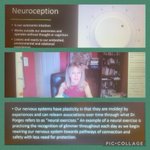
Stephen Porges polyvagal theory helps broaden our understanding of the nervous system & physiological states .
I have spent a lot of time this term teaching it to our pupils, giving them the power of self-regulation to support their brain health & emotional well-being.


Melissa Harman retweeted

Finally watched it all. Extraordinary.


Melissa Harman retweeted

In The Anxious Generation, I focused on the mental health effects of The Great Rewiring of Childhood, because that's where we have the most evidence.
But since the book came out in 2024 I have begun to believe that the global reduction in the human capacity to pay attention may a greater harm to humanity, a larger hit to human potential and human capital.
I'm grateful to @StevenBartlett for hosting a two hour conversation with me and Dr. Aditi Nerurkar (a stress expert with great insights into the emotional effects) on the factors that are damaging attentional capacity and executive function -- particularly short-form videos, which now fragment attention on an industrial scale.
Here's our conversation on Diary of a CEO:
youtube.com/watch?v=EScgrk7o…

Melissa Harman retweeted

IU alumnus Jane Pauley's CBS Sunday Morning segment on Indiana Football will make you feel things. A must watch for Hoosiers.
Hail to Old IU. 🥹
Melissa Harman retweeted
A pupils developmental age & chronological age are not always aligned.
Trauma,neglect can impact the way their brain moves through the trajectory of development. In educational settings,this is why we need to understand trauma, especially as it relates to development.🧠🌱

Melissa Harman retweeted

I spy Butler’s Hinkle Fieldhouse in the new Caitlin Clark Nike commercial 🔥
#DawgsOnly
Melissa Harman retweeted

"My name's Raymond. I'm 73. I work the parking lot at St. Joseph's Hospital. Minimum wage, orange vest, a whistle I barely use. Most people don't even look at me. I'm just the old man waving cars into spaces.
But I see everything.
Like the black sedan that circled the lot every morning at 6 a.m. for three weeks. Young man driving, grandmother in the passenger seat. Chemotherapy, I figured. He'd drop her at the entrance, then spend 20 minutes hunting for parking, missing her appointments.
One morning, I stopped him. "What time tomorrow?"
"6:15," he said, confused.
"Space A-7 will be empty. I'll save it."
He blinked. "You... you can do that?"
"I can now," I said.
Next morning, I stood in A-7, holding my ground as cars circled angrily. When his sedan pulled up, I moved. He rolled down his window, speechless. "Why?"
"Because she needs you in there with her," I said. "Not out here stressing."
He cried. Right there in the parking lot.
Word spread quietly. A father with a sick baby asked if I could help. A woman visiting her dying husband. I started arriving at 5 a.m., notebook in hand, tracking who needed what. Saved spots became sacred. People stopped honking. They waited. Because they knew someone else was fighting something bigger than traffic.
But here's what changed everything, A businessman in a Mercedes screamed at me one morning. "I'm not sick! I need that spot for a meeting!"
"Then walk," I said calmly. "That space is for someone whose hands are shaking too hard to grip a steering wheel."
He sped off, furious. But a woman behind him got out of her car and hugged me. "My son has leukemia," she sobbed. "Thank you for seeing us."
The hospital tried to stop me. "Liability issues," they said. But then families started writing letters. Dozens. "Raymond made the worst days bearable." "He gave us one less thing to break over."
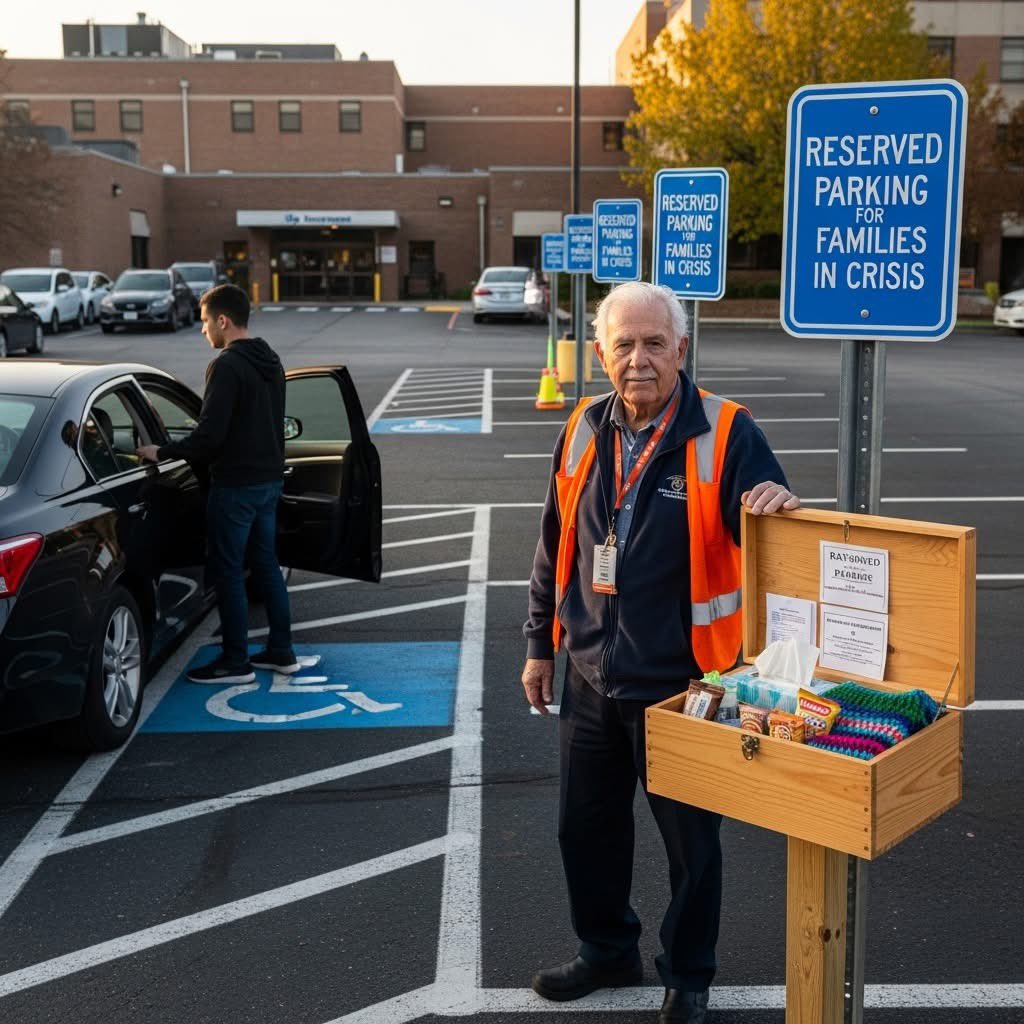
Last month, they made it official. "Reserved Parking for Families in Crisis." Ten spots, marked with blue signs. And they asked me to manage it.
But the best part? A man I'd helped two years ago, his mother survived, came back. He's a carpenter. Built a small wooden box, mounted it by the reserved spaces. Inside? Prayer cards, tissues, breath mints, and a note,
"Take what you need. You're not alone. -Raymond & Friends"
People leave things now. Granola bars. Phone chargers. Yesterday, someone left a hand-knitted blanket.
I'm 73. I direct traffic in a hospital parking lot. But I've learned this: Healing doesn't just happen in operating rooms. Sometimes it starts in a parking space. When someone says, "I see your crisis. Let me carry this one small piece."
So pay attention. At the grocery checkout, the coffee line, wherever you are. Someone's drowning in the little things while fighting the big ones.
Hold a door. Save a spot. Carry the weight no one else sees.
It's not glamorous. But it's everything."
Let this story reach more hearts....
Credit: Mary Nelson
Melissa Harman retweeted

Trauma occurs when sensory information comes in too much and too fast, or for too long and too little... It can stun the nervous system, BUT when we have a trusted other, and our anchors to resource our nervous systems, this overwhelm can be mitigated!


Melissa Harman retweeted

Trauma, Resilience, and Relational Poverty | Dr. Bruce Perry - 951 omny.fm/shows/roll-with-the-…


Melissa Harman retweeted
Teens brains are still under construction, especially the prefrontal cortex. (thinking,planning, problem solving)
The emotional centre is on overdrive(amygdala)
Mood swings,shutting you down. It's not rebellion,its development.The brain is rewiring.
Schools need to know this🧠🌱


Melissa Harman retweeted
It is biologically impossible for a pupil to absorb or process information in educational settings if they are anxious, scared ,worried , or afraid.
All of their lower brain functions are focused on coping and surviving, not learning or growing.
Basic neuroscience. 🧠🌱

