

We study the processes that shape landscapes on Earth and other planets.
Cambridge, Massachusetts, USA
Joined January 2013
- Tweets90
- Following4
- Followers1.7K
- Likes34





MIT scientists measure river flow rates on Mars and Titan, Saturn’s largest moon bostonglobe.com/2023/08/08/m… via @BostonGlobe

The Perron Group at MIT retweeted

Working at the intersection between surface processes and biology? Please submit to our #AGU23 session on Ecogeomorphology, with invited speakers Xiaoli Dong and Eyal Marder
@VendittiLab @MITgeomorph
LINK: agu.confex.com/agu/fm23/prel…

The backstory on Sam's paper from @MIT @ScienceMIT

A new technique uses remote images to gauge the strength of ancient and active rivers beyond Earth. The approach allows geologists to see how intensely rivers once flowed on Mars, and how they currently flow on Titan, which is Saturn’s largest moon. mitsha.re/B5z150P8KW8

ALT An image showing Titan's river and lake system.

New in @PNASNews: Sam Birch estimates river flow and sediment transport rates on ancient Mars and present-day Titan using only channel width and slope. doi.org/10.1073/pnas.2206837…

The Perron Group at MIT retweeted

"If we can understand the geologic factors that contribute to biodiversity, we can do a better job of conserving it," says @eapsMIT professor Taylor Perron news.mit.edu/2023/river-eros…

7/7 This mechanism could have increased freshwater biodiversity elsewhere in the Appalachians, and in other ancient mountain ranges. A collaboration with @TJNear @DaeminKim3 @TVAnews @hybridActinop @BenavidBolivia @juliawood527 @yalepeabody @eapsmit doi.org/10.1126/science.add9…

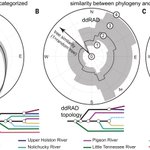
6/7 The order in which fish populations would have been isolated by this geological mechanism matches the order implied by genetic data.

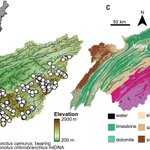
5/7 As rivers eroded through different types of rock, the extent of metamorphic rock in the upper Tennessee shrank – trapping Greenfin Darter populations in separate tributaries, where they have started to evolve into different species.

4/7 We realized that Greenfin Darters only live in metamorphic rock – not in sedimentary rock. Data from the Tennessee Valley Authority @TVANews.

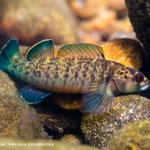
3/7 We studied the Greenfin Darter as an example. DNA shows that Greenfin Darters living in different tributaries of the upper Tennessee River are genetically distinct, which means they have been isolated from one another for a long time. What’s the mechanism?

2/7 We know that young mountain ranges like the Andes can be centers of biodiversity…but so can old mountain ranges like the Appalachians, especially for freshwater species. Why?
New in @sciencemagazine: Maya Stokes shows how rivers eroding through different types of rocks help explain high freshwater biodiversity in old mountain ranges like the Appalachians. With @TJNear @DaeminKim3 @TVAnews doi.org/10.1126/science.add9…

ALT The Greenfin Darter, Nothonotus chlorobranchius. Photo by Isaac Szabo.
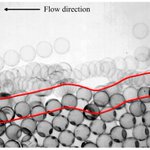
Sediment transport rate depends on how many grains are in motion and how fast they are moving. Santiago Benavides @s_j_benavides shows that when bedload flux is on-off intermittent (punctuated by rare, large bursts), it's because of the "how fast" part. doi.org/10.1029/2022GL101919

ALT Strobed photograph of spherical grains moving as bedload in a laboratory flume
Mrs. @MITgeomorph, a.k.a. @LisaVPerron, has been busy writing books for children. Her debut, out today, has some beautiful landscapes and other charismatic patterns from the natural sciences. More info and ordering options here: lisaperronbooks.com/books/#p…
