

/ Panta Rhei \ Tantum Quantum Possum Guaranteed Human (with all its merits and flaws)
🌏🇪🇺🇩🇪 Hansestadt Hamburg
Joined November 2015
- Tweets23.9K
- Following376
- Followers374
- Likes9.2K




Pinned Tweet
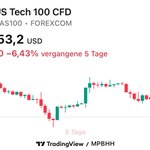
Interesting monthly #NAZ100 candle! 🧐🧐
This will not portend well going forward for markets.
[at least how I've learned to interpret charts]
#QQQ #SPY
Bears may rejoice 😎
C/ @MauiBoyMacro

Michael P. Bornemann retweeted

Today is what we call the
Working Group on Financial Markets
stepping in
DYOR
Michael P. Bornemann retweeted

The Starshield restrictions in Ukraine have created a vicious circle: neither of the key stakeholders has been able to clarify who made the decision to impose these limitations.
The longer this situation remains unresolved, the greater the risk that it will gradually disappear from the attention of those who have the authority to address it. We cannot allow that to happen.
To be frank and straightforward: Ukrainians already face enough life-threatening challenges as a result of Russia’s ongoing aggression. We cannot afford to accept the disruption of a critical service such as Starshield as just another episode and simply move on. This issue must remain on the agenda until it is fully resolved.
This technology has saved countless lives in Ukraine by enabling us to effectively intercept Russian drones. We, and generations of Ukrainians to come - our children and grandchildren - will remain forever grateful for that. However, the sudden restrictions, imposed without any prior warning more than a week ago, have placed Ukrainian civilians in additional danger. Every day these limitations remain in place creates real risks and potentially devastating consequences for people on the ground.
Russia continues to expand its drone production and launch thousands of drones against Ukraine every week. At a time when the scale and intensity of these attacks are growing, any disruption to a capability that helps protect Ukrainian lives is a matter of the utmost urgency. We simply cannot afford to let this issue fade away
Michael P. Bornemann retweeted

Morten Morland on #JensenHuang’s return to #Nvidia #Trump @thetimes – political cartoon gallery in London original-political-cartoon.c…

Looking for Paisley Canal Station, anyone?
/ @GeorgeCochrane1


2
70

Michael P. Bornemann retweeted

The recent crude oil glut prognosis had the hollow ring of propaganda to me…

Chinese refiners are accelerating crude purchases, writes Bloomberg's @yongchang_chin
Oil is cheaper but hardly cheap.
Why buy aggressively now if an oil glut is coming?
Perhaps Chinese buyers are less convinced of an impending surplus than market commentators are.
theedgesingapore.com/news/oi…
HT @staunovo
Michael P. Bornemann retweeted
“Miller is the son Trump wanted. Worshipful, aligned, smart, and ruthless.
When Trump looks at Miller, he sees a guy who would volunteer to be buried in the tomb with the pharaoh.
Who do you think is more attractive to an aging pathological narcissist?”
open.substack.com/pub/thebul…

Why people still do business with this serial bankrupter is beyond me! 👀🤷♂️

Vom Wunderkind zum Zahlungsflüchtigen: Lars Windhorst war einst das deutsche Gesicht der «New Economy». Nun hat sich der Investor nach Dubai abgesetzt – mit Schulden von 519 Millionen Franken im Gepäck. Hier lesen Sie den ganzen Artikel:
10


Michael P. Bornemann retweeted

I don’t think many investors are aware (or understand the relevance) that $NVDA is incorporated in Delaware. The Delaware Court of Chancery will preside over all shareholder and derivative lawsuits.
IYKYK


Michael P. Bornemann retweeted

NEW: Alice Huang to Jensen Huang: “I’d like to be reinstated as your mistress and Chinese spy, too.” 🥴

Excellent commentary - especially noteworthy for the uninitiated investor !
>> Irrationality, hubris, and complacency are all signposts of expiring bull markets. << 🔥
Must read. c/ @SchiefenHg @JokerPKO

My Editorial In Barrons Over The Weekend
I authored an editorial - What A Corporate Scandal Says About Our Bull Market - in this weekend's "Other Voices" section of Barrons magazine. I hope you enjoy reading it.
COMMENTARY
What a Corporate Scandal Says About Our Bull Market
By Doug Kass
Nov 20, 2026 12:06 pm EST
Scandals like Nvidia’s inevitably emerge as markets peak.
It always happens at the end of an economic expansion, as a bull market begins to wind down: The risks, the frauds, and the corrupt suddenly appear in broad daylight.
Sometimes they come in the form of overexuberant corporate executives who have been quietly skating on the thin ice of business ethics, like former Nvidia CEO Jensen Huang.
Or they emerge from within our country’s leadership, when figures like former plumber, now Secretary of Homeland Security Markwayne Mullin and former reality TV star, now Transportation Secretary Sean Duffy, are exposed as incompetent lackeys.
But the truth always surfaces when the tides go out. Major scandals featuring questionable figures—Enron, WorldCom, Tyco, Countrywide Credit, Joe Granville, the savings and loan crisis—all appeared late in their respective economic and market cycles.
Seen in this light, the recent revelation of the Nvidia CEO’s affairs with an executive at the firm and an alleged Chinese spy, and his company’s sales to the latter’s Singapore-based shell company, which potentially routed banned Nvidia chips to China, is a classic late-cycle phenomenon. (The Washington Post has also reported that President Donald Trump’s stake in Nvidia had risen as high as $62 million this year, raising more questions about impropriety).
Huang is far from the first business leader to fall from grace in such terrible fashion —the predicament of being human never changes.
Collectively, we tend toward excess. In July 2007, as some of Bear Stearns’ hedge funds were collapsing and New Century Financial was deep in bankruptcy proceedings, Chuck Prince, then Citigroup CEO, told the Financial Times that “as long as the music is playing, you’ve got to get up and dance. We’re still dancing.” Bankers and investors danced over cracks in the credit and housing markets that appeared in the winter of 2007, just as they did in late 1999 as the dot-com boom neared maturation.
Time and time again, market participants have shown they will dance right up until the music stops. They are confident or haughty enough to think that they can anticipate the signposts of a market top. Of course, assessing when an excess is reaching a tipping point is never so easy.
But such a moment is guaranteed: Excesses are never permanent.
In hindsight, former Federal Reserve Chair Alan Greenspan’s “irrational exuberance” idea wasn’t wrong, just premature. Irrationality, hubris, and complacency are all signposts of expiring bull markets. Investors lower their guard. Corporate accounting guardrails drop, as erroneous claims like “price is truth” and questionable accounting practices like “non GAAP” earnings per share gain acceptance.
Large market drawdowns follow.
I believe we are nearing a similar decline, but there are differences compared with 1999 and 2007 that make today’s market shakiness more troubling. The magnitude of investment in AI is much larger than that in the internet at the height of the dot-com boom.
Hyperscalers’ capital expenditures as a share of gross domestic product this year is more than double the telecoms’ capex in 1999, according to Apollo Global Management. The federal government is also far more significantly leveraged than it was in 2007—the debt as a share of GDP is roughly twice as high now.
Another difference today is the leverage in the cryptocurrency and private-equity markets. New risks accompany a more-levered market structure, in which passive investing activities like quant strategies and electronic-traded funds that “worship at the altar of price momentum” dominate active investing.
Too many investors reside on the same side of the boat.
It’s also worrisome that a substantial portion of U.S. economic growth depends on technology companies that are massively interconnected via circular financing schemes, nondisclosed leverage, and dubious accounting practices.
Artificial-intelligence proponents argue that productivity gains from AI and machine learning represent our best hope for future economic prosperity. But, thus far, it seems that AI may eliminate jobs and shrink rather than grow corporate spending.
A recent study by researchers at the Massachusetts Institute of Technology claims that AI can already replace 11.7% of the U.S. labor market. As the hyperscalers charge ahead trying to perfect their AI models, our society is ill prepared for the consequences if they succeed.
Our markets are poorly positioned if they fail. To this observer, so much could go wrong in the time ahead. Yet, until very recently, few have been actively anticipating a potential downturn.
It’s as if we all forgot the other piece of Prince’s quote to the FT, the part where he warned that “when the music stops, in terms of liquidity, things will be complicated.”
When the wind is at investors’ backs and the tide is coming in, it’s easy to believe in a new paradigm of uninterrupted economic and corporate growth, in which investors’ money trees will reach to the sky. But corruption and indiscretions are surfacing, idolatry is gaining acceptance, incompetent government officials are facing unforeseen issues, companies are up to accounting tricks, and industries like AI thrive on convoluted financing—right in front of our very eyes.
As in the case of Huang, scrutiny is the night to the very bright day of invulnerability and impunity.
Doug Kass is president of Seabreeze Partners Management and general partner of the Florida-based hedge fund Seabreeze Capital Partners.
@andrewrsorkin @beckyquick @saraeisen @TheJudgeCNBC @carlquintanilla @guyadami @SullyCNBC @KeithMcCullough @HedgeyeDJ @Hedgeye_HGRO @RPKInvestor @HedgeyeDJ @gnoble79 @tomkeene @ferrotv @lisaabramowicz1 @business @annmarie @joesquawk @peterboockvar @convertbond @whitneytilson @carlquintanilla @TheJudgeCNBC @CNBCFastMoney @HalftimeReport @maddow @RahmEmanuel @cnn @msnbc @sruhle

Michael P. Bornemann retweeted

God damn man do you ever stop complaining? You could afford to do effectively anything and you choose to complain that interest rates go up. Pull yourself up by your bootstraps and work out how to profit instead of crying about every little obstacle!

I think the Fed is about to make another mistake on December 9th. Financial conditions have tightened massively. For example, @SpaceX, an investment grade company, just raised secured debt financing at an 8.259% interest rate versus below 6% for its unsecured bond offering at the time of its IPO.
The cost of equity capital has also increased materially with the recent substantial decline in the stock market.
The Fed’s 2% inflation ambition is misguided. Geopolitical risk and the required investment in global military spending, de globalization and tariffs, and the massive AI infrastructure and related energy investment are features of the world that did not exist when the 2% target was set. 3% inflation is a more realistic ambition in the new world.
The Fed will put the U.S. and world in recession if it continues to raise rates in a failed attempt to drive inflation to 2%.
Tell me why I am wrong.

