

MSU Department of Entomology https://teapawt.net/t.co/8ESJpsr4Wg
- Tweets361
- Following260
- Followers432
- Likes77
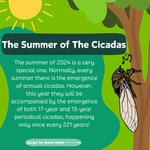




ALT A green background with a cartoon tree and a cicada. Text reads: The Summer of the cicadas. The summer of 2024 is a very special one. Normally, every summer there is the emergence of annual cicadas. However, this year they will be accompanied by the emergence of both 17-year and 13-year periodical cicadas, happening only once every 221 years! Swipe to learn more.

ALT This page shows a title with two boxes. One labelled annual cicadas with a picture of a green cicada and the other labeled periodical cicadas with a black and red cicada. Text reads: The annual and periodical cicadas. Annual cicadas There are around a dozen different species of annual cicadas in North America. Typically, they are larger with black and green coloration. The lifespan of these cicadas is significantly shorter, ranging from 3-5 years. Periodical cicadas There are 7 North American Periodical cicadas. They appear black with red eyes and legs. These cicadas emerge from the ground and mature into adults every 13 or 17 years depending on the species.

ALT This page has a title with a text box. You can see cartoon cicadas with music notes and hearts. There is an image of a cicada with an arrow labeled tymbal pointing to a spot behind the cicada wings. Text reads: The songs of the cicadas. To attract females, male cicadas produce their signature high-pitched and continuous song by vibrating their tymbals, a small, rubbery structure in male cicadas. When this structure is vibrated it generates the sound waves we hear outside. Most female cicadas lack a tymbal and instead rub their wings together to make a clicking sound to attract males.

ALT This page shows a flow chart showing an egg, cicada nymph, a cicada molting, and a cicada. Text reads: Adult cicadas live for only a few weeks, focusing on reproduction. They lay their eggs on woody plant tissue. Eventually, the nymphs will hatch and burrow underground. Most of a cicada's life is spent as nymphs underground feeding on fluid from the roots of plants called the xylem. Once it is time to emerge, the cicadas will molt from their nymph stage to an adult cicada with wings. Scientists are unsure of the exact method used by cicadas to synchronize their emergence.

ALT A green background with a large cartoon mosquito on the right side. At the bottom there is the MSU Bug House Logo. To the left there is text that reads: prevent bites without pesticides mosquitos. Mosquitos are irritating pests who carry disease. Here are some effective methods to reduce or prevent mosquito bites around your home!

ALT Background is still green. There is a image of mosquito larvae and a bucket spilled over with mosquito larvae in the water. The text reads: remove still water. Still water is the breeding ground for mosquitos. Mosquito larvae require still water habitats to survive. Eliminating still water from your property can be an effective way to reduce the amount of mosquitos present. Even the smallest water containers such as buckets, tires, pots, and tarps can provide a habitat for breeding mosquitos. Remove these breeding grounds by flipping them over to prevent the pooling of water.

ALT A green background with various plants. Text reads: Repel Naturally. Some plants naturally deter mosquitos! Planting these near outdoor seating is a natural way to repel the mosquitos. Here are some natural repellant plants: lavender, basil, marigolds, peppermint, catnip. It is important to note that some of these are not native depending on your region. It is best to plant these in planting boxes and pots. Citronella candles are also effective at repelling mosquitos.

ALT Green background with birds and bats and bird houses. Text reads: Attract predators. Many species of birds and bats consume mosquitos. Attracting these natural predators will help keep your mosquito population in control. Installing bird feeders, bat boxes, and nesting boxes is a great way to attract birds to feed on mosquitos.

ALT In the background there is an image of our tarantula display. You can see various enclosures and pinned insects. In the center there is a white box with the MSU Bug House logo and text. Text reads: August open house Monday, August 12 5:30-7:30 Join us for free! 288 Farm LN Nat Sci Room 147 East Lansing, MI 48824

ALT A collage of four photos with a logo in the center that looks like a chalkboard that says "insects in the classroom MSU Bug House 2024". One photo shows two participants handling Madagascar hissing cockroaches, one shows participants viewing a presentation about insects, one shows a participant filling out a worksheet, and the last one shows a photo of blue death feigning beetles in their enclosure.

ALT Page 1: A dark blue background with a picture of a firefly as well as a cartoon image of a child catching fireflies with the MSU Bug House logo in the corner. Text reads: Fireflies! One of the most magical moments of summer is the emergence of fireflies. Fireflies, also known as lightning bugs, are beetles belonging to the Family Lamypridae, which includes 125 species. The eastern firefly (Photinus pyralis) os the species most frequently caught in mid-Michigan backyards. Swipe to learn more!

ALT Page 2: On the right side there are 4 images. One shows a firefly glowing from a distance, 2 show firefly larvae labeled with arrows, and the last one is an up close image of a firefly glowing. Text reads: In most firefly species, the flashing of their abdomen is used to find mates, with each species having a unique glowing pattern for identification. While in the larval stage, Lampyridae larvae produce a steroid that makes them unappealing to predators. They glow to advertise their distastefulness, signaling to predators that they are not a good meal choice.

ALT Page 3: At the bottom there is a flying cartoon firefly with a question mark above its head. Nearby, there is an image of a firefly and a sign that says: warning suspicious fireflies. Text reads: Fireflies mainly use their glow to find mates, but some have found additional ways to exploit this phenomenon. For example, the predatory female fireflies of the Genus Photuris will flash in response to the flashes of other firefly species. The unsuspecting firefly approaches the Photuris female, hoping to find a mate, but is caught and consumed instead!

ALT Page 4: Text reads references. Check out these resources to learn more!

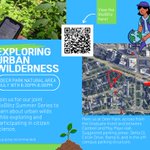
ALT A blue screen an image of a garden and the location of Deer Park. A QR code is present that says "View the BioBlitz here!" Text reads: Exploring urban wilderness. Deer Park Natural Area July 16th 6:30-8:00pm. Join us for our joint BioBlitz Summer Series to learn about urban wilds while exploring and participating in citizen science. Bug spray is recommended. Meet us at Deer Park, across from the Graduate Hotel and between Cambell and Mayo Hall. Suggested parking areas: Delta Ct, Circle Drive, Ramp 6, and in the off-campus parking structure."

ALT A poster that looks like a chalk board. At the top you can see logos for department of entomology at Michigan state, a NSF logo, and the MSU Bug House Logo. On the bottom you can see chalk grass, a chalk orange flower, and a chalk bee and butterfly flying around it. You can also see a QR code at the bottom. Text reads: Insects in the classroom, a free 1-day professional development workshop for teachers! July 12, 2024 10am - 3pm. Insects are fascinating creatures who live in our own backyards! This workshop will provide demonstrations and resources to empower teachers to incorporate more entomology in their classrooms.

ALT The background is a collage of arthropods including bees, beetles, cockroaches, tarantulas, and superworms. In the center, there is a dark green box with text that reads: Happy National Insect Week from the insects and other arthropods at the MSU bug House. Next to the text is the Bug House logo.

ALT There is an image of a prairie but the only thing in focus is a few wildflowers and grasses on the right. You can see various insects climbing the plants. At the top left there is a white circle framed by a wreath like design with small flowers and some white butterflies. Text reads: July Open House All are welcome! Join us for free, no registration is required. Monday July 8th 5:30-7:30 pm 288 Farm Ln Nat Sci Room 147 East Lansing, MI 48824

ALT A poster that looks like a chalkboard. At the top you can see logos for the department of Entomology at Michigan State, a NSF logo, and the MSU Bug House Logo. On the bottom you can see chalk grass, a chalk orange flower, and a chalk bee and butterfly flying around it. You can also see a QR code at the bottom. Text reads: Insects in the classroom, a free 1-day professional development workshop for teachers! July 12, 2024 10am - 3pm. Insects are fascinating creatures who live in our own backyards! This workshop will provide demonstrations and resources to empower teachers to incorporate more entomology in their classrooms.


ALT A bright blue background with abstract green floaty shapes, and a bouquet of yellow and pink flowers with long striped leaves and small round leaves. Bees fly around and a beetle crawls up a leaf. Text reads "The MSU Bug House presents: 2023 Insects in the Classroom Workshop, Friday, July 21, 10am-3pm." A chalkboard holds additional text reading: "K-5 Teachers! Learn how to use insects in your classes during this FREE workshop!" One last bit of text reads: "Register here: https://bit.ly/BH_Workshop" At the bottom of the flyer are the logos for NSF (a globe with yellow shapes surrounding it and the letters NSF), MSU (spartan helmet), and the Bug House (abstract house with realistic lady beetles and the text "MSU Bug House")

ALT A sunny yellow background with wildflowers, berries, bees, butterflies, and ladybugs scattered about. Text reads "MSU Bug House Monday Night Open House, May 8, 5:30-7:30" The MSU Bug House logo is in the middle. The logo consists of the words "MSU Bug House" inside a simple outline of a house, with three large red-and-black ladybugs crawling on the house. At the bottom text reads "Register here: bit.ly/BH-Monday-Open-House"

ALT Abstract butterfly and bee fly on either side of text reading "Join us on Saturday, April 1 from one to four pm at the MSU Bug House Open House for the MSU science festival! For more information: https://tinyurl.com/BugHouseSciFest."

ALT Against a background of whitewashed wooden planks, pink text reads "MSU Bug House Monday Night Open House, February 13, 5:30-7:30 pm, Free!" There are two pink hearts, one of which contains a QR code for the registration link. Along the bottom is a clothesline holding with paper hearts decorated with bugs.

