

We transform complex economic data into clear insights to help people understand Pakistan's economy.
Pakistan
Joined June 2020
- Tweets2.3K
- Following196
- Followers5.3K
- Likes1.4K






Petrol is up 43.6% and diesel 45.1% in a year. Meanwhile, four listed refineries made Rs57bn in July-September 2026 alone: nearly 20x the same quarter last year, and more than the entire fiscal year before it.
Islamabad has capped diesel margins and approved a petrol pricing mechanism to claw back the war-time premium. Refiners say it threatens a $6 Billion upgrade plan.


122
A quiet fact buried in the paperwork of Pakistan's distribution companies (DISCOs) privatization deserves more attention than it's getting: the three companies up for sale aren't bleeding money.
📝READ MORE FROM THE LATEST ANALYSIS BY @malikafia2021
macropakistani.com/pakistan-…
#Pakistan #DISCOs #Privatization #news #economy

Macro Pakistani retweeted

Pakistan is preparing to connect its payment system with the Arab Monetary Fund's Buna network by the end of this year, making it about 30% cheaper for millions of Pakistani workers in the Persian Gulf region to send money home.
s.nikkei.com/4AnolVP

Mixed Business Signals

Moody’s upgraded Pakistan’s sovereign rating from Caa1 to B3, citing stronger external buffers and improved debt affordability. FX reserves rose from $14 billion to $17 billion, while interest payments fell from 49% to 35% of government revenue in FY2026.
Business sentiment, however, remains mixed. The Business Confidence Index declined from 57.7 in August 2025 to 49.1 in September 2026, despite a brief recovery to 52.4 in July.
FDI also remains modest, falling from 0.72% of GDP in 2024 to 0.45% in 2025. The indicators point to stronger sovereign fundamentals alongside continued challenges in translating macroeconomic stabilisation into business confidence and investment.
#creditrating #revenue #FDI #business #investment


169
Petrol price has surged ~55% since January 2026, and Pakistan is responding with targeted fuel relief. Is the current scheme the best approach?
🗞READ MORE FROM THE LATEST MACRO BITE: macropakistani.substack.com/…


175
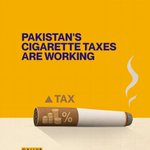
For three years, cigarettes in Pakistan kept getting more affordable, tax rates hadn't moved since 2019, while incomes and prices drifted upward around them. That changed in February 2023, when the government raised excise duty by over 150% in a single move, the largest one-time hike on record.
Affordability reversed overnight: buying 2,000 cigarettes went from costing 3% of per capita income to 6.2%, more than doubling in a matter of months. The behavioral response tracks the theory closely.
SPDC's own research on an earlier price increase found that 29% of smokers cut back and 12.8% quit or seriously considered quitting once cigarettes got more expensive, and the national numbers bear that pattern out: cigarette smoking fell from 12.4% of adults in 2014 to 9.8% in 2024, driven mostly by men, whose smoking rate dropped from 22.2% to 15.8%. Price, not persuasion, appears to be doing the heaviest lifting in Pakistan's tobacco control story, which is exactly why sustaining the tax rate matters more than any single hike.
@GallupPak x @MacroPakistani


Despite Pakistan’s aggregate state owned enterprise net loss deteriorating by 301% year over year to PKR 122.9 billion in FY2025, government support to state owned enterprises surged 37% to PKR 2.08 trillion. This financial degradation was primarily driven by a 24% profit contraction in Oil & Gas alongside widening deficits in the Power sector.
The sharpest fiscal escalation stemmed from equity injections, which jumped more than sixfold from PKR 99.6 billion to PKR 728.9 billion to fund recapitalizations. Furthermore, loans extended to state owned enterprises expanded 34% to PKR 354.1 billion, while sovereign guarantees rose 52% to PKR 2.16 trillion.
Although grants fell 27% and subsidies dropped 7% to PKR 726.3 billion, overall backing placed severe pressure on public finances. Government support remained equivalent to roughly 16% of federal tax receipts across both fiscal years.


130
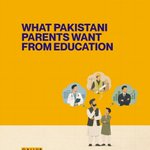
According to a Gallup & Gilani Pakistan survey of school-going children's parents, 75% of respondents believe expensive schools generally provide better education, with 41% agreeing completely and 34% agreeing somewhat.
However, this perception varies notably across demographics: older parents aged 50 and above express the highest level of agreement at 84%, while parents under 30 are significantly more skeptical, with 42% disagreeing. Stronger agreement is also observed among urban residents (81%) compared to rural residents (72%), as well as among parents educated to FA level or higher (80%) compared to those with less education (75%).
Overall, while a solid majority associates higher school fees with superior quality, nearly a quarter of parents (23%) reject this connection, pointing to a distinct generational shift in how educational value is viewed.
@GallupPak x @MacroPakistani


130
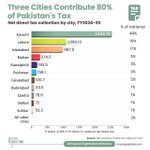
Pakistan's tax base is as concentrated today as it was seven years ago. Karachi, Lahore, and Islamabad collected 80% of net direct tax in FY2017-18 and collect 80% of it in FY2024-25, even with the total more than tripling in nominal terms. The fastest-growing contributors over the past five years, Hyderabad, Peshawar, and Sialkot, are outside the top three. Their growth hasn't yet moved the national split.
Satellite data helps explain why. By the Degree of Urbanisation method, 98% of Pakistan's population lives in a city, town, or suburb, in line with global peers. Only 48% of that is in a full city, the lowest share among the six countries compared. Half the country lives in towns and suburbs the state still classifies and taxes as rural. Widening the tax net geographically starts with recognizing urbanization that has already happened, not waiting for new cities to grow.
#EmpoweringPakistanWithData #OICCIPakistan #FBR #TaxNet


1
196
Pakistan's tax-to-GDP ratio sits at 10.3%, still short of the 13.6% the IMF asked for and further still from the 15% the World Bank ties to a real jump in future growth.
🗞READ MORE FROM THE LATEST MACRO BITE: macropakistani.substack.com/…
#Pakistan #tax #taxtoGDP

Macro Pakistani retweeted

Pakistan’s ports are seeing a sharp increase in cargo and transshipment activity as the Gulf War disrupts established shipping routes through the Strait of Hormuz. Karachi Port handled around 11,000 transshipment containers in March, while Port Qasim saw transshipment volumes rise sharply.
This gives Pakistan a timely opportunity to attract cargo that may otherwise move through Gulf hubs, but the current gains may not last without improvements in port efficiency, connectivity, digitalisation and maritime services.
The experience of Jebel Ali and Salalah shows that competitive ports depend not only on physical infrastructure but also on efficient logistics, skilled labour and strong links with the wider economy. The challenge for Pakistan is to use this temporary shift in trade routes to build a stronger maritime sector that can remain competitive after the Gulf War ends.
#EmpoweringPakistanWithData #OICCIPakistan #GulfWar #MaritimeEconomy
Macro Pakistani retweeted
Pakistan’s freelance export sector has achieved massive total volume expansion, crossing the milestone of over $1 billion in annual IT export earnings and accounting for approximately 25% of total national IT exports.
However, this top-line surge masks an underlying value compression, as the median transaction value plummeted 41% from $106 to $63. This shift signals that growth is currently being driven by a high volume of lower-ticket, effort-based tasks that remain vulnerable to AI automation, highlighting an urgent strategic need to transition the talent base toward higher-value digital services and agency structures.
#EmpoweringPakistanWithData #OICCIPakistan #FreelanceIT #Exports


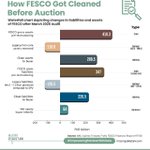
Behind the First DISCO Privatisation
FESCO is being prepared for private ownership, but its legacy liabilities remain with the state.
🗞 READ MORE FROM THE LATEST MACRO BITE: macropakistani.substack.com/…

149
Macro Pakistani retweeted
Pakistan demonstrates strong performance in initial formal setup, yet businesses face substantial operational friction driven by complex tax compliance, trade barriers, and a fragmented regulatory architecture spanning over 118 federal entities alongside provincial and municipal bodies.
According to research from the Pakistan Institute of Development Economics (PIDE) and the World Bank's B-READY 2025 assessment, this administrative "sludge" imposes a significant drag on economic activity, creating a clear disparity between ease of entry and ease of operation that directly affects investor confidence.
Streamlining this ecosystem requires consolidating compliance into a unified single-window platform like the Pakistan Business Portal, eliminating redundant licenses and inspections, and formally integrating private-sector stakeholders into the regulatory design and tracking process to ensure measurable efficiency gains.
#EmpoweringPakistanWithData #EaseofDoingBusiness
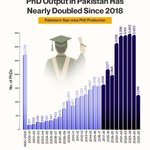
Pakistan has nearly doubled its annual PhD output since 2018, pushing total production past 40,000 graduates, even as the labour market gives almost nothing back for it.
A worker with 16+ years of schooling earns just 1.86 times what an uneducated worker makes, less than half of India's 4.18x return on the same comparison.
Pakistan's wage curve trails India's by almost a full education stage at every point, meaning the incentive to finish school, let alone pursue a doctorate, is weak to begin with. The credential pipeline is expanding fastest at the exact moment the market is signalling that credentials barely matter, a mismatch that points to an absorption problem.
@GallupPak x @MacroPakistani


Macro Pakistani retweeted
Pakistan’s foreign direct investment landscape remains heavily concentrated in non-manufacturing sectors like power and finance, while manufacturing segments continue to exhibit low or volatile capital inflows.
Although niche areas like electrical machinery and electronics have shown recent growth, Pakistan’s overall FDI footprint (totalling $1.85 billion) lags significantly behind regional peers such as India, Indonesia, Vietnam, and Malaysia. These competing economies successfully attract capital by leveraging clear value propositions in advanced manufacturing, mineral processing, global supply chains, and digital infrastructure.
To narrow this gap, strategic focus could shift toward developing targeted industrial supplier networks, upgrading local electronics supply chains, linking mineral extraction to downstream processing, and establishing predictable conditions for foreign IT and engineering centres.
#EmpoweringPakistanWithData #OICCIPakistan #FDI #Manufacturing #Vietnam


More than 670 newborns die in Pakistan everyday, while WHO identifies preventable causes as a major share of neonatal deaths in high-burden countries.
🗞 READ MORE FROM THE LATEST MACRO BITE: macropakistani.substack.com/…


1
182
Macro Pakistani retweeted
Pakistan’s water problem is less about how much rain it gets and more about how that water is managed. For five consecutive years, more water has flowed past Kotri Barrage into the sea than the minimum flow experts say the Indus Delta needs.
At the same time, the country’s major reservoirs are losing storage to sediment, with Tarbela’s capacity now around 41% below its original design. Much of the water that does reach the irrigation system is also lost before it gets to fields, while less than 1% of irrigated land uses more efficient systems than open earthen channels. The problem is limited storage, poor water distribution, and inefficient irrigation infrastructure.
#EmpoweringPakistanWithData #OICCIPakistan #Floods #Nepal