

Cryptocurrency Analyst at @firiapp. Prev. crypto analyst at Steno Research, crypto analyst at Saxo Bank, trader at Bitcoin Suisse, and founder of BetterCoins.
Joined February 2014
- Tweets1.4K
- Following316
- Followers3.7K
- Likes5.8K



The U.S. Clarity Act is stalling due to debate over whether any rewards should be allowed on stablecoins.
Year-to-date, the stablecoin supply has increased by about 4%.
This increase has mostly been driven by yield-bearing stablecoins, including tokenized money-market funds, even though these products are not publicly available, including to U.S. residents.
BlackRock’s BUIDL is up 61.6%, or $1.08 billion, year-to-date.
Circle’s USYC is up 88.9%, or $1.22 billion, year-to-date.
Ondo’s USDY is up 212.3%, or $1.89 billion, year-to-date.
Surely, this is what users want. Therefore, it would be a shame for the industry if such stablecoins were not allowed in the U.S.

During the 2025 U.S. government shutdown, Bitcoin and Ethereum declined by about 9.5% and 17.0%, respectively.
The recently increased risk of another U.S. government shutdown has arguably put downward pressure on crypto, though that risk has eased over the past 12 hours.


The crypto market appears to be reacting this afternoon to the potential U.S. government shutdown, and not least to speculation about possible Japanese intervention to support the yen, potentially with U.S. involvement.
The yen appreciated against the dollar late on Friday as markets began to believe that intervention was likely.
The crypto impact from this may again be tied to the so-called yen carry trade, which has affected markets significantly over the past few years. At least, that is what the market fears.
Traditionally, traders have borrowed yen to fund speculative investments, including crypto.
When the yen appreciates, it becomes more expensive to repay yen-funded borrowing, which can prompt traders to sell risk assets, including crypto, to repay loans. This is even worse if those assets have fallen in value, fueling deleveraging and liquidations.
If the U.S. government were, in fact, to assist, it would likely take the form of selling dollars and buying yen to support the currency. Over the longer term, sustained dollar weakness can be positive for crypto, all else equal. Whether there is any U.S. involvement is more speculative, in my view.
Exponential growth is one hell of a drug.
The stablecoin supply grew nearly 50% in 2025, up more than $100 billion.

During 2025 alone, publicly listed firms—also known as Digital Assets Treasury (DAT) firms—acquired $56.4 billion worth of the five largest cryptocurrencies, versus $23.0 billion in 2024.

"Year In Review 2025: A Crazy Start, Then Sobering Up":
🇳🇴 firi.com/no/innsikt-analyse/…
🇩🇰 firi.com/dk/indsigt-analyse/…
🇬🇧 firi.com/firi-insight/year-i…

"Jeg pleier å si at noe av det viktigste man lærer som kryptoanalytiker, er å kunne være uenig med folk. I løpet av 2025 har jeg hatt stadig mindre behov for det.
Mange av aktørene som nå omfavner krypto, var tidligere blant markedets mest høylytte kritikere. Når snøballen først begynner å rulle, er den ofte svært vanskelig å stoppe."


I en klumme i Børsen kalder jeg 2025 for det hidtil bedste år for krypto.
Prisudviklingen var sløj, men det var et gennembrudsår for udbredelsen af krypto. Det blev året, hvor tidligere hårdkogte kryptokritikere gjorde deres indtog i krypto.
Når snebolden først ruller, er den som bekendt svær at stoppe.
Markedet belønnede ikke denne udvikling på kort sigt, men det vigtigste er, at fundamentet rykkede sig på lang sigt.


On top of the fear of another four-year cycle, one should probably not discount the fear surrounding the Digital Asset Treasury (DAT) companies, many of which trade near their net asset value (NAV).
Take the by far largest of them all: Strategy. It holds 3.21% of all bitcoins (worth about $62 billion) and presently trades at about 1.03× its Bitcoin holdings when measured using estimated diluted shares.
If it falls below 1, then the firm suddenly has an incentive to sell bitcoins and buy back shares. The larger the discount, the stronger the incentive.
Looking at the Price to NAV ratio for MicroStrategy, it has been on a nearly continuous downward trajectory throughout the entire year.


In our view, one of the main reasons for crypto’s recent tumble is the market’s perception of another four-year cycle.
For those unfamiliar, historically, the crypto market has peaked every fourth year. If this four-year cycle is to repeat itself, the market should top around these months.
So, what are the main arguments for and against the repetition of another four-year cycle?
For:
- The four-year cycle has never been discussed as much as it is this time around, so perhaps market participants are not only selling now because of the cycle, but also bought earlier in anticipation of it.
- In the past few months, onchain data has shown that crypto natives - and whales - have been selling. It appears some of them believe in the four-year cycle.
- The four-year cycle has traditionally been centered around Bitcoin’s halving. This occurs roughly every four years and halves the Bitcoin reward to miners, reducing inflation and thus selling pressure. Bitcoin’s dominance of the total crypto market is historically high for a potential market top. If that’s the case, then Bitcoin - and its halving - could have an outsized influence over the next crypto cycle.
- In recent months, we have seen a notable decline in corporate buying of Bitcoin and other cryptocurrencies by so-called Digital Asset Treasury (DAT) companies. These entities have been a major driving force behind the current bull market, so the slowdown may suggest that this source of demand is running low on fuel.
Against:
- Let’s start with Bitcoin’s halvings themselves. Even though the next halving, at these price levels, is yet large in fiat terms, it’s the smallest in bitcoins - and arguably the smallest relative to liquidity in crypto markets. So the question is whether it will still serve as a guiding star.
- The crypto market is now at a different level of institutional adoption than before. We increasingly see banks entering the space and launching new products. For instance, in a bear market, we may initially see a decline in stablecoin supply, but it’s likely that supply won’t stay suppressed for long, as stablecoins have found real market fit regardless of crypto prices.
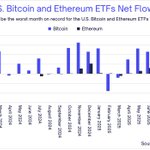
- Speaking of institutional adoption, the newly launched U.S. ETFs may become critical, as they cater to institutional and other traditional investors. These have seen outflows over the past few days, but are still far from their worst days on record. These investors may simply not operate based on a four-year cycle thesis.
- In the previous four-year cycle, the crypto market’s peak and following bear market were partially influenced by the broader macroeconomic backdrop - rising inflation and higher interest rates - rather than purely by crypto-specific dynamics.
That said, perhaps more than ever, crypto is heavily influenced by macroeconomic developments and by movements in the equity market - particularly among AI-related stocks.
The Czech National Bank has created a test portfolio of digital assets, including Bitcoin, totaling $1 million.
According to the Central Bank, the purpose is to "gain practical experience with holding digital assets and to implement and test the necessary related processes."

In our view, one of the main reasons for crypto’s recent tumble is the market’s perception of another four-year cycle.
For those unfamiliar, historically, the crypto market has peaked every fourth year. If this four-year cycle is to repeat itself, the market should top around these months.
So, what are the main arguments for and against the repetition of another four-year cycle?
For:
- The four-year cycle has never been discussed as much as it is this time around, so perhaps market participants are not only selling now because of the cycle, but also bought earlier in anticipation of it.
- In the past few months, onchain data has shown that crypto natives - and whales - have been selling. It appears some of them believe in the four-year cycle.
- The four-year cycle has traditionally been centered around Bitcoin’s halving. This occurs roughly every four years and halves the Bitcoin reward to miners, reducing inflation and thus selling pressure. Bitcoin’s dominance of the total crypto market is historically high for a potential market top. If that’s the case, then Bitcoin - and its halving - could have an outsized influence over the next crypto cycle.
- In recent months, we have seen a notable decline in corporate buying of Bitcoin and other cryptocurrencies by so-called Digital Asset Treasury (DAT) companies. These entities have been a major driving force behind the current bull market, so the slowdown may suggest that this source of demand is running low on fuel.
Against:
- Let’s start with Bitcoin’s halvings themselves. Even though the next halving, at these price levels, is yet large in fiat terms, it’s the smallest in bitcoins - and arguably the smallest relative to liquidity in crypto markets. So the question is whether it will still serve as a guiding star.
- The crypto market is now at a different level of institutional adoption than before. We increasingly see banks entering the space and launching new products. For instance, in a bear market, we may initially see a decline in stablecoin supply, but it’s likely that supply won’t stay suppressed for long, as stablecoins have found real market fit regardless of crypto prices.
- Speaking of institutional adoption, the newly launched U.S. ETFs may become critical, as they cater to institutional and other traditional investors. These have seen outflows over the past few days, but are still far from their worst days on record. These investors may simply not operate based on a four-year cycle thesis.
- In the previous four-year cycle, the crypto market’s peak and following bear market were partially influenced by the broader macroeconomic backdrop - rising inflation and higher interest rates - rather than purely by crypto-specific dynamics.
That said, perhaps more than ever, crypto is heavily influenced by macroeconomic developments and by movements in the equity market - particularly among AI-related stocks.
“Stablecoins, not crypto” is the new “Blockchain, not crypto.”
In a year, it’s “Tokenization, not crypto.”
Then “Onchain finance, not crypto,” followed by “Infrastructure, not crypto.”
Crypto treasury firms are not a black box in which the crypto never leaves the firm again.
In fact, it may be sold as quickly as it was acquired.

I have recently been asked a lot about the risks of crypto treasury firms.
I will outline the main risk I see. This is not a complete walkthrough—just a surface-level overview. With risks, as with many things, they are often obvious in hindsight but not always clear beforehand.
I think, in general, market participants should consider that in the worst-case scenario, these treasury firms could sell their positions just as quickly as they acquired them.
Often, these firms raise money through equity funding—meaning they issue shares to acquire crypto. Some also utilize convertible bonds or convertible preferred shares.
However, I do not see these financing methods as the biggest risk. The greater risk, in my view, is whether these firms trade at a premium or discount to their net asset value (NAV).
Remember: these firms often do not have a cash-flow-generating business. Instead, their share price trades relative to the value of their crypto holdings.
For now, most have been trading at a premium to their NAV. In that case, they have an incentive to raise money to acquire more crypto—because doing so can effectively increase the value of crypto per share.
But this incentive flips if they start trading at a discount to their NAV. In that situation, they may be incentivized to sell crypto and buy back their own shares.
Some in the market seem to believe it’s a natural law that these firms will always trade at a premium to NAV. It’s not. As these firms grow larger, and if market sentiment turns sharply negative, it becomes increasingly likely they could trade at a discount.
Take Grayscale, for example. In 2020, the firm’s Bitcoin and Ethereum funds traded at a premium to NAV. Only a little more than two years later, its Bitcoin fund was trading at a 47% discount, and its Ethereum fund at nearly a 60% discount—because the funds could not sell crypto and redeem shares. I think most people in 2020 would have expected that Grayscale could not trade at such a large discount.
While firms might not want to sell crypto, if their discount to NAV widens too much, it could be in shareholders’ best interests to do so. The larger the discount, the stronger the incentive to sell crypto to buy back shares.
Here’s a hypothetical example: a firm trading at a 50% discount to its crypto holdings is effectively acquiring crypto exposure at half price by selling crypto to buy back its shares.
If this happens, a significant amount of crypto could be sold in a short time. Just as the market benefited when these firms bought crypto, the reverse could also happen quickly.
I’m not trying to spoil the party—but it’s important to understand that these treasury firms are not without risks. If, and when, this scenario plays out is something only time will tell.