

Immune cell dynamics, migration, and diversity in cells & people @mcgillu. Account run by an exceptional team of trainee-clowns 🧑🔬🤡, with critical PI input.
Montréal, Québec
Joined June 2022
- Tweets75
- Following262
- Followers391
- Likes81





Mandl Lab retweeted

NEW POST ALERT just in time for the start of school! Let's talk about T-cell education. Although the curriculum these immune soldiers undergo has only 2 main topics the process involving this education is intricate and extremely beautiful #ImmunologyForAll
immunothoughts.com/how-our-i…


Want more details? Dive into the full study here: doi.org/10.1371/journal.pbio… 🔗

Interestingly, against a chronic fungal infection 🍄that T cells can't clear, both our model and experiments agreed that this TCR diversity didn't offer any extra protection. So, it seems that these low-binding TCRs are useful for certain chronic battles!

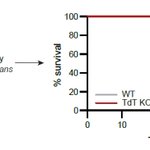
But does TdT contribute primarily to low-reactivity T cells? We show experimentally that this is indeed the case, with TdT-deficient T cells (🔴) 1) binding viral antigens stronger, on average, and 2) clearing a chronic viral infection slower than TdT-sufficient T cells.

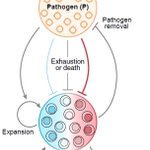
Our model showed that, unlike with acute infections (🟣) skewing the response toward reactive (but more readily exhausted😪) T cells, chronic infections (🟠) instead lead to a dominance of more “endurant” T cells with weaker antigen binding strengths (ie “looser” handshakes 🤝).
We hypothesized that TdT-diversified TCRs had lower antigen binding strengths (pMHC reactivity) on average, and that these T cells would specifically benefit clearance of chronic pathogens- and we started by designing a computational model to test this idea.

Yes, but… if you take away ~90% of TCR repertoire diversity in mice 🐁 by removing a DNA polymerase called TdT, acute pathogen control is unaffected- so what exactly does this additional diversity by TdT DO? 🧐 This is exactly the question we sought to answer in this work ✨
T cells are a crucial line of defence 💪for our bodies’ fight against foreign pathogens- and given the enormous variety of bugs 🦠 out there, we need a diverse pool of T cells, each with a unique T cell receptor (TCR), to adequately respond to these challenges… right? 🤔
Check out our recent publication in collaboration with the Khadra Lab at @mcgillu - where computational modelling 🖥️ and experimental immunology 🔬join forces to study the role of T cell diversity and antigen binding strength on chronic infection clearance! Find out more 👇

>90% of #TCR sequence diversity is generated by TdT-mediated nucleotide addition, but what is the benefit of TdT-altered TCRs? @MandlLab show that low-affinity #Tcells generated by TdT are important for curtailing chronic pathogen replication #PLOSBiology plos.io/3HJKOCl

Mandl Lab retweeted

First MIM happy hour of the year is tomorrow! Who else is coming? 😎
Le premier 5 à 7 de l'année de MIM est demain! Qui d'autre prévoit y être? 👀


Mandl Lab retweeted

Excited to share a new preprint from our group! Marie-Ève and team demonstrate an unexpected role for NGFR/CD271 in directly suppressing T cell activity!
biorxiv.org/content/10.1101/…

Our PhD student Angela @ImmuneVet co-host of the TWiV podcast with @profvrr recently interviewed @bjesseshapiro and Corinne Maurice with their students Sana Naderi and Anshul Sinha about their cool virus research going on at @mcgillu! @McGillMed 📺bit.ly/3Hb9Aet


And this work featured on the current issue cover! Amazing collaboration with @JohannesTextor @MelicharLab, and the Westermann team

Wondering what we can learn from the T cell receptor beta sequence about the self-reactivity of a T cell? check out our paper in Cell Systems where we used machine learning to ask this very question👇: cell.com/cell-systems/fullte…

Mandl Lab retweeted
First talk of the evening is by Dr. Mandl who will talk about T cell migration 🧫
La première présentation est par Dre Mandl qui va nous parler de migration cellulaire 🔬


