

System Builder. Vision Architect. 20Y+ turning ideas into machines that run. AI • Infrastructure • Commerce https://teapawt.net/t.co/dLQ5XJLJLV + Boushops Founder / Chief Architect
Israel
Joined August 2022
- Tweets240
- Following55
- Followers139
- Likes31




Pinned Tweet
Stop managing your e-commerce stack.
Tell it what you want.
Watch it execute.
Boushops AI is an autonomous e-commerce operating system built to replace the plugin maze with one execution layer.
Early Access is open.
↓ See it in action
boushops.com
EARTH FIRST.
Not because the universe isn't worth exploring.
Because this planet is worth keeping.
First, sell us a flying car.
Then sell us a ticket to Mars.
The product changes.
The pitch doesn't.
Tomorrow will fix what we're unwilling to fix today.
We've learned to land rockets on moving platforms.
Now we dream of turning a frozen, lifeless planet into a second Earth.
While slowly turning Earth into something that resembles Mars.
And somehow, we call that progress.
Sometimes I look at that red planet and wonder:
What if Mars isn't our next destination?
What if it's our previous warning?
What if we're not pioneers exploring new worlds, but a species with an extraordinary talent for destroying its own home and calling the escape an achievement?
Maybe humanity's greatest limitation was never intelligence.
Maybe it was the direction we chose to point it.
I'm not against space exploration.
I'm against treating escape as progress.
We don't need less ambition.
We need a better target.

65
Investors say they’re looking for innovation.
But they expect founders to think systematically, follow familiar playbooks, and fit into predictable patterns.
Here's the contradiction:
Real innovation doesn't always follow a system.
It challenges the system.
It questions assumptions.
Breaks familiar patterns.
Connects ideas that weren't supposed to belong together.
After a year of talking to investors, I keep asking myself:
Are investors actually looking for innovation?
Or are they looking for familiar businesses wrapped in innovative language?
I built the product myself.
It works.
The technology is real.
And I still haven't met the investor who truly understands what we're building.
Maybe the problem isn't a shortage of innovative founders.
Maybe it's that we've built an investment culture that celebrates thinking outside the box-
As long as the founder stays inside it.
3
121
What if we used SpaceX-level technology to save Earth instead of escaping it?
We can land reusable rockets on floating platforms in the middle of the ocean.
We can deploy hundreds of satellites in months.
We can build machines that withstand extraordinary forces, navigate autonomously, detect failures, and return safely to Earth.
Think about that.
Now think about where we choose to invest this intelligence.
In 2024 alone, governments worldwide spent approximately $132 billion on space programs.
At that annual rate, that's $1.32 trillion over a decade.
Government spending alone.
Imagine what could happen if we redirected even a fraction of that engineering power, capital, and human talent toward the planet we're already living on.
Not another rocket.
A different destination for our intelligence.
1. Aircraft that fight to keep us alive.
SpaceX has demonstrated that a rocket booster can autonomously return from the edge of space and land upright on a moving platform.
Now imagine investing comparable engineering effort in aircraft emergency survival systems.
Adaptive flight control. Autonomous emergency recovery. Multiple layers of protection against catastrophic failures.
Not a promise that planes will never crash.
A mission to turn more fatal accidents into survivable ones.
2. A world where fewer people disappear.
SpaceX has already demonstrated direct satellite communication with ordinary mobile phones.
Now imagine a globally coordinated rescue network built around that capability.
A child missing in the wilderness.
A fishing boat stranded hundreds of kilometers offshore.
A family trapped after an earthquake.
Emergency signals, location data, autonomous search systems, and rescue teams working together, even when ground infrastructure has collapsed.
Not mass surveillance.
A planetary safety net.
3. A planet that can recognize its own destruction.
We have the technology to observe Earth from orbit.
We have the computing power to analyze enormous volumes of data.
We have demonstrated the ability to manufacture and operate satellite networks at extraordinary scale.
Now imagine connecting those capabilities into a global environmental intelligence system.
A forest disappearing.
A river becoming contaminated.
An ocean ecosystem deteriorating.
A wildfire emerging before it spreads.
Not simply collecting images.
Understanding patterns, connecting human activity to measurable consequences, detecting threats earlier, and verifying whether our interventions actually work.
Imagine humanity finally being able to see the consequences of its own actions while they unfold.
Not decades later.
Now consider the economics.
Just 10% of that $132 billion annual government space budget would represent:
$13.2 billion every year.
$132 billion over ten years, assuming the same annual spending.
Dedicated to developing and deploying technologies that protect human life and the ecosystems supporting it.
Would that solve every problem?
Of course not.
But imagine what a sustained, internationally coordinated engineering effort of that magnitude could accomplish.
We didn't know how to land and reuse orbital-class rocket boosters until we invested the resources, talent, and determination to make it possible.
What other supposedly impossible problems have we simply never decided to pursue with the same intensity?
I'm not arguing against space exploration.
I'm questioning our priorities.
Because the greatest tragedy wouldn't be discovering that humanity lacked the intelligence to protect its home.
It would be discovering that we had the intelligence, the technology, and the resources all along.
We simply chose to point them somewhere else.
Perhaps humanity's greatest limitation isn't intelligence.
It's where we choose to invest it.
Perhaps Earth doesn't need an escape plan.
Perhaps it needs us to become intelligent enough to stop destroying our own home.

2
78
Is AI a tool or our replacement?
We built tools to do what we couldn't.
Now we're building intelligence to do what we can.
Are we expanding human potential or making ourselves obsolete?

3
151
Microsoft's BitNet might be a bigger deal than people think.
1.58-bit weights could change how we architect AI systems.
Local intelligence. Cloud reasoning. Dynamic orchestration.
Not every cognitive workload needs the same model, hardware, or cost structure.
That's where BitNet gets interesting.
#BitNet
1
81
AI: To bind or to free?
Do more in less time.
Live more with the time you gain.
AI should empower workers, not replace them.
Humans first.

94

Self-love may be one of the keys to world peace.
Not the selfish version of it.
Almost the opposite.
Much of our need to feel more successful, more important, or superior to someone else begins with something simpler:
We don't see our own uniqueness.
Every person born into this reality is literally one of one.
No one has your exact memories.
No one has lived your exact sequence of moments.
No one has built exactly the relationships you have built, seen the world through your eyes, or accumulated the same past that created your present.
You are not one more copy of a human being.
You are an entire world.
And these worlds connect.
We spend enormous parts of our lives building integrations with other worlds - exchanging knowledge, emotion, experience, love.
We change one another.
Sometimes two worlds connect deeply enough to create an entirely new one.
It learns from both, develops its own memories, becomes independent, and eventually begins creating connections and worlds of its own.
It's an extraordinary architecture.
Yet somewhere along the way, we made a strange design decision.
We built an internal ranking algorithm and gave everyone else write access.
What do they think of me?
Am I more successful than him?
More beautiful than her?
More important?
More respected?
And then we let the result determine how we feel about ourselves.
That's the bug.
Self-love isn't believing you are better than everyone else.
It's understanding that you never needed to be.
You were already unique.
And perhaps a world that truly understood that would have far less need to dominate, diminish, or defeat another world simply to prove its own value.
Fix the internal ranking system, and maybe we begin fixing the network.

1
102


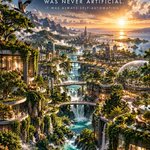
INTELLIGENCE WAS NEVER ARTIFICIAL.
It was always self-automating.
We didn't invent autonomous systems.
We are one.
A cell doesn't wait for instructions.
A body doesn't run from a dashboard.
A forest has no central operator.
An ecosystem doesn't open a ticket when something changes.
Life senses.
Learns.
Adapts.
Repairs.
Connects.
Creates.
And continues.
Then we built our world differently.
Software became screens humans operate.
Companies became hierarchies humans manage.
Cities pushed nature outside their walls.
Economies optimized people into numbers.
And intelligence became something we thought could be measured, ranked and controlled.
Now AI arrives.
And what do we do?
We put it behind another screen.
We build agents to click the buttons we built because humans once had to click them.
That's not the destination.
That's automation of an old architecture.
The real transition begins when we stop asking how AI can operate our systems and start asking why our systems need operators at all.
But this goes beyond software.
The strongest systems in nature don't erase individuality to create order.
They do the opposite.
Billions of unique organisms.
Independent.
Interdependent.
Each carrying its own history, relationships and information.
No two humans are the same system.
Yet we spend enormous amounts of energy trying to calculate our value through other people's perception of us.
We compete to feel unique when uniqueness was never scarce.
It was the architecture from the beginning.
Maybe that's why our systems keep breaking.
We keep designing against the pattern that created us.
We separate humans from nature.
Technology from biology.
Individual from community.
Intelligence from life.
Then we spend fortunes trying to integrate everything back together.
I don't think the future is humans versus AI.
Or humans controlling AI.
Or AI controlling humans.
I think the next architecture is integration without erasure.
Technology that doesn't remove humanity.
Cities that don't remove nature.
Intelligence that doesn't remove individuality.
Systems that become stronger because their participants remain different.
The goal isn't a machine that can run the world.
The world already knows how to run.
Maybe our job is finally to stop fighting its architecture-
and start building with it.

1
105
AI didn't kill the CTO.
It killed the excuse for being a CTO who can't build.
For years, the CTO role drifted upward.
Away from the code.
Away from the infrastructure.
Away from the actual system.
Into vendor management, budgets, roadmaps, hiring plans and endless executive meetings.
The assumption was simple:
The more senior you become, the less technical you need to be.
AI just broke that model.
A real CTO in the AI era should be able to move through the entire stack:
Business problem
➔ Architecture
➔ System design
➔ Code
➔ Infrastructure & GPUs
➔ AI execution
➔ Security
➔ Deployment
➔ Live production
You don't need to write every line.
But you need to be able to write the critical ones.
Open the repository.
Read the architecture.
Challenge the implementation.
Kill a bad design before it becomes a six-month budget black hole.
And when an AI agent hands you 5,000 lines of code, you need to be able to look at it and ask:
Will this survive production?
That is not management.
That's technical ownership.
That's a Systems Builder.
And AI gives this person something previous generations of CTOs never had:
Leverage.
One exceptional technical mind, amplified by AI agents, can now move with the velocity that once required an entire engineering organization.
Which means the modern CTO shouldn't be further away from the machine.
He should be closer to it than ever.
Deep in the code.
Deep in the infrastructure.
Deep in the architecture.
Deep in the product.
Deep in production.
The old CTO managed the people who built the machine.
The new CTO understands the machine well enough to build it himself.
That's the difference.

1
93
Most enterprise software is built as a collection of isolated screens.
Sales.
Warehouse.
Projects.
Logistics.
Accounting.
But a real business doesn't operate in silos.
A single transaction is born as a lead, matures into a customer, becomes an order, splits dynamically into physical goods and services, gets delivered, and eventually converts into money.
The system should follow the transaction through its entire lifecycle.
Not humans manually copying data from one module to another.
Not an AI assistant floating over six different screens asking for context.
One entity.
One source of truth.
One continuous state transition.
That’s where AI becomes genuinely interesting:
Not as another feature inside the software, but as the intelligence orchestrating the state machine itself.

1
65
A chatbot that talks is not a system.
It is a form that learned language.
The model can draft the invoice and route the ticket.
The moment money or an address moves, judgment belongs to the system - not the model.
Authorization isn't a vibe the model has.
It's a rule the system enforces.
1
226

AI made code generation cheap.
It made code ownership expensive.
10,000 lines in two seconds?
Cool.
Now show me the kill switch.
🤖 Made with AI

160
Interesting and important.
If token costs drop significantly alongside this speed, we finally have a viable foundation for cost-effective autonomous execution.

This is Ultrafast.
Our premium speed tier, Ultrafast offers up to 8x faster token generation (300 tokens per second) in Codex and up to 6x in the API.
128