

Christ-centered Nutrigenomics + Mental Health Consulting & Men's Marriage Coaching
Valparaiso, IN
Joined April 2020
- Tweets207
- Following11
- Followers43
- Likes87


My major discoveries in nutrigenomics this month:
- individuals with fast COMT (high turnover of dopamine and nnorepinephrine/epinephrine(stress hormones) flush water more quickly and are at risk of chronic dehydration.
- individuals with fast MAO (low baseline serotonin) have poor sodium retention and are at risk of sodium deficiency. Inversely, individuals with slow MAO have a sodum sensitivity.
- serotonin suppresses salt appetite and promotes sodium retention
- dry air (winter + furnace heating) causes insensible water loss and risk of dehydration
- chronic dehydration raises baseline cortisol levels (stress)
- cortisol functions as a fat thermostat and blocks fat mobilization (especially abdominal)
- cortisol increases insulin resistance
- dehydration suppresses thyroid conversion
- dehydration lowers baseline dopamine tone - you lose motivation and menal treward function, but also movement function. Effort feels more costly and daily caloric expenditure drops.
- dehydration biases the body toward water-retentive fat
To summarize, chronic dehydration shifts your body into a defensive metabolism that actively resists fat loss and promotes fat gain, even without excess caloric intake. Your genetics determine dehydration risk and sodium retention. Since sodium is required to retain water, a sodium deficiency will cause functional dehydration even if you drink tons of water. Electrolytes are critical for individuals with genetic profiles sensitive to dehydration and/or sodium deficiency. Sometimes, losing weight isn’t about effort, but physiology.
There are many more impacts on mental health that I don’t have time to get into.
1
62
Food is fuel, not fun.
You can drastically improve your health by applying this principle to 2 out of the 3 meals you eat every day.
1
55
People ask why some create a link between Tylenol and autism, and why others claim it doesn't exist.
As with anything, it's nuanced and there are multiple risk factors involved that multiply when compounded.
Risk factor 1: Tylenol depletes glutathione. There's a genetic mutation that some people have (CYP2E1) which results in much faster glutathione depletion during acetaminophen metabolism.
Risk factor 2: MTHFR. There are three genes responsible for compromising MTHFR enzyme activity, which results in lower glutathione levels since glutathione production is methylation-dependent.
Risk factor 3: Age. Infants have an undeveloped blood-brain barrier that relies heavily on methylation and glutathione for protection.
Risk factor 4: Aggressive vaccine schedule giving the body far more that it needs to detox.
Risk factor 5: Diet poor in folate or high in folic acid. Poor folate exacerbates the methylation deficiency caused by MTHFR gene mutations, and high folic acid creates unmetabolized folic acid that blocks folate receptors and pathways.
Those are just the ones I'm familiar with. I'm sure we can come up with more, but this is why it is linked to autism in some cases and not in others. It's a formula of compounding risk factors.
2
82
XTRevolution retweeted
Gladly.
pmc.ncbi.nlm.nih.gov/article…
"The ketogenic diet was found to decrease the levels of metabolites of biogenic amines such as dopamine and serotonin which are neurotransmitters pivotal to the pathophysiology of depression"
jamanetwork.com/journals/jam…
"Mood among long-term consumers of LC diets may also be negatively affected by changes in serotogenic expression and neurotrophic factors. While a high-carbohydrate intake can increase serotonin synthesis, fat and protein intakes reduce serotonin concentrations in the brain" - we literally have doctors prescribing SSRIs to block serotonin reuptake and MAO inhibitors due to poor serotonin tone. Low carb diets literally create this problem.
jamanetwork.com/journals/jam…
A controlled trial over 4 weeks found that a low‑carb diet had negative effects on psychological mood states over that short period (increased tension, fatigue) in some participants.
clinicalnutritionespen.com/a…
A study that showed "increased carbohydrate intake was significantly associated with better mood."
ajcn.nutrition.org/article/S…
A human metabolic study showed that after a high‑carbohydrate meal, the plasma tryptophan-to-LNAA ratio increased (which favors brain serotonin synthesis), whereas a fat & protein meal caused the ratio to decline. Sufficient carbs are required for mood stability because they support the synthesis of serotonin, dopamine, and PEA. Carbs boost tryptophan and tyrosine transport into the brain and support BH4 recycling, which is a critical cofactor for that synthesis.
Without enough carbs, brain chemistry suffers, leading to poor mood, neurotransmitter imbalance, anxiety, and poor sleep. Individuals with fast COMT/MAO (like myself) have an even higher turnover of neurotransmitters and rely more heavily on sustained carb intake.
Someone with slow COMT could get a way with a reduced carb diet, but without a genetic test, it is irresponsible to make generalized statements promoting low-carb diets.

Oh yeah, we're having kids, we're keeping marriages together, we're bound to a code of ethics that commands more of us than the US constitution, and we give of our time and resources generously to help those in need.
Such damage.
1
49
Folate receptor autoantibodies alone aren't enough to cause autism or catastrophic developmental outcomes, but they become much more damaging when combined with other genetic, nutritional, and environmental vulnerabilities. It's a risk-multiplication model, not a single-cause trigger, like everything related to autism.
Some of those risks include MTHFR and/or other methylation-related genetic impairments, VDR (vitamin D receptor), micronutrient deficiencies (choline, Vitamin A, etc.), UMFA (unmetabolized folic acid), and other epigenetic stressors like environmental exposures. All of these multiply risk, and underscore the importance of a holistic approach to health.
38
By far my greatest accomplishment was curing 10 years of my chronic anxiety and the recurrence of major depressive episodes without pharmaceutical drugs.
1
38
Several years ago, we made the decision not to vaccinate our children solely on the basis that the schedule was too aggressive and we couldn't find a valid reason to give any one of the vaccines that we individually researched at length. We're both exceptionally analytical and we dedicated months of study to this subject. I personally feared the potential consequences of not getting vaccinations done, but at the end of the day, it just didn't make sense.
Years later, I discovered that I have a genetic variant that rapidly depletes glutathione when taking acetaminophen, major MTHFR gene impairments, and multiple methylation-related gene mutations, which would have been major risk factors for vaccine injury.
In hindsight and with the recent advisory on spreading out vaccines and outright removing Hep B from the infant schedule, I believe we made the right decision, but during that time, the entirety of the medical community would have mocked and ridiculed us as "anti-vaxx" for making that decision.
The older we've grown, and the more kids we've had, the more we've realized just how wrong the medical community has been about certain topics, and how boldly arrogant they've been in their misinformation.
Having an MD or PhD by your name no longer gives you universal authority or credibility; rather it gives people a reason to be exceptionally critical about anything you have to say.
1
38
Symptomatic vs systematic health.
Symptomatic involves identifying the symptoms (I'm constantly depressed) and prescribing a pill to fix it.
Systematic involves searching for dysfunction and deficiency in pathways responsible for mental health (fast MAO, methylation, D3/B12 absorption/transport, etc).
In this example, depression is a check engine light that signals that your system is broken.
Symptomatic relief unplugs the check engine light, and allows the underlying dysfunction to cause damage, often resulting in cardiovascular disease and cancer.
Systematic relief solves the symptom while also proactively protecting against future health conditions.
Nutrigenomics with a holistic (the whole of) approach is the key to both mental and physical health.
32
I got into nutrigenomics to help people with chronic mental health struggles, not to educate MDs and PhDs on the basics of methylation.
I’m very disappointed in our medical community right now.
XTRevolution retweeted
Statistically, speeding is one of the #1 causes of mortality in motorcycle riders. Therefore, if speeding causes death in motorcycles, why aren't all motorcyclists who speed already dead?
The reason Tylenol was mentioned is because of the CYP2E1 genetic variant, which causes a far more rapid depletion of glutathione when the person takes acetaminophen.
If you combine this with an MTHFR gene mutation and a heavy dose of three dozen vaccines simultaneously while being so young that your brain still hasn't fully developed its blood-brain barrier and is extremely dependent on methylation and glutathione for protection, then it's alot like...
...speeding on a motorcycle, without wearing a helmet, while drunk, at night.
Everything is a risk factor, and cumulative risks create catastrophic combinations.
Leucovorin is now the miracle drug for autism huh? You know what it is?
Folinic acid. It's the form of folate I've recommended for individuals with a genetic methyl donor sensitivity and a MTHFR gene mutation.
Leucovorin is simply the pharmaceutical version of it.
Tylenol + genetic acetaminophen sensitivity +MTHFR genes + folic acid = depleted glutathione, neurological vulnerability, oxidative injury, and epigenetic stress.
Functional health requires a systematic approach. We're not likely to find the root cause of anything by blaming just one thing.
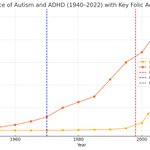
98% of autistic people have an MTHFR gene mutation. This creates a bottleneck in the conversion of folic acid. Many of them also have a DHFR gene mutation which is directly responsible for folic acid conversion. Unmetabolized folic acid has been found in early 100% of the population.
Unmetabolized folic acid blocks folate receptors and clogs folate pathways, resulting in undermethylation.
This is a major reason why kids with autism show improvements in symptoms when switching to a gluten-free diet; it eliminates the #1 source of folic acid.