



mart21 retweeted

A Bored Ape might be a forever PFP, but a HACD is something different.
It's a digital diamond forged through Proof-of-Work, with its own unique on-chain identity and history.
Not just an image to own, but a rare digital asset created by mining.
Some NFTs are collected for their appearance. HACDs represent the beauty of computational work, scarcity, and digital ownership. 💎⛏️

mart21 retweeted
Today, the system mined another pure $HACD diamond. 💎
This is not just a diamond. It is a product of Proof-of-Work, created through mining, secured by the network, and recorded with its own unique identity.
No artificial production. No shortcuts. Just computational power, consensus, and digital scarcity.
Every newly mined diamond adds another piece to the history of #HACD.
The next chapter of digital diamonds is being written, one block at a time. 💎⛏️
github.com/hacash
explorer.hacash.org/?lang=en…
$tao $rio $rwa $hac


mart21 retweeted

A pure $HACD diamond has just been mined! 💎
This is only the 40th pure diamond ever produced by the $Hacash mining system. Just 40 exist.
One was once sold for 1 BTC. With Bitcoin around $80K today, imagine the value of such digital rarity.
True scarcity. Real #POW. 💎
$nft

unavailable
mart21 retweeted
A HACD miner is incredibly excited, waiting for the final block to claim one of the rarest collections in the ecosystem: Penta Repeat. Only 13 have been mined!
The anticipation is real. He's eagerly waiting to discover which unique diamond will emerge.
What will this rare diamond look like? 💎🔥
The final block is approaching. Let's see what destiny has in store!
#HACD #Hacash #PoW #DigitalDiamonds

mart21 retweeted
How much do you think this is worth in #ETH? It’s a pure diamond—the world’s first #NFT mined using #PoW. Only 39 of them were ever mined.
hacash.diamonds/types
hacash.money/

mart21 retweeted
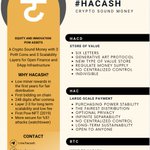
Bitcoin conferences are important, but the separation of money and state requires more than conferences. It requires resilient, decentralized monetary systems. Hacash offers an alternative PoW-based approach to sound money, while HACD introduces digitally scarce, unique diamonds. The future deserves open experimentation.
mart21 retweeted
#Bitcoin vs. #Hacash: Two Different Approaches to Digital Payments and Monetary Divisibility 💎
👇
🔍 Hacash’s Key Difference: Monetary Precision at the (10^{248}) Scale
💰 On pages 57–58 of the Hacash whitepaper, Section 6.3, “Units and Symbols,” explains how Hacash amounts are stored using a data structure similar to scientific notation.
🪙 The unit system described in the text is as follows:
Unit| Relationship in the Whitepaper
Mei| (10^8) Zhu
Zhu| (10^8) Shuo
Shuo| (10^8) Ai
Ai| (10^8) miao
Miao| The smallest named unit
The whitepaper also uses the notation "unit = 248" to describe a monetary representation system capable of handling values at a scale of (10^{248}).
An important technical distinction: This does not mean that every HAC transaction can literally be divided into (10^{248}) transferable pieces. It describes the numerical precision of the representation mechanism; actual transaction granularity depends on the network’s implementation and rules.
Why Does This Difference Matter?
Bitcoin can be divided into 100 million satoshis per BTC. This already supports very small payments, but its standard on-chain unit is limited to one satoshi.
Hacash’s design explores a different approach to numerical representation, aiming to accommodate an exceptionally broad range of monetary values.
As economic activity evolves, higher numerical precision could offer flexibility for representing small-value payments and different scales of economic exchange. However, precision alone does not guarantee lower fees, greater transaction throughput, or wider adoption.
💵 Where Does HACD Fit Into This Model?
HACD takes a fundamentally different approach. The Hacash whitepaper describes Hacash Diamonds as scarce, indivisible, uniquely identifiable assets.
This creates two distinct concepts within the Hacash ecosystem:
- 💵 HAC: A monetary asset designed for payments and the representation of value.
- HACD: Scarce, indivisible digital diamonds distinguished by their unique identities.
HAC focuses on monetary functionality, while HACD emphasizes digital scarcity and uniqueness. They are designed around different properties rather than serving identical purposes.
⛏️ The Bigger Picture: Hacash vs. Bitcoin
Bitcoin combines a maximum supply of 21 million BTC with divisibility into 100 million satoshis per bitcoin. Its monetary model emphasizes scarcity, decentralization, and a predictable supply limit.
Hacash explores a broader architecture that combines monetary representation with distinct asset types, including HAC and HACD.
The key difference is not simply that one system divides its currency into smaller units than the other. It is that Hacash explores different monetary and asset models within one ecosystem.
This does not automatically make Hacash superior to Bitcoin. Security, decentralization, liquidity, network performance, and adoption remain essential factors in evaluating both systems.
The central idea is that scarcity and divisibility are different properties. A monetary system can explore high-precision value representation while also supporting scarce, indivisible digital assets.
Bitcoin established a powerful model for decentralized digital scarcity. Hacash explores a different monetary architecture—one that deserves to be evaluated through its underlying design, implementation, and real-world performance.
hacash.org/whitepaper.pdf
mart21 retweeted
HACD is a different kind of NFT. It’s not just digital art to trade, but a rare PoW-mined diamond with unique properties and a connection to Hacash’s monetary vision. You don’t need to chase every trend to appreciate something truly scarce. 💎


mart21 retweeted
@BoredApeYC
A Bored Ape sold for $2M. A rare EEEEEE #HACD sold for $7K. 💎 HACD is more than an NFT: it combines Proof-of-Work, digital scarcity and on-chain art. What happens when the world discovers the true potential of Hacash Diamond?
#BoredApeYC $nft $zec $hacd


5 hours ago someone spend $2.4 million on a Aqua background @BoredApeYC people are making bear market moves.
NFTs are free.


$QRL kuantum güvenliğine, $Qubic hesaplama gücüne odaklanıyor. #Hacash ise #PoW tabanlı parasal altyapısı ve benzersiz dijital varlıkları #HACD ile farklılaşıyor. Merkeziyetsiz geleceği yalnızca teknoloji değil; kıtlık, güvenlik ve gerçek kullanım belirleyecek. 🚀

Quantum-resistant coins are already sitting at $23.3 billion.
By 2030, many of these coins could do 50x.
→ Quantum Resistant Ledger ( $QRL)
→ Qubic ( $QUBIC)
→ Quantus ( $QTC)
Here are 3 projects building native post-quantum alternatives and how their token designs compare.
🟡Quantum Resistant Ledger ( $QRL): The Post-Quantum Pioneer
✦ Tech Used → XMSS + Hash-Based Security
• Uses XMSS, a hash-based signature scheme covered by NIST SP 800-208.
• Post-quantum signatures have been mandatory since its June 2018 mainnet launch.
• Stateful signing requires careful tracking of one-time signature keys.
QRL’s security approach starts with its signature system. Users have relied on post-quantum transaction signing since genesis, giving the project years of operational experience.
That history matters. Deploying cryptography means maintaining wallets, managing keys, and keeping a network running over time.
✦ Network Design → Established Chain + Smart-Contract Expansion
• Built around Proof-of-Work, with a planned transition toward Proof-of-Stake through Project Zond.
• QRL 2.0 targets smart contracts and broader developer tooling.
• Its roadmap aims to expand utility while preserving post-quantum protection.
QRL’s next challenge is turning its security foundation into a broader application ecosystem.
Smart contracts could give developers more reasons to build on the network. Execution, tooling, and adoption will determine whether that expansion creates lasting activity.
✦ Token → $QRL
• Maximum supply of 105 million QRL.
• Approximately 65 million allocated at genesis.
• Remaining issuance follows a declining emission schedule.
QRL combines capped supply with a security-focused network. Its longer-term economic case depends on whether users and developers create demand for blockspace and network services.
A supply cap provides predictability. Adoption gives that scarcity economic relevance.
My take: QRL is the established security contender, pairing a long production history with ambitions to support a broader developer ecosystem.
🔵Qubic ( $QUBIC): The Decentralized AI Compute Network
✦ Tech Used → Useful Proof-of-Work + Quorum Consensus + Aigarth
Useful Proof-of-Work directs mining toward AI-related computational tasks.
Aigarth is the project’s experimental AI initiative.
Quorum consensus handles agreement over network execution.
Qubic connects computational work with an AI research ambition. Its thesis is that distributed hardware can contribute useful outputs while supporting participation in the network.
However, useful computation and quantum-resistant signatures address different problems. Qubic’s documented SchnorrQ signature system does not put it in the same native post-quantum category as QRL and Quantus.
✦ Network Design → Computors + AI Miners
A set of 676 Computors executes transactions and smart contracts.
Agreement requires a quorum of 451 Computors.
Mining performance contributes to selection for the Computor set.
The network separates computational competition from agreement over execution. Miners compete through computational work, while Computors maintain the shared network state.
This makes participation, hardware requirements, and the distribution of influence important parts of the decentralization assessment.
✦ Token → $QUBIC
Native asset used within the Qubic ecosystem.
Rewards connect network participation with computational performance.
Its economic thesis depends on demand for useful compute and applications.
QUBIC’s value proposition centers on whether the network can turn distributed computation into services people use.
Emission reductions and burns can affect supply, but they cannot establish product demand. The key test is whether computational outputs and applications develop sustainable economic value.
My take: Qubic is the experimental AI compute contender, with potential tied to execution and adoption. It belongs in a decentralized computation comparison rather than being described as quantum-safe.
⚫Quantus ( $QTC): The Lattice-Based Privacy Contender
✦ Tech Used → ML-DSA + Post-Quantum Networking
• Uses ML-DSA-87, the high-security signature parameter set under NIST FIPS 204.
• Extends its post-quantum approach to peer-to-peer networking through ML-KEM.
• Uses zero-knowledge aggregation to address the overhead of larger signatures.
Quantus takes a lattice-based approach to transaction signing.
Its design also addresses a practical problem: post-quantum signatures can be large. Aggregation aims to make that security more usable without allowing signature size to overwhelm network capacity.
✦ Network Design → Proof-of-Work + Privacy
• Uses a custom Proof-of-Work design built around Poseidon2 hashing.
• Targets approximately 12-second blocks.
• Focuses on encrypted payments, wormhole addresses, and zero-knowledge infrastructure.
Quantus combines post-quantum signing with a privacy-oriented payments design.
That creates an ambitious technical proposition. Its younger network has had less time to demonstrate reliability, decentralization, and sustained usage than the two 2018 projects.
✦ Token → $QTC
• Maximum supply of 21 million QTC.
• Genesis allocation represents 27% of supply.
• The remaining 73% is allocated to mining through declining emissions without discrete halvings.
QTC has the clearest headline scarcity narrative of the three.
But the cap is only one part of the picture. Genesis allocations, vesting, miner emissions, and available liquidity all influence how supply reaches the market.
My take: QTC is the newer technical contender, combining lattice-based signatures, privacy ambitions, and capped supply—with greater uncertainty around execution and adoption.
Conclusion: The Post-Quantum Edge
Here’s how I see the three approaches:
QRL → Established post-quantum security with a smart-contract expansion path.
MCM → Payments-focused infrastructure with enforced key rotation and lightweight nodes.
QTC → Lattice-based security combined with privacy and a strict supply cap.
Final Rankings →
These are qualitative assessments of the supplied project profiles, rather than security audit results.
Operational Track Record:
$QRL ≈ $MCM > $QTC
QRL and Mochimo have operated since 2018. Quantus has a much shorter production history. Longevity provides evidence of operation, though it cannot guarantee future security.
Application Expansion Ambition
$QRL > $QTC > $MCM
QRL targets a broader smart-contract ecosystem. Quantus emphasizes privacy and cryptographic infrastructure. Mochimo maintains a more focused payments proposition.
Supply-Cap Simplicity:
$QTC > $QRL > $MCM
QTC’s 21-million cap is straightforward to communicate. QRL also has a defined cap. Mochimo’s continuing reward tail requires more explanation. This ranking says nothing about expected returns.
My Takeaway:
If your priority is an established post-quantum network with broader application ambitions → QRL.
If your priority is lightweight payments with enforced one-time key handling → Mochimo.
If your priority is lattice-based security, privacy, and capped supply → QTC.
All three address the quantum-signature problem at the protocol level. Their long-term success still depends on implementation quality, usable wallets, economic security, and adoption.
Post-quantum protection is the starting point. Building a network people use is the next test.

mart21 retweeted

200ms blocks are coming to @base. ⚡
10x faster blocks. More possibilities for PoWFi.
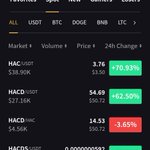
$HAC and $HACD are already on Base.
🌉 Bridge HAC & HACD:
defi.hacd.it/bridge
🔄 Swap $HAC:
app.uniswap.org/swap?chain=b…
💧 Add HAC/USDT Liquidity:
app.uniswap.org/explore/pool…
💎 Buy & Sell HACD NFTs:
opensea.io/collection/hacd-l…
More to come on Base.
Let's build PoWFi together.

5 days to Denim on @base Sepolia (10/21) 👖
- 10x faster blocks: 2s → 200ms
- BaseTime: millisecond time onchain
Mainnet in November