

I work on multimodal foundation models | PhD student @siebelschool @UIUC_NLP | Prev. @Meta @RealityLabs @Amazon | @CapitalOne PhD Fellow
Champaign, IL
Joined May 2021
- Tweets1.4K
- Following1.2K
- Followers1.1K
- Likes6.3K




Pinned Tweet
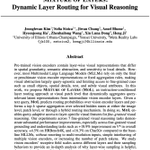
👀 What if better visual reasoning isn't about more pixels or more vision encoders, but knowing WHICH visual representations to use?
Excited to introduce Mixture of Layers (MoL), our work at #NeurIPS2026! 🎉
🧵 Here's how we make vision encoders work smarter:

Jeonghwan Kim @ NeurIPS 2026 (Atlanta) ✈️ retweeted

Prediction: Frontier models will beat all specialized robotics models available to be tested publicly (VLAs / WAMs) on most tasks in terms of task completion rates by the end of next year.
They will also still not be useful or economically viable enough to deploy to 95+% of real industrial applications.
Jeonghwan Kim @ NeurIPS 2026 (Atlanta) ✈️ retweeted

Introducing Scalable Beckmann Maps (SBM): one-step generators trained from scratch that reach FID 1.6 on ImageNet 256, GenEval 0.86 on text-to-image, and beat SOTA one-step world models.
One network call. No teacher. No distillation. No feature loss. 🧵
Jeonghwan Kim @ NeurIPS 2026 (Atlanta) ✈️ retweeted

People claim agentic robotics is slow. Even today this can be wrong.
Just watch Fable 5.2 being 1x and up to 4x the speed of human teleoperators. @AnthropicAI @kalinowski007
It can be fast, reactive and does not get easily OOD or distracted. 1/3
Jeonghwan Kim @ NeurIPS 2026 (Atlanta) ✈️ retweeted

We try to explore:
- Which tests do agents fail?
- How do agents control robots?
- What helps with sim access: Resets? Exact state?
- Does spending more help?
- Different harness?
- Prompt matters? RoboDoJo rises
- Olympics: Can agents continually improve?

Jeonghwan Kim @ NeurIPS 2026 (Atlanta) ✈️ retweeted

Excited to share our new paper on sharp capacity scaling of the Muon optimizer! Joint work with @EshaanNichani Denny Wu @albertobietti @jasondeanlee:
arxiv.org/abs/2603.26554 (1/7)

Jeonghwan Kim @ NeurIPS 2026 (Atlanta) ✈️ retweeted

A language model can rewrite its own weights, by its own reasoning, and get better.
No gradients. No training. No larger model doing it for it. This has not been done before.
No pre-training. No post-training. No test-time scaling. No harness engineering. No prompt engineering.
🌐 Project page: jiajunfan.com/projects/self-…
📄 Paper: arxiv.org/abs/2611.21885
Every language model you have used was trained once and then frozen. Making it better has meant one of two things: train it again, with the infrastructure and the GPUs only a few labs have, or pile prompts, harnesses and extra computation on top, gone the moment the task ends.
Our new paper, Language Models Can Rewrite Their Own Weights, opens a third way. We call it self-rewriting: the model is its own optimizer.
We handed an open model its own weights, its graded answers and the ability to run itself. It diagnosed its own failure and rewrote the weights behind it.
What happened next:
→ It surpassed itself. Its own edit made it 6.6 points more accurate on problems it had never seen.
→ It kept getting better. It tests its edits on practice problems and submits only what works. Eight sessions in a row, its accuracy only went up.
→ It repaired itself. We damaged a copy until it solved almost nothing. With no retraining, and without ever reading the original weights, the model brought it back to over 80% of the original accuracy on image tasks it had never seen. Like a broken robot that fixes itself without being rebuilt.
→ It emerges with scale. The smaller models could not do it: they made no edit, or broke themselves. Only the largest improved and repaired itself.
Why this changes things:
→ The gain is written into the weights. Every answer costs what it cost before.
→ It runs only forward passes, as serving does. No training pipeline to build. No cluster to rent.
Affordable. Scalable. Recursive.
The wall between training and inference is a limit of our tools, not a property of intelligence.
We believe self-rewriting is a necessary step toward recursive self-improvement: a model that, like a human, does not separate training from inference could keep upgrading itself for life, with no larger model, no harness or prompt engineering, and no pre- or post-training.
In 1947 Alan Turing said that letting a machine alter its own instructions "of course does not get us very far." Seventy-nine years later, it gets us further.
Welcome to the Era of Self-Rewriting.


Jeonghwan Kim @ NeurIPS 2026 (Atlanta) ✈️ retweeted

How can societies of AI agents keep getting more capable as they grow?
Excited to share our essay on artificial collective intelligence: what limits current multi-agent systems, and how agents can learn to specialize and work together.
Led by @ZhentingQi!

We may soon live in a world where AI agents are way more than humans, each interacting with one another at a scale and speed far beyond human communication.
It's time to think beyond "multi-agent systems" and study artificial collective intelligence at larger scales: how societies of agents behave, organize, and evolve; and, crucially, how to ensure these societies remain aligned, observable, and controllable.
We’re taking steps in this direction through a series of studies, beginning with an introductory essay, Steps Towards Artificial Collective Intelligence:
zhentingqi.github.io/blogs/s…

Jeonghwan Kim @ NeurIPS 2026 (Atlanta) ✈️ retweeted

🖥️ Two years after we introduced OSWorld, frontier models have rapidly advanced in computer use, completing real workflows across the digital world.
🖥️ 🔜 🤖: Physical interaction is the next frontier, where foundation models expand into robot-use agents in the physical world while retaining their general intelligence. Agents like Claude Fable 5.2 already score 65% on RoboDojo. Problem already largely solved?
Not even close.
🚀 Today we introduce RoboWild: Can Frontier Models Generalize to Robot Use in the Wild?
🏠 38 furnished realistic scenes, from homes and stores to workshops and labs
🛠️ 4,480 objects, with operable doors, dials, drawers, and more
🤖 341 diverse tasks across four robot embodiments
📊 Best results: Claude Fable 5.2 reaches the highest accuracy at 13.3% on RoboWild, while GPT-6 Astra is far more token-efficient yet plateaus at 11.6%. No model is close to solving real robot use yet!
🏠 Homepage: robowild.xlang.ai
📄 Paper: huggingface.co/datasets/xlan…
📽️ Slides docs.google.com/presentation…
💻 Code: github.com/xlang-ai/RoboWild
🤗 Dataset: huggingface.co/datasets/xlan…
🧵 [1/8]
Jeonghwan Kim @ NeurIPS 2026 (Atlanta) ✈️ retweeted

New #NeurIPS2026 paper from @NVIDIA
Video world models can now generate realistic interactive worlds, but they often forget places they have visited. Turn the camera away and back again and the scene has changed.
We introduce WorldTrace 🧵
research.nvidia.com/labs/sil…
Jeonghwan Kim @ NeurIPS 2026 (Atlanta) ✈️ retweeted
Proud to see StarVLA from @JinhuiYe! I had the pleasure of working with him when he interned with me, and even more of a joy to see what he built since:
A clean, open codebase for developing your own VLA models, with nearly 4,000 stars and 60+ community projects.
If you work on VLAs, start here!

We’re happy to introduce StarVLA, an open-source codebase to help you develop and experiment with your own VLA models.
Nearly 4,000 GitHub stars, with 60+ community projects building on it.
Models, recipes and benchmarks:
starvla.github.io/
Jeonghwan Kim @ NeurIPS 2026 (Atlanta) ✈️ retweeted

We enable open-source VLM to control robot in real-time !
Check our local-hosted Qwen3.8-Flash-Next to zero-shot control xarm in 5hz high frequency without any real-robot data training!
This is 1x speed video without any editing:
Jeonghwan Kim @ NeurIPS 2026 (Atlanta) ✈️ retweeted

Interested in a PhD? I’m recruiting students at Cornell Tech this year.
Apply through Cornell CS and mention my name and your research interests in your application:
cs.cornell.edu/phd-computer-…
Jeonghwan Kim @ NeurIPS 2026 (Atlanta) ✈️ retweeted

If you’re a PhD student you should be reading at least 10 papers a week early on… and a few of those you owe multiple rereads. And then you may have to read that same paper again in a few months after you learned something new.

I've been talking to a bunch of PhD students and researchers recently, and I've qualitatively noticed two growing (but concerning) trends with AI:
1. Researchers seem to be reading less. Some even reported that they read <10 papers a year now with AI because they can simply either 1) retrieve or 2) summarize papers. BUT deep reading is how we engage with underlying intellectual arguments, develop research taste, spot methodological flaws, and form original ideas. It's arguably the most fun part of a PhD imo
2. Researchers seem to be vibe-coding and paper-maxxing. AI dramatically cheapens execution, such as implementing experiments, running analyses, and producing manuscripts. Some even "let [Claude Code] rip" without checking the code or validating the results somehow. BUT it also incentivizes quantity over depth, rigor, and meaningful contributions.
Overall, the cost of producing research is falling much faster than the cost of developing genuine intellectual understanding. Rather than simply producing more papers, I think we should engage deeply with the literature, ask questions that truly matter, and produce work that meaningfully advances our collective understanding.
Jeonghwan Kim @ NeurIPS 2026 (Atlanta) ✈️ retweeted

Latent diffusion needs no decoder😵
New paper: DWD, a linear head on DiT predicts pixels directly
• Same or better quality on every tested latent model, less flicker in Wan video
• Even pixel models improve: ImageNet FID 1.55 ➡️ 1.43 (pixel SOTA), photorealistic texture in T2I
Jeonghwan Kim @ NeurIPS 2026 (Atlanta) ✈️ retweeted

Bye bye looped reasoning… and hello Energy-Based Reasoning⚡!
Introducing Energy-Based Reasoners
TLDR:
- EBRs use 345x less inference compute and 2.6x fewer training FLOPs than the best baselines
- EBRs are 7x-43x more sample-efficient than the best looped baselines at inference
- EBRs achieve 99.9% on Sudoku-Extreme and near 100% accuracy on multi-solution benchmarks
🧵Thread
Jeonghwan Kim @ NeurIPS 2026 (Atlanta) ✈️ retweeted

I've been talking to a bunch of PhD students and researchers recently, and I've qualitatively noticed two growing (but concerning) trends with AI:
1. Researchers seem to be reading less. Some even reported that they read <10 papers a year now with AI because they can simply either 1) retrieve or 2) summarize papers. BUT deep reading is how we engage with underlying intellectual arguments, develop research taste, spot methodological flaws, and form original ideas. It's arguably the most fun part of a PhD imo
2. Researchers seem to be vibe-coding and paper-maxxing. AI dramatically cheapens execution, such as implementing experiments, running analyses, and producing manuscripts. Some even "let [Claude Code] rip" without checking the code or validating the results somehow. BUT it also incentivizes quantity over depth, rigor, and meaningful contributions.
Overall, the cost of producing research is falling much faster than the cost of developing genuine intellectual understanding. Rather than simply producing more papers, I think we should engage deeply with the literature, ask questions that truly matter, and produce work that meaningfully advances our collective understanding.
I can't say enough good things about Chi. He is an exceptional researcher and an even better person. I have no doubt he'll be an amazing advisor. If you're considering PhD in NLP/LLMs, go work with Chi @WisconsinCS !

I am excited to be joining CS@U Wisconsin-Madison in Fall 2027! I will recruit PhD students. If you are also enthusiastic about researching how LLMs work and/or applying them to other scientific problems, please apply and mention me in your application. @WisconsinCS
18
876
Jeonghwan Kim @ NeurIPS 2026 (Atlanta) ✈️ retweeted

I think it’s 3 hours not 3 minutes help but yes SuperMimic is crazy
supermimic.github.io/

Jeonghwan Kim @ NeurIPS 2026 (Atlanta) ✈️ retweeted

Almost a year after taking a sabbatical from UCLA to join Google, I’m thrilled to introduce my new research team: AIS (Agents for AI-Infra and Science)! 🚀
We’re betting big on AI for Discovery — co-designing models & agentic frameworks to optimize ML/AI infra and tackle frontier scientific problems. Check out our new team page: aiinfra.google/agents/
Excited to share that two of our projects were just featured on the Google Research Blog (Read more: research.google/blog/advanci…) and are rolling out for GA to all users via Antigravity’s /teamwork:
⚡ DuoDiscover (Systems Optimization): Achieved a 4.09x avg speedup across 17 JAXBench kernels, and beat hand-tuned baselines with a 2.99x avg speedup on vLLM TPU Pallas kernels. arxiv.org/abs/2610.17184
📐 LEAP (Formal Math): Autonomously generated 1.8M lines of Lean to complete an end-to-end formalization of the Weil conjectures, achieved the first formalization of Hilbert’s 10th problem (919k+ lines), and independently reproduced the 3D Navier–Stokes formalization. arxiv.org/abs/2606.03303
Building a team from scratch reminds me a lot of starting my academic lab as a new professor, except this time, backed by @Google’s infra & ecosystem, I am fortunate to witness frontier research turns into real-world tools at an extraordinary pace.
I’m truly grateful to build and grow alongside my amazing team, interns, and collaborators across Google AI2 R&D, @GoogleDeepMind, and @GoogleResearch!
Jeonghwan Kim @ NeurIPS 2026 (Atlanta) ✈️ retweeted

Labs disagree on vision encoders for MLLMs! ⚔️
Gemma 4 12B scrapped the encoder.
Kimi K3 dropped encoder pretraining.
Inkling 2 Small revived the encoder Inkling killed.
We trained 200+ models in a controlled study to settle it:
✅ Keep vision parameters, skip the pretraining. And they don't have to be an encoder! 🤔
Paper: arxiv.org/abs/2611.17334 🧵
