

Stanford CS PhD | 3D vision for robotics and autonomy
Joined December 2020
- Tweets135
- Following237
- Followers255
- Likes1.4K



Pinned Tweet
Can a robot handle coffee mugs and machines it has never seen, after having watched a human do the task once?
Real2Sem2Real turns one phone video and a video scan of the objects into 2000+ robot demos across cousins, and matches or beats 150 teleop demos on 2 robots, across nearly 2000 real world robot rollouts.
🧵
Code and checkpoint is released at github.com/peasant98/dinov2-…! Hope others enjoy it. Curious how WSP can be used as "surgeon" for existing pretrained models.


DINOv2 weight space programming. With the help of Opus 5.5, its features both look better and actually improve downstream task performance.. Not as good as DINOv3 (trained on 10x more data) still, but was shocked to see tbh
Hi all, the fixes made were four edits:
Code here: github.com/peasant98/dinov2-…
1. Opus found the neurons that make features have speckle, and damped them.
2. It found that simply switching off the last block's MLP made it better.
3. It hid a position code in unused channels and added a smoothing (hand written) attention block.
4. It wrote a Fisher discriminant from training keypoints (in one of the datasets we evaluate on) and basically shrinks directions where feature vectors for matching keypoints are very different, and boosts directions where feature vectors for matching keypoints are similar. This and the other changes ended also helping the other downstream tasks, which I thought was quite cool.
4b. To kind of simulate "not having access to DINOv3", I didn't let Claude look at its features.
9
581
We made a robot policy robust to visual distractors and more extreme camera poses with weight space programming! No gradients or finetuning needed! 🧵
For camera geometry, we (Claude) can pair tokens that see the same 3D point from different camera poses (using sim for now), and shrink what only the viewpoint changes, and edit the attention values from image tokens that the action expert receives.
1
96
Held-out LIBERO, all 4 suites:
🖼️ background swapped: 58% → 73%
📷 camera moved 90°: 41% → 54%
✅ nothing change: 97% → 98%
Code: github.com/peasant98/pi05-we…
We provide both the recipe (fast) and agentic approach (slow) to do this. The direction of weight space editing for robotic models may improve them even more for free.

65
I noticed here that no amount of time is given for the gear fitting task (and 60x sped up lol). How long did it actually take to solve this?
Still impressive, and perhaps Fable 5.2 learning these tasks can be used for a teacher recipe to distill into faster, specialized models.

Fable 5.2 shows substantially improved skills in controlling physical robots, even on tasks it has never explicitly been trained to do.
On RoboDojo, a benchmark with a simulated two-arm robot, it outperformed other models and most AI systems built to control robots.
1
10
471
This was a fun collaboration with @ankushd5812, Julien Poffet, Giuse Pham, Jinho So, and @monroe_kennedy3!
Paper: arxiv.org/abs/2610.28880
Project page: real2sem2real.github.io
Code: coming within 30 days
Coffee: DM me for coffee recs. This project got me into coffee lol.

6
194
I think this work strikes a nice balance with generative and agentic. Lets generative do the initial heavy lifting, then refines with an agent. I think this will save a LOT of time for generation of sim-ready scenes, especially for robotics. I still find that estimating depth from images is not very grounded with the real world (have tried DepthAnythingv3, Pi3, VGGT-Omega, MoGe, etc) though, so I still recommend a real world scale factor to ground the scene.
Excited for code release!

Casual photos in, simulation-ready 3D objects out! Introducing 🐊GATOR🐊, generative + agentic 3D object reconstruction. Here, humanoids interact with GATOR-reconstructed furniture [1/n]
Website: research.nvidia.com/labs/lpr…
Paper: arxiv.org/abs/2610.11215
Introducing VisTacAlign 👁️👆📐: co-training dexterous policies on human demos collected with a different tactile sensor than the robot’s.
How we align vision and touch so cheap human data actually helps the robot! 🧵
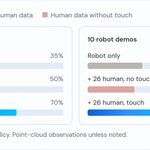
The policies do quite well, and we see that good, aligned (visual+tactile) human demos are additive to policy quality.


1
1
35
Paper: arm.stanford.edu/papers/vist…
Website: vis-tac-align.github.io/
Great collaboration work with Julien Poffet, @ankushd5812, Baiyu Shi, Shalika Neelaveni, Yujian Yuan, Zhenan Bao, and Monroe Kennedy at Stanford University, supported by the Toyota Research Institute University 3.0 program. We believe that human video is not enough, and touch will close some of the gaps in dexterous manipulation.
1
43