

Latin from the Middle Ages. By @Boaz_Schuman
orbis terrarum
Joined December 2014
- Tweets2K
- Following1.8K
- Followers3.5K
- Likes6.9K


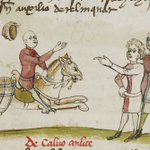






Another relatively common abbreviation with medieval roots:
videlicet > viꝫ > viz.
The ꝫ stands for the sound et. Years ago, back at the Dictionary of Old English (U of T), someone showed me a Middle English text that included the abbreviation kꝫle, "kettle".

You can still see this practice here and there—for instance, in the ℞ symbol associated with pharmacies.
Apparently this was the abbreviated form of recipe, "take".

Unicus (-a, -um)
—one and no more; only, sole, single
—singular, unparalleled, unique
—(rare) singularly bad, detestable
—(romantic) my one and only; the one
It is in the last sense that Heloise frequently addresses Abelard as unice.

Image courtesy of the @GettyMuseum's Open Content Program. Link with details: getty.edu/art/collection/obj…

2
73
non debet reputari honor vel reverentia a pravis impensus vel impensa
"Honor or reverence from a man or woman burdened by depravity should not be taken into account"
—John Buridan (Questions on the Soul, 1.3)
2
200
A humorous pseudo-Scholastic question, courtesy of Rabelais:
Quaestio subtilissima: utrum Chimaera in vacuo bonbinans possit comedere secundas intentiones
The most subtle question: can a chimera, buzzing in a vacuum, consume second intentions?
(Note that medieval Latin bombus can mean "fart", so one possible reading is "a chimera farting in a vacuum")

1
7
346
Source: Pantagruel II.7
Image courtesy of the @GettyMuseum's Open Content Program.
Link with details:
getty.edu/art/collection/obj…

1
114
Modo (adverb)
—only, merely, but
—in any way or degree; at all
—almost, nearly
—now, at present
It is in the last sense that the medievals referred to themselves as 'Moderni'
19
833
If you wish to be known by everyone, first make it so that you know no one.
Si vis omnibus esse notus, prius effice ut neminem noveris.
—De Moribus (Pseudo-Seneca), 37

Image courtesy of the @GettyMuseum's Open Content Program.
Link with further info: getty.edu/art/collection/obj…

3
185
mirabile dictu

Applications are now open for our 2026–2028 OxLAT programme, which offers free tuition in Latin language and literature from scratch through to GCSE examination.
If you are in Year 8 or 9 at a nearby state school which does not teach Latin, but you are interested in learning the language of the Romans, apply to study it here with us!
Full details and applications forms are available at classics.ox.ac.uk/outreach
***APPLICATION DEADLINE: Friday 15th May 2026***

If words are just their etymologies, then no politician is an idiot (ἰδιώτης, idiótes).
But at least some politician is an idiot.
Therefore, words are not just their etymologies.
1
5
347
The Seine comes up again and again in philosophy from the 1100s onward, where it serves as an example of something that is constantly changing yet somehow the same.
It's a big problem for things like identity across time, the semantics of indexicals ("this river"), and mereology (whole-part relations).
A great recent piece on this is Andrew Arlig's (2026) "Chairs and Rivers: How to Survive Change If You Have No Soul".


2
6
458

Credit for image on the right: Thesupermat (Wikimedia Commons user)
Link: en.wikipedia.org/wiki/File:S…

200
Wheelock's is great, especially the Sententiae Antiquae and Scripta in Parietibus, which give a sense of what people were actually using the language to say.
Far better than some of the artificial 'obstacle-course' constructions you sometimes see: "Did you see the sailors who gave money to the farmer who, with the harvest having been gathered, was watching his horse?"


PHILOCAPTUS (-a, -um)
—Captured by love; infatuated, besotted
From Greek φίλος (phílos, "beloved, dear") + Latin captus ("captured, seized")

Manuscript image courtesy of The @GettyMuseum's Open Content Program.
Link with details: getty.edu/art/collection/obj…
