

Co-founder, https://xitter.cf/t.co/pcivAPuCJa. Branding and product design for @token2049, @superai_conf, @KuruExchange. Prev product design lead at https://xitter.cf/t.co/OwF46byRlv
Book your call at →
Joined April 2026
- Tweets2.6K
- Following512
- Followers1.6K
- Likes7.5K





Pinned Tweet
We did about 26 web3 projects so far, average length 6+ months.
A lot of design teams will be like "Oh we did 5000 projects last week."
But us, we always end up working with people for a long period of time, some even over 2 years.
- @KuruExchange raised $13.6M and had a cumulative DEX volume of $2.42B (now they hit $3B recently)
- @Globalcoinrsrch raised $2.2M
- @ZetaMarkets had cumulative perps volume of $12.09B
I love taking on an idea, genuinely improving it with the team and watching it grow.


.@KuruExchange has surpassed $7B in trading volume, raised $11.6M and passed 100K followers on X.
They were referred to us by another client, @Globalcoinrsrch.
When we started they only had the name, so we did everything else:
- Brand identity from scratch: logo, colour palette, guidelines
- Pitch deck (helped them raise $2M in seed)
- Marketing website
- Trading UI: swap, positions and vaults, desktop and mobile
- 11 months of new features after launch, built from real usage
The visuals have moved on since, but the structure we mapped is still the one they built upon.


We moved from designing only for web3 to also AI.
You'd think the two are completely different, but they're not. You're still designing for a human.
And humans have the same needs regardless of the product, they want things that feel familiar, not interfaces they have to figure out.
Like, why does every single AI product have a chat interface? Because ChatGPT pioneered it, so it feels familiar now.
Same as Uniswap pioneered swapping in web3.
Every DEX since has used the same pattern.
When you understand that every industry has best practices, you can design for any niche.

I voted for Superteam Thailand in the Superteam Award at @SolanaConf. 🏆 solana.com/breakpoint/awards

Sorry, @matty_xyz actually did the logo, then led the art direction.

We helped rebrand Nexus, the startup competition at TOKEN2049.
1,000 startups applied to Nexus this year, only 10 pitched in front of Tom Schmidt from Dragonfly, Akshat Vaidya from Maelstrom and Spencer Applebaum from Multicoin Capital with the prize pool of $250K.
The hackathon is getting a lot of traction and needed a new look.
My co-founder Mat did the art direction and TOKEN2049 in-house team executed on it.
Singaporeans are so fit.
A run club went past the hotel almost every night when I was in Singapore for @token2049 and the tennis court outside my window was always full in the morning.
Also someone on the @token2049 team who resides in Singapore has done six Hyroxes.
It is a bit crazy considering they're trying to be more healthy but they're sucking in all the pollutants in the air..
I am looking to connect with more people who are into 0→1 product, branding, vibe-coding, senior and junior designers, founders in the web3 and AI space.
Reply here if that sounds like you.
Heard at @token2049 that @coinbase used to run everything on one AI model, until their CEO called it an Achilles heel.
If that provider cuts you off, you're done.
So they started using multiple models, anonymous platforms like Venice to protect their data, and agent costs went from $100 to $75 or $60 flat, so they can actually predict them.
I've already been cut off by @claudeai, so I get it.
The setup I'm going for: a CEO and COO agent on the strongest frontier model doing the thinking, and a really good free open source model for things like writing emails.
I'm not Coinbase, but I think even smaller, leaner teams can learn from this.

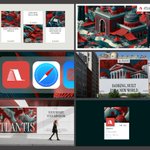
We're working with @token2049 across branding, website and product.
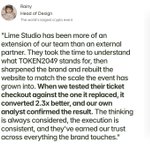
That includes a ticket checkout that converted 2.3x better than the one it replaced, confirmed by their own analyst.
A complete checkout revamp and a website refresh, both yet to be released.
A dedicated site for the New York edition, And the logo and art direction for Nexus, their startup competition.
So their former head of design left us a quote that speaks louder than we could.
The word I'd love to highlight there - trust.
Trust it is what founders and design leads are really buying when they hire a studio, and it's built the slow way, by being consistent.
It's how you go from external partner to an extension of their team.

I am announcing my disappearance from social media with this image. Thank you for your attention 😂
*hyperventilates*

Something I tell designers: never present work with "here's the design, what do you think?"
That opens the floor to free-for-all feedback, and suddenly everyone's talking about the placeholder image instead of what you actually need feedback on.
Frame it instead.
Say what we're looking at, like the user signup flow, what you did and why you think it'll lead to the result you want, and keep it tight.
Then draw a circle around everything else. The visual is a work in progress, or it was provided by someone else and fits the brand guidelines.
If someone still wants to talk about the image, park it and pick it up after the signup flow.
At @token2049 I spent two days talking with a product designer from a perps exchange in Singapore about agents and design systems.
I couldn't see how one .md file could hold a whole design system. It gets long, and every edit means the agent rewrites the whole thing.
Say you want to change your buttons. If everything lives in one file, the agent has to touch that file, and it can break something you never asked it to change.
So split it up. One file per part:
tokens for colour, type and spacing
one file per component, with its variants inside
patterns for components used together
pages that only reference what they use, never redefine it
an index that tells the agent where everything lives
Now a button change means opening button(.)md and nothing else. Every page that uses a button just says "use button(.)md", so they all pick up the change without anyone editing them.
It's the same idea as a Figma component library, written so an agent can work with it.

ALT Diagram showing a design system split into one file per part: tokens, components, patterns, pages, and an index
I used to build my own tools, but I stopped.
It's a diminishing return. Every tool you build becomes another product you have to manage, and when it breaks you have to stop, fix it, test it again, and it turns into this endless cycle.
I see the attraction, especially when you don't want to keep paying for something. But if you use a tool every day, you really just want it to work. Building it yourself is like trying to build a car while you're driving it.
Just because I can doesn't mean I should.
Japan is about 3 hours from Hong Kong, so I've been going ever since I was young.
Every time it feels like an ideal city. The streets are spotless, the food is fantastic and people go out of their way to help you, even when they don't speak English.
Which brings me back to a very deep memory I have about the people of Japan.
In my early 20s I was visiting somewhere far out and got lost in the train station. Being from Canada, my idea of trains was very limited.
I asked a lady which platform I needed. All I was expecting was for her to point me in the right direction. She was pushing a baby stroller, and a lot of stations didn't have elevators back then, just stairs.
She walked me all the way to the platform anyway.
I know it's not easy for the people who live there. Their culture is very socially responsible, and that comes with a lot of pressure.
But as a visitor, you feel safe and taken care of. We're very lucky to be able to visit a place like that.


Struggling to pick color palette for the product? do this:
Choose an image from the approved moodboard
Use mosaic plugin to pixelate the image (value of 30 to 50)
Pick colors with the eye dropper
Learned this during my days doing packaging design.


I've been designing for 21 years and one thing I'd tell a younger designer is this:
Study printed work.
Anything that makes it to print has gone through rigorous rounds of review. If you mess it up after printing, it's a costly fix.
That pressure produces really considered design decisions.
I personally love Monocle magazine is one of my favorites, the layouts, the typography, the use of color, all deliberate.
Of course, you might have a lot more complexity in digital in the sense where you need to account for different screen sizes and a wider audience with different backgrounds and accessibility issues.
But fundamentally if you look at a printed magazine or a really well-designed book, it is where you see design at it's clearest.

Most stable coin cards are built for crypto bros. At @token2049 I sat down with @adityakiteapp from @kiteapp_xyz and he's building for the completely different end.
Kite lets you store, send and spend digital dollars.
It's already live across Asia, and it's built for travelers, freelancers and foreign workers, not just crypto natives.
Where he's looking next is interesting.
In Nigeria, USDT usage is already huge, and in his user research the question kept coming back: can your app let me store my money there? A lot of people there don't earn enough to get a credit card. The local currency keeps losing value, so they'd rather hold USDT.
Then there's the business side. Nigerian importers will pick a Chinese supplier that takes USDT over one with a better product that doesn't.
That's where you see the real application of blockchain, not a new way to spend, but a fix for problems people have around the world.
That's sort of the original intent of crypto. it is the solution to a lot of the world's problems, an equalizer of opportunity.
Find kite below:
kiteapp.xyz


How to make modern finance look cool:
Add dither effects.
unicorn.studio
playgrnd.tools
ascii-magic.com
On Figma: Dither - Apply amazing dithering effect for any images.
Plenty of tools to be honest, but we just used ChatGPT for these.


if you need branding for your startup, book a call here:
cal.com/meganejon/discovery?…
