



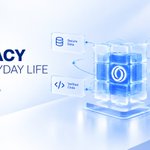


Buying wine online shouldn’t mean exposing your entire identity just to prove you’re old enough.
With @Concordium, Zero-Knowledge Proofs can verify age without revealing personal details, while its identity infrastructure brings accountability to digital transactions.
Privacy for the customer.
Confidence for the merchant.

35
Tired of explaining the same things every time you switch AI tools?
That’s what PluralityNetwork is tackling with AI Context Flow.
One shared memory layer that lets your AI tools access the context you own, instead of keeping it scattered across different platforms.
The interesting part: @OasisProtocol ROFL helps protect that context while it’s being processed, using confidential computing and verifiable execution.
One memory.
Different AI tools.
You stay in control.
#Oasis $ROSE

3/3
This is why I find the conversation around verifiable infrastructure important.
We need systems designed with resilience, privacy and accountability in mind, where critical operations can be independently checked rather than relying entirely on trust in the provider.
@OasisProtocol approaches part of this through confidential computing, Sapphire and ROFL, combining protected execution with remote attestation.
The future needs more than powerful infrastructure. It needs infrastructure we can verify and trust for the right reasons.
#VerifiableInfrastructure #Web3
2/3
Think about it.
When your email, banking, travel and other essential services rely on a limited number of major providers, one technical failure can disrupt far more than the service itself.
And when something goes wrong, most users have little choice but to wait for an explanation and hope everything comes back online.
Not exactly the kind of control we’d like to have.
1/3
The interesting part is that the reported explanations were different.
Software defects, network equipment issues, internal updates and scheduled maintenance.
Authorities and the companies involved reported no evidence that the incidents were connected or part of a coordinated cyberattack.
Still, it raises an important question:
𝒉𝙤𝒘 𝒓𝙚𝒔𝙞𝒍𝙞𝒆𝙣𝒕 𝒂𝙧𝒆 𝒔𝙮𝒔𝙩𝒆𝙢𝒔 𝒘𝙚 𝙙𝒆𝙥𝒆𝙣𝒅 𝒐𝙣 𝙚𝒗𝙚𝒓𝙮 𝙙𝒂𝙮?
Imagine waking up to Microsoft 365 down, flights grounded, banking services disrupted, and Apple and NSA systems experiencing outages, all within a few days.
At some point, you start wondering just how much of our digital lives depends on a handful of systems.
That’s what made this recent wave of outages worth paying attention to.
🧵👇
#Privacy #OasisProtocol


You know that annoying feeling when a website asks you to upload your passport and enter your date of birth just to prove you’re old enough?
We got used to sharing all that information just to access a service.
But verification doesn’t have to come at the cost of privacy.
With Zero-Knowledge Proofs (ZKPs), you can prove you’re over 18 without revealing your actual date of birth or uploading your passport every time.
That’s one thing I appreciate about @Concordium’s approach to digital identity.
Verify what matters, keep the rest of your personal information private.

MeghanCrypt retweeted

There’s a new rider in town 🚴
Privana has been training on Oasis, putting in the miles in closed testing.
It’s private DeFi, so your trades and your strategy aren’t on display for everyone.
We’ve got something for you on Monday.
Keep an eye on our socials 👀 @PrivanaFinance

You can have a heavily secured database and still leave the side door wide open 👀
That’s the lesson from Denmark’s reported data breach, where access through a third-party company exposed millions of records without directly compromising the main register.
It makes me think about how easily we overlook the systems and accounts connected to the ones we trust.
Encryption matters, but so do strict permissions, continuous monitoring and control over who can access sensitive data.
And with AI agents gaining access to more tools and credentials, this lesson becomes even more important.
Privacy is only as strong as the access you allow.
@OasisProtocol oasis-network:native #privacymatters

3/3
This is why I think privacy deserves a bigger place in on-chain governance.
Transparency should let everyone verify the outcome, not give everyone the ability to monitor individual voters.
With privacy-preserving voting, we can protect people’s choices while keeping the final tally verifiable.
@OasisProtocol #OnChainGovernance #Privacy
2/3
Here’s the catch with blockchain transparency:
Making every vote publicly visible may help people inspect individual choices, but it can also make voters vulnerable to bribery, pressure or coercion.
Keep individual votes private until the voting period closes, and a buyer loses that easy way to confirm whether you followed their instructions.
1/3
There’s a reason secret ballots became important.
When secret voting was introduced in Australian colonies in 1856, one of the problems it helped address was vote-buying.
If nobody can verify how you voted, buying your vote becomes a lot harder to enforce.
Public on-chain voting can bring that old problem back in a very modern package.
Imagine someone paying you to vote a certain way, then checking the blockchain to make sure you actually did it.
Sounds ridiculous?
That’s one of the problems with fully public on-chain voting.
Every vote can be tied to the wallet that cast it, making individual choices visible to anyone watching.
👇🧵
#Web3Governance #OasisProtocol

MeghanCrypt retweeted
AI agents are no longer just automating tasks.
They’re automating attacks.
And the scary part? They’re moving faster than humans can respond.
Security, identity and accountability need to evolve just as fast.
Welcome to the agentic era. 👀
This post is from a suspended account. Learn more
Your birthday is personal information, not a password every website should have access to.
A website may only need to know that you’re over 18, not your exact date of birth or the identity documents behind it.
With @Concordium, zero-knowledge proofs let you prove you’re old enough without revealing your birthday.
✓ Verify your identity once.
✓ Prove only what’s required whenever needed.

The website: “We just need to confirm you’re over 18.”
Also the website: “Upload your passport, date of birth, full name and every personal detail we can get.”
You shouldn’t have to reveal your entire identity to answer one simple question.
With @Concordium, you verify your identity once through an independent Identity Provider.
After that, zero-knowledge proofs let you prove you’re over 18 without sharing your passport or date of birth with every website.
Prove what’s needed.
Reveal nothing unnecessary.
Privacy shouldn’t be the price you pay to access a website/app.
#privacymatters #ZKP

that combination of real usage + accountability is exactly what the agentic economy is missing.
Still holding my concordium:native too
3
61
Imagine your AI agent making hundreds of transactions while you sleep.
Who answers if it makes a decision you never authorised?
This is why I find the identity discussion around AI agents so important.
x402 is making it possible for agents to pay for services autonomously.
But a successful payment doesn’t tell a merchant who authorised the agent or who is responsible for its actions.
During his conversation with Paul Barron, Concordium CEO @BBilowitzki explained why this matters.
With its Agent Registry and Verified by @Concordium badge, agents can be linked to verified human or business owners without exposing their private identity.
We need smarter agents, absolutely. But we also need to know who stands behind them.
Autonomy should never mean accountability disappears.
🎙️ Full conversation: youtu.be/Ojq4P8EBlfg
