

Machine Learning Engineer | Time-Series & Sequence Models for Fraud Detection & Payments | System Design
Joined May 2025
- Tweets563
- Following31
- Followers27
- Likes1.2K





AI/ML interview questions
- What is dropout, and why does it work?
- Explain gradient descent and its variants.
- What is prompt injection? What's your defence? (Anthropic)
- What is the KV cache, and why is it needed? (OpenAI)
- Speculative decoding: why is output quality preserved? (NVIDIA)
24


Today’s problem: Normalize a vector
One of the easier questions. Maybe I should try something harder tomorrow. np.linalg.norm() put everything in place. Also “Normalize a vector” isn’t the same as “normalization (min max - ranging from 0 to 1)”


13
This is why your cold emails don't get responses.
We send out email after email and assume people don't want to reply for a number of reasons. But a lot of the time, they never even see it. It lands in their SPAM.
Most of us are sending from a free address (Gmail, for example) to a work address. Free addresses get extra scrutiny and work addresses are stricter toward them, so your email often ends up in spam.
We can't fully fix this, but we can increase the odds. Here's how to position yourself better:
- Use your own domain ([email protected]), not Gmail
- Verify your domain. SPF, DKIM, and DMARC let inboxes confirm your emails are genuine, not spoofed
- Warm up slowly. A few emails a day at first, not hundreds
- Keep first emails simple: plain text, a clear subject, no attachments, few or no links
- Aim for replies. They're the strongest trust signal there is
This still doesn't guarantee your emails will stay out of spam, but it puts you in a better position for recipients to see them and respond.
1
48
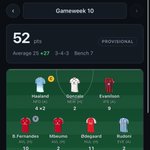
Earlier this season I decided to use Machine Learning to play Fantasy Premier League (FPL), 2 models (The Manager and Best XI), following the same rules and competing against the average score of global players every gameweek.
The Best XI - This selects a new set of players every game week based on the highest expected score of the upcoming gameweek. Good way to help actual players selects players, you can go there to see the players expected to perform in the upcoming gameweek. The average score has been beaten 6 times out of 10 gameweeks.
The Manager - This started just as everyone else, selected a set of players and programmed to follow the rules like transfers cost etc. It has beat the average score of global players 5/10 times so far.
Link 👇


Today's problem was on L2 Norm (Ridge). Similar to yesterday's problem because of the "without overflow" condition. The fix here was scaling the vector before calculating the sum of squares. Also, code's looking more structured today.


28

Here are some interview questions i worked on today:
1. Explain cross-validation. Why use it?
2. L1 vs L2 regularization: what’s the difference? (Amazon)
3. Prompting, RAG or fine-tuning: how do you choose? (OpenAI)
4. FlashAttention doesn’t cut FLOPs, so why is it faster? (Together AI)
5. What is the lost-in-the-middle problem in LLMs? (Moonshot AI)
How many could you answer? Solutions below
1. teapawt.net/amitiitbhu/status/1939…
2. outcomeschool.com/blog/regul…
3. outcomeschool.substack.com/p…
4. outcomeschool.com/blog/decod…
5. outcomeschool.com/blog/lost-…

Understanding Cross-Validation in Machine Learning.
Cross-validation is a technique used to evaluate machine learning models by testing how well they generalize to unseen data.
It involves splitting the original dataset into multiple parts (or "folds"), training the model on some parts, and testing it on the remaining parts. This process is repeated multiple times so that every data point gets a chance to be in the training and test sets.
How does it work?
The most common form is k-fold cross-validation, where the dataset is divided into k equal-sized subsets (folds). The model is trained k times, each time using k-1 folds for training and the remaining fold for validation. The final performance metric is typically the average across all k iterations.
For example, in 5-fold cross-validation:
• Split the data into 5 equal parts
• Train on folds 1,2,3,4, and test on fold 5
• Train on folds 1,2,3,5, and test on fold 4
• Continue this process for all combinations
• Average the 5 performance scores
Why is it used?
• To estimate model performance on unseen data.
• To reduce overfitting risk by checking how the model generalizes.
• To tune hyperparameters
• To make better use of limited data, as all samples are used for both training and validation across the folds.
That's it for now.
#MachineLearning #AI
1
33


The resources for my current learning stack:
System Design - algomaster.io/learn/system-d…
AI Engineering - vibeengines.com
Quantitative Finance - quantmemo.com
Machine Learning Coding - trentorch.com
I'm looking for free alternatives for AI Engineering
24
Decided to try this today. Relatively straightforward question, the interesting part here is “without overflow”. The ideal sigmoid formula is:
σ(x) = 1 / (1 + e⁻ˣ)
But you are most likely gonna get an error (floating point overflow) when you have to use that on a large negative number. For large negative numbers, use the identical form to avoid overflow errors:
σ(x) = eˣ / (eˣ + 1)


2
66

If you are just starting with System Design, here are some key concepts you should get familiar with:
- Scalability: Handling more load by adding resources
- Availability: How much of the time the system is up
- Reliability: Doing the right thing, even when parts fail
- Single Point of Failure (SPOF): One component whose failure kills everything
- Latency vs Throughput vs Bandwidth: Time per request vs requests per second vs max data capacity
- Consistent Hashing: Spreads data across servers so adding or removing one moves few keys
- CAP Theorem: In a network partition, pick consistency or availability
22


