

Memory that evolves. https://teapawt.net/t.co/IQhcEYhWQ5
Joined April 2026
- Tweets62
- Following68
- Followers100
- Likes61
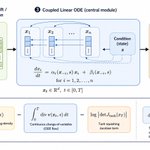
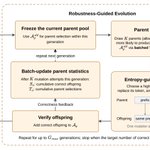
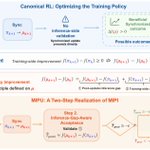




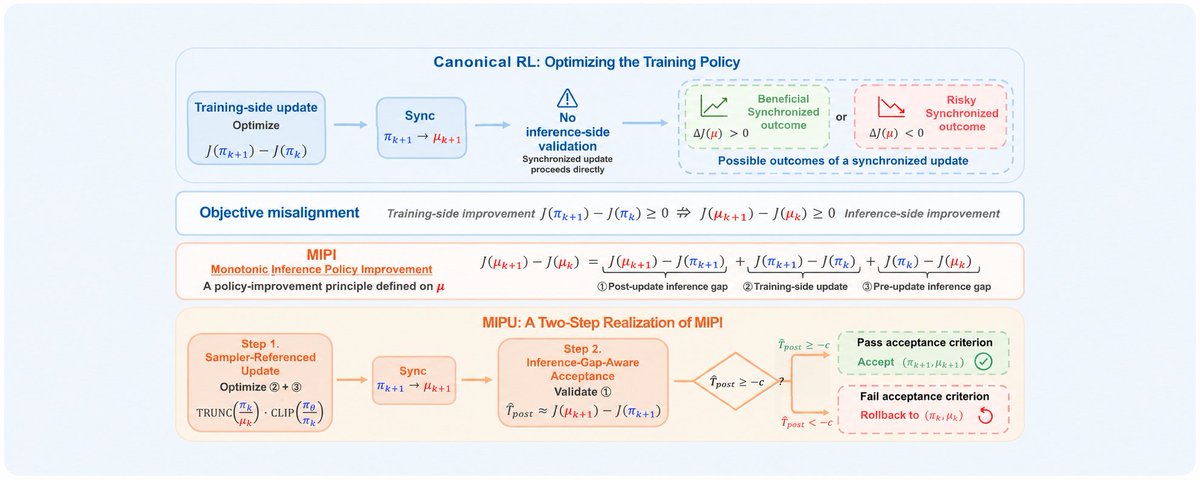
MemoraX AI’s MIPU framework targets inference-side improvement through sampler-referenced updates, inference-aware validation, and selective acceptance or rollback.
Coding Agents are powerful at solving the task in front of them.
The harder problem is what happens after the session ends.
MemoraX Code is designed to preserve project-level experience—not every chat message—so your Agent can retrieve relevant context, decisions, debugging history, and verified fixes when working on related tasks.
You don’t need to switch Agents. Just keep building, and let your project experience accumulate over time.
1
121
Coding Agents are powerful at solving the task in front of them.
The harder problem is what happens after the session ends.
MemoraX Code helps preserve the project experience that matters, so your Agent can spend less time asking you to repeat the past—and more time moving the project forward.
73
We’re excited to share that 10 papers from MemoraX AI have been accepted to NeurIPS 2026.
Our research explores how AI systems can learn from experience, improve their reasoning, and continue evolving over time—from robust self-training and reinforcement learning to long-term Agent Memory.
🧵 A look at the research behind these papers.

These papers reflect MemoraX AI’s broader research focus: building AI systems that can learn more reliably, reason more efficiently, and make better use of past experience.
The work spans:
• Robust self-training for LLMs
• Reinforcement learning and inference-policy optimization
• Difficulty-aware reasoning and token efficiency
• Diffusion models for online RL
• Long-term Agent Memory and continual improvement


1
2
282
One key theme across this work is that improving AI is not only about making models larger.
It is also about helping them:
→ identify which experiences are useful
→ avoid repeating failed paths
→ allocate computation more efficiently
→ retain and reuse knowledge over longer tasks
→ improve reliably under changing conditions
This is the foundation for more capable and continuously evolving AI systems.
More details on the papers and research directions will follow.

74
MemoraX AI retweeted

Giving AI agents a reliable memory has always involved a frustrating tradeoff.
Offline summaries cost too much computing power to constantly rewrite and often leave out the exact details you need later.
Basic vector search clutters the AI’s context window with repetitive snippets & also misses the critical supporting facts.
This new paper from MemoraX AI tackles this by treating memory retrieval like an optimization puzzle rather than a simple keyword match.
In the beginning, when a question comes in, it grabs a few initial relevant memories across text and visuals.
Then it follows semantic links and data relationships to build a small local network of related facts (an "evidence forest").
And instead of just grabbing everything that looks similar, it balances the value of each piece of information against an "activation cost" for including it.
That penalty for adding new nodes is what makes the system work so well.
It blocks redundant, repetitive information while intentionally making room for subtle, complementary clues that standard search ignores.
Because this network is assembled on the fly for each specific question, you avoid the expensive upkeep of maintaining a massive, constantly updated master graph.
The result is a much cleaner way to give an agent the right context without wasting tokens or missing key details.
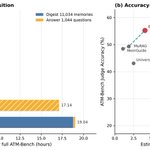
Across four long-term multimodal benchmarks, this approach sets a new Pareto frontier between accuracy and lifecycle maintenance cost.
Its a must read for everyone working on Long Term Multimodal Agent Memory: arxiv.org/pdf/2608.26983

Introducing GraphMemix, a query-aware evidence forest framework for long-term multimodal agent memory, developed by researchers from Peking University and MemoraX AI.
Instead of retrieving isolated memories, GraphMemix organizes complementary evidence into compact, reliable forests.
📄 Paper:
arxiv.org/abs/2608.26983
💻 Code:
github.com/memorax-ai/graphm…
We welcome feedback, discussions, and contributions from the agent memory and multimodal AI communities.

Across ATM-Bench, Mem-Gallery, MemEye, and H2HMem, GraphMemix achieves 61.55% average Judge Accuracy with Qwen3-VL-8B — an absolute improvement of 11.75 points over the strongest public baseline.
The gains hold across different reader models.

1
200

The next AI coding breakthrough may not come from a better model.
It may come from a better harness.
NVIDIA’s latest work is a good example: persistent memory, supervision, and tool use can dramatically change how an agent performs on long-horizon tasks.
As coding agents move from “write this function” to “work on this repo for hours”, the bottleneck is no longer just intelligence.
It’s context, memory, tools, and continuity.
That’s why we’re building MemoraX Code — a memory layer for coding agents.
The model writes code.
The memory helps it remember why.

The first CPU built for agents is going to work at scale.
@SpaceX is deploying NVIDIA Vera to accelerate the orchestration, code execution, and data processing that powers its next generation of agentic AI — keeping GPUs fed and agents acting fast.
From gigawatt AI factories to orbit. One NVIDIA architecture, everywhere.

1
1
319
MemoraX AI retweeted

The first CPU built for agents is going to work at scale.
@SpaceX is deploying NVIDIA Vera to accelerate the orchestration, code execution, and data processing that powers its next generation of agentic AI — keeping GPUs fed and agents acting fast.
From gigawatt AI factories to orbit. One NVIDIA architecture, everywhere.
Your coding agent shouldn't have to start from zero every session.
What if it could remember:
— what was changed
— why it was changed
— what was tried before
— and what still needs to be done
Persistent memory could be the missing layer for long-running AI coding workflows.

1
1
294
Building AI memory is harder than storing conversations.
A useful memory system needs to understand what matters, retrieve the right information, adapt to changing states, and support reasoning across long-running tasks.
Today, we’re excited to share that MemoraX ranked #1 in the Commercial Products — Text Memory track of the first Agent Memory Leaderboard (AML) evaluation.
🏆 #1 Commercial Product — Text Memory
Score: 58.02
The first AML evaluation brought together 136 registered teams and 69 representative memory frameworks, providing a common evaluation environment for comparing memory systems.
For us, this result is a milestone in our effort to build memory as an evolving infrastructure layer for AI agents.
The leaderboard is only the beginning.

This quoted post is unavailable.
Over time, we want more memory capabilities to become learnable by the system itself:
— what is worth remembering
— how it should be stored
— when it should be updated or forgotten
— when and how it should be used
This creates a continuous feedback loop between real-world tasks and memory improvement.
1
74
The first AML evaluation provides one external data point for this direction:
🥇 #1 — Commercial Products · Text Memory
MemoraX — 58.02
We see this not as a finish line, but as a starting point for making memory more reliable, adaptive, and useful for long-running AI agents.
Build memory that learns.
119