

M7 is the first of its kind FDE firm for financial technology. We invest in early-stage trading technology companies and scale the rest.
Here
Joined September 2022
- Tweets163
- Following20
- Followers76
- Likes126








Pinned Tweet
Prediction markets have mastered one thing: turning attention into orders. The bigger question is: can they turn attention into durable trading flow?
The first trade is only the beginning. For prediction markets to scale, attention needs to move through multiple layers:
Attention → Funded Account → Market Access → Venue & Clearing → Liquidity → Resolution & Integrity → Local Permission
Today, M7 Research is launching From Haaland to Hormuz: How Public Attention Is Turning Into Trading Infrastructure.
The report maps the seven layers that determine what happens after the first order. Which of these layers will become the biggest challenge or the biggest competitive advantage as prediction markets continue to grow?
Read the full report in the thread.


Finding the right influencer partner is only half the equation.
What are you paying them to do: create tutorials, bring in new customers or support a community?
Those contributions call for different agreements. Define the work before deciding the compensation.

Prop firms can pay for a sale without acquiring a new customer.
Affiliate programs may reward first purchases, recurring purchases or resets. A referral report shows who gets credit under the rules. It does not, by itself, prove who created the demand.

We're excited to announce our investment in PropHub, which will join our Harbor accelerator.
The partnership pairs working capital with hands-on operating support to expand PropHub’s product suite, strengthen distribution and support growth beyond Latin America.

Trading businesses can build on specialized, connected infrastructure instead of developing every component themselves.
PropHub supports that model with individual products, white-label platforms and custom turnkey builds.
Full announcement: prnewswire.com/news-releases…

What if a brokerage could own more of the trader journey from the very beginning?
It’s a question worth asking as the line between prop trading and traditional brokerage continues to evolve. For years, brokerages have largely entered the relationship when a trader is ready to put their own capital to work. But what happens if the brokerage moves further upstream?
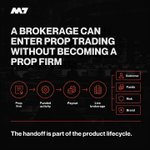
Building a prop trading arm could give a brokerage the ability to engage traders much earlier, before they are ready to fund a traditional brokerage account. The journey could look something like:
Evaluation → Simulated Trading → Funded Account → Payout → Live Brokerage
Instead of waiting for a trader to arrive at the final stage, the brokerage could build a relationship throughout the entire progression. That creates potential advantages across the business:
• Earlier customer acquisition
• A longer trader lifecycle
• More opportunities to monetize engagement
• First party insight into trader behavior
• A direct path from funded trading to live capital
• Greater control over the technology and customer experience
• The ability to build a brand around the entire trader journey
But building a prop arm also means taking on more of the infrastructure, operations, technology, risk management, customer support and regulatory considerations that come with running that part of the business.
That is where the strategic decision gets interesting. A brokerage could build the prop capability internally, partner with an established prop firm, or create a model that combines both. The right answer may depend less on the product itself and more on what the brokerage wants to own.
Does it want to own the:
- customer acquisition?
- trader relationship?
- technology?
- economics?
- transition into live capital?
Prop trading may be more than another product a brokerage adds to its offering. It could be a way to enter the trader journey earlier, build the relationship sooner, and create a path toward live capital from day one.

What happens when a trader's journey doesn't end with a prop firm payout?
The traditional path has been fairly fragmented. A trader discovers a prop firm, completes an evaluation, trades a funded account, earns a payout and then often starts the process all over again somewhere else if they want to trade their own capital.
There may be a bigger opportunity sitting between prop firms and brokerages.
The natural progression is fairly simple:
Evaluation → Funded Trading → Payout → Live Brokerage
Prop firms have become an important entry point for traders who want access to markets without putting significant amounts of personal capital at risk. Brokerages, meanwhile, are built for the next stage of the journey: traders deploying their own capital.
That creates an interesting question. Why should those experiences remain completely separate?
A brokerage doesn't necessarily need to build a prop firm from scratch. A prop firm doesn't necessarily need to become a full scale brokerage. There is potentially a middle ground where the two businesses connect their ecosystems and give traders a clearer path from one stage to the next.
There are already signs of this happening. Tradeify launched Slay Markets in 2026 around its existing trader community and partnered with NinjaTrader for clearing and technology. @Tradeify also promotes the ability for traders to move payouts into Slay Markets and transition toward trading their own capital.
That example points to something bigger than a new brokerage launch.
It suggests that the prop firm could become an acquisition and development channel for the brokerage, while the brokerage becomes the natural next step for traders who have progressed beyond funded trading.
The interesting part is what happens between those stages.
Who owns the relationship? How does a payout become live account funding? What happens to the trader's identity, history and experience during the transition? Which risk rules belong to the funded program and which belong to the brokerage? And how can two separate businesses make the experience feel like one continuous journey?
Those questions become even more important in U.S. futures, where introducing brokers and FCMs have different regulatory roles. A seamless customer experience still has to preserve those boundaries.
The opportunity isn't necessarily for brokerages to become prop firms or for prop firms to become brokerages. It may be to connect two businesses that already serve different points in the same trader lifecycle.
Because if a trader goes from evaluation, to funded account, to payout, and eventually to trading their own capital, the biggest opportunity may not be owning every step. It may be owning the transition between them.

A stalled bill does not pause rulemaking. It changes the operating perimeter.
In a 2024 interview, @crosbyventures made a broader point about crypto policy in the U.S.: when an issue becomes closely aligned with one political party, it can narrow its coalition of otherwise strong supporters. That observation is worth revisiting this week.
The Senate Banking Committee advanced the Digital Asset Market Clarity Act by a 15–9 vote in May. On September 15, the Senate voted 49–50 on cloture, falling short of the 60 votes needed to advance the measure.
Meanwhile, agencies continued acting under existing authority. On September 17, the SEC issued temporary, conditional relief for certain tokenized NMS-stock trading, while the CFTC's crypto market pre-rule action entered White House review. The SEC is also considering a custody-rule modernization proposal that includes crypto assets.
Those are meaningful moves, but they are not the same regulatory signal. A temporary exemption, a proposed rule and legislation each carry different scope, timing and legal foundations. That matters because regulatory uncertainty affects real business decisions: which products get launched, where they can operate, what licenses are required, how companies structure partnerships and how much capital they are willing to commit.
For firms building in crypto, the question is not only what the eventual framework says. It is how much confidence they can have that the framework will remain in place long enough to support those decisions.
When legislation stalls, companies still have to operate within the perimeter created by existing agency authority, rulemaking and enforcement risk. Political durability is therefore part of the operating model, not background noise around it.
The bigger question is what gets built in the gap between what regulators can do today and what Congress has yet to settle.
A new marketplace doesn’t differentiate itself simply by creating another place to trade. It differentiates itself by proving it can produce a better execution outcome.
CIX began live trading in Canada this week, the first new standalone Canadian equity marketplace in more than a decade, with three trading books: MIDPOINT, ASPEN, and ASPEN VERT. Its proposition is centered on improving adverse selection, market impact, slippage, and post-trade mark outs.
That raises a bigger question for any new venue: Can you measure the difference? More venues create more choice, but also another connection, data feed, routing decision, and layer of complexity. The venues that earn market share will need to demonstrate that the added complexity produces a measurable improvement in execution.
In other words, a new marketplace isn't just a liquidity proposition. It's an execution-quality hypothesis.
What metric should a new venue prove first: mark outs, fill quality, market impact, or order interaction?

Trading platforms are finding new ways to turn trader performance into user discovery and engagement.
Leaderboards, trader feeds, and shareable return cards give users a way to see what others are trading, discover new traders to follow, and find opportunities they may not have encountered on their own. For platforms, these features can create more reasons to return, encourage community participation, and turn trader activity into a potential acquisition channel.
FOMO is already bringing this concept to life. Its app combines a public P&L leaderboard, a feed to discover and follow traders, and real-time trade alerts alongside execution. Rather than treating performance as something that happens behind the order ticket, @fomo makes it part of the product experience.
But as performance content moves closer to the order ticket, it needs to be built as more than a marketing feature. The value of a leaderboard depends on whether users can understand and trust what they see.
That raises four questions:
1. What does “performance” actually mean?
2. Can it be verified?
3. What risk context travels with a win?
4. Who governs the surface?
This is not simply UX. For regulated firms, performance content and social features can implicate communications, supervision, and recordkeeping obligations. The SEC has examined how digital engagement design can shape retail behavior. Where discovery moves toward copying or execution, the control questions expand again.
Social proof may make a trading interface more discoverable. The harder test is whether a firm can make performance legible without making it misleading.
There is no silver bullet. The opportunity isn’t to build the loudest P&L leaderboard. It’s to pair visibility with credible performance data and meaningful user controls, creating a discovery experience that users can actually trust.
The question is: What needs to accompany a shared P&L to make it trustworthy?

Not every hiring gap is a hiring problem.
At Merchant Seven, we work with fintech companies navigating the difficult transition from 1 to 2 and from 2 to 4.
Growing fintechs are bringing market data, trading technology, marketing, commercial experience and much more into the same conversation.
That creates an important question for founders:
Do we need to hire an entire team, or do we need access to the right expertise at the right stage?
This is where specialized fintech consultancies and fractional operators can create meaningful leverage. A strong fractional partner can help a growing fintech:
- Evaluate trading technology, market data, infrastructure, and vendor decisions before they become expensive mistakes.
- Optimize market data licensing, costs, compliance considerations, and operational processes.
- Translate technical capabilities into stronger products, customer value, and commercial opportunities.
- Build sales operations, CRM workflows, partnership strategies, and go-to-market systems.
- Support brand, content, investor communications, and market positioning.
- Bring experienced leadership and execution support without requiring the company to immediately build a large internal team.
The goal is not to replace the team. It is to extend the team.
The right fractional partner can provide the experience, flexibility, and execution capacity needed to move faster while allowing the internal team to stay focused on building the core business.
This is where Merchant Seven excels. We bring experience from across the fintech ecosystem, including trading platforms, market data, financial media, and financial technology businesses, to help companies identify the key, avoid the landmines, and accelerate outcomes.
The objective is not simply to build a bigger organization. It is to build a better business.

24-hour trading is coming. But longer trading hours are only the beginning.
The real question is whether your business is ready to deliver a market that traders can trust when the traditional trading day ends.
The data shows why this matters. Overnight trading volume rose 359% year over year in August, reaching 144.6 million shares per day. Yet overnight trading still represented just 0.9% of total NMS share volume, with the 10 most active stocks accounting for 43.4% of overnight volume.
The opportunity is growing. But so is the operating challenge.
As the SEC prepares to examine the future of overnight trading on September 17, the conversation is moving beyond access and into the infrastructure that makes markets work: liquidity, clearing, surveillance, systems resilience, and client experience.
The firms that win this race won't simply keep the order ticket open. They'll build the operating model that makes trading credible around the clock.

Since publishing our latest prediction markets report, we've had some great conversations about the challenges of operating across different jurisdictions. One question came up repeatedly: What happens when a market is global, but local access becomes a regulatory problem?
Brazil offers an interesting case study.
The chart below shows relative search interest for Kalshi and Polymarket in Brazil. It offers a snapshot of how attention can persist even when local distribution becomes a regulatory challenge.
In April 2026, Brazil’s Secretariat of Prizes and Bets (SPA) analyzed prediction-market platforms offering contracts on real sporting events and other non-economic-financial events. It suggested blocking Brazilian access to platforms within that scope.
The important distinction is that this was not a universal ruling on every prediction-market contract design. It was a proposed restriction on local access to platforms within that scope. This makes the situation more complex than a simple “banned or not banned” story.
The remaining questions are:
- What contracts can be listed?
- How can users be onboarded, funded, and supported?
- What can be marketed, and to whom?
- How does the customer journey change across jurisdictions?
For prediction markets, regulation can shape the inventory, access, and customer journey from the start. And this is where the broader opportunity becomes interesting.
Prediction markets are a new form of event-based futures trading. The event contract headline only tells part of the story.
The complexity lies in the infrastructure behind the contract, which includes market access, liquidity, clearing, distribution, compliance, and customer acquisition. It's important to note that global attention does not automatically translate into global trading access.
Thanks to everyone who read our latest report and sent thoughtful questions.


Access merchantseven.com/Research and find the latest Research Report published.
Prediction markets are becoming a routing problem.
The question is no longer just what people can trade. It’s increasingly about where the signal appears and how seamlessly it reaches execution.
Three trends Merchant Seven is watching:
1. Discovery and execution are coming together.
Platforms are making it easier to compare contracts across venues and execute from a single workflow.
2. Probability data is moving into institutional tools.
Market-implied probabilities are showing up alongside analytics, portfolio data, and execution tools.
3. Workflow is becoming the competitive advantage.
The winner may not be the platform with the most contracts, but the one that puts the right signals in front of traders at the right time.
Prediction markets may be evolving from standalone destinations into another part of the trading stack. As probabilities and event contracts move into existing platforms and workflows, distribution could become just as important as the markets themselves.
What do you think? Will prediction markets become a core feature inside existing trading platforms or remain standalone destinations?
Our Prediction Markets Research Report is coming in the next few days. Stay tuned.

Extending market hours is an easy headline. Upgrading the functional infrastructure is the hard part.
@Cboe's latest update on expanded options trading for selected single-stocks is a BIG signal of where derivatives infrastructure is heading.
The planned model adds a morning session before the U.S. cash open and a 15-minute post-close session. But again, the update also makes clear that this is not a universal shift: the scope is limited to designated, highly liquid names; market, stop and stop-limit orders will not be available in the new windows.
This leaves a lot of questions unanswered:
1. Access: Which products, users and order types are actually available in each session?
2. Liquidity: Can the option market open only when the underlying has a round-lot print and a two-sided market?
3. Counterparties: Who carries the quoting obligation across sessions?
4. Controls: Are risk rules, routing, market data, alerts and support operating coherently before the customer sees a tradable screen?
While a platform can announce extended access, liquidity is yet to be seen.
This is now the design challenge for traders, brokers, market makers and trading platforms to adapt to. We're excited to watch how the market adapts.
