Named to @businessinsider 13 Badass Immigrants In Technology, revolutionizing fintech. Built Entryless, acquired by @AvidXchange (NASDAQ: AVDX).
Joined November 2011
- Tweets5.8K
- Following2.2K
- Followers3.1K
- Likes40.8K






Pinned Tweet
When I first arrived in the US back in 2009; this is the ADVICE I wish somebody would've told me. Today I am excited…lnkd.in/gRBG3k6
Mike Galarza retweeted

My conversation with Michael Moritz, one of the great venture investors of the last 40 years.
Michael joined Sequoia in 1986 and co-led the firm with Doug Leone (@dougleone) from 1995 to 2012. His investments include Google, Yahoo, PayPal, and Stripe.
His new book, Ausländer, traces his parents' escape from Nazi Germany and helps explain his lifelong interest in what shapes exceptional people.
We discuss:
- The infamous Steve Jobs profile
- Why Don Valentine hired him
- The question he finds most revealing when interviewing people
- Monomania and the cost of greatness
- Why he has never felt good at anything
- Writing, journalism and AI
- What he learned about himself writing Ausländer
I'd recommend watching this one if you can. Michael was incredibly thoughtful and reflective throughout, particularly when talking about his parents, childhood, and the more difficult parts of his personal story.
Enjoy!
TIMESTAMPS
0:00 Intro
0:53 Family History & Identity
7:03 Survival & Outsider Instinct
18:53 Studying Exceptional People
33:50 Self-Doubt & Success
41:17 Steve Jobs & Obsession
52:50 Joining Sequoia
1:03:22 Leadership & Alex Ferguson
1:08:25 Elon Musk & AI
1:17:12 Becoming Who You Are
Mike Galarza retweeted

Ali Ghodsi never wanted to be CEO. In 2015, he was interviewing for a professor job at Berkeley when the @Databricks board handed him the interim title. Revenue that year was $1.5M.
This episode with @alighodsi will go down as one of my favorites. 10 things I took away:
1. Focus the entire company, orders of magnitude of attention, on its single biggest bottleneck. Like a laser, almost to an extreme. The cycle is 1-3 years, not weeks. If your focus changes weekly, then you’re just in firefighting mode.
2. There is nothing worse than a conflict-averse CEO. They are wonderful people, but they are in the wrong job. Conflict is the gym for a CEO: nobody likes it, but everyone has to go.
3. Study your enemy carefully, understand their weaknesses and apply your strengths to those weaknesses. Snowflake had 2x his revenue. He didn’t copy them. He found three weaknesses (proprietary, no AI, expensive) and hammered them account by account for four years. Watch the competition, never follow it.
4. The concept of a Lakehouse was ridiculed internally and online. No one wanted to market with this new term. So he made the whole company religious about it anyway, killed the ads that converted better without the word, and put it in the sales comp plan. It worked. All hands on deck, no exceptions.
5. Be willing to take a step back for a much bigger vision, even when the company is already succeeding. At multiple hundreds of millions in ARR, he was unhappy, because the vision he pitched investors wasn’t the company he was running. So he took one step back to go ten forward.
6. On the flat org, player-coach model that a lot of people have talked about this year: “it’s BS.” Separate how the company thinks (AI, ontology) from how the humans get managed (they are after all, still humans). His staff meets 3x a week. I asked if it could just be coordinated in a Google doc. His answer: do you meet your wife and kids, or coordinate that in a Google doc?
7. His test for a sales leader: can they build the car, or just drive it? Ron Gabrisko, the Databricks CRO, had seen $0→50M and $50→100M+, and hadn’t changed jobs in 10 years prior to joining. Now he has been the CRO for over a decade. He built and drove the car the whole way. That almost never happens.
8. Hire execs ahead of the curve because by the time you need them, it’s too late. A real search takes 6-12 months. The extra time helps you increase false negatives and decrease false positives. Do an insane number of backdoor references because 80% of ‘front door’ references are bs.
9. The best salespeople are not super technical, so stop trying to force them to be. Square peg, round hole. The best win with professional aggression, high EQ, and mapping the real power base (how decisions get made high up in an organization), not technical depth.
10. Yes, your best AEs will annoy people. One of the first at Databricks got a meeting nobody could get, but got banned from the customer’s building for it. He told Ali, “what are you complaining about? I got the meeting.” Professionally aggressive is the bar.
One bottleneck, zero wussing out. He reminds me of @elonmusk that way.
Chapters
0:00 – Introduction
1:22 – The secret CEO search and why the board bet on a founder
4:11 – Professor or CEO? Always taking the harder option
8:18 – Pour everything into one bottleneck
12:16 – Killing PLG and learning what great enterprise sellers actually have
19:09 – Hiring ahead of the curve: sales leaders, execs, and back-door references
27:02 – The Snowflake rivalry: study your enemy, never copy them
33:22 – Lakehouse: conviction, ridicule, and the case for second acts
41:02 – The killer instinct and why conflict-averse CEOs fail
44:10 – Dunbar's number and rethinking the org chart around AI
48:00 – AGI is already here — enterprises just use it as a chatbot
52:55 – Does he still code? Two days for a connector vs. three quarters
57:18 – A day in the life, and why the Monday meeting isn't theater
1:04:53 – Why Databricks will go public, just not yet
1:08:09 – Get over conflict aversion, or don't be CEO
1:11:07 – Brian's takeaways
Link to more in the comments.
Mike Galarza retweeted

More on AI pacing:
Sarah Friar CFO of OpenAI yesterday on CNBC: “from where I sit today there is so much opportunity to drive growth that I am still highly focused on getting more compute to keep that flywheel going.”
Sachin Katti VP of Compute Strategy at OpenAI @sk7037 yesterday: “The way we will make sure frontier models are safe and aligned is by spending compute. So the counterintuitive point is that we’ll need even more compute to make sure future models are more safe and aligned.”
If you thought “pacing” was negative for AI infrastructure demand, think again. Almost as bullish as open-weight AI taking share but not quite.
Mike Galarza retweeted

Anthropic’s Economics team is sharing a new model of how AI might affect economic growth, jobs, wages, and more by 2030.
Explore the scenarios, tell us what you think will happen, and see how your answers compare to more than 10,000 Americans. anthropic.com/institute/econ…

Mike Galarza retweeted

Anthropic's Andrej Karpathy just released 1-hour Stanford lecture on full AI engineering from scratch:
"You can actually delete everything… Delete everything, keep Graph"
here's his lessons:
10% → LLM: I treat GPT as a general-purpose computer that can be reprogrammed at runtime
30% → Prompt: I give that computer a program written in natural language
50% → Agent: I surround the model with a goal, context, memory, and tools that turn prediction into action
70% → Loop: I separate the inner loop, where the model learns from context, from the outer loop, where training updates its weights
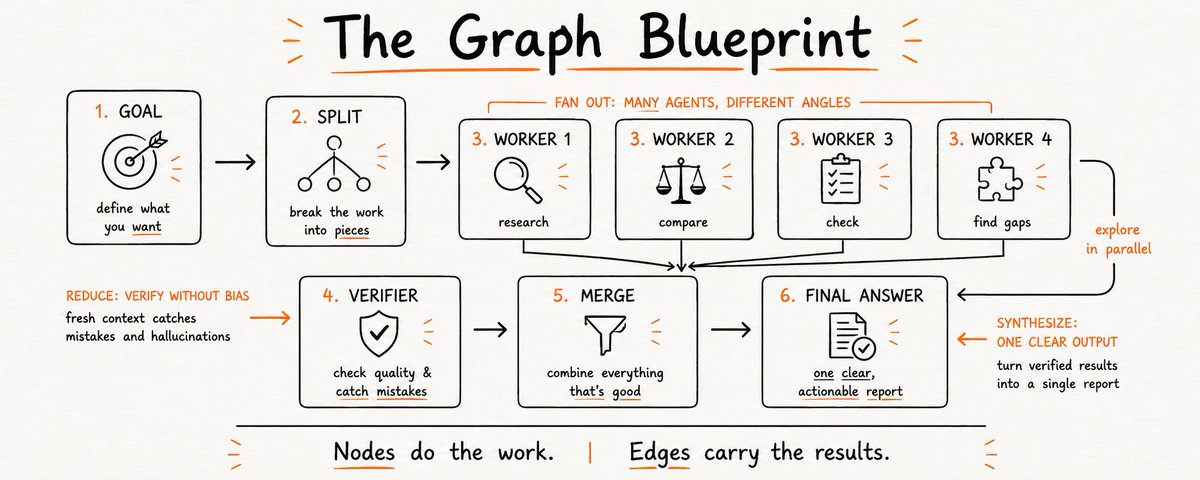
100% → Graph: I organize communication as data-dependent message passing over directed graphs
This 1-hour at Stanford will teach you more about AI than 100 YouTube video guides
“Just chop up everything and throw it into the mix”
watch - bookmark, then read the article below ↓


Mike Galarza retweeted

The market is reducing itself to:
Technology people who knows how this stuff works
Vs
Everyone else who has no idea and so gets short because it violates their non-technology priors

CoreWeave $CRWV: We recently signed an A-100 contract that extends into 2029. This SKU was introduced in 2020.

Mike Galarza retweeted

NVIDIA CEO, Jensen Huang:
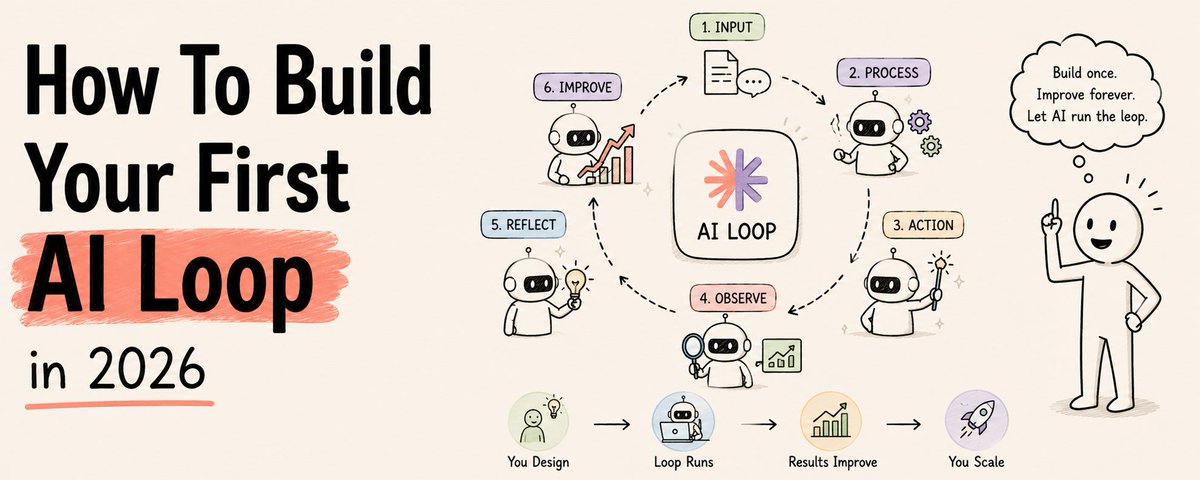
"Nobody writes prompts anymore, the new job is building Loops and Graphs."
In 50 minutes he breaks down what replaced prompting and why most people haven't caught on yet.
It's the difference between using AI and having AI work for you.
Watch it, then read the guide below on how to build a system that improves itself.

Mike Galarza retweeted
Power is THE binding constraint.
Data centers are being shut down, GPUs are sold out, models are being commoditized and spot rates are rising all leads to power being critical. Not fanciful plans for power, future forecasts of BTM or distributed batteries blah blah blah but energized power today.
This means the following hierarchy is developing from greatest to least value:
1. Hyperscaler
2. Neocloud
3. Model maker
Ideally, you are 1+3 (Google, SpaceX, Meta) where you own massive power today and have a leading set of models to keep API pricing from 3rd parties honest enough to benefit them vs the model maker. But even if you are just (1), you can still extract great economics from (3) because owning the power is the leverage.
This means (2) needs to scale up fast. If Neoclouds do not scale up fast and move up the value stack towards hyperscalers (solely measured by energized compute online today) they are going to leave a lot of revenue on the table which will complicate their long term financing plans.
Also, starting now, a neocloud’s real competitors will be well capitalized frontier model companies who will do sweetheart deals with (1) and/or will vertically integrate and try to become (1). You can see this in the fact pattern (Ant+AWS, OAI+Stargate).
Get your hands on power.
It’s the spice.

This chart is the single best argument for why neoclouds are about to print money (Save this).
SpaceX is generating between $30 million and $50 million in annualized revenue for every active megawatt of compute capacity, while pure play neoclouds like CoreWeave, Nebius and IREN sit in the $9.4 million to $10.4 million range.
Traditional colocation players like Digital Realty and Equinix trail even further behind at $3.5 million to $4.4 million per MW.
That gap matters because it shows exactly how much upside exists if neoclouds can push their revenue per MW closer to the top of that range and the mechanism that gets them there is simple: GPU rental pricing.
GPU lease rates have been rising fast which is the opposite of what most people assume about a commoditized rental market.
One year H100 contract rates jumped nearly 40%, from a low of $1.70 per GPU hour in October 2025 to $2.60 by now.
This is essentially a self reinforcing cycle where tightening supply drives price increases and those price increases push neoclouds to lock in more hardware which tightens supply again.
On demand pricing is even more extreme because every GPU model is essentially sold out on demand right now, with Blackwell generation B200 pricing running $4.99 to $18 per GPU hour depending on provider.
Several neoclouds have already started raising published rates rather than cutting them, with Lambda moving from $2.99 to as high as $4.29 an hour and Verda climbing from $2.29 to $3.25.
This pricing power flows directly into that revenue per MW chart, because every megawatt of power a neocloud controls becomes more valuable the higher GPU rental rates climb.
Rising rental prices expand return on invested capital for deployed GPUs and extend the economic useful life of existing hardware, meaning neoclouds squeeze more cash flow out of the same physical footprint before needing to reinvest.
That's the real bull case underneath the chart because power and megawatts are the scarce, fixed input, since Gartner expects power constraints to limit 40% of AI data centers by 2027, while GPU lead times already run 36 to 52 weeks.
If a neocloud already has power secured and GPUs deployed, rising per GPU hour pricing translates almost directly into rising revenue per megawatt with minimal added capex and that's precisely why CoreWeave, Nebius, and peers sit so far above legacy colocation players on this chart.
Colocation companies just rent out space and power but neoclouds capture the pricing upside of the actual compute running on top of it, and as GPU scarcity persists, that spread between neoclouds and traditional colocation should only keep widening.
Bullish on Neoclouds, make sure to follow @MelvinInvests for more AI infrastructure insights and if you want to see exactly what I'm buying as an analyst at Milk Road Pro, you can check out the link below for more.


Mike Galarza retweeted
If I were the company on the right I would try to kill every company that is like the one on the left.
This way, the company on the right can make trillions of dollars and then infect American politics with hundreds of billions of dollars to implement their vision of being the sole judge, jury and executioner of future progress.

Mike Galarza retweeted
Here is my AI investing guide.
Sitting here August 2026, my current best thoughts are as follows:
1. LPS (Land Power Shell) is still the most obvious and fastest path to cash on cash returns. Lots of value can be assembled and traded quickly at this layer. And as data centers get more pushback, energized land can explode in value. Very bullish here.
I’ve stepped into this layer very aggressively. My partner @anitavlallian and I have acquired almost 6GW coming online in a ramp from today thru 2029 of grid power and behind the meter.
2. Silicon - I helped get @GroqInc off the ground in 2015 and we licensed it to @nvidia for $20B Dec2025. I won’t invest or incubate anything in this layer now. The perf demands of the chips are too high, manufacturing precision is too complex and supply chain influence to get adjacent components like memory isn’t possible for a startup anymore. Lots of capital will be wasted here chasing Groq and Cerebras’ success. Note that both startups made sense a decade ago when these constraints were much more modest.
3. Clouds - Clouds are very very lucrative but very hard to build and very expensive and technically complicated to maintain. And as alignment becomes a more important issue, I expect the clouds will be asked to build robust KYC and attest to it. This makes the risk:reward ratio skewed. I don’t want to be responsible when the USG says a cloud allowed a bad actor to do something bad because of poor KYC.
4. Models are complicated. The big open question is how much of the revenue being generated by them today is because of tokenmaxxing and poor model behavior. If it’s a lot, then the annualized revenues will diminish meaningfully even as token consumption inflects upwards. This is the big economic question at this layer.
5. Harnesses are where the action is and why I started @8090solutions two years ago. In a nutshell, the harness helps enterprises owns their proprietary context (what Alex Karp calls their ‘alpha’). This is an enterprise’s data, workflows, evals, and business rules. A harness that gives this to an enterprise is what creates very low model-agnostic switching costs, which further reinforces my views of #4 above.
6. Applications will be another long term winner along with harnesses. This is where the differentiation between “off the shelf” and “custom time and materials” melts away. Every company, with the right harness, can now imbue their alpha into the software that runs their company. I expect this to mean that “off the shelf” is largely replaced with custom software creating a huge opportunity to write these solutions for companies. Build once and sell repeatedly is a laggard GTM motion for a SaaS world that isn’t needed here. Think custom by design, alpha embedded, proprietary by nature.
Fin.
Good luck to all the players!

Mike Galarza retweeted

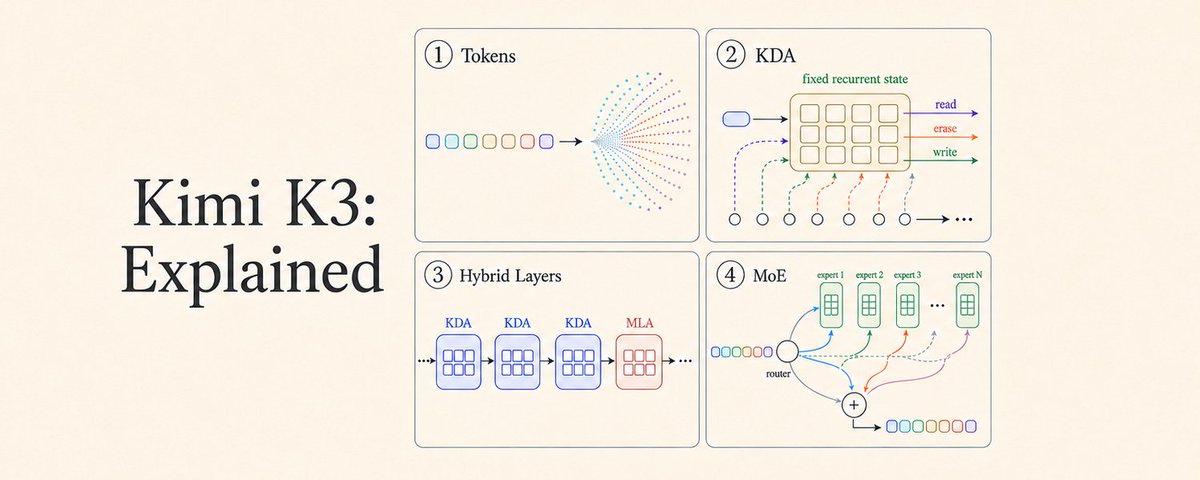
Best explainer on Kimi K3 i've read.
It walks you through how the model works & the elegant innovation behind it:
- K3 is the biggest open model anyone has released: 2.8 trillion parameters total, though only 104 billion of them do the work on any given word.
- The problem Moonshot went after is memory. Normally a model keeps notes on every word it has read, and that pile grows with every token, which is why long conversations get slow and expensive.
- K3 mostly stops the memory pile from growing. Three out of every four layers use a new mechanism called Kimi Delta Attention, which keeps a fixed-size working memory and edits it as it goes, overwriting what's stale instead of hoarding everything. The fourth layer keeps a compressed record of each word so exact details are still recoverable when they matter.
- They proved this on a small model first. A 48B test version used up to 75% less memory and ran about 4× faster at long context, while matching or beating the conventional design on the benchmarks they reported.
- Training leaned hard on long jobs including coding, browsing, research, visual work, agent sessions running hundreds or thousands of tool calls in a row.
- 1 Million cached input tokens costs $0.30. An agent can pull the same repo, the same docs, the same tool definitions back into context over and over without the bill getting stupid. Moonshot credits that to the memory design working alongside their serving stack.
- The biggest takeaway: context window size is the main character, but what matters is what a model compresses, what it forgets, and how it gets exact information back.

Mike Galarza retweeted

One pattern I find useful for working with LLMs is a nice long ramble session. Sometimes the LLM needs more bits to understand what you're trying to achieve, but you're too lazy to type them. In these cases I like to lean back, switch to /voice and just ramble for like 10 minutes, total mess, anything goes, full stream of consciousness. Sometimes I declare it up top, something like "switching to speech recognition sorry for any typos...". Sometimes I turn it into a small interview of a few turns. But I find that the LLMs are somehow very good at reconstructing long incoherent rambles and often their echo of your own tangle of thoughts comes out quite a bit cleaner than what you started with. The result is that you improve the mind meld and have to correct things less from that point on.

Mike Galarza retweeted

Something strange happened at Replit in the past six months.
The same engineers 3x’d output. Support resolved its hardest tickets 60% faster. Anyone could suddenly query the business like an analyst.
We’re seeing a new kind of organization: the self-driving company.


Mike Galarza retweeted

Andrej Karpathy just dropped a 6-hour course on how to build LLMs from scratch:
• 00:00 - Deep dive into LLMs like ChatGPT
• 03:31:23 - Building ChatGPT from scratch in live
• 05:27:43 - How to use LLMs (Karpathy method)
This course will replace a $90K Stanford LLM master’s degree.
Start watching today, then read how to become an AI engineer in article below.


Mike Galarza retweeted

Google Brain founder, Andrew Ng:
"100% of my tasks are done by ai agents, self-improving loops are next.
Give it 3-6 months and prompting is gone."
32 minutes of clear explanation on building loops from scratch.
Worth more than any $500 agentic course.
Watch it, then read the full guide below.