Mucosal immunology group with @s_milling at @UofGSii Interested in the intestine's role in human disease (alopecia, IBD, axSpA) & dendritic cells in the gut

Glasgow, Scotland
Joined April 2018
Include

Only show posts containing:

Exclude

Hide posts containing:

Time range
-
Minimum likes
Replying to @AlopeciaUK
This Barbie is an inspiration 😍 she's going to make a wonderful friend & mascot, wherever her journey takes her!
1
37
Love this idea! We'd love to welcome these little helpers in the lab!
64
A great pitch by Anna from @MillingLab on intestinal DC2! #EMDS2023
1
19
1,383
It doesn't look promising currently! There are some reports of decreased CRP in various rheumatological conditions with probiotic use though... perhaps their use could be complementary to more conventional therapies? 🦠🤔
1
23
Couldn't agree more @AmyShergold ! Congratulations on the fantastic work & paper 🥳
MORE EVIDENCE THAT DENDRITIC CELLS ARE THE BEST IMMUNE CELL!!! Our lab has published our first paper explaining how cDCs transfer context specific information from the site of inflammation to the lymph node and its bloody brilliant 😎 @chiara_pirillo @Robertslab1
7
1,186
How hard is it to do science in a language that’s not your first language? We quantified the severity of #languagebarriers for non-native English speakers when reading/publishing papers and attending/presenting at international conferences. doi.org/10.1371/journal.pbio… 1/9
87
3,546
521
7,508
1,208,945
We had an absolute blast at the Spring Fling at @UofGSii yesterday! Thanks for arranging it @hcbialic & can't wait to try again next year 🥳 we'll be working away on our artistic skills!
Scientists on a mission to paint the best flower pot! Another cracking @UofGSii social thanks everyone for coming 😊 and a special thank you to @GenScript for sponsoring the prizes!
3
508
Join @s_milling, @A_N_Ferguson, @Erika_Aqu1no, @AdrienneICPV & Vivienne Wilkes at #BSI22 today at 13:15 in Hall 1C to discuss the importance of public & patient involvement in research. Spoiler: it's hugely valuable to everyone involved in more ways than you may have thought...
3
Finally, @A_N_Ferguson has been investigating trained immunity in monocytes from people with axial spondyloarthritis, and pondering how the gut-joint axis contributes to this disease
3
Then you can catch @annaandrusaite's work at P-156 to learn intestinal dendritic cells and how these are modified by helminths to skew the host immune response
1
2
Next, you can find Catriona Laverty's work at P-045 where she has been looking at how iRhom2 could be targeted in inflammatory bowel disease as a novel therapeutic
1
2
Last chance to catch a glimpse at #BSI22 of the work going on in the Milling lab before our posters get packed away! First up, we have P-041 where Alana Brown showcases her work investigating the role of macrophages in alopecia areata
1
1
4
We've had an incredible time at #BSI22, catching up with both old & new friends, and being inspired by all the remarkable research that we've come across here! Can't wait for #BSI23 in Belfast next year! 🥳
1
12
A fascinating talk from @FredeAnnika today at #BSI22 on the effects of autophagy on Treg cells - always love to hear the work going on in the @kjmaloy lab!
1
21
THANK YOU to all our participants – 65 people with alopecia areata & 38 healthy volunteers – whose generous donations made these discoveries possible! And thank you to @AlopeciaUK, @AstraZeneca & Medical Research Scotland for their funding & support throughout this research!
4
Atopy often occurs in people with alopecia – but little is understood about how the diseases are linked. Here, we found that people with both alopecia areata & atopy showed changes to their B cell subsets – could B cells be a key component linking these diseases? 6/🧵
1
1
2
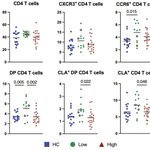
People with lower levels of hair loss had increased frequencies of CCR6+ and CCR6+ CXCR3+ CD4 T cells, with the increase of Th1/17 cells correlating with increased CD8 memory T cells. Surprisingly, no major changes were seen in circulating CD8 T cells overall 5/🧵
1
1
2
Although alopecia areata is thought to affect around 400,000 people in the UK, not much is known about the mechanisms that drive the hair loss, and treatment options are extremely limited 3/🧵
1
1
Alopecia areata is a common autoimmune disease, causing patchy hair loss. Normally our immune system acts as the guardian of the body. But in alopecia, these cells attack hair follicles 2/🧵
1
1
2% of people in the UK are affected by alopecia areata. Have you heard of alopecia areata? 1/🧵
56%Yes - tell me more!
44%No - please explain!
39 votes • Final results
1
4
10