

Data, insight, and analytics for forecasting, modelling, and trading European energy.
Europe
Joined April 2010
- Tweets8.2K
- Following369
- Followers9.7K
- Likes821




November trades at 209€/MWh. Q1 2027 around 190€/MWh.
The market is pricing an average. What's behind it?
Power prices for the winter are linked to gas prices all over Europe. France is no exception.
Is there anything to stop the climb?
Structurally, no. Hydro is low and still impacts nuclear production at Chooz. Hopefully Chooz 1 is restarting today. We are close to the end of environmental constraints, but far from water abundance.
Overall, nuclear production will be high this winter, similar to last year.
From the parameters we can anticipate, the die is cast.
Temperature is the most important parameter. We saw the consumption impact last week. And the first week of November will be colder than normal.
But as we are in France, we forget the wind impact.
France is known for the nukes, for the nuclear and for its delay in renewable energy.
Wind installed capacity is 25.8 GW, with 23.9 GW of onshore wind. When wind production reaches 14 GW, it's a quarter of last week's 56 GW peak demand. Not negligible.
Said differently: with good nuclear, as soon as wind appears, prices crash.
Last week is a great case study to analyse the wind sensitivity on solar hours:
- Wednesday 21st: wind forecast is at 16 GW, solar is at 11.5 GW and DA prices crash to 0€/MWh, far below the 210€/MWh in Germany
- Thursday 22nd: wind forecast is at 12 GW, solar is at 11 GW and DA prices are at 93€/MWh, above the 73€/MWh in Germany
In winter, temperature fixes the load. Nuclear production fixes the remaining load to fill. Or with renewables at 0€/MWh. Or with gas and imprts at 180-200€/MWh and above.
Binary states. There's no in between.
👀💰 Temperature sets the load. Nuclear sets the gap. Wind sets the price. Now you know. Get ready for the ride. 👍
^CB

📉 French day-ahead power prices are heading for a near four-year high next week.
Friday’s forecasts point to a sharp drop in wind output, with average generation falling 7.5 GW to 4.9 GW. Consumption is expected to rise 0.9 GW to around 49 GW.
⚡Residual load, the demand not covered by wind and solar, is forecast to jump 7.5 GW to an average of 40.8 GW.
Nuclear, which makes up around 70% of France’s mix, is forecast to rise 5.8 GW week on week to 43.6 GW.
💶 The front-week contract last traded at EUR 188/MWh, compared with an average day-ahead price of EUR 130.10/MWh this week. That is roughly 45% higher.
Further out, Cal 27 peaked at EUR 116.75/MWh, its highest level since November 2023.
Wind is the main swing factor in the week ahead. Want to stay ahead of the swings? Click the link here to see them on Montel EQ: eu1.hubs.ly/H0zlSHF0
Also reported by Andreas Lochner for @montelnews.
⏳ Less than one week to go to join our new Machine Learning course.
Over three live online sessions, you’ll learn to build, test and explain machine learning models using real European energy market data.
The course covers forecasting and classification models, how to spot overfitting and data leakage, and how to use AI coding assistants while checking their output.
It’s taught by sjur westgaard, Professor of Finance at NTNU, and Morten Risstad, Associate Professor at NTNU.
No machine learning experience is needed. You should be comfortable working with data and basic statistics. A pre-course module covers Python basics.
📅 Sessions: 29 October, 5 November and 12 November
💻 Format: Live online, with self-paced materials and exercises between sessions
Register by 27 October, or until places are full: eu1.hubs.ly/H0z61B20

Montel Analytics retweeted

🚌 All aboard for Montel’s UK Energy Day!
The event is just a few weeks away.
Join us in London on 10 November to connect with people across the UK energy sector.
Exchange perspectives on the developments, challenges and opportunities shaping the market.
Hear different viewpoints, catch up with colleagues and make new connections.
Will you be joining us? Register here: eu1.hubs.ly/H0zjGmy0

Today’s session closes Energy Intensive Week 2026 with a session on how to use PPAs to secure lower-cost and low-carbon electricity ⚡
Power Purchase Agreements can support long-term price stability while helping organisations meet their sustainability goals 🌍 Choosing the right structure and managing its risks is harder, and that’s what this session tackles.
📅 Today, 14:00–15:00 CET
🤝 In partnership with EUROPEAN ALUMINIUM
We’ll cover:
🔹 When PPAs make financial sense for industrial buyers
🔹 The main corporate PPA structures and which suit energy-intensive companies
🔹 Managing profile, balancing and shaping risk
🔹 How PPAs compare with traditional supply contracts
🔹 What legislators and regulators can do to support wider adoption
Speakers:
🎙️ Josephine Steppat, Senior Market Analyst, Montel
🎙️ Killian Daly, Executive Director, EnergyTag
🎙️ Nick Bitsios, Head of Brussels Office, Metlen Energy & Metals
🎤 Moderated by Alina Trabattoni, PhD, Italy Correspondent, Montel News
Register here: eu1.hubs.ly/H0ypZK70

Montel Analytics retweeted
What could push European gas prices higher this winter? 🌡️
At Montel’s Benelux Energy Day, Erisa Pasko, Lead European Gas Analyst at Energy Aspects, discussed the risks facing the market.
Europe’s storage position is stronger than expected, and Erisa does not currently see prices returning to the highs of 2022 and 2023.
The outlook could change if severe cold coincides with longer disruptions to LNG flows through the Strait of Hormuz. That combination could push prices above €100/MWh.
▶️ Watch Erisa’s session, Is Europe facing another energy price crisis?: eu1.hubs.ly/H0zgPC60
How to reduce energy costs through hedging and gas risk management
Join us today for a free Energy Intensive Week webinar, held in partnership with European Aluminium.
Erisa Pasko, Lead European Gas Analyst at Energy Aspects, and Wimmel Wick, Quantitative Developer at Montel, will discuss:
🔹 What is driving gas price volatility
🔹 The outlook for European gas markets this winter and beyond
🔹 Which market indicators industrial buyers should monitor
🔹 Hedging strategies for managing price exposure
Laurence Walker, Deputy Editor-in-Chief at Montel News, will moderate.
📅 Today, 14:00–15:00 CET
Register here: eu1.hubs.ly/H0z0bMP0

Set a price level. Get an alert when the market reaches it. See why it moved.
🔔 In Montel Markets, you choose the contract and the price level that matter to you, such as a hedging trigger or a budget limit. When the market reaches that level, you get an alert.
You can then check the context in the same platform:
📰 Montel News stories on what is moving the market
📈 Price history charts that show when the market was last at this level
The alert, the news and the price history are all in one place.
👉 Start your free trial: eu1.hubs.ly/H0yPlNn0
⚡When should industrial businesses buy electricity, and how can they manage the risks?
Electricity costs are shaped by more than wholesale prices. Generation, grid constraints, taxes and network charges all affect what businesses pay. And because gas-fired power plants often set the wholesale price, changes in gas markets can also have a significant impact.
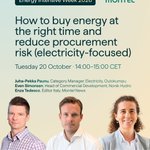
Tomorrow, Even Simonsen, Head of Commercial Development at Norsk Hydro, and Juha-Pekka Paunu of Outokumpu will discuss how industrial buyers can approach procurement in this complex market.
Enza Tedesco, Editor Italy at Montel News, will moderate the session.
🔎 They’ll cover the main risks for electricity buyers, which market indicators to monitor, and procurement strategies that can help manage price exposure and support longer-term planning.
🤝 Delivered in partnership with European Aluminium.
📅 20 October, 14:00–15:00 CET
Free webinar
Register here: eu1.hubs.ly/H0yWhZW0

Autumn arrived this morning.
At 9am, France was importing 420 MW.
Temperatures are finally closer to normal: low from 6 to 8° this week, 19 to 25 October, and high at 14°.
That's 4 to 8 degrees lower in the morning and close to 10 degrees less in the afternoon.
And load reacts. Immediate impact: this morning at 9am the load is at 53.7 GW after minimums at 6°C. Last week same time it was 49.4 GW with minimums at 10°C.
4°C colder, 4.3 GW more. That's the temperature gradient above 5°C.
When we pass below 5° the gradient increases, close to 1.5 GW per degree.
Below 0° it's closer to 2 GW.
How to cope with such a demand increase while all CCGTs were already running fully in morning and evening peaks?
No more exports. From 8:30 to 10am this morning France was importing.
Nuke availability is stuck at 38 GW. From Wednesday it should increase to 41 GW. Without significant change before the end of the month.
As long as nuke is not back, France will couple with Germany in peak hours and remain more expensive during solar (and off peaks).
Yes France above Germany on daily average.
👀💰 Every degree counts now. And it flips the dynamic. Get ready to make money 👍
^CB

Energy Intensive Week starts on Monday! ⚡
In partnership with EUROPEAN ALUMINIUM, we’re bringing together experts from across the energy sector for four free sessions on managing costs and navigating market uncertainty.
📅 Monday, 19 October | 13:00–14:00 CET
How to reduce industrial energy prices and costs in an increasingly volatile market
With Paul Voss of EUROPEAN ALUMINIUM, Cillian O'Donoghue of Eurelectric and Snjólfur Richard Sverrisson of Montel News.
📅 Tuesday, 20 October | 14:00–15:00 CET
How to buy energy at the right time and reduce procurement risk
With Juha-Pekka Paunu of Outokumpu, Even Simonsen of Norsk Hydro and Enza Tedesco of Montel News.
📅 Wednesday, 21 October | 14:00–15:00 CET
How to reduce energy costs through hedging and gas risk management
With Erisa Pasko of Energy Aspects, Wimmel Wick of Montel and Laurence Walker of Montel News.
📅 Thursday, 22 October | 14:00–15:00 CET
How to use PPAs to secure lower-cost and low-carbon electricity
With Josephine Steppat of Montel, Killian Daly of EnergyTag, Nick Bitsios of Metlen and Alina Trabattoni, PhD of Montel News.
Explore the sessions and register here: eu1.hubs.ly/H0yfTbc0


Montel Analytics retweeted
Thank you to everyone who joined us for Benelux Energy Day yesterday.
Across the programme, we explored how geopolitical uncertainty is influencing energy markets, the outlook for European gas prices and carbon, and the plans shaping the Dutch energy system.
We also looked at what growing electricity demand from data centres could mean, the factors driving long-term power prices, and the challenges of investing in volatile markets.
⚡ The afternoon turned to short-term and balancing markets, including Dutch imbalance prices, flexible portfolios and how market participants can respond to volatility.
A big thank you to our speakers, delegates and the Montel team for bringing the Benelux energy community together for a day of discussion and conversation.
📍 Next up: Italian Energy Day in Milan on 29 October.


Montel Analytics retweeted
What is the biggest risk the Benelux energy market is underestimating right now, and why? ⚡
We’ve had an excellent day so far at Benelux Energy Day, discussing the pressures shaping the region’s energy market. We put that question to four speakers, whose answers highlighted how tightly connected the challenges are.
🔌Joanna Pandera PhD, President of Forum Energii, pointed to the pressure on Europe to act quickly, while the policy options available come at a cost.
🔋Erisa Pasko, Lead European Gas Analyst at Energy Aspects, highlighted rising electricity demand from data centres, EVs and heat pumps. Flexible generation is not growing at the same pace as demand, and she said power markets look tight this winter.
🏭 Erika van der Linden, Senior Policy Officer for Dutch Energy System Strategy, focused on the need to invest in new industries as fossil industries decline, and the importance of having those industries in place for Europe’s competitiveness.
🌡️ Fleur Greetham, Director of the Management Consulting Division at AFRY, raised questions about how hotter summers and falling water levels could affect energy infrastructure, from transmission lines and power stations to solar panels.
Which of these risks do you think the market is underestimating most?
📊 Energy markets are more volatile than ever.
More wind and solar. More negative price hours. 15-minute day-ahead products.
That’s more data than any team can work through by hand.
🤖 AI tools can build a forecasting model in minutes.
But can you tell if it’s any good?
A model can look excellent in a backtest because future data leaked into its training. Catching that takes machine learning knowledge, not a better prompt.
🎓 Our new course, Machine Learning for Energy Professionals, teaches you to build, test and explain ML models on real spot and forward curve data.
👩🏫 Taught by:
🔹 sjur westgaard, Professor of Finance at NTNU and Adjunct Professor at Inland Norway University of Applied Sciences
🔹 Morten Risstad, Associate Professor at NTNU
📅 Three live online sessions: 29 October, 5 November and 12 November.
You’ll learn to:
✅ Tell when machine learning beats traditional econometrics
✅ Build forecasting and classification models on EQ market data
✅ Test time series models and spot overfitting or leakage
✅ Explain forecast uncertainty to traders and risk committees
No ML experience needed, just comfort with data and basic statistics. Everything runs in Python in Google Colab, so there’s nothing to install.
⏳ Register here: eu1.hubs.ly/H0z61B20
Battery revenue potential across Europe moved sharply between September 2025 and September 2026. 🔋
For a 2-hour battery, Greece leads our benchmark at €1,755,068 per MW per year in September 2026, ahead of Poland (€978,981) and Spain (€655,228). 📊
Year on year, Belgium grew fastest at +79.31%, followed by Poland (+72.03%) and Greece (+67.18%). Germany fell 42.03%, the steepest decline in the index. 📉
These figures come from a standardised battery index model that applies the same configuration and perfect foresight optimisation in every market. That makes markets directly comparable, so you can see where structural value is created before moving into asset-level modelling.
The Battery section in Montel EQ covers three areas: theoretical revenue across wholesale and balancing markets, top-bottom spread indexes that measure potential arbitrage and volatility, and installed battery capacity tracking that shows competitive pressure. It is built for market screening, revenue analysis, and early-stage investment discussions, not project-level returns.
Learn more about the Battery Index by Montel EQ here:
That’s a wrap on Montel Energy Deep Dives – Benelux.
A fully booked afternoon brought energy professionals together to explore the fast-moving Benelux power market. ⚡
The programme covered short-term forecasting in the Netherlands and Belgium, co-location and hybrid PPAs, battery revenues and the ramp-rate question, as well as the key issues facing the region.
In a conversation with Benjamin Wrigley, he highlighted gas stocks and temperatures as two things to watch this winter. If either stays too low for too long, he expects a bumpy ride.
Thanks to everyone who joined us, and to our speakers and moderator for sharing their expertise.
Couldn’t make it today? Join us tomorrow, 15 October, for Benelux Energy Day: eu1.hubs.ly/H0yFjGR0


Could low gas stocks make for a difficult winter in the Benelux? ⛽
We’ve had an excellent Benelux Deep Dives so far.
We asked Benjamin Wrigley what market participants should prepare for. He pointed to persistently low gas stocks, with the Strait of Hormuz blockage still unresolved.
Temperatures will also be important to watch. If either stocks or temperatures stay low for too long, market conditions could become more challenging. 🌡️
⚡ Italy has recorded its first negative day-ahead power prices in three of its seven market zones, on both quarter-hourly and hourly bases.
📊 Year to date, Italy’s seven zones have logged 772 hours of zero prices. That’s more than double the 291 hours over the same period last year.
📍 Sicily recorded the most zero-price hours, at 179. Central Italy saw the sharpest rise, from 12 hours to 91 in a year. Sardinia was the only zone where these hours fell, down about 20%.
Market participants can bid at negative prices in both the day-ahead and intraday markets, within the technical limits set by EU regulation. In the first half of 2026, the share of volumes offered at negative prices was 9.6% in day-ahead and 2.5% in intraday.
Reported by @montelnews. Alfredo Spalla and Enza Tedesco
