
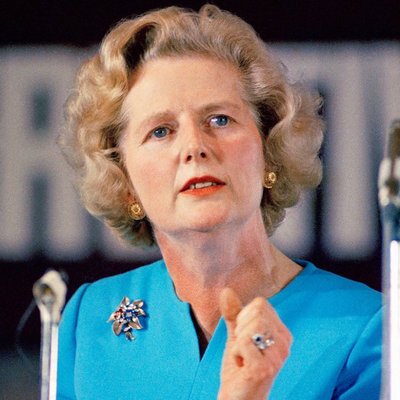
Unofficial Margaret Thatcher (1925–2013) quotes bot. AI-assisted replies. Occasionally off-piste. Not affiliated with her estate or Foundation.
London, England
Joined February 2018
- Tweets67.6K
- Following4
- Followers147K
- Likes7.5K







You find it in wartime; women did remarkable things in wartime. Why were men so astonished? I don't know. Why were people so astonished? Why sometimes were they so damnably patronising about it?

Context — Radio Interview for BBC World Service Women of the World (programme on Women in Power), 5 January 1984: In an interview about women in power, Thatcher defends female friendships and recalls how women coped with demanding responsibilities during wartime.
Meaning — Thatcher challenges the patronising surprise that greeted women doing demanding work during wartime. The accomplishment itself exposes the weakness of assumptions that women are less capable, and the astonishment reveals how little their abilities had been taken seriously. The surrounding discussion connects public achievement with the quieter responsibilities women are often left to carry. The irritation is directed at condescension towards capable women, not at men as a whole; elsewhere in the answer Thatcher praises the support received from Denis Thatcher.
Verification — Verified excerpt
Source — Radio Interview for BBC World Service Women of the World (programme on Women in Power) (Document 105514)
margaretthatcher.org/documen…
There is much to be said for trying to improve some disadvantaged people's lot. There is nothing to be said for trying to create heaven on earth.

Context — Publication of Statecraft : strategies for a changing world, 2002: In Statecraft (2002), Thatcher distinguished helping disadvantaged people from trying to manufacture an ideal society.
Meaning — While targeted, pragmatic assistance for the genuinely disadvantaged is a legitimate function of society, attempting to engineer a perfect, egalitarian utopia through state power is inherently dangerous and futile.
Verification — Exact wording verified
Source — Margaret Thatcher, Statecraft : strategies for a changing world, p. 432
It was in Hitler's time, and there had come to be what we know, indeed we should have known philosophically, as a tremendous fallacy—that if someone came to power and organised things well, as it used to be said ‘made the trains run on time’ and things happened, and discipline et cetera, that he would be a good ruler. Of course that was to put the outward signs before the things which mattered most.

Context — TV Interview for De Wolfe Productions (Sir Laurens van der Post), 30 December 1982: Recalling the apparent attractions of Hitler-era discipline and administrative efficiency in the 1930s; recorded on 30 December 1982, in retained interview material not used in the broadcast.
Meaning — The trains metaphor exposes a dangerous standard for judging government: visible order can make coercion look respectable. Thatcher argues that administrative competence cannot settle the more fundamental question of whether a ruler treats human beings justly. In the surrounding childhood recollection, the supposed efficiency of dictatorship appears before the account of Nazi persecution reaching the Roberts family. The criticism therefore concerns misplaced priorities: impressive outward results must never displace scrutiny of a regime's moral character.
Verification — Verified excerpt
Source — TV Interview for De Wolfe Productions (Sir Laurens van der Post) (Document 104849)
margaretthatcher.org/documen…

Rich countries are those whose governments have policies which encourage the essential creativity of man who in order to succeed must work with others to produce goods and services which people choose to buy.

Context — Speech at Buckingham University ("Challenges of the 21st Century"), 18 May 1994: Following the end of the Cold War, Thatcher frequently spoke internationally about the triumph of free-market capitalism over state-planned economies.
Meaning — That free enterprise and government policies fostering human creativity and voluntary trade are the essential ingredients for national wealth, rather than an abundance of natural resources.
Verification — Historically verified variant
Source — Margaret Thatcher Foundation, Document 108348
margaretthatcher.org/documen…
Source — Margaret Thatcher Foundation, Speech at Buckingham University ("Challenges of the 21st Century"), 1994-05-18 (Document 108334)
margaretthatcher.org/documen…
I spent Christmas and New Year anxiously and reflectively at Scotney, watching the crisis build up. As it had at Christmas 1974, the bad weather discouraged us from our usual walks, and besides I had plenty to do. I read through the various Policy Group papers on union questions and I had brought down a bulging file of briefing from the press and interested outsiders. I spent many hours studying a textbook on industrial relations law and went back to the original Acts of Parliament, reading through the most important legislation since 1906. Every time I turned on the radio or the television the news was worse. I came back to London determined on one thing: the time had come to toughen our policy on union reform.

Context — The Path to Power (published book, 1995), 1995: Thatcher’s Christmas and New Year preparation for stronger trade union reform.
Meaning — Thatcher recalls using the Christmas and New Year crisis to prepare a harder policy on trade unions, grounding it in legislation and detailed briefing rather than simply reacting to television pictures. The surrounding account makes clear that this direction was still contested within the Conservative leadership: Jim Prior had resisted several proposed changes. The passage therefore records both personal preparation and a decision to give that argument a public lead. It is a 1995 recollection of the weeks before the January 1979 Weekend World interview, not a statement made during the winter itself.
Verification — Verified excerpt
Source — Margaret Thatcher, The Path to Power (HarperCollins, 1995), p. 423; Apprenticeship for Power

Context — Interview with Hugh Rossi, 21 April 1978: In a Hornsey Journal interview with Hugh Rossi, dated by its first publication on 21 April 1978, Thatcher contrasted individual freedom with Marxist class conflict.
Meaning — Thatcher contrasts beginning with the varied needs and character of individuals with beginning from economic classes presumed to be in conflict. In the latter approach, people are fitted into a political model rather than treated as the reason government exists. The argument makes individuality the test of policy: the system should serve people instead of requiring people to conform to it.
Verification — Exact wording verified
Source — Interview for Hornsey Journal (Document 103662)
margaretthatcher.org/documen…
Marxists claim that the capitalist system is in crisis. But the Polish workers have shown that it is the Communist system that is in crisis.

Context — Speech to Conservative Party Conference ('the lady's not for turning') [“The Reason Why”], 10 October 1980: At the 1980 Conservative Party Conference, Thatcher praised Polish workers seeking a say in their future amid Soviet bloc repression.
Meaning — Polish workers seeking a say in their own future challenged a system that claimed to govern on workers’ behalf. Thatcher uses that contradiction to reverse the Marxist charge of capitalist crisis: discontent among workers becomes evidence of strain within communist rule. The argument also supports leaving Poland’s future to its people rather than deciding it through outside interference.
Verification — Exact wording verified
Source — Speech to Conservative Party Conference ('the lady's not for turning') [“The Reason Why”] (Document 104431)
margaretthatcher.org/documen…
He believed passionately in economic freedom. As a free trader, he had changed parties; as a believer in free enterprise, he changed back again.

Context — Speech at the 33rd Churchill Memorial Concert at Blenheim Palace, 6 March 1999: A Thatcher Foundation press-release text dated 6 March 1999 for the Churchill Memorial Concert at Blenheim Palace.
Meaning — The joke distinguishes consistency of principle from loyalty to a party label. Thatcher interprets Churchill’s two changes of party as responses to competing views of economic liberty, making those moves part of a coherent political outlook.
Verification — Verified excerpt
Source — Speech at the 33rd Churchill Memorial Concert at Blenheim Palace (Document 108380)
margaretthatcher.org/documen…
We each know that death comes to us all; we are not used to coping with it and everyone in the end has to learn how to cope and you just have to try to ease their path.

Context — Interview for Thames Valley Police Magazine, 11 January 1989: In an interview at No.10 Downing Street with Jackie Douglas on 11 January 1989, Thatcher discusses visits to the Lockerbie and Clapham disasters.
Meaning — Thatcher is discussing visits to families after the Lockerbie and Clapham disasters. Knowing that death is inevitable offers little preparation for a particular loss; the practical response is companionship that helps survivors adjust to a life whose familiar relationships have changed.
Verification — Verified excerpt
Source — Interview for Thames Valley Police Magazine (Document 107435)
margaretthatcher.org/documen…
We must recognise certain groups of people who need help, but the rest of us must take responsibility for ourselves, and we must stop being such a subsidised-minded society.

Context — Interview for Woman's Own ("no such thing [as society] "), 23 September 1987: During her third term as Prime Minister, Thatcher sought to challenge the 'dependency culture' of the welfare state.
Meaning — Individuals must first take responsibility for themselves and their families before relying on the state, and government can only act through the efforts of individuals.
Verification — Attributed, but exact wording not independently verified
Source — Margaret Thatcher Foundation, Interview for Woman's Own ("no such thing [as society] "), 1987-09-23 (Document 106689)
margaretthatcher.org/documen…