

Astronomy & Earth/Space Science teacher | STEM enthusiast | she/her
- Tweets192
- Following117
- Followers57
- Likes243






ALT Red dual opposing jets coming from young stars fill the darker top half of the image. At bottom center is a glowing pale yellow, cave-like structure, its top tilted toward two o’clock, with a bright star at its center. The dust of the cave structure becomes wispy toward eight o’clock. Above the arched top of the dust cave, 3 groupings of stars with diffraction spikes are arranged. A dark cloud sits at the top of the arch of the glowing dust cave, with one streamer curling down the right-hand side. The dark shadow of the cloud appears pinched in the center, with light emerging in a triangle shape above and below the pinch, revealing the presence of a star inside the cloud. The largest jets of red material emanate from within this dark cloud, thick and displaying structure like the rough face of a cliff, glowing brighter at the edges. At top center, a star displays another, larger pinched dark shadow, this time vertically. To the left of this star is a more wispy, indistinct region.


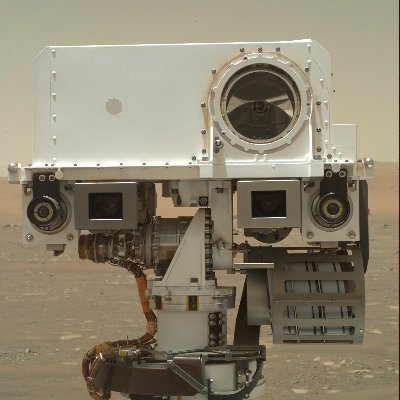

ALT Photo shows a rocky landscape on Mars, dominated by a hill in the foreground, and a large, shallow crater in the background. Visible on the surface in different sections of the image are NASA's Mars Perseverance rover, the shadow of the Ingenuity Mars Helicopter, and a small piece of shiny debris.

ALT Photo shows a rocky hill on Mars, with much larger hills in softer focus in the background. Against a background of dusty terrain, NASA’s small, robotic Ingenuity Mars Helicopter is visible.


ALT The Cheat River in West Virginia. The river is brown and lined with tan rocks. Sunlight is reflecting off the water. Thick, green trees are on both sides of the river. Credits: NASA




ALT Hubble's view of SMACS 0732. Very dim-lit photo with more orange colors in the center and blue/green towards the outside of the photo. Few spots of bright white dots.

ALT The background of space is black. Thousands of galaxies appear all across the view. Their shapes and colors vary. Some are various shades of orange, others are white. Most stars appear blue, and are sometimes as large as more distant galaxies that appear next to them. A very bright star is just above and left of center. It has eight bright blue, long diffraction spikes. Between 4 o’clock and 6 o’clock in its spikes are several very bright galaxies. A group of three are in the middle, and two are closer to 4 o’clock. These galaxies are part of the galaxy cluster SMACS 0723, and they are warping the appearances of galaxies seen around them. Long orange arcs appear at left and right toward the center.


ALT The image is split down the middle, showing two views of the Southern Ring Nebula. Both feature black backgrounds speckled with tiny bright stars and distant galaxies. Both show the planetary nebula as a misshapen oval that is slightly angled from top left to bottom right and takes up the majority of each image. At left, the near-infrared image shows a bright white star at the center with long diffraction spikes. Large, transparent teal and orange ovals, which are shells ejected by the unseen central star, surround it. At right, the mid-infrared image shows two stars at the center very close to one another. The one at left is red, the smaller one at right is light blue. The blue star has tiny triangles around it. A large transparent red oval surrounds the central stars. From that extend shells in a mix of colors, which are red to the left and right and teal to the top and bottom. Overall, the oval shape of the planetary nebula appears slightly smaller than the one seen at left.


