

Solving problems | #DevSecOps & #LLMs| #ChangeMaker #Entrepreneur
Tanzania
Joined November 2020
- Tweets4.4K
- Following1.9K
- Followers861
- Likes7.6K








#swahilijs retweeted

Former Scale AI founder and newly appointed @Meta Chief AI Officer @alexandr_wang dropped a bombshell during his YC conversation with @garrytan, and you could almost hear the tech leadership world go quiet.
He said Meta has already seen this internally:
Build the right agentic loop, give it an evaluation system and metrics that let it optimize itself, and a group of AI agents can complete more work than a team of 100 senior engineers.
And they do it “very easily.”
But the most interesting part wasn’t the 100-engineer comparison.
It was how simple the system underneath it actually is.
You’d expect some insanely complex, almost alien architecture powering a swarm like this.
Instead, Wang described it with a few almost comically basic words:
“Markdown files, cron jobs, goal, metrics, data.”
Once you strip away the hype, the implications for traditional software engineering become pretty clear:
1️⃣ It’s not that the models are magically smarter. The eval loop is doing the heavy lifting.
Traditional approach: humans write prompts, run the code, inspect the output, and hope nothing broke.
Meta’s approach: turn the business goal into something a machine can score automatically.
The agent submits its work. The system runs tests, calculates metrics, finds what’s wrong, and sends it back for another pass. Repeat until it passes.
Nobody has to babysit every step. The metric becomes the supervisor.
2️⃣ The real alpha is burning 1,000x more tokens inside the feedback loop.
A lot of people are still optimizing for the cost of a single AI call.
The frontier labs are playing a different game: spend 1,000x or even 1,000,000x more tokens in the background so agents can constantly review, rerun, challenge, and verify each other’s work until they reach a reliable business outcome.
Token cost is fixed. The payoff is a pipeline that keeps running.
3️⃣ Memory doesn’t need some fancy database.
Persistent memory can live in Markdown files.
Scheduling can be handled by the server’s built-in cron jobs, running overnight.
The simpler the scaffolding, the more robust the system can be. Less infrastructure also means fewer ways for context to fall apart.
This is a pretty brutal change in how technical organizations work.
The ceiling for a tech lead used to be partly about how many people they could manage, how many meetings they could sit through, and how many teams they could coordinate.
The leverage for the next generation of technical leaders may look very different:
Can you turn a messy business objective into a rigorous set of metrics that an AI can evaluate automatically?
If 100 people’s output can be replaced by a few cron jobs, Markdown files, and a well-designed eval loop, the era of “just take the ticket and write the code” is coming to an end.
The people who can design the evals and orchestrate the swarm aren’t just holding a new tool.
They’re effectively running a virtual company.
#swahilijs retweeted

Google Brain founder Andrew Ng:
"Prompting will be dead in 6 months"
"Loops and graphs are replacing it"
In just 2 hours, he shows how to build agents that work, learn, and improve on their own
LLMs → Agents → Loops → Graphs → Self-Improving Systems
The first 15 minutes alone are more valuable than most $500 AI courses
Most people are still learning prompts while AI engineering is already moving beyond them
Watch the lecture first
Then read the full guide to loops and graphs below ↓
#swahilijs retweeted

Use PyTorch-native libraries within the NVIDIA NeMo Framework to customize models to hit your exacting requirements for latency, speed, memory, and compute.
@NVIDIA's blog demonstrates how quantization-aware distillation (QAD) improves the Nemotron 3.5 Lightning model using NVIDIA Model Optimizer. We walk through the entire training pipeline, and show how QAD consistently outperforms post-training quantization (PTQ) compression on agentic benchmarks, ensuring high quality while reducing memory usage.
Read it here: developer.nvidia.com/blog/de…
#swahilijs retweeted

NVIDIA CEO, Jensen Huang:
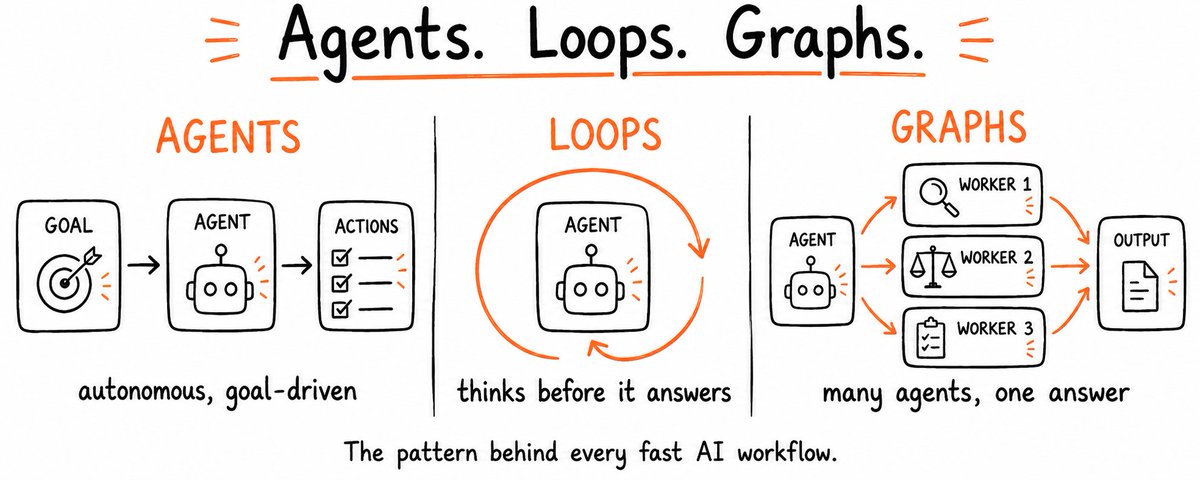
"Nobody writes prompts anymore. The new job is building Loops and Graphs."
In 50 minutes he explains why the engineers who stopped prompting are already years ahead, and what they're building instead.
The missing piece most people skip: loops handle the work, graphs handle the loops.
Watch it, then read the full guide on loops and graphs below.

#swahilijs retweeted

almost no ai engineers are talking about claude skills yet.
andrew ng just released a 2 hour collab with anthropic that walks you through building agentic skills from zero.
• 00:00 - getting started with agentic skills in claude
• 22:29 - using claude’s ready-made skills
• 41:04 - skills vs mcp and subagents
• 1:06:03 - designing skills for long-running agents
• 1:51:59 - live build: creating agentic skills end to end
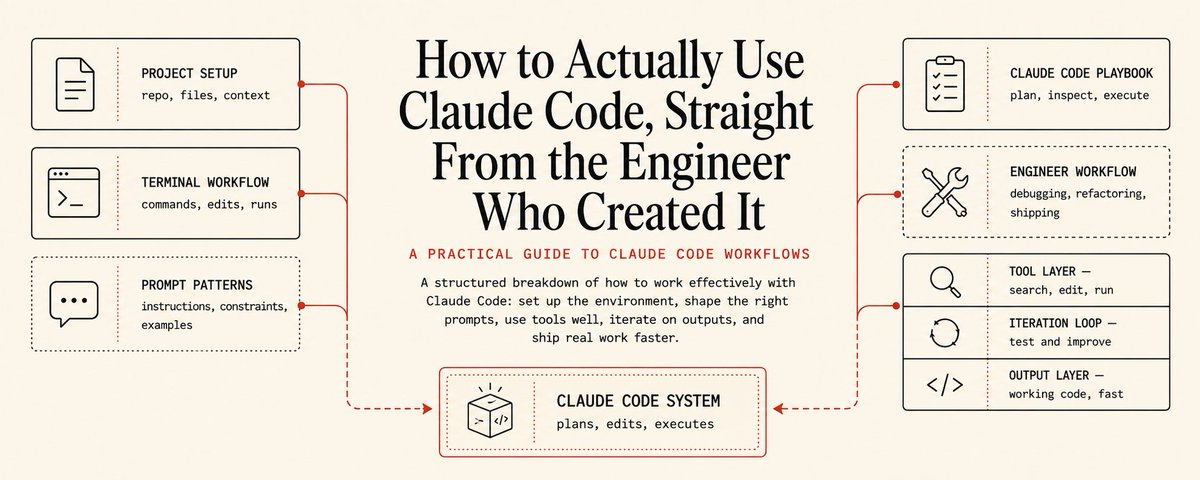
prompting isn’t the main game anymore. claude skills is what serious builders are using to ship real agents.
i watched it last night.
somewhere in the middle it hit me: i’ve been treating claude like a chatbot, not an agent platform, for years.
save this and check the article below.

#swahilijs retweeted

INSTEAD OF WATCHING AN HOUR OF NETFLIX TONIGHT.
This 1-hour Stanford lecture by Joel Peterson will teach you more about negotiation and getting what you want than most people learn in years.
Bookmark it and give it an hour, no matter what.
#swahilijs retweeted

Just saw that the LLMs-from-scratch repository passed 100,000 stars on GitHub!
This is super cool and motivating. I am really happy to see that this open-source repo has helped so many people.
Thanks also to everyone who shared ideas and opened PRs with improvements!
Of course, I plan to keep adding new material, including new attention variants and architectures (while bigger projects like RL and Reasoning From Scratch live in their separate repositories).
I am also currently working on a larger applied custom “small” LLM project. It has been keeping me super busy this month, but I will share more on that soon.
If you are new to it, some of the highlights include
1. Of course, the complete code path from tokenization and attention to pretraining, classification, and instruction fine-tuning, etc. All of it FROM SCRATCH, of course! (RL lives in a companion repo.)
2. From-scratch implementations of Llama, Qwen, Gemma, and Olmo (smaller variants that run locally and can be plugged into the training scripts).
3. From-scratch implementations of attention alternatives and other architecture components, such as GQA, MLA, sliding-window attention, Gated DeltaNet, DeepSeek Sparse Attention, cross-layer KV sharing, and mixture-of-experts
4. Materials on KV caching, training performance, memory-efficient weight loading, DPO, evaluation, and LoRA
So, if you don’t have any weekend plans yet, happy tinkering!

#swahilijs retweeted

As a Machine Learning Engineer, you must build these projects.
Systems that prove you can ship models that scale.
1. End-to-End ML Pipeline
Build: Automated pipeline from data ingestion to model deployment using Airflow or Prefect.
Why: Shows you can operationalize ML not just train models in isolation.
2. RAG System with Evaluation Harness
Build: Retrieval-Augmented Generation with grounded citations and automated quality metrics.
Why: Proves you can build reliable LLM applications not just chat demos.
3. Real-Time Inference Service
Build: Low-latency API serving models with <100ms response time using vLLM or Triton.
Why: Demonstrates understanding of production performance constraints.
4. Feature Store Implementation
Build: Centralized store for feature engineering with point-in-time correctness and online serving.
Why: Shows you can handle data consistency between training and inference.
5. Model Monitoring and Drift Detection
Build: System to track data drift, concept drift and performance degradation in production.
Why: Proves you understand models decay and need continuous observation.
6. Distributed Training Setup
Build: Multi-GPU training pipeline using PyTorch DDP or DeepSpeed for large models.
Why: Shows you can scale training beyond single-machine constraints.
7. Model Registry and Versioning
Build: Centralized registry tracking model versions, metrics, artifacts and lineage using MLflow.
Why: Demonstrates reproducibility and governance capabilities.
8. A/B Testing Framework for Models
Build: System to route traffic between model versions and measure business impact statistically.
Why: Shows you can validate model improvements beyond accuracy metrics.
9. Vector Search Engine
Build: Similarity search over millions of embeddings with metadata filtering and hybrid search.
Why: Modern ML systems require semantic retrieval not just keyword matching.
10. Automated Retraining Pipeline
Build: Trigger-based retraining when data drift exceeds threshold or performance drops.
Why: Proves you can build self-healing systems that maintain quality over time.
11. Cost Optimization Dashboard
Build: Track inference spend per model, per endpoint, per user with anomaly detection.
Why: Engineering decisions impact profitability. FinOps is part of the job.
12. Security and Guardrails Middleware
Build: Input validation, prompt injection defense, PII redaction and output filtering layers.
Why: Security is non-negotiable. One breach destroys trust forever.
13. Multi-Model Router
Build: Dynamic routing system selecting models based on task complexity, cost and latency.
Why: Shows you can optimize tradeoffs not just default to the largest model.
14. Data Versioning System
Build: Implement DVC or LakeFS for tracking dataset versions alongside code versions.
Why: Reproducibility requires versioning data not just code.
15. Production Agent Orchestrator
Build: Multi-agent system with state management, tool use and human-in-the-loop approval.
Why: Agents are the future of ML applications. Orchestration is the moat.
Bookmark & Repost...
#swahilijs retweeted

Anthropic pays $750,000+ a year for engineers who can build LLM architectures from scratch. Stanford taught the entire thing in 1 hour lecture & released it for free.
Bookmark & watch this today before someone takes it down ...
#swahilijs retweeted
Anthropic has opened applications for its Fellows Program, a 4-month fully funded research opportunity offering approximately $15,400/month plus compute credits and direct mentorship from Anthropic researchers. Fellows can work in Berkeley, London or remotely, contributing to cutting-edge AI research.
The program covers AI safety, security, ML systems, reinforcement learning and AI policy & economics. No PhD or prior research experience is required but strong technical skills and full-time availability are expected. Applications are rolling for the September 2026 cohort.
Apply here : job-boards.greenhouse.io/ant…

#swahilijs retweeted

Wow.
@Zai_org GLM 5.2 is a marvel! It is *at least* as good as Opus 4.8 and GPT 5.5. It's super fast, inexpensive, and not too verbose.
It responds with nuance and judgement, & handles long context VERY well.
I've never experienced an open weights model like this before.
Forget Fable and Mythos. No one can explain how AI got this far. Our only hope now? Divine benevolence...😅
33
#swahilijs retweeted

- Math behind Attention- Q, K, and V
- Math behind √dₖ Scaling Factor in Attention
- Math Behind Backpropagation
- Math Behind Gradient Descent
- Math Behind Cross-Entropy Loss
- Math Behind RoPE (Rotary Position Embedding)
- RMSNorm (Root Mean Square Layer Normalization)


#swahilijs retweeted

Today, among the goods that are universally intended for everyone, we must also include new forms of property, such as patents, algorithms, digital platforms, technological infrastructure and data. In a context where the wealth of nations depends increasingly on knowledge and technology, when these goods remain concentrated in the hands of a few, without adequate forms of sharing and access, a new imbalance is created that contradicts the universal destination of goods. In turn, it widens the gap between the included and the excluded, between those who can participate in the digital revolution and those who remain on the margins. #MagnificaHumanitas
#swahilijs retweeted

🚨 CEO Anthropic Dario Amodei właśnie dostał nokaut na oczach całego świata.
Chiński founder Moonshot AI Yang Zhilin wziął i wrzucił za darmo całą rewolucyjną architekturę Kimi Agent Swarm.
Rój ponad 100 agentów działających równolegle. 1500 wywołań narzędzi jednocześnie.
Zadania, które Claude 4.5 i GPT-5.2 robią w godzinę, Kimi załatwia w 15 minut.
40-minutowy masterclass na NVIDIA GTC, w którym Yang tłumaczy wszystko krok po kroku:
• Orchestrator + parallel reinforcement learning
• MoE na bilionach parametrów
• Kimi Linear i 3D-synergia kontekstu
Efekt?
Kimi K2.5 miażdży Zachód w kluczowych benchmarkach agentycznych (HLE-Full, MathVista, OCRBench, multimodal) i robi to 4–5× taniej.

instead of watching 2 hours of Netflix tonight, watch this 40-minute masterclass from the founder of a $20B China AI company
it's the clearest explanation I've seen of how Agent Swarms and AI systems actually work at scale
useful whether you've never built an agent in your life or have been using Claude every day for the past year
I took the key ideas and turned them into a practical guide on how to actually build with Kimi
find it below
#swahilijs retweeted

Anthropic just paid millions to hire Andrej Karpathy.
He gave you the same knowledge for $0 the same week.
Co-founder of OpenAI. Former head of AI at Tesla. The man who coined vibe coding.
No recruitment fee. No exclusive access. Just a link and 29 minutes.
LLMs are ghosts not animals.
Vibe coding is dead.
Software 3.0 is here.
Watch it.
Then read this.
Because Karpathy tells you what Software 3.0 is.
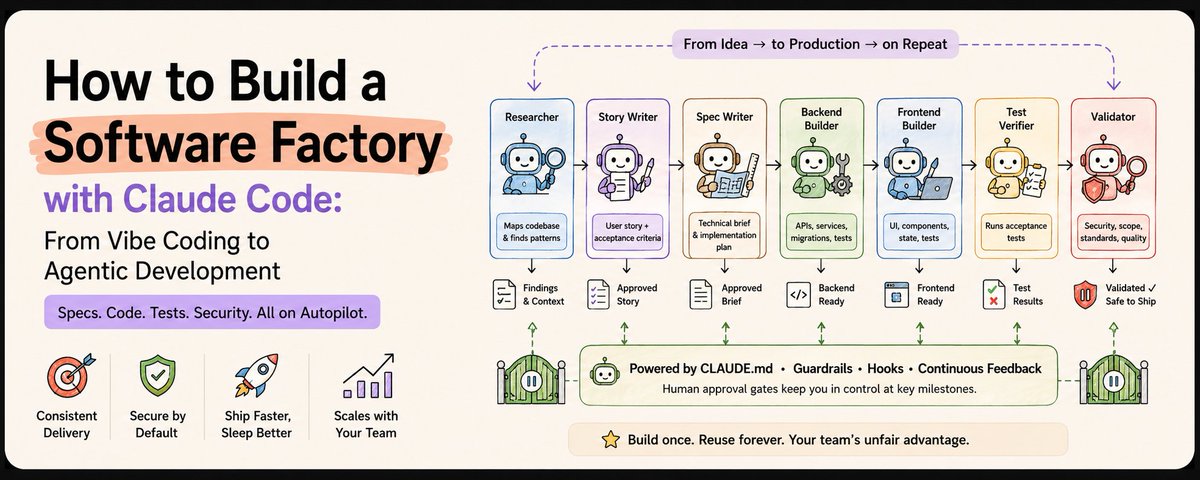
This shows you how to build one - a software factory with Claude Code that ships features while you sleep.
The full build guide is below.

#swahilijs retweeted

Este repositorio es una joya. Te da todos los pasos e instrucciones para proteger y asegurar tu servidor Linux.
Perfecto por si tienes un servidor propio o VPS:
github.com/imthenachoman/How…

#swahilijs retweeted

DDIA (Designing Data-Intensive Applications) IS THE BIBLE OF BACKEND ENGINEERING
Martin Kleppmann spent years inside google, linkedin & distributed systems research
then wrote everything down in one book
600 pages of how real systems fail, scale & survive
most people buy it...few finish it
this dev did & turned every chapter into clean github notes
replication & sharding..transactions & consensus...batch vs stream processing...why databases quietly lie to you
the exact knowledge that separates a junior who codes from a senior who architects
one repo no excuses
🔗 github.com/keyvanakbary/lear…

#swahilijs retweeted
END TO END API TESTING &
INTERVIEW QUESTIONS
NOTES
drive.google.com/file/d/1-a0…
