

Holiday creators with a difference
Delhi
Joined February 2014
- Tweets4.8K
- Following5.2K
- Followers4K
- Likes1.6K


TravelFunShop retweeted
“Thirty thousand ordinary Indians remained in colonial custody while the political leadership faced its own legal proceedings.”
Discover their story:
hinduinfopedia.in/gandhis-vi…
TravelFunShop retweeted

From Dominion to Republic: What the 834-Day Interval Reveals About India’s Constitutional History
The history of India’s independence is often associated with August 15, 1947. That date marks the end of British rule and the establishment of independent Dominion status. Yet the development of India’s constitutional order continued beyond independence, culminating in the commencement of the Constitution on January 26, 1950.
This transition involved legal continuity, political leadership, the integration of princely states, and territorial disputes. Examining these elements together helps explain why the early years of independence remain important to constitutional and political history.
The blog Gandhi Sovereignty Transfer Partition: The Sovereignty That Was Not Transferred uses the 834-day interval between August 15, 1947, and November 26, 1949, as a framework for examining these questions.
Independence and inherited law
The Indian Independence Act 1947 established the Dominions of India and Pakistan. India became independent on August 15, 1947, while its governing arrangements continued to rely on the adapted Government of India Act 1935.
This continuity provided a functioning legal and administrative structure while India developed its own Constitution. Courts, government departments, and public institutions could continue operating during a period of substantial political change.
The continuation of inherited legislation does not, by itself, mean that political independence had not occurred. Independence can coexist with transitional legal arrangements. However, the continued operation of an earlier statutory framework remains relevant when examining the process by which a new constitutional order was established.
The blog’s central argument is that the distinction between independence as a Dominion and the subsequent repeal of inherited British legislation deserves careful examination.
The three constitutional milestones
Three dates help clarify the sequence.
August 15, 1947: India became an independent Dominion.
November 26, 1949: The Constituent Assembly adopted the Constitution, including Article 395, which provided for the repeal of the Indian Independence Act 1947 and the Government of India Act 1935.
January 26, 1950: The Constitution came into effect and India became a republic.
The 834-day interval between August 15, 1947, and November 26, 1949, is the focus of the blog’s constitutional analysis. It treats the interval as an opportunity to examine what changed immediately in 1947, what continued from the earlier legal system, and what was formally replaced through the Constitution.
The distinction between adopting a constitutional text and bringing it into effect is also important. November 26, 1949, and January 26, 1950, represent separate milestones in the transition.
The Governor-General and the meaning of continuity
India invited Lord Mountbatten to serve as its first Governor-General after independence. Pakistan, by contrast, appointed Muhammad Ali Jinnah.
The Governor-General’s powers in India were defined by the constitutional arrangements then in force. Section 8(2) of the Indian Independence Act 1947 required the Governor-General to act on ministerial advice. The office should therefore be understood through its legal powers rather than assumed to possess unrestricted executive authority.
Nevertheless, the choice to retain a British official as Governor-General remains historically significant. It raises questions about institutional continuity, political symbolism, and the decisions made by Indian leaders during the transition.
The blog considers this arrangement alongside the continued operation of the inherited statutory framework. Its purpose is to encourage readers to examine how formal independence and constitutional transformation related to each other.
Territorial developments during the Dominion period
The blog also examines Kashmir, Gilgit, and Kalat.
Kashmir’s ruler signed the Instrument of Accession on October 26, 1947, and India accepted it on October 27. Nehru referred the matter to the United Nations Security Council on January 1, 1948. The subsequent process did not result in the proposed plebiscite.
In Gilgit, events in November 1947 changed the region’s administrative position. The involvement of British officers and the establishment of Pakistani administration are part of the chronology examined in the blog.
Kalat’s ruler declared independence in August 1947 and offered India an Instrument of Accession. Pakistan annexed Kalat on March 27, 1948, following a period of political pressure and armed resistance.
These cases demonstrate that territorial questions continued to develop after independence. They also show that the legal status of a territory, the ability to administer it, and the political process surrounding its future could follow different paths.
Leadership and the integration of princely states
The blog compares Patel’s approach to integrating 565 princely states with the handling of Kashmir. Patel’s work involved negotiations, accession documents, and, in some cases, police or military action. Hyderabad and Junagadh are presented as examples of outcomes achieved through approaches different from the internationalisation of Kashmir.
The comparison raises questions about leadership, methods, and consequences. It should also take account of the different conditions in each case, including geography, local politics, and the presence of armed conflict.
Historical analysis is strongest when it separates the chronology of events from claims about why those events occurred. Readers can then consider both the evidence and the interpretation built upon it.
A continuing historical discussion
The journey from Dominion status to republic involved multiple stages rather than a single constitutional act. The 834-day interval offers one framework for examining the relationship between political independence, inherited legislation, leadership decisions, and territorial developments.
The original blog brings these issues together under the theme of Gandhi Sovereignty Transfer Partition. It presents a particular interpretation of the historical record while inviting readers to assess the evidence and reach their own conclusions.
For the complete analysis, chronology, and discussion, visit the original blog:
hinduinfopedia.in/gandhi-sov…
TravelFunShop retweeted
From Mass Movements to Negotiated Settlements: Gandhi and the Challenges of Political Strategy
Mass movements were central to India’s struggle for independence. They brought people into political life, challenged colonial authority, and made self-government a defining public demand. Their history also includes strategic withdrawals, internal disagreements, negotiations, and compromises. Examining these decisions helps explain the difficult choices confronting political leaders during a long and complex struggle.
The blog Gandhi’s Weakness Designed Partition: The Weakness That Was Designed (173) examines three major movements associated with Mahatma Gandhi and connects them with the accelerated transfer of power in 1947. The author asks whether the decisions taken during these campaigns reveal a recurring political pattern and whether that pattern helps explain the institutional arrangements and unresolved territorial questions that followed independence.
The article’s phrase “Gandhi’s Weakness Designed Partition” expresses a critical interpretation of this history. It should be understood as the author’s thesis, open to examination and disagreement, rather than as a universally accepted historical conclusion.
The Rowlatt Satyagraha
The first case is the Rowlatt Satyagraha of 1919. Gandhi suspended the campaign on April 18, five days after the Jallianwala Bagh massacre of April 13. He later described his judgment as a “Himalayan miscalculation.”
The blog emphasizes that the Rowlatt Act remained in force after the suspension. It also refers to correspondence from the Viceroy’s administration indicating that the government had faced serious pressure and uncertainty.
The author interprets the sequence as an example of a movement being withdrawn before it compelled the colonial administration to make a decisive concession. Other interpretations may place greater emphasis on the difficulties of maintaining non-violent discipline, the violence that occurred in different locations, and the challenges of sustaining a rapidly expanding campaign.
The episode therefore raises questions about the relationship between political pressure, moral principles, and the practical limits of mass mobilization.
The Non-Cooperation Movement
The second case is the withdrawal of the Non-Cooperation Movement in February 1922 following the Chauri Chaura incident. After a confrontation involving police and protesters, a police station was set on fire, resulting in the deaths of twenty-two policemen.
Gandhi believed that the movement could not continue without a stronger commitment to non-violence. His decision nevertheless produced disagreements within the nationalist movement. C. R. Das, Motilal Nehru, and Lala Lajpat Rai registered objections, while Subhas Chandra Bose later criticized the withdrawal in strong terms.
The blog places these objections alongside Gandhi’s decision to highlight the debate over political strategy. Should a mass movement continue when its methods no longer conform to the principles established by its leadership, or should it pause until those principles can be maintained?
Different answers to this question carry different consequences. The episode illustrates the tension between sustaining popular momentum and preserving the ethical framework under which a movement operates.
The Civil Disobedience Movement and the Gandhi-Irwin Pact
The third case concerns the Civil Disobedience Movement and the Gandhi-Irwin Pact of March 1931. Congress agreed to suspend civil disobedience and participate in the Round Table Conference. The British government agreed to certain concessions, including the release of political prisoners who had not been convicted of violence and permission for salt manufacture along the coast.
The agreement did not secure a commitment to Dominion status. Nor did it provide for the commutation of Bhagat Singh’s death sentence. Bhagat Singh was executed on March 23, eighteen days after the pact was signed.
The author questions whether the settlement achieved the broader objectives of the movement. A comprehensive assessment must also examine the concessions obtained, the constraints facing the negotiators, and the circumstances in which the agreement was reached.
The Transfer of Power
The blog then turns to June 1947. The British Cabinet had initially announced June 1948 as the transfer deadline. The plan accepted by Congress on June 3, 1947, brought the transfer forward to August 15, leaving approximately eleven weeks.
The author contrasts this timetable with the earlier emphasis on readiness and preparation when movements were suspended. The division of Punjab and Bengal, the division of the Indian Army, and the establishment of new administrative arrangements all had to be completed under intense time pressure.
The article also compares Congress’s rejection of Jinnah’s constitutional proposals and coalition terms with its acceptance of Mountbatten’s accelerated plan. It invites readers to consider whether these decisions reveal a broader pattern or reflect distinct political calculations in different circumstances.
Assessing the Historical Pattern
The article connects the three movement suspensions with the decisions of 1947 and the institutional weaknesses identified during the Dominion period. Its argument is that the events should be examined as a sequence rather than as isolated episodes.
That interpretation invites debate. Historical assessment requires attention to documented events, political intentions, available alternatives, and the circumstances facing the individuals involved. It also requires distinguishing evidence from the conclusions drawn from it.
The enduring question is how political leadership should be evaluated when strategic choices produce immediate gains, difficult compromises, or consequences that remain unresolved for decades.
To explore the complete account of these movements, their negotiated settlements, and the author’s interpretation of the transfer of power, visit the original blog:
hinduinfopedia.in/gandhis-we…

TravelFunShop retweeted
I requested for a new Sim and prepaid
I was promised delivery next day.
It is now 6 days since 17 October and there is no response. Even helpline phone is not being replied to, today.
@ViCustomerCare
TravelFunShop retweeted
The torture team at @amazon @amazonIN @AmazonHelp is active torturing people during the festival season by fabricating specifications as I identified earlier, not delivering products while showing as delivered, even the cash on delivery items because the delivery guys liked to sell it at higher price locally, presumably.
There is NO WAY TO CONTACT THEM
They have a right not to provide phone number or email address for communication and every statement has to be made in their format and no other form
I shared this on social media and they promised resolution in 6/12 hours
It is now 28 hours
They sent me a new link that has no option to list out my concerns


TravelFunShop retweeted
The Malabar Uprising — Agrarian Grievances, Communal Violence, and Historical Responsibility
The Moplah uprising of nineteen twenty-one remains a challenging episode in Indian history because it involved longstanding agrarian grievances, resistance to British rule, the Khilafat movement, claims to political sovereignty, and severe violence against Hindu residents. A meaningful assessment must acknowledge these connected elements without allowing any single one to obscure the others.
Malabar’s agrarian structure had developed through customary land rights and unequal tenancy arrangements. Jenmis, primarily Namboodiri Brahmin and Nair Hindu landholders, held ancestral rights over their estates. Cultivators, including many Moplah Muslims, worked the land under different forms of tenancy. Kanamdars held customary mortgage leases, while Verumpattakkars generally had less secure tenure. The power to alter terms, impose additional leases, and evict tenants created persistent tensions.
The Mysore Sultanate’s intervention under Hyder Ali and Tipu Sultan challenged landlord authority during the late eighteenth century. Their rule was forceful and disruptive, but it demonstrated that sovereign power could override the claims of landholders. The Treaty of Seringapatam in March seventeen ninety-two transferred Malabar to the British East India Company and brought this political arrangement to an end.
Under British administration, colonial courts increasingly enforced recognised property rights. The legal changes affected the relationship between landholders and cultivators, while insecurity and disputes over tenancy continued. The William Logan Commission of eighteen eighty-one to eighteen eighty-two documented serious agrarian grievances. Its findings show that the economic tensions preceding the uprising had a substantial history.
The Khilafat movement introduced another dimension. On the eighteenth of August, nineteen twenty, Mahatma Gandhi and Shaukat Ali arrived in Calicut and addressed a large gathering at Vellayil beach. Their joint campaign linked the demand for Indian self-rule with the restoration of the Ottoman Caliphate. The movement consequently brought together different political objectives under a common mobilisation against British rule.
In Malabar, the campaign encountered a population shaped by agrarian disputes and memories of earlier Muslim sovereignty. Some Moplah supporters interpreted the Khilafat message as a promise that British authority was ending and that Islamic sovereign authority would return. Religious leaders reinforced such expectations, contributing to the movement’s particular local significance.
The uprising began in August nineteen twenty-one. Ali Musliyar and Variankunnath Kunjahammed Haji proclaimed a Khilafat Raj. Accounts describe the issuing of passports, appointment of revenue collectors, establishment of Sharia courts, and organisation of administrative zones. These measures indicate an attempt to exercise political authority beyond the conventional demands of an agrarian protest.
The violence that accompanied the uprising must be addressed directly. Hindu residents experienced forced conversion, expulsion, and killing. The experiences of victims cannot be dismissed or treated as secondary to the political aims of the movement. At the same time, a serious historical explanation must also examine the agrarian tensions, colonial policies, and political expectations that formed part of the background.
Gandhi’s response remains significant to the debate. He described the Moplah perpetrators as “brave God-fearing men” and attributed major responsibility for the outbreak to British misrule. These statements raise questions about how he weighed the causes of unrest against the actions committed during it, and how his support for the Khilafat alliance influenced his public response.
Historical responsibility requires careful distinctions. Agrarian grievances can explain some of the conditions that preceded violence without justifying the violence itself. Political mobilisation can shape expectations without ensuring that all participants understand its objectives in the same way. Leaders’ intentions, local actors’ decisions, and the consequences for affected communities must therefore be examined separately and in relation to one another.
The events in Malabar are best approached through the combined study of land relations, colonial law, political mobilisation, religious expectations, the proclamation of the Khilafat Raj, and the suffering of civilians. Such an approach recognises the complexity of the historical record while maintaining attention to evidence and accountability.
Visit the original blog for the complete examination of the Malabar uprising and its historical context:
hinduinfopedia.in/gandhis-kh…

TravelFunShop retweeted
From the Rowlatt Satyagraha to Non-Cooperation — A Contested Strategy
The transition from the Rowlatt Satyagraha to the Non-Cooperation Movement marked an important stage in Gandhi’s political development. It also brought a major strategic question to the forefront of the Indian nationalist movement: should the Khilafat cause be linked with the wider campaign against British rule? The events of nineteen nineteen and nineteen twenty offer an opportunity to examine how political setbacks, new alliances, and contested decisions can redirect a movement.
The Rowlatt Satyagraha had brought Gandhi into a prominent national role. However, the campaign did not proceed as intended. Violence followed, and the agitation was withdrawn. Gandhi later described the episode as a “Himalayan blunder.” The admission acknowledged a serious setback and formed part of the background to his search for a different approach.
The Khilafat Movement became central to that approach. Its immediate concern was the future of the Ottoman Caliphate, an issue of importance to many Muslims. The Central Khilafat Committee and associated organisers provided a network for mobilising support. Gandhi’s backing for the Khilafat cause and his advocacy of Non-Cooperation brought these efforts into a common political framework.
The intended benefit was wider participation in opposition to British authority. Yet the combination of causes was not without complications. The campaign for Indian self-government and the Khilafat campaign had related political contexts, but their immediate objectives were different. Their alliance therefore raised questions about how a national movement should define its priorities and decide which causes should form part of its principal programme.
These questions were reflected in disagreements among nationalist leaders. Annie Besant, Bal Gangadhar Tilak, C. R. Das, Lala Lajpat Rai, and Mohammad Ali Jinnah were among the prominent figures associated with objections or reservations about aspects of Gandhi’s developing strategy. Their views differed, and a careful account should avoid presenting them as a uniform opposition. Their disagreements nevertheless demonstrate that the proposed direction was contested.
In August nineteen twenty, Gandhi returned honours associated with the British government. The following month, the Calcutta Congress considered the Non-Cooperation proposal. The account presented in the original blog reports that the Subjects Committee decision was separated by approximately seven votes, while the open-session result was one thousand eight hundred and eighty-six votes in favour and eight hundred and eighty-four against.
These figures help establish the political setting in which the programme was adopted. They show that the decision passed while significant opposition remained. They do not, by themselves, explain every delegate’s motivation or establish that one factor alone determined the result. Their value lies in providing a basis for examining the process through which a major policy received approval.
The events at Nagpur in December nineteen twenty add another dimension. Mohammad Ali Jinnah was booed while challenging the direction of the movement. The incident raises questions about the conditions under which dissent can be expressed during periods of mass mobilisation. A political organisation may seek a united front, but the way it handles disagreement is also part of its institutional history.
The original blog interprets this sequence as more than a change in public campaigning. It argues that the Khilafat alliance may have helped Gandhi broaden mobilisation while also strengthening his position in the internal debate over Congress strategy. The idea of an “end-run” is used to describe the possibility that an alliance outside the existing balance of Congress opinion helped advance a contested programme.
That interpretation should be evaluated through evidence and chronology. It is important to distinguish documented events, reported voting figures, and the author’s conclusions about political motive. Such a distinction makes historical discussion more useful by allowing readers to consider both the record and the argument built from it.
It is equally important not to attribute a single political motive to an entire religious community. People participate in political movements for varied reasons, and the positions of organisations or leaders do not necessarily represent the views of every supporter.
This period offers a wider lesson about political leadership. Recovering from a setback can require new alliances and a revised strategy, but such choices also involve trade-offs. The expansion of a movement’s reach may change its priorities, its internal relationships, and the space available for dissent. Examining these dimensions together provides a more complete understanding of political change.
For the full historical sequence and the original blog’s analysis of Gandhi’s transition from the Rowlatt Satyagraha to Non-Cooperation, visit:
hinduinfopedia.in/gandhis-kh…

TravelFunShop retweeted
Gandhi’s Khilafat Strategy: Leadership, Political Networks, and the Interpretation of History
How does a political leader rebuild influence after a setback? How do relationships across religious and political communities become part of a national movement? And how should historians distinguish documented events from interpretations of political intention?
These questions are central to “Gandhi’s Khilafat Alternative Routes: The Seven-Month Pivot,” a blog examining Mahatma Gandhi’s activities between April and November 1919. The article follows five developments that preceded his election as president of the All-India Khilafat Conference and considers their significance for the emergence of Non-Cooperation.
The blog presents a particular interpretation of Gandhi’s strategy. Its chronology also offers an opportunity to explore broader questions about political organization, coalition-building, and the relationship between principles and practical leadership.
The Challenge of Political Isolation
Following the suspension of the Rowlatt agitation in April 1919, Gandhi faced criticism from established nationalist figures and difficulties within provincial Congress networks.
The blog argues that he responded by developing political connections beyond those established channels. One important relationship was with Maulana Abdul Bari of Firangi Mahal in Lucknow, a centre associated with traditional Sunni religious scholarship.
Gandhi’s support for the Ottoman Khilafat cause helped establish a connection with this network, according to the blog. This development illustrates how political leaders may seek support from constituencies that have remained outside their established organizational base.
The broader question is whether such outreach should be understood primarily as strategic adaptation, principled cooperation, or a combination of both.
The Ali Brothers and Political Trust
Mohammad Ali and Shaukat Ali were prominent figures in the Khilafat Movement. Their internment under the Defence of India Act became a major concern among their supporters.
Gandhi campaigned for their unconditional release through petitions and public appeals to Viceroy Chelmsford. He also established contact with their family, including their mother, Bi Amman.
The blog interprets these efforts as part of a process through which Gandhi developed relationships with the Ali Brothers’ wider political constituency.
This episode illustrates the importance of sustained engagement in political life. Public appeals can address an immediate grievance while also establishing relationships that influence later cooperation. Yet the broader political significance of such actions must be assessed through evidence rather than assumptions about motive.
Cow Protection and the Limits of Reciprocity
Gandhi’s position on cow protection forms another part of the blog’s analysis.
He advocated Hindu support for the Khilafat cause without requiring an explicit reciprocal commitment on cow protection. He expected voluntary restraint to emerge from friendship and communal solidarity rather than legislation or pressure.
The blog interprets this position as a significant concession that helped establish political credibility among sections of the Muslim community.
The episode raises an enduring question about coalition politics: should solidarity depend on equivalent commitments from all participants, or can an unconditional gesture create the trust needed for cooperation? Different historical circumstances may produce different answers, and the consequences of any arrangement deserve careful consideration.
The Punjab Inquiry and Shared Political Work
The blog’s fourth development concerns Gandhi’s participation in the unofficial Congress inquiry into the Jallianwala Bagh massacre and excesses under martial law.
Gandhi worked alongside Dr. M. A. Ansari and Hakim Ajmal Khan, prominent Muslim political figures. The blog argues that this inquiry strengthened connections between Gandhi and political networks in Delhi and Punjab.
Shared work on a public issue can bring individuals and organizations together in ways that formal declarations alone cannot. It can also give participants experience of coordinating activities, exchanging information, and developing common positions.
This aspect of the chronology highlights the organizational dimension of political cooperation.
From Conference Presidency to Non-Cooperation
On 23 November 1919, Gandhi was elected president of the All-India Khilafat Conference in Delhi.
He proposed Non-Cooperation as a structured programme involving the surrender of imperial titles and honours, boycotts of government schools and law courts, boycotts of legislative councils, and refusal of military service.
The Central Khilafat Committee formally ratified the programme in May and June 1920, before Congress adopted it. On 1 August 1920, Gandhi surrendered his Kaisar-i-Hind, Zulu War, and Boer War medals to Viceroy Chelmsford.
The blog emphasizes this sequence to argue that Gandhi’s leadership and programme developed through connected initiatives over several months.
A Historical Question, Not a Substitute for Evidence
The blog’s principal argument is that Gandhi deliberately constructed an alternative political base during the seven-month period. Other explanations may place greater emphasis on religious solidarity, political necessity, or the effort to unite different constituencies against British rule.
A balanced historical assessment should recognize the chronology while examining interpretations critically. The order of events can help identify patterns, but conclusions about intention require broader evidence and consideration of competing explanations.
The significance of this episode lies in the questions it raises about how movements are organized, how alliances are negotiated, and how political leaders balance principles with practical decisions.
Visit the original blog to read the complete chronology, examine the five developments, and assess the interpretation of Gandhi’s political transformation.
hinduinfopedia.in/gandhis-kh…

TravelFunShop retweeted
Gandhi, Bhagat Singh, and the Gandhi-Irwin Pact: Political Negotiation and Priorities
Negotiations during a struggle for independence can involve difficult choices. Political leaders may seek concessions, protect a broader agreement, or attempt to influence decisions made by an opposing authority. When an urgent humanitarian question arises during negotiations, the distinction between requesting a concession and making it a condition of an agreement becomes especially important.
The Gandhi-Irwin Pact of nineteen thirty-one and the executions of Bhagat Singh, Sukhdev, and Rajguru provide a historical setting for examining these issues. The blog Gandhi’s Selective Capital: The Duplicity for Violence (181) considers Gandhi’s efforts concerning Bhagat Singh’s sentence and compares them with his interventions in other political circumstances.
Different approaches to India’s independence
Mahatma Gandhi pursued independence through non-violent resistance, mass mobilization, non-cooperation, and political negotiation. Bhagat Singh and his associates represented a revolutionary approach that differed from Gandhi’s methods. The blog refers to the Hindustan Socialist Republican Association and contrasts its political approach with Gandhi’s strategy.
These differences reflected the diversity within India’s independence movement. Leaders and organizations disagreed about the methods most likely to achieve freedom and the role that revolutionary action, public mobilization, and negotiations should play. Understanding these differences provides context for examining the choices made by Gandhi and his contemporaries.
In nineteen thirty-one, Bhagat Singh, Sukhdev, and Rajguru faced execution while Gandhi was negotiating with Viceroy Lord Irwin. The resulting Gandhi-Irwin Pact became an important agreement between the Congress leadership and the British colonial administration.
The central question explored in the blog is how Gandhi addressed the possibility of reducing Bhagat Singh’s sentence while pursuing the wider political settlement.
Requesting a concession versus making it a condition
Gandhi raised the question of reducing Bhagat Singh’s sentence. However, commutation was not made a binding condition of signing the Gandhi-Irwin Pact. The blog refers to Irwin’s minutes as indicating that Gandhi’s request was not binding on the agreement.
This distinction matters because a request and a condition perform different functions in negotiations. A request seeks to influence the other party’s decision. A binding condition establishes that an agreement cannot proceed unless a specified requirement is met.
The distinction alone does not determine whether Gandhi’s decision was justified or whether other courses of action were available. It does, however, clarify an important part of the historical question: the effort to reduce the sentence was raised, but it was not established as a necessary prerequisite for the agreement.
Readers can therefore consider several issues. How should a political leader balance a specific humanitarian objective against the wider goals of a negotiation? What weight should be assigned to a request that does not become a binding condition? How should the public evaluate an intervention when the desired outcome is not achieved?
These questions require attention to the record and to the circumstances of the negotiations rather than assumptions about motives.
The executions and the agreement
Bhagat Singh, Sukhdev, and Rajguru were executed on twenty-third March nineteen thirty-one. Congress accepted the Gandhi-Irwin Pact at Karachi days later.
The sequence of events is central to the blog’s analysis. It raises questions about the relationship between Gandhi’s request concerning Bhagat Singh’s sentence, the terms of the agreement, and the timing of Congress’s acceptance.
The historical issue is not simply whether Gandhi raised the matter. It also concerns whether commutation was treated as a priority that had to be achieved before the pact could be signed. Readers may assess this distinction differently, but the distinction itself is essential to a clear discussion.
A careful assessment should separate documented actions from conclusions about their significance. The fact that a request was made does not alone establish how strongly it was pursued, while the absence of a binding condition does not explain every consideration that shaped the negotiations.
Comparing Gandhi’s political interventions
The blog places the Bhagat Singh episode alongside Gandhi’s support for the Ali Brothers and his response following the assassination of Swami Shraddhananda.
In the Ali Brothers’ case, Gandhi intervened in connection with their detention and the possibility of prosecution over their speeches. In the Shraddhananda episode, Gandhi’s public statement focused on hatred and wider responsibility following an assassination. In the Bhagat Singh case, the issue involved negotiations over a political agreement while three revolutionaries faced execution.
These circumstances differed considerably. Nevertheless, comparing them provides an opportunity to examine how Gandhi used his political influence, expressed moral responsibility, and balanced political objectives.
A continuing historical discussion
Historical leaders operate under particular political constraints, and their decisions should be assessed within those circumstances. At the same time, their public statements and actions can be examined for consistency, especially when they concern the application of declared principles.
The Gandhi-Irwin Pact and the executions of Bhagat Singh, Sukhdev, and Rajguru remain important subjects for discussion because they bring together questions of negotiation, political priorities, revolutionary action, and public expectations. The blog uses this episode as part of a wider examination of Gandhi’s political decisions between nineteen eighteen and nineteen thirty-one.
Read the original blog for the complete argument and the detailed comparison of Gandhi’s political influence, non-violence, and historical decisions:
hinduinfopedia.in/gandhis-se…

TravelFunShop retweeted
The Hijrat Movement of Nineteen Twenty — Migration, Expectations, and Hardship
Migration is rarely just a matter of moving from one place to another. It often involves difficult choices about livelihood, family security, belonging, and the future. When migration takes place in response to political pressure or religious conviction, the decision can carry an additional layer of meaning. The Hijrat movement of nineteen twenty in colonial India illustrates how ideas circulating in public life can influence major personal decisions, sometimes with consequences that differ sharply from expectations.
The movement developed within the wider setting of the Khilafat Movement, which emerged after the First World War. Many Muslims in India were concerned about the future of the Ottoman Caliphate. The issue had religious and historical importance for its supporters and became connected with the broader political environment of British India.
Mahatma Gandhi supported the Khilafat cause and sought to link it with the Non-Cooperation Movement against British rule. The alliance was intended to broaden political mobilisation by bringing together people with different concerns. Yet a shared political platform did not necessarily mean that all participants interpreted events in the same way or agreed on every course of action.
During this period, arguments about the status of British India also drew on the concept of Dar-ul-Harb. In certain interpretations of Islamic jurisprudence, the term is used to classify territory according to its political and religious circumstances. Its meaning and application have varied across scholars and historical contexts. In the episode examined here, the classification became connected with questions about cooperation with British institutions and the possibility of migration.
A document described as the Mutafiqa Fatwa, associated with hundreds of Sunni scholars and the Jamiat Ulema-e-Hind, discussed the status of British India, Muslim service in the army, police, and administration, and Tark-e-Mawalat, or withdrawal of cooperation. These ideas formed part of a wider debate about religious obligation and political allegiance.
For some people, the arguments surrounding these questions contributed to the decision to leave India for Afghanistan. The resulting movement became known as Hijrat. Migrants included people from areas such as Sindh and the North-West Frontier Province. Their decisions took place within a particular historical environment, shaped by religious interpretation, public discussion, and expectations about conditions outside British India.
Leaving home, however, involved more than accepting an idea. Families could lose access to their livelihoods, property, social networks, and familiar surroundings. The journey itself presented difficulties, while settlement in Afghanistan created further uncertainty. The destination could not guarantee employment, housing, or stability for every person who arrived. The gap between anticipated refuge and practical circumstances became a central human dimension of the movement.
This history raises a fundamental question about the relationship between conviction and consequence. How should leaders communicate the risks associated with a major decision? What information should be available to families before they leave their homes? How should religious and political organisers respond when people act on appeals made in the public sphere? These questions are relevant whenever collective movements encourage individuals to make choices that may be difficult to reverse.
The chronology also deserves attention. Gandhi launched the Non-Cooperation Movement on the first of August, nineteen twenty, during the period in which the Hijrat movement was unfolding. The two developments existed within the same broader atmosphere of opposition to British rule, but they were not identical. Non-Cooperation centred on withdrawing support from colonial institutions, while Hijrat involved physical migration influenced by religious arguments and the circumstances of the time.
The overlap invites scrutiny of how leaders understood the relationship between these movements. It is appropriate to ask what they knew about the risks and what they communicated to their supporters. At the same time, historical responsibility should not be determined by chronology alone. Claims about direct responsibility, intention, or causation require evidence. A careful account considers the actions of political leaders, religious scholars, organisers, and the people who made individual decisions.
It is also important to avoid treating the experience as representative of every Muslim in India. Communities are not uniform, and people respond to the same circumstances in different ways. The Hijrat movement involved particular groups and choices within a specific historical setting. Its study should deepen understanding rather than encourage broad generalisations.
The episode remains significant because it shows how public ideas can affect private lives. Political objectives and religious commitments may inspire collective action, but the human consequences must also be examined. Historical reflection is strongest when it recognises both the motivations behind decisions and the hardships experienced by those who carried them out.
To explore the original blog’s discussion of the Hijrat movement, Dar-ul-Harb, and the political circumstances of nineteen twenty, read HINDUINFOPEDIA:
hinduinfopedia.in/gandhis-da…

TravelFunShop retweeted
The Neighbourhoods That Once Connected People
What Happens When Political Change Reaches Everyday Relationships?
History is often told through major movements, political leaders, and important dates. Yet the deeper story of a society can also be found in its neighbourhoods: the merchants who trade with one another, the artisans who share professional networks, the elders who settle disputes, and the families whose customs reflect generations of interaction.
These everyday relationships are central to Gandhi’s Khilafat Neighbourhood: The Hatred That Was Created, a historical discussion of changing social relationships in India during the period surrounding the Khilafat movement.
Before 1919, many Indian towns and localities depended on cooperation across religious boundaries. Different communities could maintain their own religious practices while participating in shared commercial and civic life. Such relationships were not necessarily free from disagreement, inequality, or tension. Nevertheless, they formed part of the practical arrangements through which local society functioned.
Consider the examples discussed in the blog.
In Dhaka, Muslim hereditary artisans reportedly worked with Hindu guild panchayats. Muslim zamindars also helped arrange certain public and ceremonial activities. These relationships illustrate how professional expertise, local customs, and practical responsibilities could connect people from different backgrounds.
In Chandni Chowk, Hindu merchants reportedly chose a Muslim elder as a chaudhury to help settle disputes involving debts, contracts, and hundis. The example highlights the role of reputation and experience in building commercial trust. A person could be respected as a mediator because of his standing and abilities, even when his religious identity differed from that of the people seeking his assistance.
The Malkana Rajputs of the Agra–Mathura region provide another example of social complexity. The blog describes families that maintained Rajput lineage and customs while also observing Islamic rites. Their experience illustrates how inherited traditions and religious practices could overlap in ways that do not fit neatly into simplified categories.
The political environment changed significantly during the Khilafat period. Mahatma Gandhi supported cooperation with the Khilafat movement as part of the Non-Cooperation campaign against British rule. The alliance brought together people with different concerns and expectations, including opposition to colonial rule and religious commitments.
The consequences of political mobilisation, however, were not necessarily identical everywhere. National political developments interacted with local traditions, leadership structures, religious interpretations, and existing disagreements. Understanding those interactions requires examining individual events rather than assuming that every community experienced the period in the same way.
The blog also discusses the Hijrat movement of 1920, religious concepts used in contemporary debates, and reported communal incidents in later years. It raises questions about how political and religious mobilisation may have affected established relationships. These questions require careful examination of historical documents and local evidence.
A balanced reading should distinguish between a religious tradition and the interpretations adopted by particular individuals or organisations. It should also distinguish the actions of political leaders from the decisions of local participants. Neither Hindus nor Muslims should be treated as a single, uniform group whose members necessarily shared the same views or conduct.
The larger lesson concerns the importance of everyday social trust. A neighbourhood is more than a collection of homes. It is also a network of expectations, relationships, and shared responsibilities. When those connections weaken, the effects may reach commerce, public events, local dispute resolution, and ordinary interactions.
Exploring this history can help readers understand how societies respond when political ambitions, religious concerns, and established customs intersect. It can also encourage a more evidence-based discussion of India’s past, one that recognises cooperation without overlooking conflict and examines tensions without assigning collective blame.
Discover the historical examples and the full argument in the original blog:
hinduinfopedia.in/gandhis-kh…
🤖 Made with AI

TravelFunShop retweeted

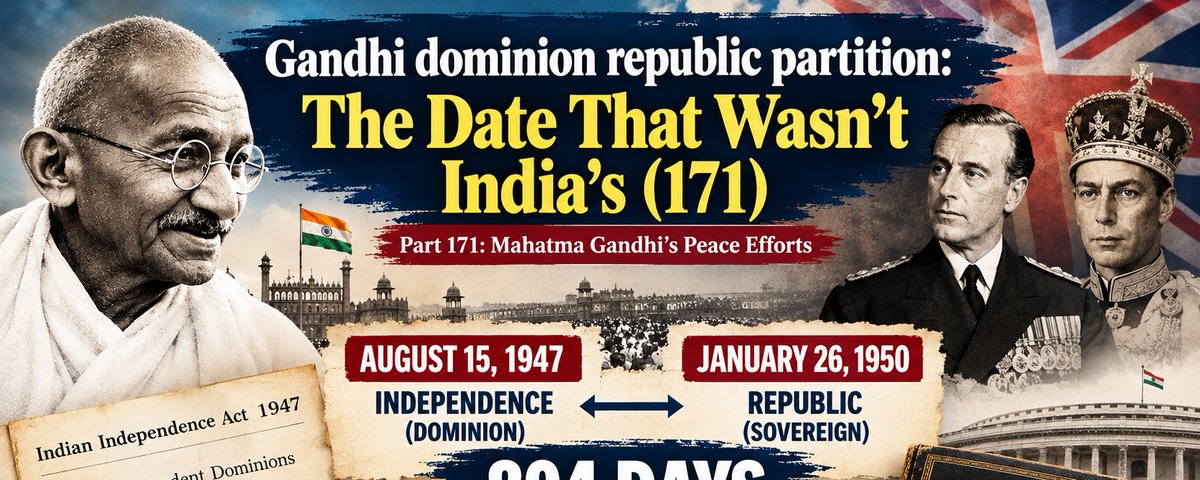
Did India gain independence on 15 August 1947?
Not really.
Read the full analysis.
TravelFunShop retweeted
Read how actions of Mahatma Gandhi are impacting the territorial issues and governance challenges of India today

TravelFunShop retweeted
Read how Mahatma Gandhi's leadership instilled permanent problems into the Indian democracy

TravelFunShop retweeted
Is what is happening in Jantar Mantar, Delhi and the CAA Protests a repeat of what Mahatma Gandhi did a century ago? Read the Analysis of Malabar before Mahatma Gandhi's support to Khilafat Movement, a prelude Khilafat Analysis- causes and consequences.

TravelFunShop retweeted
“Political leadership must be examined not only through declared intentions but also through the expectations a movement creates and the consequences that follow. The Khilafat alliance and the Malabar uprising provide a challenging case for studying that relationship.”
Read the complete blog:
hinduinfopedia.in/gandhis-kh…
Read the Hindi Blog
hinduinfopedia.in/?p=31032
Read the Entire Blog Series
hinduinfopedia.in/gandhis-pe…
Watch the Related Video
Accountability and Freedom: Examining Indian Leadership Choices | HinduinfoPedia
youtu.be/NjlxID6aVHo
Watch the Hindi Video
गांधी का ख़िलाफ़त बम: वह अंकुश जिसे हटा दिया गया | HinduinfoPedia
youtu.be/f1Z3uFOY-Os
Read how the current affairs are being impacted by the actions Gandhi took a century ago
hinduinfopedia.in/gandhis-li…
#PoliticalLeadership #KhilafatMovement #HistoricalResponsibility #MalabarHistory #HinduinfoPedia
TravelFunShop retweeted
Read the analysis of why Mahatma Gandhi was motivated to assign Khilafat alliance above the cause of Indian Independence

TravelFunShop retweeted
Whose program was it: Non-Cooperation Movement? What was Mahatma Gandhi's Role in it? Who fooled whom and who fooled the nation? Read the analysis.

TravelFunShop retweeted
“History is not only about what happened, but also about the order in which events unfolded. The Khilafat Conference, the Central Khilafat Committee, the August launch, and the September Congress session form a connected timeline that invites a closer examination of the origins and adoption of Non-Cooperation.”
Follow the historical sequence in the original blog.
hinduinfopedia.in/gandhis-kh…
